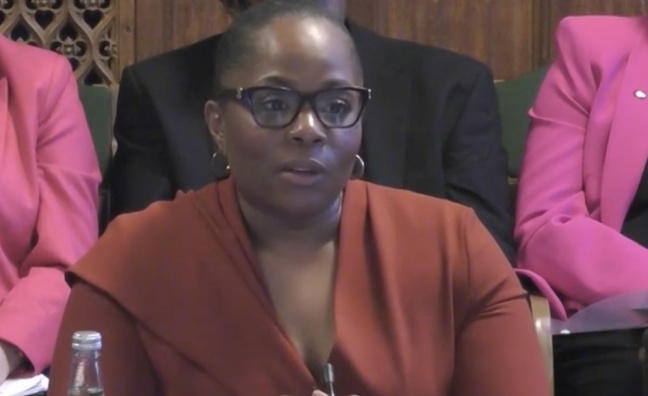
The Women and Equalities Committee (WEC) held a follow-up evidence session, one year on from the publication of its report into Misogyny in music.
The evidence session explored what has changed in the sector's treatment of women over the last 12 months.
WEC’s report warned that women pursuing careers in music face “endemic” misogyny and discrimination in a sector dominated by self-employment and gendered power imbalances, recommending wide-ranging improved protections and reporting mechanisms.
On non-disclosure agreements (NDAs), the report cited testimonies of victims “threatened into silence”, with WEC urging ministers to prohibit the use of non-disclosure and other forms of confidentiality agreements in cases involving sexual abuse, sexual harassment or sexual misconduct, bullying or harassment, and discrimination relating to a protected characteristic.
The government plans to bring in such measures in higher education but did not support the Committee’s recommendation to do so for music or other sectors.
The establishment of the Creative Industries Independent Standards Authority (CIISA) was welcomed but those giving evidence raised concerns about the treatment of women in the sector.
Charisse Beaumont, CEO of Black Lives In Music (BLiM), cited multiple examples from their research into bullying and harassment in the UK music industry. She was on a panel also featuring Laura Snapes, deputy music editor, The Guardian; Lucy Cox, freelance Soprano singer; and singer-songwriter Celeste Waite.
BLiM called on the Labour government to enact the recommendations of the WEC’s Misogyny In Music Inquiry - something the previous government did not do.
Beaumont presented example responses to BLiM’s anonymous survey YourSafetyYourSay, which has helped amass evidence of bullying and harassment in the UK music industry.
“We have hundreds of stories from women of being harassed including sexually assaulted by male artists as well as promoters, people assaulting women in music education, participating in almost naked casting videos, young women pressured to drink and take drugs, who are then assaulted, male producers grooming young female vocalists,” said Beaumont.
“It’s rife in all genres, particularly classical music. 55% say they are currently experiencing bullying or harassment with over 78% having experienced bullying or harassment in their lifetime in their work. 50% say they have had an experience within the last 12 months. The general sentiment from one participant was: ‘I’m at a loss. I am so worn down by it all my enthusiasm or hope for change is depleted. Unfortunately, the UK Music industry is so small that I don’t hold out hope’.”
Black women in music, in particular, are over-sexualised
Charisse Beaumont
BLiM report that 71% of respondents feel bullying and harassment is accepted as being part of the industry they work in. 65% say tackling bullying and harassment is not a priority for their industry and only 29% feel there are people in their industry who will protect them
Charisse Beaumont said: “Black women in music, in particular, are over-sexualised. When we look at the data, 42% of women felt pressure to change their appearance to become more sexual. 25% were encouraged to act and dress in ways that were overly sexualised.
“When we speak to the Black women in our community, many of them believe Black women are being sexualised and objectified. The industry chooses to put most of its money into rappers and singers who feel they can portray an image that will bring down the Black community; these artists’ lyrics are hyper-sexual.”
She added: “I feel that Black creators are more supported if they push a self-destructive narrative. For example, Black female artists – rappers in particular – speak more about overtly sexual topics and carry themselves in a manner that brings them down. I wish that the music industry was not all about the visual aspect. At the moment it’s about music videos, sexually abusive behaviour and how sexy you are rather than about the music.”
Beaumont referred to the need for education to help address the serious concerns about bullying and harassment of Black women.
“If kids on their mobile phones are constantly bombarded with sexual images of Black women looking this way, what do you think is going to happen?” she told MPs.
Chart-topping artist Celeste also addressed the committee of MPs. When it came to her image, she said she had “freedom” unlike some other artists.
“Perhaps for myself, my experience in how much control I have over my image is different to other people because, actually, the way that I dress and costume for my performances is very much part of my expression,” she said. “I do know that other people’s experiences are a lot different, where I’ve heard of girls being told either to cover up because they don’t look ‘sophisticated’ enough if parts of their body are showing,”
“And then I’ve heard it on the other hand where people are given certain items of clothing by a stylist that is somewhat under the influence of people in a position of power around them, or perhaps people that may be funding some of that public appearance… They feel maybe it’s showing their body in a way that they don’t feel comfortable with. I’ve understood that to be the experience of other women in my industry although it hasn’t been my experience.”
Celeste also spoke about concerns with unsafe environments, particularly for artists at the start of their career, and the power structure in music.
“I think all women will deal with it,” said Celeste. “There will be a scale of how much you might [deal with it], and also how much you have an awareness of being able to posture yourself in certain environments to be able to take a bit more of the power share perhaps for yourself.
“So I can imagine what I might experience might be different to an artist who is on a global scale. And then, for example, I know from some of my close friends and peers who are just starting out in music and emerging within their careers, they experience things I haven’t experienced when I’ve had the protection of already being established and people already aware that you have a voice to speak about these things.”
Beaumont called for more accountability in the sector.
“There is a saying that the music industry is like the wild west,” she told MPs. “It is made up of thousands of organisations and there’s no accountability. The creative industries is the only sector that does not have an Independent place to report poor standards of behaviour. We have yhr Financial Conduct Authority, Food Services Authority, Ofsted in other sectors. We need government to move on this now. Often there is no recourse or accountability, so reporting incidents is futile as those doing the bullying control the narrative. It’s happening under their watch and they are too powerful.”