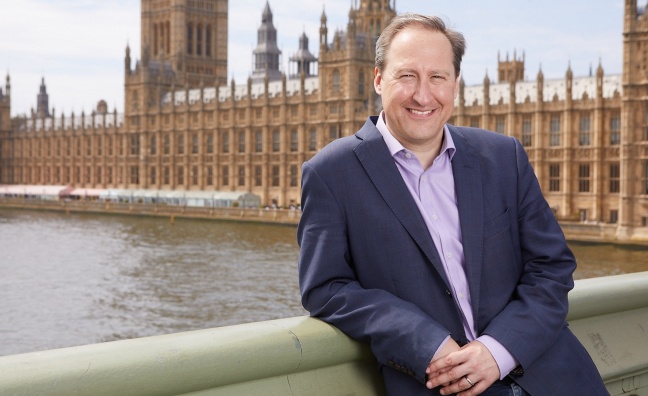
To start the New Year, UK Music CEO Tom Kiehl calls on political leaders to follow through on pledges in areas ranging from AI and copyright to EU touring and exports…
At this time of the year many of us are already struggling to keep those resolutions made just a few days ago on New Year’s Day. Sticking to resolutions and promises made is also a challenge for the government and Prime Minister Sir Keir Starmer’s ministerial team.
When it comes to the UK music industry, there was a critically important resolution made by Culture Secretary Lisa Nandy last year about the impact of the government’s plans on artificial intelligence (AI) and our sector and the 210,000 people who earn their living through music.
“If it doesn’t work for the creative industries, it will not work for us, and we will not do it. That is my promise to you,” the Culture Secretary told the industry leaders and politicians gathered at our UK Music summer party to hear her speech on AI and other issues facing the industry.
Since that pledge last July, described by the cabinet minister herself as “crystal clear”, a lot has happened – not least the publication of the findings from the government’s Copyright and AI Statement of Progress in December.
The government’s consultation exercise on AI found that just 3% of the 11,500 respondents backed the government’s initial preferred position of a text and data mining (TDM) exception, which would allow AI developers to use music to help develop their models, unless the rights holders opt out.
The results outlined in that statement of progress were a huge vindication of the position taken by UK Music and the wider creative and ethical AI industries against these damaging plans.
In fact, they were the kind of “crystal clear” results that politicians can only dream of, highlighting the urgent need for the government to give the music industry much needed clarity about its future plans when it comes to AI and how it will impact our sector.
The government must establish a robust regulatory framework for the interaction of AI firms with copyright protected works. It should set out plans that require transparency, labelling and a need for AI companies to comply with UK copyright laws – regardless of where models are trained if they are to access the UK market.
As chief executive of UK Music, which champions and campaigns for a sector that generates £8 billion a year for the UK economy, I saw at first-hand just how critically important it will be this year to make progress on AI as part of a government-backed sectoral delegation to South Korea in December.
My presence in Seoul may have demonstrated a desire for collaboration on K-pop and Britpop, yet the fact that AI has also been identified as a key part of the UK’s strategic partnership with the world’s 12th largest economy shows that the government still fully recognises the transformative impact of AI and its huge potential.
The government must recognise that it needs to do far more to give the UK music industry the clarity and reassurance it needs and deserves if we are to continue to be a driving force as part of one of its key pillars for growth. Our latest UK Music figures show that the music industry generated a record £4.8 billion in export revenues in 2024. If we are to continue to grow that figure by exporting our creative talent to South Korea and across the globe, then we need the government to stand up for our world-leading sector.
In the months ahead, UK Music will be turning up the volume to ensure that politicians and policy makers understand what our sector needs if it is to flourish
Tom Kiehl
What is more, we must not forget the huge pulling power of the UK’s festivals, venues and studios to international acts, and the opportunity they provide for artists from across the world to work with our musicians, songwriters and producers. In 2026 we therefore need to sort out the business rate system for our cultural spaces, so that we can continue to attract performers from South Korea and elsewhere to our flagship studios, such asAIR Studios and Abbey Road.
In order to keep the music industry growing both at home and abroad, we need to see more action to remove the barriers facing UK musicians, performers, businesses and crew when touring the EU. This is an area where, again, there was a key pledge from the government to support our efforts to clear the burdensome red tape and extra costs that are sadly making overseas touring unviable at present for some UK acts.
At UK Music we are working with our European counterparts, forming a new campaign called the Cultural Exchange Coalition to drive forward changes to make touring the EU and UK easier for both UK and European acts.
We still, however, need the government’s support to encourage our European counterparts to deliver positive change. It is now a decade since the Brexit vote and we are at risk of seeing the UK’s global market share diminishing fast unless we can make progress in this area.
When it comes to promoting UK music globally there is no doubt that the BBC with its extensive broadcast network and the huge diversity of its musical offer is an integral part of the music industry’s ecosystem. There are fears that the impending process for the renewal of the BBC’s Royal Charter, which expires at the end of 2027, could see cuts to the Corporation’s musical output.
That would be a huge blow to our sector and we will be fighting hard over the coming months to ensure the BBC continues to offer the brilliant and diverse range of music that it does at present.
With key elections in Scotland and Wales in May, as well as some important local elections in London and elsewhere, politicians are now focusing on what people want to hear before deciding how to cast their vote.
In the months ahead, UK Music will be turning up the volume to ensure that politicians and policy makers understand what our sector needs if it is to flourish – and we will be holding their feet to the fire to ensure our political leaders commitments don’t end up like that long forgotten new gym membership card that seemed like such a good idea in January.