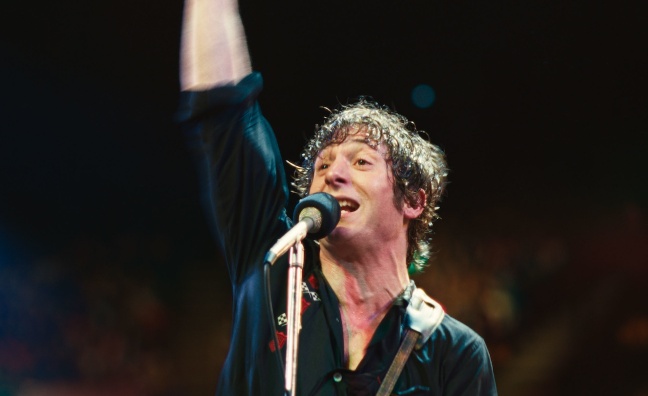
Springsteen: Deliver Me From Nowhere is released in cinemas this week (October 24). Written and directed by Scott Cooper and based on the book Deliver Me From Nowhere by Warren Zanes, it stars Jeremy Allen White (The Bear) as Bruce Springsteen, Jeremy Strong (Succession) as his long-time manager and co-producer Jon Landau, and Stephen Graham (Adolescence) as Bruce’s father, Douglas Springsteen.
Rather than aiming for beat-by-beat hagiography as other music biopics have tried to, Springsteen: Deliver Me From Nowhere (20th Century Studios) takes a similar approach to last year’s A Complete Unknown, which narrowed its focus to the first five years of Bob Dylan’s career.
Following that lead, Deliver Me From Nowhere tackles the conception and making of 1982’s stark masterpiece, Nebraska – a period of personal and professional upheaval for its creator. Having made a trio of excellent records with Born To Run (1975), Darkness On The Edge Of Town (1978) and The River (1980), Bruce Springsteen was on the cusp of superstardom, with mounting pressure to capitalise on that momentum.
That pressure was compounded by Springsteen’s burgeoning fame contrasting with the tumultuousness of his youth, represented by a difficult relationship with his troubled father, eventually resulting in an uncompromisingly raw record at odds with the music industry’s expectation of him at that point. To mark the biopic, Sony Music has released an expanded edition of Nebraska.
For director Scott Cooper, the subject matter couldn’t have been more perfectly suited. As a child, he’d been introduced to Nebraska by his own father, who passed away the day before filming on Deliver Me From Nowhere began.
The record had also soundtracked the writing of the screenplay and the making of his 2013 blue collar crime thriller, Out Of The Furnace, starring Christian Bale, Casey Affleck and Willem Dafoe. So when the director received an email from his producing partners that simply read: ‘Are you a fan of Bruce Springsteen’s Nebraska?’, fate took the wheel, leading to a drive down to the Jersey Shore, where a walk on the beach with one of the state’s most famous sons began the project in earnest.
We’d be remiss not to start by asking what was discussed with Bruce Springsteen on the beach when you first met him…
“It was a life-changing moment. Bruce Springsteen is notorious for rejecting any idea about a narrative film on his life, as you might imagine. I think every studio in town and many directors have asked Bruce to tell various stages in his life, whether that’s the Born To Run or Born In The USA eras, or the cradle-to-present-day Bruce Springsteen story. I travelled to the Jersey Shore to pitch Bruce on making a film about a very, very specific and narrow timeframe in his life – the most painful time of his life – about an album that is, I think, his most enduring, but certainly his most personal. It was, believe it or not, a very quick ‘yes’ from Bruce. He is a cinephile and a student of film. He’d seen many of my films, some of them several times. Once he’d agreed, he asked who I had in mind to play him, to which I said, ‘I think there’s only one person and that’s Jeremy Allen White’, so I turned Bruce on to The Bear. Next thing you know, Jeremy Allen White was enduring the humbling process of becoming Bruce Springsteen.”

Your connection to Nebraska is very personal, having been introduced to it by your father. Given the film’s focus on Bruce’s relationship with his father, did that come up in your conversation with him?
“I did tell Bruce that my father introduced me to his music through Nebraska, and that I thought this would work on a number of levels, but the most important emotional level is as a story about fathers and sons. My father passed away the day before I started shooting the movie and his spirit carried through the film. In some ways it bonded Bruce and me in an unexpected, familial kind of way – I lose a father and gain a great friend who’s older and an almost a father figure, while we’re telling the story of a young man dealing with the unresolved trauma of his life in trying to reconnect with his father through songs. It’s kind of spooky the more I think about it. I’m thankful that this project exists, and ever more thankful that it brought me very close to my father. But it’s also a film that I’m so deeply proud of, and now I have a lifelong relationship with someone whose music has moved me for years.”
What can you tell us about Jeremy Allen White’s preparations for becoming Bruce Springsteen, and how direct contact with the man himself fed into that?
“They had some very private conversations, but I said to Jeremy what I said to Bruce, which is: this is not a film about cosplay or mimicry. Yes, Jeremy bears a striking resemblance to Bruce in a lot of the photos of him from ‘81 and ‘82, and they both have this kind of blue collar working man physicality, but it was about embodying his essence and his spirit. The way Jeremy moves is very similar to the way Bruce moves. They're both incredibly humble, filled with humility, and this kind of bruised decency. Jeremy has a really wonderful ability to convey so many emotions silently, which is what I look for in an actor. What I don't like to do is have a lot of dialogue in my films. I want people to be able to express themselves non-verbally. What I didn't know was that Jeremy would play guitar like Bruce, play harmonica like Bruce, and sing like Bruce. He doesn't sound just like Bruce, but you can feel his warmth, and it's close. There were times when Bruce would turn to me and say, ‘Is that me, or is that Jeremy?’”
There were times when Bruce would turn to me and say, ‘Is that me, or is that Jeremy?’”
Scott Cooper
You were granted access to the Springsteen archives to make the film – how important was that in achieving that period authenticity?
“Many people bring so many fixed ideas about who Bruce is, but one thing we all know is that he’s America’s most authentic artist. I made this film just the way he made Nebraska – no gloss, no spectacle, stripped down and minimalist. We had to be authentic, though. I said to Bruce, ‘Do you have anything that I might use in terms of textures, just to get a sense of this time in your life?’ He says, ‘God, I have an archive filled with everything from 1982 in most of the areas of my life’, so my production designer and I went through every item in that treasure trove, many of which are in the film. Some of the items of clothing Jeremy wears are Bruces, as are the notebooks you see.”
What, as a lifelong fan and as a writer-director, was the biggest thing you had wrong about Bruce before you made the film?
“I don’t know if I got it wrong, but I didn’t know the depths of Bruce’s suffering. Bruce opened himself up to me in ways that I never expected to give me insight to his darkest moments. There are two moments in the film that Bruce has never spoken about – two moments in which he's experiencing suicidal ideation, and that takes a great deal of artistic courage to be an icon and almost a myth, certainly a legend, to tell that version of your story.”
 Director Scott Cooper at the London premiere of Springsteen: Deliver Me From Nowhere
Did you consciously try to avoid the tropes associated with music biopics, as the film is refreshingly free of them?
“I think other people will have to tell me if I have completely avoided those music biopic tropes. So often we see in music biopics the ascent to fame, addiction, the fall and rise again. Well, I wanted to avoid all of those tropes, and I did so by simply telling Bruce’s story as truthfully and honestly as I could, which is to find Bruce at lowest and most vulnerable – a man who doesn’t even know that he’s suffering from depression, but is very slowly and quietly unravelling. A man who realises and thinks this might be inherited from [his] father, who, as we find out in the film, suffered from undiagnosed schizophrenia and went untreated, which explains a lot of his complicated moments with Bruce. So to be able to get that kind of information from Bruce Springsteen that’s not in a memoir or in a biography, is a real gift.”
The film includes the writing of Born In The USA, originally written for a planned but abandoned Paul Schrader film of the same name. It’s a song that started out markedly different from the anthem people know and love today. How important was it for you to reframe it as the subversive and rebellious song it is?
“Bruce Springsteen is wholly misunderstood. Our film shows a man who is writing an acoustic version of Born in the USA that really encapsulates who Bruce Springsteen is, which is a man who loves his country, but is unafraid to indict it – and that was true in 1982 and it’s true in 2025. Bruce Springsteen is a political figure, not in the partisan sense, but in the human sense, because he speaks for people who don’t have a voice, who who don't don't have the ability to express themselves, people who live on the margins of society, people who are living lives of quiet despair, people who feel like they're reaching for the American dream and falling short, and for most people who hear the electric version of Born In The USA, they hear it the way that former President Ronald Reagan heard it, as a supportive anthem, which is directly opposed to what Bruce is saying.
“So my hope is that when you hear the acoustic version of this, and when Bruce releases the Nebraska electric version, which I hope that song is on [the demo version of Born In The USA is included in the disc of ‘Solo Outtakes’ included on the forthcoming Nebraska ‘92: Expanded Edition release], people can listen very closely to those lyrics, because what one of Bruce’s gifts is he's able to write these dark anthemics, that, when backed by the E-Street Band, take on a whole different almost positive and upbeat tenor.”
I made this film just the way he made Nebraska – no gloss, no spectacle, stripped down and minimalist
Scott Cooper
How did you decide which songs to surface in exploring this chapter of Bruce Springsteen’s life, and was there coordination with Sony/Columbia on the release of Nebraska ’82: Expanded Edition, which is released the same day as the film?
“Interestingly, I have had nothing to do with Sony and Columbia releasing anything Nebraska-related – that’s a whole other side of Bruce. I think it’s serendipitous but not coincidental, and very well considered that it’s coming out the same day our movie is released. I’m so thankful for that, as the more versions of Nebraska we get, the better. As for the songs that I chose, they all had to have a narrative point of view and serve a purpose. Obviously, we need to understand the song Nebraska. Seeing Terrence Malick’s [1973 film] Badlands was the creative engine for Bruce, and him almost taking on the persona of [Martin Sheen’s character] Charles Starkweather, which concerned Jon Landau. Mansion On A Hill is about Bruce and his sister, and a father who could never attain the mansion on the hill [that we see in the film]. Obviously My Father’s House is one of the most important songs in the film and the emotional DNA of the record. I thought it was important to hear Atlantic City, but an electrified version, because about an hour into the movie, in a very despairing moment, Bruce says to Jon Landau, ‘We’re never going to get Atlantic City’. Well, they got it, because it closes the movie with the E-Street Band, led by a man looking forward to a future that he communes with all of us.”
And finally, what was Bruce’s reaction when he first saw the film?
“He was in tears. He hugged me, he kissed me, and he said it’s far better than he could have ever hoped. He’s now seen it probably 10 more times since then, and he says it gets better every time. He also shared it with his family, his sisters, his kids, his closest friends. For me, in such an incredibly difficult year, it’s the gift that I most needed – and it keeps on giving.”
PHOTOS: Disney/Getty