
UK electronic music generated £2.47 billion in measurable economic activity in 2025, up 3% year-on-year.
That increase was despite the loss of more than one in three nightclubs since 2020, according to a major new industry report released today.
The fourth edition of the Electronic Music Report, produced by the UK’s Night Time Industries Association (NTIA) in partnership with Audience Strategies and Amazon Music, found that the sector remains globally dominant and culturally resilient, but increasingly fragile at home as economic pressure forces venue closures. There are also ‘progression gaps’ with artists unable to scale careers because of a lack of mid-tier venues.
Since March 2020, the UK has lost 36% of its nightclubs, leaving just 823 venues nationwide. Over the same period, electronic music event programming has grown by 10.5%, highlighting sustained audience demand even as the physical infrastructure that supports nightlife continues to shrink.
ECONOMIC CONTRIBUTION
– £2.47 billion: Total measurable economic activity generated by UK electronic music in 2025, up 3% from the previous year
– £231.4 million: Combined recorded music and publishing revenues in 2025, up 8% from £215m in 2024
– £86.8m: UK electronic music exports in 2025, representing 8% growth from £81.3m in 2024
UK RANKS NO.2 IN GLOBAL ELECTRONIC MUSIC
The UK continues to punch above its weight internationally, according to the NTIA report.
It ranks second in the world for electronic music artist development, with 13 artists in the global Top 100 DJs and 72 in the Top 500 (according to Viberate analytics). British artists represent 11% of global electronic music creators, yet account for 15% of the world’s Top 500.
Noteworthy artists in DJ Mag’s Top 100 DJs polls included Calvin Harris (No.16), Carl Cox (No.25), Jamie Jones (No.27), and Fred Again.. (No.33).
Genres pioneered in the UK remain globally dominant, with 30.5% of drum & bass artists and 14.7% of dubstep producers worldwide originating here.
“The underlying strength of British music, reflected in its global commercial success and cultural power, is its creative breadth and depth across different genres and musical styles, fed by artists from all backgrounds and parts of the country,” said BPI CEO Dr Jo Twist in the NTIA report. “Electronic music absolutely plays its full part in this rich cultural diversity and helps to shape the unique appeal of British music around the world.”
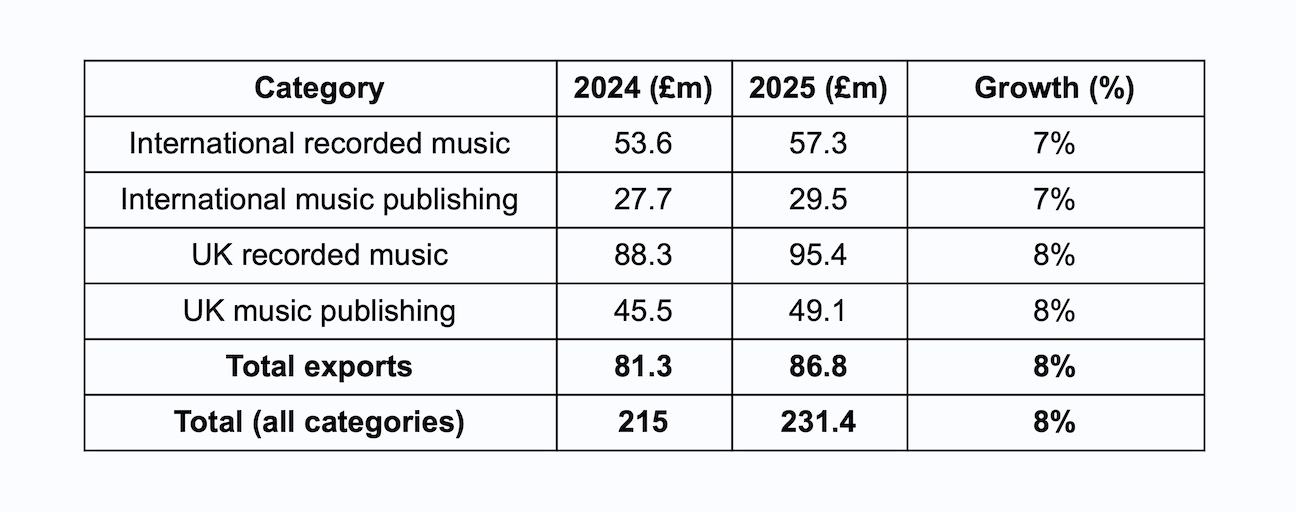
Exports for UK electronic music reached £86.8m in 2025, an 8% increase year-on-year.
UK artists' international recorded music generated £57.3m in 2025, up 7% from the previous year, while international music publishing contributed £29.5m. Domestically, recorded electronic music in the UK reached £95.4m, up 8% from £88.3m in 2024. Music publishing in the UK hit £49.1m, also up 8% from £45.5m.
The recorded music total across all categories – UK sales, UK publishing, international recorded music, and international publishing – reached £231.4m in 2025, up 8% from the previous year.
UK electronic music revenue 2025:
 The BPI’s Dr Jo Twist highlighted the UK’s export initiatives but noted that other countries provide more backing for their music sectors.
"It can at times be a source of frustration that other governments appear to value their creative industries more,” she said. “If you look at the example of South Korea, its government reportedly invests around £25 million annually into its creative industries, helping to make K-pop the global cultural phenomenon it has become.
“In the UK we are given support through the Music Export Growth Scheme (MEGS). Since launching in 2014 it has supported over 450 UK artists and has invested £7.9m, leading to an estimated £73.5m financial return to the UK economy and a ROI of nearly £14 for every £1 received from government. If MEGS can do that, with such a relatively small budget, imagine what more expansive initiatives could achieve."
DOMESTIC FRAGILITY
The report warns that this global success masks growing structural weaknesses in the domestic ecosystem – particularly the accelerating collapse of mid-tier venues.
Just 15% of UK venues now fall within the 500–2,500 capacity range, creating severe bottlenecks for emerging artists attempting to progress beyond grassroots level.
“Rising operational costs, high business rates, a 20% VAT rate on tickets, licensing pressures and weak planning protections have made this segment increasingly unviable,” stated the report.
Electronic music remains one of the UK’s most powerful cultural and economic assets, but the domestic ecosystem that sustains it is now in crisis
Michael Kill
Grassroots venues now operate on an average profit margin of just 0.48%, with operators earning approximately £26,000 per year while working 60-hour weeks. Artists face similarly fragile economics: 81% of producers earn less than 10% of their income from royalties, while 64% of nightclub performance royalties are misallocated due to data and attribution failures.
The situation for grassroots venues is set to improve following the first distributions from the voluntary £1 levy on stadium and arena show tickets.
ELECTRONIC MUSIC INFRASTRUCTURE
– 823: Nightclubs operating in the UK in 2025, down from 851 the previous year—a 3% decline continuing the 36% contraction since March 2020
– 15%: Proportion of UK venue infrastructure in the critical mid-tier capacity range (500-2,500), creating career progression barriers
– 2.5%: Average profit margin for grassroots venues in 2025 (up from 0.48% in 2024)
The report finds that electronic music audiences are changing how, when and where they engage as venues close and affordability worsens.
Free events now account for 15% of all electronic music programming, rising 34% year-on-year. Daytime electronic music events have increased 82% since 2022.
Interest in sober events is up 92%, reflecting wider cultural shifts, with nearly 40% of Gen Z adults abstaining from alcohol.
“As licensed venues continue to disappear, electronic music activity is increasingly shifting into alternative and informal spaces – including cafés, which are emerging as new hubs for music and cultural programming,” stated the report. “Activity in art galleries has risen by 83%, while record shops have seen a 53% increase, pointing to innovation driven by necessity rather than long-term sustainability.”
The report cautions that the growth of free parties and unlicensed events reflects a displacement effect: audiences are being pushed out of traditional venues by rising costs, reduced capacity and shrinking availability.
NORTH LEADS GROWTH AS LONDON’S DOMINANCE DECLINES
For the first time, a majority (51%) of UK electronic music events now take place outside London, marking a significant decentralisation of the sector.
Growth has been strongest in the North of England, where electronic music activity increased by 93% between 2022 and 2025. Newcastle recorded 72% year-on-year growth, far outpacing London and highlighting the emergence of new regional powerhouses.
The report identifies this regional expansion as a major opportunity for cultural and economic growth – but warns that without targeted investment in venues and infrastructure, the same pressures that hollowed out city-centre nightlife could be replicated across the regions.
The report contrasts the UK’s position with international examples of coordinated policy support:
– Amsterdam invests €2.2 million annually in its nightlife ecosystem.
– Germany’s reclassification of clubs as cultural institutions unlocked tax relief and planning protections, helping Berlin generate £1.5 billion annually
– Sydney climbed global nightlife rankings in under four years following targeted reform
By comparison, the UK maintains a 20% VAT rate on cultural tickets – nearly three times the European average – alongside high business rates and limited planning protections, placing the sector at a growing competitive disadvantage.
Michael Kill, CEO of the Night Time Industries Association, said: “Electronic music remains one of the UK’s most powerful cultural and economic assets, but the domestic ecosystem that sustains it is now in crisis. We are seeing free parties rise, mid-tier venues disappear and audiences pushed out of licensed spaces – not because demand is falling, but because the sector is being squeezed by sustained economic pressure.
“At the same time, the North is leading growth and innovation, proving that opportunity exists if infrastructure is protected. This report shows extraordinary resilience, but resilience is not a policy. Without urgent reform – from VAT alignment and business rates relief to meaningful planning protections – we risk dismantling the very foundations that made the UK a global leader.”
I am genuinely encouraged by signs of progress, the first recipients of LIVE Trust funding show that collective action is possible when the right frameworks exist
Finlay Johnson
Finlay Johnson, CEO, Association for Electronic Music (AFEM), said: “The electronic music sector contributing £2.47 billion to the economy is incredible, as long as we ensure this value is spread across a broader artistic community from different backgrounds, and more people have more space and time to take artistic risks and build businesses.
“I am genuinely encouraged by signs of progress, the first recipients of LIVE Trust funding [distributing funds to grassroots venues] show that collective action is possible when the right frameworks exist.
“Our mission is simple: to help as many people in the sector as possible by sharing knowledge freely without gatekeeping (from advice on marketing music to best practice for emerging promoters), and to encourage those with influence and power to lift others up and participate in collective action for the greater good.”
Laura Lukanz, head of music industry, Amazon Music UK, said: “Electronic music has always evolved at a rapid pace. It exists at the intersection of creativity, community, and technology, constantly innovating to produce new scenes and genres every year. On dancefloors around the world, artists test new musical styles while audiences find belonging and reconnect with music’s deep roots. These spaces, be they clubs, festivals or DIY venues, are where electronic music cultures coalesce and evolve.
“At Amazon Music, we believe that progress starts with listening: to artists, to the industry, and to the communities that have built this culture from the ground up. The NTIA Electronic Music Report plays a vital role in that process. It offers a holistic view of where electronic music stands today, highlighting both its cultural and economic value, as well as the challenges that threaten its future if left unaddressed.
“This report gives us an opportunity to pause and reflect at a pivotal moment. It details evolving audience behaviours, developments in music technology, and the realities facing venues, festivals, and creators. More importantly, it helps frame the conversations we need to have to ensure electronic music remains sustainable, inclusive and resilient in the years ahead."
The report helps frame the conversations we need to have to ensure electronic music remains sustainable, inclusive and resilient in the years ahead
Laura Lukanz
Dame Caroline Dinenage MP, chair of the House of Commons Culture, Media and Sport Committee, said: “The UK’s fantastic electronic music industry is an irreplaceable part of both the British music scene and our country’s rich cultural heritage. But despite being integral to both local communities and the wider music ecosystem, we know that many nightclubs and small venues are facing uncertain futures."
The Culture, Media and Sport Committee’s fan-led review of live and electronic music included first-hand accounts from artists, promoters, venue operators and audiences of the challenges that the sector faces, including business rates and an inflexible planning system.
“Such barriers not only affect existing clubs, but they can also stifle entrepreneurs and innovators who want to establish new venues and turn unused spaces into long-term cultural assets,” said Dinenage.
“Progress has been made with the voluntary levy on stadium and arena tickets to support the grassroots, but venues up and down the country are still falling silent at an alarming rate. There clearly is more that both the government and industry can do to protect the electronic music industry and ensure venues and the wider sector can be sustainable and thrive long into the future. This report comes at a vital time, it’s time to dial up the volume on the case for action.”
PHOTO: Fred Again.. performing at Ex-Macello in Milan (Francesco Prandoni/Getty Images)
 FOLLOW