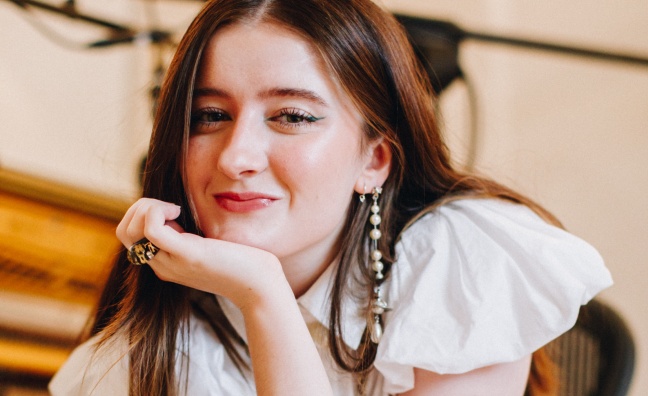
Award-winning songwriter Ines Dunn has discussed AI, remuneration and the evolving landscape for songwriters in a new interview with Music Week.
The Maisie Peters and Mimi Webb collaborator's career reached a new high in 2025 when she picked up the Music Creative – Spirit Of The Studio honour at the Music Week Women In Music Awards. Dunn was also named Songwriter Of The Month by Spotify UK & Ireland earlier this year.
Speaking in Music Week's June edition, the two-time Ivor Novello nominee opened up on her approach to her craft.
“Getting to the core of a song, a lyric and a feeling is where I find the songs that are most me, or the ones where I feel I’ve been most useful," she said. "Learning how to distil feelings into words is hard – it is the lifelong task of being a songwriter: taking this thing that you feel and trying to say it in a way that not only makes sense, but is new enough and precise enough.
"I make sure I work on things I genuinely care about. It’s not necessarily about being good; it’s about being consistent. It’s about showing up, and I think it’s about being able to give all of yourself to the room.”
Sometimes the transition from being friends to collaborators can be harder than going from collaborators to friends, but with Maisie it was so easy
Ines Dunn
Despite a relatively short time in the music industry, Dunn has written songs for artists including Lewis Capaldi, Maisie Peters (including Vampire Time on new album Florescence), Griff, Mimi Webb, Jazzy, Rachel Chinouriri and Flowerovlove. She had multiple co-writes on Peters’ No.1 album The Good Witch (83,328 sales, OCC), and considers the star a close friend.
“She’s so quick – she’s the most intellectual person, and so witty and smart. No one else can keep up," said Dunn. "She and I were with her boyfriend the other day, and within five seconds he was like, ‘I can’t keep up with the pair of you – you just become one brain cell.’ And we do, a little bit!
"Working with her is so easy and fun because we’re friends first. Sometimes the transition from being friends to collaborators can be harder than going from collaborators to friends, but with Maisie it was so easy. We knew everything about each other: we knew all the situations, all the drama, all the gossip and the feelings of the other person. It gives us a seamless chemistry when we write songs.”
Dunn, whose other credits include Mimi Webb’s Top 10 smash House On Fire (861,702) and viral dance hit No Bad Vibes (425,362) by Jazzy featuring Kilimanjaro, is also the youngest member of the Ivors Academy Senate, a group elected to champion the rights of songwriters and composers.
“It’s allowed me to see behind the scenes in a different way," she said. "When you’re around people from classical music, film and TV, library music, pop, the business side, or journalism, it gives you a wider perspective. You can get very focused on your portion of the music industry and how it’s affecting you. Then you realise that fighting for other areas is important too.
"Roberto and Tom [Neri and Gray, CEO and chair of the Ivors Academy respectively] are unbelievable champions of musicians’ rights and legislation on AI. I’m relieved that the Ivors have such strong and steady control as we face these big problems.”
Dunn described the work around songwriter remuneration as "such a long battle".
"I don’t expect there to be a quick turnaround – there hasn’t been and there won’t be," she said. "It’s a long marathon of making progress in millimetres, then taking three steps back, and then pushing forward again. It’s part of the undertone of being a songwriter.”
I don’t think the point of making music for anyone should be a quick and easy process. I don’t think there’s meant to be perfection or no struggle
Ines Dunn
When it comes to the subject of AI, meanwhile, Dunn suggested there were pros and cons.
“I think it can be used for good and I think it can be damaging," she said. "I don’t use it, but in production there’s kind of an efficiency to it, so I can understand why people feel like it’s [a sign of] progress. I think it does what it says on the tin, which is that it takes away the human essence.
"I don’t think the point of making music for anyone should be a quick and easy process. I don’t think there’s meant to be perfection or no struggle. I think that is the point of being creative and that’s what makes it special – what makes it human, interesting and nuanced.”
Nevertheless, Dunn struck an upbeat tone on the wider outlook for songwriters.
“It goes through changes," she said. "Pitching was a much bigger thing a few years ago and then artists started having tight crews, becoming quite closed off, and everyone wanted to knuckle down with their circle. Now I feel like things are opening up again and pitching is coming back in. It’s a great time to be a songwriter.
"I think there are so many exciting artists and so many cool opportunities – different worlds, different genres and different countries to go and make music. It feels like there’s a never-ending kaleidoscope of things that you can do.”
Subscribers can read the full interview with Dunn here.