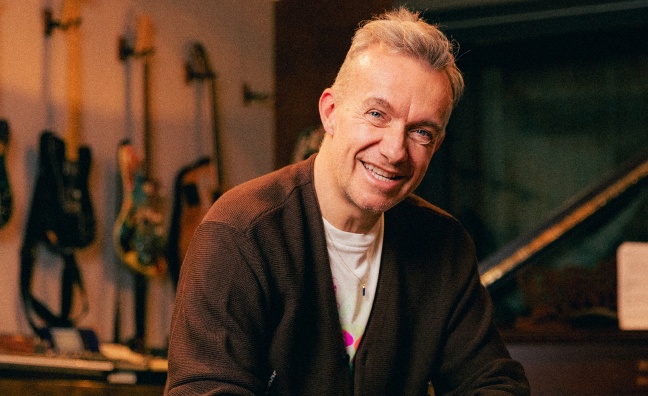
Fraser T Smith is on a mission to “rebalance the lack of true cultural and economic diversity within the music industry” through The Future Producer Academy.
The award-winning producer, songwriter and artist has spoken to Music Week about why he set up the project, which is in partnership with Music Guardians, the Music Producers Guild (MPG), PPL and online learning platform Virtuoso.
“We’re choosing 16 young producers from challenging upbringings from right around the UK,” he told Music Week. “We're getting out into the provinces, finding talent and putting those students through a year of mentoring, workshops and seminars. We’re hoping to place all 16 successful students within the industry, in studios and with other producers.”
Smith stressed that the project is “putting an emphasis on rebalancing the lack of true cultural and economic diversity within the creative arts and within music”.
“We'll be searching for students that wouldn't normally be given the opportunity to attend a course such as this,” Smith said.
Here, we dig a little deeper into Smith’s plans for The Future Producer Academy...
In terms of bringing through people from all backgrounds, what is the reality of life in studios now?
“I think the industry is getting better, but it's far from where it needs to be. Certain opportunities can be reserved for the privileged, and I think it's everyone's duty, as they get older and have more experience, to do what you can to redress that balance. My wife [and co-manager Sarah] were at the Music Week Women In Music Awards in October and it was great to see, there seems to be way more equality. But again, it’s very, very, far, far from where it needs to be.”
What has your own personal experience been like?
“I think I've been in something of an ivory tower in terms of always employing amazing women including Manon Granjean, Beatriz Artola and Isabel Gracefield. I’ve had three female engineers and they've been phenomenal. So that to me has just been the norm. And I'm used to working with a lot of artists from challenging upbringings, working in UK rap and working with lots of artists that, when they're coming through, are coming from very challenging upbringings. But then you come out of what you view to be the norm and see that it actually isn't quite the same in other areas. I feel very passionately about doing what we can to readdress that balance.”
Can you shed any more light on your vision for the Academy?
“It’s to give 16 students a year the opportunity or, I guess, the privilege of learning a lot of traditional techniques that I feel should be maintained. In this world where AI, simplicity and ease are becoming more and more prevalent, I think it's very important to show people that sometimes the long way around is the better way. We can hopefully give rise to a legion of creatives who are thinking outside the box, thinking more laterally, rather than just straight ahead and looking for the easiest way to do everything. To be fair, that is our natural disposition as humans, to find the easiest way, but I think in music we've fallen into the trap of making it so easy.”
We can hopefully give rise to a legion of creatives who are thinking outside the box
Fraser T Smith
What do you mean exactly?
“So, Spotify can release more than 100,000 tracks a day. It's really important for me to show young creatives that, if you go the long way around, don't fall into that 130,000, fall into the 10 tracks a day that are released that are just mind blowing. There are still great artists out there who are doing that, we've got to keep the faith and know that there is that light. The fun bit is the exploration, it’s way better than even a record coming out, in my opinion. It's these sort of adventures that that I want the next generation of future producers to go on with us, and for us to to show that mindset and really look at the holistic side of of making records and how you can sustain a long career in music and have the most fun and stay in a great mental, physical place and really be of value.”
Is there enough support from big music companies for the next generation of producers and engineers?
“I think so. I mean, we've yet to go in and speak to the majors, but I always feel positive. It's really heartwarming to know that people are acting on a conscious and creative level within the commercial concerns of the big three. I think the majors have kept good hearts, we just need to know that there's people within the creative fields that are doing things like this. There are lots of initiatives like the one that I'm doing, but we're trying to be unique, as we should be, because there's no point in falling into the trap of doing what everyone else is doing. It's going to be a really interesting journey. I'm loving it.”
Finally, what kind of dialogue have you had with your fellow producers about the scheme?
“This is where the MPG has come in. At their summer drinks I was talking to people like Catherine Marks, who is just an amazing example. Everyone's so behind what we're doing, and is also standing up to be counted in that people are becoming mentors, which is an amazing thing. We're looking for an hour a month of people's time, and that becomes super beneficial for the mentor and the mentee, because it can help both sides. Closing the gap between generations and culture is the most important thing.”
Subscribers can read Fraser T Smith's recent hereinterview
 FOLLOW