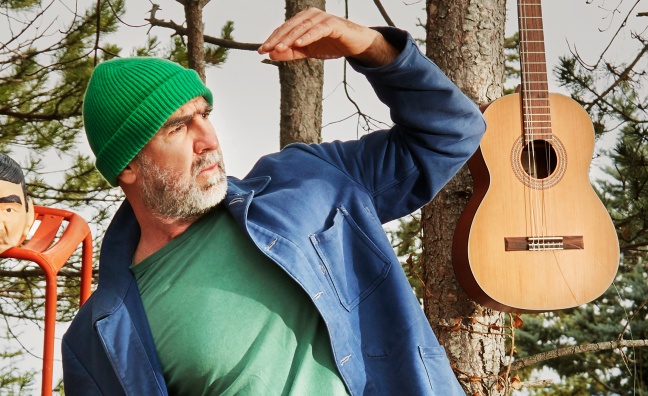
Last week, football legend Eric Cantona released his debut studio album Perfect Imperfection via Barclay (Universal Music France) & Fontana. And, with its bold mix of musical styles and intriguing lyrics, it's taking a lot of fans and critics by surprise. Here, Music Week joins King Eric in conversation about his plans as a solo artist...
Normal was never an option for Eric Cantona. The Manchester United legend blazed an extraordinary trail on the football pitch, while his mercurial personality, philosophical disposition and poetic inclinations made for some of the most memorable press conferences ever. Yet the moves he’s made since have been every bit as distinctive. Far from the usual player-to-pundit trajectory, Cantona’s extracurricular activities have taken in appearances in films, TV shows, documentaries and theatre, as well as books and social activism. But the most recent development has been his surprise move into the music business.
In 2017, he wrote the lyrics to a song for Lady Sir (the French group comprising his wife, Rashida Bakni, and Gaëtan Roussel). It’s just not everyone knew it. Wisely, he was sceptical about some people’s scepticism.
“I wrote the lyrics of a song called Le Temps Passe but I used a pseudonym,” he explains. “There was a journalist from a very intellectual magazine in France, who writes about music, and they asked her if she listened to the album of Rachida Bakni, my wife, and she said, ‘No, I will not listen to an album with lyrics written by an ex-footballer.’ But I used a pseudonym. Later, they asked her, ‘Did you ever listen to the Lady Sir album?’ She said, ‘Oh, I love it, my favourite is Le Temps Passe.’”
That's not to say that Cantona doesn't understand why there can be such a sharp intake of breath from critics when they hear about professional athletes releasing music. The results, traditionally, have not been good.
“Even with me sometimes I’ve said, ‘Oh, I don't want to listen this,’ or, ‘I don't want to watch this kind of movie,’ because there is somebody that's not the kind of artist [I like], but sometimes it’s stupid to think like this,” Cantona says. “But even Fernando Pessoa, the Portuguese writer, used a lot of pseudonyms depending on the books he wrote. We have a lot of people inside of us. I have a lot of people in me. Even if you know that it's me, I still create a small barrier, which is important.”
Since that Lady Sir Track, in 2020 Cantona famously appeared in Liam Gallagher’s video for Once. In 2023, he released his debut single The Friends We Lost (hailed as “seriously good” by The Guardian) as well as UK and EU tour dates and the I'll Make My Own Heaven EP. By 2024, he had released a live album, Cantona Sings Eric – First Tour Ever, and sold out London’s O2 Shepherd’s Bush Empire. Most recently, last year he appeared as part of the star-studded line-up for the Together For Palestine concert.
Which brings us neatly to this month and the release of his debut studio album Perfect Imperfection via Barclay (Universal Music France) & Fontana. Recorded in La Frette studios in Paris – where Cantona lived with all the musicians for 15 days sharing breakfasts, lunches and dinners together – it is a melting pot of all his influences. With eight of its 11 songs written by Cantona, at times you’ll hear Leonard Cohen and The Doors, while On Se Love features a gorgeous guitar solo from Amen Viana that nods to the true breadth of his taste. “You might think it's played with a Kora, but it's with a guitar,” Cantona smiles. “I love African music so it was very important for me to have a lot of that influence in this album.”
Clearly – as with Jeff Goldblum’s deft turn to music – Cantona is in this for the long haul. And to think, he only picked up the guitar during the pandemic.
“I'm very proud,” he beams. “I had the freedom to work on it exactly as I wanted.”
Without further ado, raise your collars as we join King Eric in conversation about where he’s heading next…
Let’s first rewind the clocks to your musical roots. Who were your heroes at, say, 16?
“When I was 16, it was David Bowie. Before that, it was Sex Pistols, The Clash, and also opera. My father listened to a lot of opera. Even today on my playlist, I have 1300 tracks and when I put it on I could have The Clash but also Schubert. I've been lucky because at home we listened to a lot of music. And when I was 16, I was in an academy for football in Auxerre, 700 kilometers from my parents’ house, and I also listened to a lot of the French singer Bernard Lavilliers who wrote a lot about working class people and travels, so I could feel free through his songs.”
Maybe one day we will see a punk album from Eric Cantona…
“Yeah, you never know – I listen to a lot of kinds of music [laughs].”
In terms of your journey towards recording your own debut, you started learning guitar in the pandemic, right?
“In the pandemic I had a lot of time, so I said to myself, ‘I will use it to do something.’ I spent hours and hours learning every day, and I'm still a bad guitar player, so I don't actually play on the album. But I’m good enough to write a tune, to write a song. And sometimes you can have a great guitar player but they don't like to, don't want to, or cannot, write songs. Sometimes great players can write. And you can also have bad players who can write songs. I feel completely free because I know that after [writing] I will work with Johan Dalgaard who’s a great, great musician and a great man. I’ve worked with him from the beginning. We go in his studio and we create the atmosphere of the song together. Him, and me and my manager, Clarisse Fieurgant, share some moments, we create things, and then we go to the studio with the musicians. For me it's very important to work with people not only with talent, but who are very inspiring, and also very human. The human part is very important for me and the energy we have all together.”
As you noted before, we've seen actors or sports people turn to music before and it's rarely gone well. In contrast, The Guardian called your music “seriously good” – does critical acclaim matter to you, or have you long learned to distance yourself from other people's opinions on your work?
“I've been completely free, and I'm very proud [of the album] because it's me. This is the kind of music I listen to, these are the kind of lyrics I like to read. I've been inspired by a lot of musicians, writers and singers, and I’ve created my own world and I'm very proud of that. This album seems to be very well received by journalists, and also by the people, but for me, the most important thing is the artistic adventure. But of course, if the press, if the people, love it, as it seems to be, it's even better.”
The title-track Perfect Imperfection has been said to reference “David Lynch's dream logic” which speaks to the subconscious coming out, which feels a bit like your “When the seagulls follow the trawler, it is because they think sardines will be thrown into the sea” speech, which you said came to you in the spur of the moment. To that end, with your lyrics, is Eric Cantona still trying to work out what Eric Cantona has to say on this album?
“For a song like Perfect Imperfection, or We Drive, I have an image, a movie that I think about – which is a movie that I could have seen, or something that I imagine in the moment – and I try to write it as a song. I write differently in French or in English. In English, it's more that I want to tell a story, and I know the story I want to tell because if there is a scene, I try to be inside of it and be as free as possible. I try to use my subconscious, but subconscious for the image I have – I try to be in between and in balance. I’ve written since the age of 10 and all of the great poets I love, it's the kind of people who tell things that we cannot even say. There is a Portuguese writer, Antunes, who says, ‘When it’s too easy to understand, it's like a swimming pool for kids – you cannot dive.’ For me, it's important that the water is very deep. That's the kind of poetry I love like Arthur Rimbaud, a French poet and writer called the Laura Vazquez, and my favourite songwriter Jim Morrison – Jim’s lyrics are unbelievable. I grew up with this kind of poet.”
You're signed to Barclay and Fontana for your record. How have you found the music business so far, having so much experience in different industries?
“I think – well, I don't think, I’m sure – that I've been very, very, very free to do whatever I wanted to. So I want to thank all of the people who I worked with who gave me the freedom that I needed. Also, I'm lucky because my wife and I are friends with Gaëtan and his wife Clarisse Fieurgant is a manager. She’s been in the music industry for 40 years, and she worked in radio before. Because we’re friends, I've been lucky to work with her – she became my manager right at the beginning. Clarisse has a very artistic point of view, and she's very important for me. We’re very proud of what we have done together.”
You've already done Shepherd's Bush live, you've appeared at the Together For Palestine concert. What can we expect from you live on this album?
“I started out live – normally it's the opposite way, but I prefer to start like this. It helped me a lot to have that experience, and also I'm involved in a lot of other projects as an actor. So, yeah, I’m trying to manage everything. It’s not easy, but I'm very lucky.”
Finally, you once commented on a goal scored by Mesut Özil by saying, “Sometimes football is like art.” If we flip that, in what way have you found art to sometimes be like football?
“It depends on the way you play football, but I think it's an expression of ourselves when we are in front of an audience, and we're in front of the fans, we share the energy all together. If you're a goalkeeper, it's because you have a certain kind of personality. You take all the goalkeepers, they have a certain kind of personality; a striker, again, is a certain kind of personality. So it's an expression of ourselves. But the next expression of ourselves is to then go in front of 80,000 people and not feel paralyzed. You want to share the energy of the people who take you to a level where you’re over the moon. During COVID, without the people, you had the same players, the same competitions, the same teams, but because nobody was in the stands we were all bored. On the set of a movie, you don't have the people – you just have maybe 50 or 60 people working on it, and you play a scene with somebody and the camera will take something from you or not. The light will come through you or not. It’s all about the people in the audience, the energy we share and the adrenaline.”
Photo: Jason Hindley
 FOLLOW