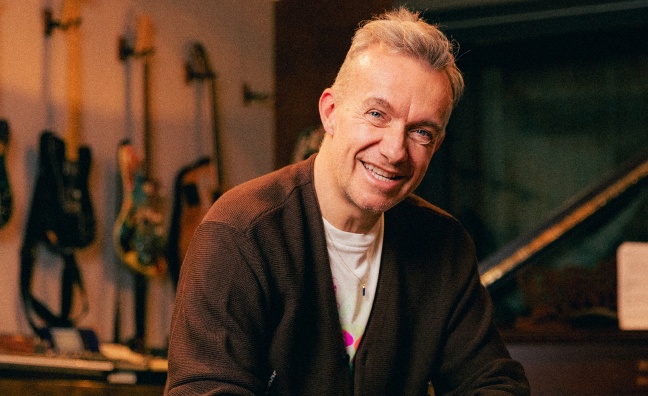
According to Fraser T Smith, the music industry is in danger.
In a new interview with Music Week, the award-winning songwriter, producer and artist warned that the business must do all it can to ensure that music-making does not become “a playground for the privileged”.
Smith hosted Music Week at his home studio, where he worked on Snow Patrol’s recent No.1 The Forest Is The Path and is currently deep into sessions with Kae Tempest and Dave for their new albums. It is also where he works on his artist project, Future Utopia, which releases through his own 70Hz imprint.
“If you’re a songwriter that doesn’t also produce, then it’s extremely challenging out there,” Smith said, surveying the landscape for creatives. “Royalties through radio play are not what they used to be. It’s not as if you can have the hit that then enables you to do lots of other types of songs – work on commercial stuff, and then work on less commercial stuff, which is a model that I adopted when I was younger. If you’re just writing songs, then it’s extremely challenging and we have to really look at ways to help sustain the careers of young creators.”
Smith said that, for producers, things are also “extremely challenging”.
“I guess the positives are that there are more outlets like film, TV and gaming that you can work in, but some people don’t necessarily want to go down those avenues,” he said. “Those challenges are real and, again, we have to safeguard young creatives, producers and writers to make sure that they’re remunerated so that the landscape doesn’t become this playground for the privileged.”
Smith, who has set up the Future Producer Academy in order to fire a new generation of studio talent, is also concerned about touring prospects for emerging acts.
“In terms of the cost, I’m very lucky in that I put a substantial amount of money into Future Utopia that I’m able to earn from other means, which is working on artist projects, and I have that skill,” he explained. “I really feel for younger bands where they don’t have that infrastructure. And when you start to think about that on a socio-economic front, the live circuit cannot be a playground for young, wealthy bands, because then, culturally, we’re in a really dark place. It can’t be a privilege. It should be accessible to everybody.”

One of the first artists Smith welcomed to his countryside set up was Kae Tempest and he was moved by the experience.
“It showed me that the studio and everything we’ve set up here in the country could be such a safe space for great artists like Kae to feel relaxed,” he told us. “Kae was staying with their dog in the cottage there and felt completely at ease. We’d work late, walk the dogs in the morning and then start again. The music and the emotion just flooded out and we’ve made something which I’m as proud of as anything I’ve ever contributed to.”
The lyrical content of Tempest’s record also made a profound impression.
“It was an absolutely mind-blowing experience, to witness Kae’s transition and to see how it was informing the music,” he explained. “Kae has blossomed as this cultural beacon that is shining a light on the importance of being yourself, finding yourself and putting into words a lot of the questions that people are having on being non-binary and transitioning. Kae has made a seriously important body of work and I can’t wait to see people’s reactions.”
Smith is also exploring making music for film, is involved in a documentary about Venezuelan opera singer Samuel Mariño and is working with Bridgerton and Sex Education actor Simone Ashley.
His work with longtime collaborator Dave, who starred alongside Raye on the cover of Music Week with Smith, is set to command the spotlight, too.
“The [new] record is going to be one of the most exciting things to come out this year,” Smith said. “Dave is restless, he’s forever searching for greatness, which is incredible to see from someone that’s had so much success.”
He opened up about how Dave has developed as a musician.
“Firstly, just from a proficiency level,” Smith said. “Dave was always fantastic on the piano, but he’s practised so hard now that he’s at virtuoso level on the keys. He didn’t play guitar when we met, and now he’s so proficient, and he’s been digging into so many more influences, everyone from Jimi Hendrix to Miles Davis. He takes an agonising amount of time over every lyric, and he’s got that uncanny ability to be able to see how the world and culture are changing and put that into such expressive language that everyone can relate to, which means that every lyric he writes becomes so relevant and so exciting.”
He added: “Traditionally, artists go from being able to write about what’s going on the street, then, if they’re successful, find themselves in a slightly different scenario, which maybe isn’t as edgy or there’s not as much to write about. Dave finds things to write about in the craziest of places and has that ability, like every great writer, of being able to find everything from the hugely important, to the mundane, to the funny and put it into his work. That’s what makes him the exemplary creative that he is.”
Smith also outlined what defines his approach in the studio.
“Artists should be just allowed to create,” he said.
“What’s great about the music industry now is that no one really knows what the answer is,” Smith added. “Obviously, there are certain things which are truisms, like, if you have a nine-minute track, it’s going to be more challenging to get that played on radio.”
He cited Dave to illustrate his point.
“We’ve had conversations like that, and Dave says, ‘Well, I just want to put that record out anyway,’” he said. “What was great about working with Dave in the early days was his punkish attitude towards gatekeepers. But nowadays, who are the gatekeepers anyway? The gatekeepers are the public, and if you can get the public reacting to your music, then you’re accepted and everyone else has to fall into line. Which is the right way.”
Smith is set to release Future Utopia’s latest EP, Memory Boy, later this year. He told Music Week how the project has changed his outlook.
“It’s given me so much confidence in who I am as a creator,” he noted. “Now, I can see life on the other side, getting into the splitter van and travelling around Europe and playing small venues and seeing the music grow and connect. I keep putting myself out of my comfort zone with it. I guess that the older you get, the more comfortable you become with being uncomfortable.”
Read the full interview in the new issue of Music Week. Subscribers can read it online here.
 FOLLOW