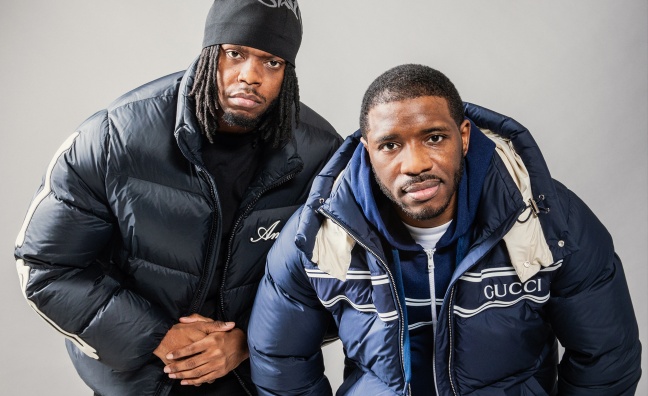
More than 15 years into their musical career, Krept & Konan are still in search of ways to shake the foundations of the industry. Now, returning for the first time since 2019 with new album Young Kingz II, the duo are independent once again. Here, for a special digital cover story, Music Week meets the pair to chart the many ways in which their lives have changed in the interim and talk business, leaving the major label world behind and why their impact will continue to resonate for generations to come...
WORDS: YEMI ABIADE
PHOTOS: LOUISE HAYWOOD-SCHIEFER
There perhaps isn’t a duo or group that has been as consequential to British rap as Krept & Konan. Circumventing the underground and becoming a fixture in mainstream UK music, they’ve rewritten the handbook on what a rap act can achieve. Their achievements reel is impressive: MOBO and BET Awards, Guinness World Record holders, British Empire Medals, co-signs by the likes of Drake and Skepta and successful entrepreneurial ventures in food, skincare and, most recently, supermarkets. They've even visited Westminster for their Ban Drill campaign. But it was their sharp lyricism, vivid storytelling and musical fearlessness that got them here, and tracks like Don’t Waste My Time, My Story and Freak Of The Week that demonstrated their knack for creating music with a timeless feel.
Returning for the first time since 2019’s Top 5 full-length Revenge Is Sweet (which has 77,521 sales to date, OCC), the former Music Week cover stars release Young Kingz II on February 7. It’s the second instalment of the project that put them on the map, 2013’s Young Kingz, which became the highest-charting album by an unsigned UK act when it reached No.19 on the UK albums chart.
The unsigned part is crucial because, after having a home with Virgin EMI for nearly a decade, the pair are independent again, set to release Young Kingz II via their Play Dirty label, with distribution handled by Virgin Music Group.
“It's a good feeling coming back to where we can do what we want to do and make the decisions when we want to make decisions,” begins Konan, whose real name is Karl Wilson. “Things are just happening very quickly, we're very proactive and reactive. If I have a feeling tomorrow that I don’t want this song on the album and I want to change it, we can do that. It’s free rein.”
“It’s ownership, man,” adds Krept (aka Casyo Johnson) underlining the reason they chose to go it alone once more.

Much has changed for the pair since the first Young Kingz record. Krept has welcomed a daughter and an award-winning child skincare business, Nala’s Baby, while Konan has explored his mental health on the Channel 4 documentary Untold: Konan – Trapped In Trauma.
“We’ve been doing this to teach our families, friends and people looking for hope and inspiration,” Krept tells Music Week. “Things that we can look back on in future generations to come and say that benefitted them. Our story has always been bigger than us.”
The pair’s team illuminate things further.
“Krept & Konan are UK rap royalty,” says co-manager Docta Cosmic. “They’ve withstood the test of time and they’ve had to navigate through different eras of the music business changing; the CD era, streaming era, TikTok era. They’ve been able to do so whilst supporting the younger generations of artists that come up. That’s what kings do, they bring up other kings and queens.”
“Krept & Konan have always been known to push the boundaries,” says fellow co-manager Aaron Kirkhouse. “They are constantly elevating their artistry and bring incredible energy and creative vision, so as a management team I see that it’s our principal job to make sure they as artists have the space and resources to stay focused on their art.”
The machinations of their world are on full display on Young Kingz II. It’s an album brimming with perspective as the duo zero in on what reflects their everyday life, from Krept’s tribute to his daughter, Nala’s Song, to Delroy’s Son, Konan’s ode to his father, the late Jamaican reggae singer Delroy Wilson. Amidst these poignant moments are flashes of their dynamism, rapping alongside Ghetts, Chip and Potter Payper on gritty soundscapes, and providing soothing, lighter anthems with Popcaan and Oxlade, kissed by genres like dancehall and afrobeats. The symbolism of their comeback is not lost on the duo, either. In fact, it has powered their return.
“So much has happened [since Young Kingz], but we’re excited to enact this full circle moment,” Konan says. “From doing Young Kingz independently to releasing Young Kingz II independently, but as older kings, wiser about the world.”
As Young Kingz II approaches, we quiz Krept & Konan about how the album came together, the UK rap scene and going back to their DIY roots…

You have taken a bit of time out exploring other ventures. What drove you to come back, and why now?
Krept: “It wasn't even a case of choosing a moment to come back. As we were making Young Kingz II, because so much has changed in our lives, the album kept changing. We've had probably three versions of this album. We were in different spaces mentally. When we got the album to a place where we felt like, ‘Yeah, this is us today,’ that's when we thought, ‘Now is the time to drop it.’”
Konan: “It’s God's timing. You can keep changing things forever, but we just thought this was the right moment.”
Was it always the plan to do a Young Kingz II?
Konan: “When we first started making the album, it was meant to be the last album on the label. The original name was Last Cards; when you play blackjack and you get the last card, you still win, so that was the concept behind it. Then obviously time goes on and things are happening, and then we managed to get out of that situation. When we became independent, we thought, ‘How do we move this forward now?’ Young Kingz was the last time we were independent, 10 years ago. Everything just aligned so we decided on Young Kingz II. It made sense.”
Can you expand on the reasons why you are going independent again?
Krept: “When you enter the game, you’re just excited to be in it, but we signed our label deal before streaming, before all of these distro deals. It was an old deal and went for so long because it was for four albums. Everything changed, but our deal didn't change. As you grow, you realise what a good and a bad deal is. There were moments where we would push it and say, ‘Come on guys,’ and eventually they heard us and we were able to become independent.”
How do you reflect on your major label experience? You had chart success doing it that way, but did that ever come at the expense of your artistry?
Konan: “Business-wise, I feel like because we were just learning about the business and seeing how things changed from vinyl and CDs to streaming, we took an L on that. But no one knew how the world was going to pan out in that way. But you've got to be in it to know that you don't want to be in it. You've got to experience it yourself, know how the machine works for you, and then come out of the machine and know how you want to navigate things.”
Krept: “The thing is, we just had a bad deal, but we didn't have a bad experience with the label. The people that worked there believed in us. They let us be creative, let us do what we wanted to do. But not everybody was there permanently, so the people we initially signed with left for other roles. So, you end up kind of diluting the initial spark behind the people that wanted to sign you. But I’ll give them props for letting us be Krept and Konan.”
On the album, there’s a real juxtaposition between life and death, especially with Nala’s Song and Delroy’s Son. You’ve never been afraid to be direct and explicit in your lyrics, but what kind of toll did being so personal take on you?
Krept: “With Nala’s Song, I just felt like anything can happen. God forbid something happens to me, I want something that she can just listen to when I'm not here. Advice that I wish I could’ve got when I was younger. Things that I want to tell her to look out for, a sign that she can hold onto forever. That was an important record for me to put out.”
Konan: “Delroy’s Son was a hard song to write. I wrote it and then I did the documentary about the PTSD literally two months later, so it was a back-to-back toll for me. I went to my dad's grave in Jamaica and then I kind of wrote the song after that. I had to really dig deep for what I wanted to say to my dad. I did shed a tear when I was writing. Listening back, it kind of hit me heavy. But it was therapeutic and gave me some happy feelings, knowing that I’m continuing his legacy.”

How did you assemble the rest of the cast list for Young Kingz II? As well as Popcaan and Sizzla, there are big UK voices in Ghetts and Potter Payper…
Konan: “They're very talented individuals, man. They all bring themselves and that's what we wanted. Popcaan came to the studio to do Smooth Loving, that song originally was a bit more greazy and we wanted that tropical element. Same with Sizzla, he just popped into my brain and that was very smooth. Krept reached out to Potter and he delivered his verse. With Youngs Teflon, I had a hook and verse and thought who could do this with us and I was randomly listening to one of his tunes. He delivered mad quickly, so it was all literally a puzzle.”
The campaign so far has involved radio interviews, Krept doing a Daily Duppy with Chip and you both hopping on a set with DJ AG. These are steps that artists of your level don’t necessarily need to take when you’re so established…
Krept: “That's how we started in this game. Freestyles, bars. We’re always going to tap into that regardless. We enjoy doing that and we’re in a space now where we just want to enjoy what we’re doing. Rather than coming with one big single, we’d rather take it back to the essence.”
Konan: “You’ve got to get on the ground, man. Connect with the people in real time, especially now with TikTok and social media dominating. Fans still want to see artists outside, doing radio, seeing freestyles and wheel ups, they miss that. Showing people you can bar randomly, just turning up, grabbing the mic, running a riddim, and just going off, and people seeing that energy and hunger. That's what built this scene in the first place.”
What kind of UK rap scene do you think you’re coming back to?
Krept: “There's just been a lot of growth. Being able to see so many people having successful careers and doing amazing things and opening doors for the next generation of artists just gives a lot more hope. When we were first coming into the scene, it felt like it was only one or two artists at a time that could have success. Now it just feels like there's multiple people doing multiple different sounds and everyone’s smashing it. There’s no conformity, people are doing what they want and it’s energising.”
Konan: “You've got the emergence of the UK underground with Len, Lancey Foux and Fimiguerrero, they're doing well. You’ve got grime back in the mix now with DJ AG, everyone's doing freestyles again. We’ve never seen this many sub-genres in our scene. When people say UK rap is falling off… They weren’t there when we just wanted to be heard. Trying to get on Channel U just to be seen. No one cared about the money back then. Because you’re seeing artists reach No.1 frequently now, you become used to it. Everybody's getting bored of seeing people win. But I’ll never get bored of seeing the scene win.”
Are you expecting mainstream success for the new album? You’ve hit so many milestones before – is there pressure to hit more?
Konan: “I'd be lying if I said I didn't want to do well. When you've done so much, you want to continue to do that. We always aim for the stars, and if we land on the planets then so be it.”
Krept: “I just want to put out music that people like and enjoy and I can perform off the back of it. I'm not in a space where I need this to chart because it just becomes not about the art any more. When we first came in, there was no pressure on anything. We just did what we wanted to do, and then it did what it did. That was the best I felt doing music. So, for me, it's just wanting to feel that way again.”
The narrative around Krept & Konan has always been that you’ve done things your own way and ploughed your own furrow, to use a cliche. Are you still doing that?
Krept: “I think even the way we’ve been rolling out music recently is proof. I rolled out a Daily Duppy with Chip because I wanted to freestyle. I didn't need to do it with Konan. Konan did another Last Night freestyle and he didn’t need to do it with me. We just do what we want, whenever, in any capacity.”
The industry you’re returning to is very different, too. TikTok is dominating, social media is even bigger, less new acts are breaking big and the major label world is very different. Have you been paying much attention to industry goings-on?
Konan: “I think everyone's just trying to follow what brings the biggest engagement, what moves the needle the most. There's a lot of focus on things like TikTok. I don't really feel like there's a desire to develop artists any more. It's more like, what's hot, what's trending and sign the deal. That’s why it’s important for artists like us to showcase the other side, talent and being able to work hard.”
It’s also harder for artists now, touring costs have gone up, it’s harder to break. What would you say to anyone starting out now?
Krept: “From personal experience, the artists that are true to themselves last the longest. So, whatever it is that you decide to do, be yourself. If you feel like you're really good on TikTok, then that's you. Don't follow trends and don't get caught up in a trend just because it's a trend. Just do what’s comfortable to you and what you feel strongly about.”

There has also been an increase in focus on the experience of the industry for Black artists and executives. Organisations such as the Black Music Coalition and Black Lives In Music didn’t exist when you were last in a campaign cycle. What is your take on how things are moving along in this area?
Krept: “If I see more representation in the places that I'm in, then there's growth and improvement and we're onto something. It’s not going to happen overnight but there's a lot more people working for corporations that look like us now. We just need to keep pushing it and supporting each other to push progress forward.”
In terms of your work outside of music, what are you focused on now?
Krept: “We’re opening Save Ways, a supermarket for Black and ethnic minorities. Sometimes you can have an aisle in a traditional supermarket for our food, but we’ve got to go elsewhere for our meat or halal meat, other places for other products. We want to create businesses that have purpose, and we want to put all of that into one place, to compete with the other supermarkets and provide necessities that we need. It’s a big move for us. We're in certain positions to do certain things and we just want to make sure our decisions make sense and can benefit the people.”
Konan: “I’m in the process of starting a charity for PTSD called Calming Minds. It will be an intro for people to get into therapy. People are hesitant about therapy and don't want to take their first steps to talking to somebody. I'm trying to make that avenue for them, that platform for them. Hopefully we’ll be announcing soon. I’ve spoken with about 30 therapists who specialise in trauma and they’re all on board. We’re just trying to get the format right and make it as transparent to people as possible. When I did the PTSD documentary, that was such a new experience for me in trying to open some wounds and heal them. I hope the charity can do the same for others.”
How important is it to you that you are involved in so much activity beyond music?
Krept: “Very important. For one, showing people that we know where they’re coming from, because we’re from it too. The more we do, the more hope it creates and hopefully people can look at what we’re doing, put their thinking caps on, and find ways that they can affect change. We want to leave a legacy.”
In terms of grand plans for this new record and beyond, what does the future look like?
Krept: “I just want our fans to like the album and for it to be part of our history. To where, when we release music in the future, it will be compared to Young Kingz II. That’s all I’m concerned about, that we’re continuously building and feeding the fans.”
Finally, the last time you were in Music Week you said you didn’t feel you get the respect you deserve, the credit for the impact you’ve made. Do you still feel that?
Konan: “I’ll keep it clean, I don’t think we do. I feel I might hyper focus on that, and maybe that’s something I get from my dad. He was a pioneer of reggae music but never got his flowers and drank himself to death. But then, as I've gotten older, through therapy and understanding life, I now know that we don't do this for credit. It’s about the bigger picture. Hopefully one day we’ll be given our flowers, but it is what it is until then.”
Krept: “I don't really care any more. I stopped caring for validation. At this point, if you know, you know and if you don’t, you don’t. I'm doing this for my family, my friends and people who can see what we’re doing. People that are looking for hope and inspiration. Ratings are not going to make my daughter [feel] good and it’s the impact of the things I’m actually doing that are going to count.”
ROLE CALL
MEET TEAM KREPT & KONAN
Management: Aaron Kirkhouse & Docta Cosmic
Live: Ant Brown (CAA)
Socials: Marta Teolato (WMA), Charlie Pollard (WMA)
Marketing: Robyn James (Virgin Music Group), Roger Walker (Virgin Music Group)
Radio: Rich Ashton (Virgin Music Group), Lydia Hoyle (Virgin Music Group)
TV: Mel Meadows (Virgin Music Group)
Commercial: Rob Watson (Virgin Music Group), Leon Diaper (Virgin Music Group), Sarah Young (Virgin Music Group), Rhea Knight (Virgin Music Group), Reece Ismael (Virgin Music Group), Amelia Hancock (Virgin Music Group)
Digital: Betty Gonzalez (Virgin Music Group)
Sync: Sam Lenthall (Virgin Music Group)
 FOLLOW