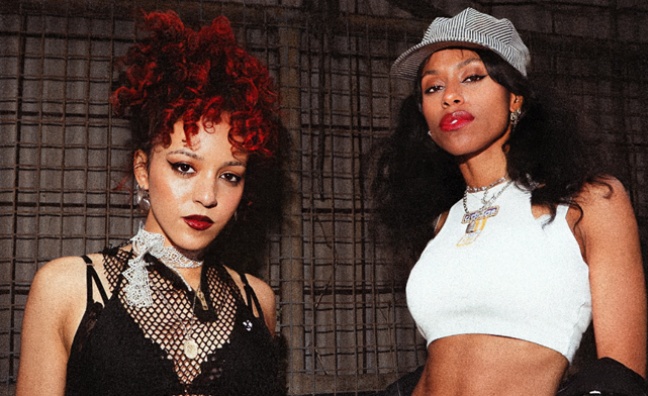
Since bursting onto the scene with their acclaimed debut Who Are The Girls? in 2020, Nova Twins have not only been racking up a host of award wins and nominations, they have also been vocal advocates for change in the music industry. For their next move? The Marshall Records-signed act have even bigger plans. Here, Music Week catches up with Amy Love and Georgia South to find out what they have in store with their new album Parasites & Butterflies...
They might be celebrating the release of their third album, but Nova Twins will never forget the moment that forged their identity as a band, despite the numerous successes and milestones they have blitzed past since.
“When we first started, when we were a lot younger and a little bit more naive to the industry, people – and it was men in the industry, A&Rs – would try and push us in a certain direction or bland-out our sound,” remembers Amy Love, instantly warming to her theme as she looks back on the London duo’s DIY beginnings.
“It was like, ‘Maybe you should try this?’, ‘Take this away, be less heavy,’ or, ‘Don’t play such complicated basslines,’” the lead singer and guitarist continues. “That’s not what we wanted to do. Why were we already being told to reduce what we do, what we deemed to be our natural selves, our instincts, as young girls, to be less?”
That prompted Love and bandmate Georgia South to make a choice.
“We were sitting there chatting and it was like, ‘Fuck it, let’s just do what we’ve always done – we need to feel happy in what we’re doing,’” she says. “We just took the long road, and thank God we did because it’s taught us so much and we are having such an amazing journey doing this.”

Their latest achievement as Nova Twins – childhood friends who met when Love played in a band with South’s brother – is the release of Parasites & Butterflies via Marshall Records, where they signed in 2021. If their debut album, Who Are The Girls?, marked the arrival of a thrilling new proposition for UK rock music, 2022 Mercury-nominated follow-up Supernova opened the floodgates. Support slots with Foo Fighters, Bring Me The Horizon and more followed, as did winning the New Artist Award at Music Week’s Women In Music Awards, BRIT nominations and a place on the MOBO shortlist for Best Alternative Music Act – a category the band themselves had campaigned for the very existence of.
“That’s definitely something that we pride ourselves most on because it's something that will just stay in history,” says bassist South.
For Nova Twins, their band has always been about opening doors, showing what’s possible.
“We always want to make sure that young girls can look up to us,” says Love. “Just showing them something different, that women can be loud. We can be brave. We can be strong. We can be fierce. We don’t have to be put into one box that a lot of the industry, especially male executives, put us in – ‘OK, you’re a Black female, R&B, hip-hop and let’s over-sexualise you.’ If you want to do that, fucking great, but it needs to be on our terms and no one else’s.”
The band are talking to Music Week from Brighton where they are rehearsing “for something really exciting that we can’t talk about”. When it comes out, Stateside, it could be that thing that pushes them to the next level after a decade of sticking to their guns.
When we first started and were a little bit more naive to the industry, people – and it was men in the industry, A&Rs – would try and bland-out our sound
Amy Love, Nova Twins
Produced by Rich Costey in Vermont, their third album presents a yin and yang of sounds and thoughts.
“We’ve been testing some out over festival season,” smiles Love, clearly excited. “For us, it was ready when it got mastered, so it’s nice that the whole world is going to get to hear it, too.”
Marshall Records founder Steve Tannett, who played in punk band Menace back in the late 1970s, says Nova Twins represent a new dawn for alternative music.
“I started my career as an artist in 1977 in the white heat of punk, which was a seismic change in the way artists were able to exist without the gatekeepers of the major record labels,” he says. “When we first saw Nova Twins, it felt like a new beginning in many ways. The music world needs to have bands like Nova Twins around, continually pushing the boundaries of what can be achieved and redefining what success means.”
Tannett adds that the band can be seen as the embodiment of the label’s MO.
“Our mission is to support grassroots and emerging talent, which is why we signed Nova Twins in the first place,” he says. “Together, we have achieved a lot and they have enormous ambition for change in the way women are represented in rock and alternative music. We will continue to support them in as many ways as possible.”
In light of chart breakthroughs from rock acts on both majors and independents, senior label manager Ellys Airey says Marshall is thinking long-term for Nova Twins, who enjoyed their latest crossover moment with a performance on ITV’s The Jonathan Ross Show.
“Of course, if an album connects on a mainstream level, that’s fantastic, but it’s equally important that the artist’s sound, message and authenticity resonate with their audience and that their foundation is strong,” says Airey. “The pressure we feel is to do right by the artist, to nurture their vision and ensure that when those big moments arrive, the band is positioned to thrive for the long term.”
Unsurprisingly, Nova Twins have their own thoughts on the mainstream’s embrace (or not) of rock music.
“Rock used to be one of the biggest mainstream genres that brought everyone together,” says Love. “We don’t quite understand why rock and alternative get sidelined by mainstream TV now when it used to be such a pioneering genre. We think it is so important for people to see that kind of musicianship, and it feels like it gets shunned by the mainstream.”
Now, Love can see that she has been mulling over the subject since her childhood.
“I grew up in Essex, and the only way I was getting music was through my mum’s records or the radio,” Love says. “So it was predominantly pop, but wouldn’t it have been great if I could have heard a really cool, raucous, punk, female band? Maybe I wouldn’t have had to have trawled the internet and it wouldn’t have taken me so long to figure it all out, you know?”
The band’s manager Rupert King of Blue Raincoat Music tells Music Week that Love and South have really “pushed forward” on Parasites & Butterflies.
“The songwriting and production feel sharper and more ambitious, with more genre-blending and sonic exploration, but it’s still unmistakably Nova Twins,” he says. “They’ve kept some core elements, like always writing with the live experience in mind and sticking to their all-pedalboard, no-synths approach, but there are some notable firsts, too.”
King points to Hummingbird, which samples Mahsa Vahdat’s The Leili Lullaby and nods to Love’s Iranian heritage, while Glory has South’s dad playing the organ.
“Those touches show how family and personal history feed into the music, which I find really grounding,” he says. “And lyrically, there’s more vulnerability and humanity this time, balancing out the superhuman energy that defined Supernova.”
The music world needs to have bands like Nova Twins around, continually pushing the boundaries of what can be achieved
Steve Tannett, Marshall Records
With a packed touring schedule across Europe and the EU (including a date at the O2 Forum Kentish Town in London) on the horizon, Nova Twins’ latest campaign is eagerly anticipated. Could this be their biggest cut-through moment yet? Are they ready for what might happen should they explode?
“We’re very true to the people who’ve been with us since day one, and we don’t let go of or forget the people that helped us get there,” answers South, sagely. “So, with that, we’ve never been swayed by the toxicity of fame and how people can get in your ear and try to divide people. That way it gets messy.”
With that, we delve into the making of Parasites & Butterflies, why Nova Twins will never stop using their platform, their take on the music industry and more…
Having made your last album during the pandemic, what was your mindset going into Parasites & Butterflies?
Amy Love: “Off the back of Supernova, it was a pretty hectic schedule of touring constantly. Not sleeping. Never being home. And when you get back off such a whirlwind of a tour, you don’t realise that you just feel a bit hollow. There was a lot of catching up to do. But, also, we had to be creative basically straight away. We wanted to have an album because we’d been touring for so long. We wanted to make sure that we can get music to our audience. Mentally, we weren’t quite ready to write another one but we pushed through.”
What are your recollections of the writing process?
AL: “At first, we were writing in the depths of winter. The music definitely had what naturally was coming to us, a slightly more open, vulnerable, darker theme to the songs, which we were intrigued by and wanted to pursue further. So, we did. But as it started to become a little bit too intense, we realised we needed balance. And that’s when we deliberately decided we needed some light on this album, too. We needed to pull ourselves out of this feeling, even though it was good to express it via music. So songs like Soprano and Drip came along, where that was the light of the album, and then we saw these really nice parallels and contradictions between feeling like you want to pull your hair out or you’re feeling not 100% in yourself and then moments where you do. And that’s a really good reflection of the balance of life, really. We’re all human and we wanted this album to feel a bit more human and just a little bit more honest.”
It’s a personal question, but where did the darkness come from?
Georgia South: “When you tour and you have such a busy schedule, you don’t necessarily have time to reflect on things that are going on in your personal life. When you’re on the road it’s on to the next thing. Put on a brave face. Just get through to the next show or the next flight. So when you get home after all of that, I feel like the rug which you’ve been brushing everything under, it’s like a mountain and you’re just tripping over it. It’s this tidal wave and it comes at you all at once – so it’s just processing all of that and trying to find your own brain through the chaos and mess of it all. But we didn’t really have that time. It was writing the next album and sifting through all that. So all of that kind of chaos went into this record.”
How important has your team been in supporting you?
AL: “We work with an independent team and they all are so amazing from our management who have just had our back. We work hard but our manager, Rupert King, matches our level of crazy. He really does. In terms of his work ethic and support. Honestly, we're a small team, but we're very strong. And mighty. Everyone, literally, is just a force to be reckoned with and we make it work. It's not easy staying on the road. It's so expensive for touring bands unless you're an A-lister at the top of the chain. Everyone else will still be trying to make ends meet. Even if they're a big artist, you won't know but they'll be sitting there juggling their books because the industry, the way it’s weighing up in terms of artists getting paid for songwriting or royalties or shows and how much we actually have to put into it, it's so much. So it's a big balancing act. But our team always have helped us make it work in every aspect.
"We don't work with people who don't get the project. For this type of project, you have to really understand it and you know when someone loves it because they're in it. It's like ride or die mentality because they completely get it. And our label, Marshall Records, have been really great at just supporting us. Our deal was super artist friendly so we've done really well in terms of keeping a really tight unit around us who are just incredible. We kissed a few frogs to get to this point for sure. We all do. But when you're doing something that we completely believe in, wholeheartedly, and they believe in what you do, it's an amazing feeling. We just feel really, really lucky to have everyone.”
While you were out on the road, were you able to get a sense of the rock and alternative world changing in terms of representation and the amount of young women coming into the scene, be it fans at shows or behind the scenes?
AL: “Since we started, up until now, there’s definitely been a change. There’s a lot more diversity. There’s a lot more women who are at the front [of the crowd] and owning the mosh-pit space. Before we’d all just stand at the back and stay well clear, but now our mosh pits are majority female [laughs]. So it’s really cool to see that. Seeing that growth in our period of time doing this is so amazing for us. When you’re having those rough times on the road and there’s a little girl on someone’s shoulders, and they’re literally looking at us, seeing something for the first time, knowing that she can be that later on, if she chooses to… And when we have that effect, you have a responsibility and we do take it quite seriously. It’s not like, ‘Oh, we’re rock stars and we didn’t ask to be role models.’ Even if you didn’t, or you didn’t intentionally, you still have a platform and you’re still using that platform to your advantage. You have a responsibility for what you’re putting out there.”
We always think we’re a band’s band, instead of an industry band, because of all the groups that have always brought us up – it's this amazing ecosystem keeping rock alive!
Georgia South, Nova Twins
Recently you shared a statement on social media encouraging people to “keep raising your voice” with the caption “Free Palestine, Eyes on Sudan, Protect our trans friends, Defend our communities”. What prompted that post?
AL: “There’s so much that’s happening that I think a lot of people really feel overwhelmed with even where to start. And it’s important that we keep using our voices and not let our governments get away with the horrific things we’re seeing day in and day out. The statistics are so scary. Whether it’s Trump getting into a position of power in America [or] whether it’s a genocide, people think, ‘Oh, that doesn’t affect me.’ But that could be you one day. And how would you feel if you had to go somewhere, if you had to flee your country, how would you want to be welcomed? How would you want to be accepted? How would you want to be treated? It's black and white; it's so simple to us. It sounds trivial, but treat others how you want to be treated. It's absurd to us that anyone can excuse it, that our government is excusing it and people are brushing it under the rug.”
Do you think that musicians sharing sentiments like this can bring about change?
AL: “People can politically fight these things how they need to. It might not be being so vocal online, but it might be that they’re boycotting certain brands or donating. People need to be kind together at this time because everyone is dealing with it. But as artists, we always feel a responsibility to make sure that our audience – because we do have trans people on our socials; we do have Palestinian people – know that we are there supporting, we are there in their corner. Around Black Lives Matter, we had that support, we really did and we really felt it. It was life-changing for us because it made us feel like, for one, we’re not going crazy, but, two, that people were in our corner and we weren’t so isolated and that we could push a movement forward. And when people do get together, things can change. So whether or not it seems impossible now, I think when people band together, it really can, slowly but surely, get the results that we want. We don’t have all the answers, but we can only do what we can do.”
What did it mean to you to have the alternative category added to the MOBO Awards as a direct result of your campaigning?
GS: “Absolutely everything. We grew up watching the MOBO Awards, and we always thought, ‘I would never be able to be on this awards show,’ so to be able to have this mainstream platform on TV, with young people watching it thinking, ‘Oh, actually, I can do that and I am accepted into that space and it’s OK for me to be alt and different and I’ll still be able to get my flowers and achieve these awards’… A big moment for us was seeing Skindred get their flowers [winning the category in 2024] finally after 20 years of being in a band and how much that meant to them. And then when we played the MOBOs this year, it was a full-circle moment, which was crazy. Knowing that that will now be there, hopefully forever, is an amazing feeling.”
AL: “It’s such a testament to [MOBO founder] Kanya King for hearing out the open letter in the first place. She’s such an incredible woman and she was telling us all about her experiences about keeping the MOBOs alive, their own internal battles, and keeping that whole community thriving. She really pushed for that with the help of Marshall [Amplification, which sponsors the award], and then it all managed to happen.”
You’ve spoken before about people questioning whether you really play your instruments – can you expand on your “no synths” rule?
GS: “Well, they will never say it to our face. We dive into comments, for sure. They’ll be like, ‘They’re not playing; they’re miming.’ But, obviously, it’s because we’re Black women playing guitars. We love synths and were really inspired by heavy electronic music, but the ‘no synth’ thing was just fun to experiment with, creating produced studio sounds but on bass and guitar. So our pedal boards are massive and it’s super cool just to have analogue pedals that have weird glitches and things that you wouldn’t necessarily get from a plug-in on a laptop. It’s just more of a cool, interesting way of exploring different sonics and pushing where we can take our instruments.”
On the other side of that coin, how does it feel to have people like Elton John, Tom Morello and others supporting and encouraging you?
GS: “It’s always such a pinch-me moment when these huge legends reach out to us. We’re always in awe and think it’s incredible how they still are super excited about discovering new music because they could easily just be like, ‘We’ve made our careers and we’re legends. We don’t need to champion new bands.’ But they do, and they’re so encouraging. They’ve said such kind things to us that will stay with us forever. And we always want to do that for other bands because we always think we’re a band’s band, instead of an industry band, because all the bands have always brought us up. So we just want to bring up the next generation of bands with us. So it’s this amazing ecosystem of keeping rock alive.”
Looking at Parasites & Butterflies and beyond, what are you most excited about for Nova Twins right now?
AL: “We’ve got some stuff we can’t talk about. But on the tour that’s happening in September and October across the EU and UK, we’re really excited to come with a whole fresh album, playing all the new songs and new arrangements. We love getting into designing our live shows. And we want people to dress up as like the Parasite or Butterfly concept! We want you to make it what that means to you. We really want people to have fun with it and just come along. All our audience always make friends as well – on Discord we see them all chatting and being excited just for the community to get back together again."
Parasites & Butterflies is out August 29 via Marshall Records
Photo: Jack Morgan