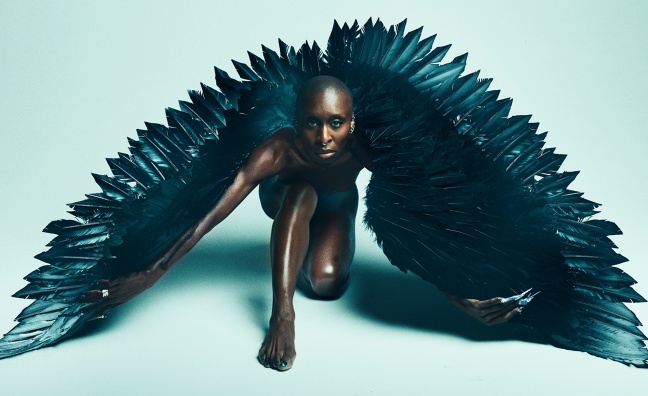
The world knows Cynthia Erivo as a powerhouse of stage and screen, primarily for her iconic portrayal of Wicked’s Elphaba. But who is Cynthia Erivo, the solo artist? With I Forgive You, her soul-baring second album released today via Verve/Republic, she is revealing a side that no one has ever seen. In this tell-all interview with Music Week, Erivo is joined by Republic's Wendy Goldstein and Verve's Jamie Krents as she traces the story of the record, from film set to recording studio, and digs deep into the quiet power of vulnerability, embracing her queerness and crying in the wings at the Oscars with Ariana Grande…
WORDS: MIRANDA BARDSLEY
PHOTOS: NORMAN JEAN ROY
“People have gotten very used to me as the musical theatre woman, the person who does these ‘big songs,’” muses Cynthia Erivo. “But that is only half the story.”
It is a hot Monday afternoon in London when Music Week meets the actor, singer and author at Universal Music’s UK headquarters. Erivo has been darting across the city between back-to-back interviews and media appearances all day to discuss her second studio album, I Forgive You, which drops today via Verve/Republic.
“Everybody at Republic and Verve is extremely passionate about Cynthia and the incredible album she’s made,” Republic Records chairwoman and chief creative officer Wendy Goldstein tells Music Week. “We work very well together and have launched some fantastic records in the past, so this felt natural to join forces and give I Forgive You the best push we can.”
Despite a whirlwind start to the week, Erivo radiates calm, curling up on an enormous L-shaped sofa as we settle into our chat. As we talk, it immediately becomes clear that this moment of grounded reflection seems to perfectly mirror the music she’s just released. I Forgive You is not only a bold creative step which sees Erivo experiment in ways she has never done before musically, it is also a personal reckoning – an unflinching, self-reflective 20-track work which, through four acts, quite literally bares Erivo’s soul.
.jpg)
“Getting into the studio was the biggest pleasure of my life,” says Erivo, who was born in London to Nigerian parents in 1987. “There was the space to create freely, which I didn’t necessarily have with my first album, and it feels like I’m more in control of what everyone gets to hear.”
“Cynthia is definitely telling a story, her story, across this whole project," asserts Goldstein. “It manifests in the artwork and the visuals as much as it does in the music. She made sure every element fit, and we matched that in terms of roll-out and strategy – her ideas dictate everything throughout."
Control and autonomy are recurring themes in this new chapter of Erivo’s career, where the singer has moved from the world of movies and theatre to the music industry as she is re-establishing her solo act. If her debut record, 2021’s Ch.1 Vs.1, marked Erivo’s initial emergence as an artist, and playing Elphaba in Jon M Chu’s 2024 critically-acclaimed film adaptation of Wicked made her an international phenomenon in 2024, then I Forgive You is her reintroduction. It is one that is not so much defined by theatrical grandeur or dramatic spectacle, but instead strikingly personal and candid songwriting.
“I was touching on things like sadness, rage, anything that has been unresolved in relationships which I haven’t really worked through,” she tells Music Week. “I had to face the part of myself that I haven’t necessarily been proud of, the parts of me that might have hurt another person, and come to terms with [the fact] that those parts exist outside of me being someone who is also hurt.”

“The depth of the writing and production on I Forgive You is staggering,” says CEO-president of Verve Label Group, Jamie Krents. “It really showcases what sets Cynthia apart and makes her more than just one of the best singers in the world. The marketing campaign the [label] teams have crafted with Cynthia and her team is also all about storytelling and inviting new fans into the chapters that make up the album. That included switching up her social content strategy, listening sessions at great studios around the world, carefully curated interviews and, to Cynthia’s credit, fan events where she attends and walks people through her process.”
At the record’s centre is Erivo’s unmistakable voice, acting as a connective thread and weaving each act together with vocal interludes. The effect is immersive – making the listener feel like they are sitting in the studio with Erivo as she sings.
“I wanted to pour as much of myself as I could into it, try to use every drop of what I could as a musician, physically,” she explains. “So that didn’t just mean the writing, it also meant my voice. I was thinking about how much of it I could use, how I could use it and the ways I had not used it before – it was a very physical experience.”
I Forgive You arrives at a pivotal point in Erivo’s career. After making her West End debut in 2011 with The Umbrellas Of Cherbourg and her first Broadway run with The Color Purple from 2015-2017, she is now a Grammy, Emmy and Tony Award-winner, and three-time Academy Award and Golden Globe nominee.
But it was last year's portrayal of Elphaba in Wicked, opposite Ariana Grande, that truly launched her into the global spotlight. The first instalment of the two-part film adaptation became the highest grossing movie based on a Broadway musical ever at the US box office, and its soundtrack raced to No.1 in the UK compilations chart. It has since racked up over 700 million Spotify streams and 171,915 sales to date (according to Official Charts Company data). The second instalment, Wicked: For Good, is due to be released on November 21.
Erivo is now a household name – thanks in no small part to her iconic ‘Aaaah’ note in Defying Gravity (691,317 sales). But praise and acclaim have come with intense public scrutiny.
“There are new things that I’m constantly getting used to,” Erivo admits. “I sometimes forget or don’t acknowledge that I don’t have the level of anonymity that I had before; I still go about my business as if no one knows who I am, and I’m quickly reminded that is not the case.” [Laughs].
Erivo’s relationships with her label and management are integral to the risk-taking on I Forgive You.
“I made my last album during the pandemic and everything felt a lot more difficult,” she says. “But this time, I really had the right team around me, and I love that it is Verve and Republic.”
Indeed, having had a longstanding partnership with Universal Music's Verve Records, Erivo joined forces with Republic, after advice from Ariana Grande.
"It’s been incredible watching Cynthia’s career develop over the last several years,” says Krents. “We knew she was a world-class singer and actress when we signed her, but watching her develop as a writer, producer and recording artist has been a genuine thrill. Following on the heels of our work together on the Wicked soundtrack campaign, this was seamless, and Monte’s [Lipman, co-founder of Republic Records] team brings so much muscle and creativity to the mix, which we complement with Verve’s nuanced and bespoke approach and our experience working with Cynthia. I have to give special credit to Wendy Goldstein, who Cynthia really connected with creatively, but the whole Republic team has shown up in a big way and it’s been a true partnership.”
“Cynthia has always stood alone, she has a voice that’s both extremely powerful and really intimate at the same time and she brought this to the forefront on I Forgive You,” Goldstein affirms. “She’s hands-on, and she knows what she wants. Alongside our incredible label partners at Verve Records, we’re following her lead and supporting however we can – it’s worked out incredibly so far, and this is just the beginning.”
With that, we delve into a fascinating and revealing conversation, as Erivo reflects on the behind-the-scenes journey of I Forgive You, the whirlwind of being catapulted into the public eye with Wicked, backstage chaos with Ariana Grande at the Oscars, her love of Britpop, embracing queerness and how fearmongering is stopping us from telling stories that need to be told…
You have described I Forgive You as marking a new chapter. What about this moment felt right to redefine yourself artistically?
“Some people have only seen me doing musical theatre, but I’ve been doing music for such a long time, it’s where I started, and for a long time it’s felt like people have only been seeing half of me. With I Forgive You, I wanted to make sure that people had a fully rounded picture of who I am. I wanted to share my voice, what it sounds like when I sing for me and when I sing my own songs. It’s not that I’m not singing as me when I’m singing other people’s music, but they’re other people’s melodies and it’s a very different feeling when I do my own. So this record was about sharing another side of me, as a soloist.”
There’s often talk about the pressure of the ‘difficult second album’. Did you feel the weight of any expectation working on I Forgive You?
“Strangely enough, I don’t think I felt any pressure. I’ve been really excited because this time it feels like it’s meant to happen the way it has, it has been really smooth. There was more of a flow with this than last time, I could actually be hands-on in the studio with someone making the music and the team around me were enthusiastic and excited about getting it to people’s ears. So it feels like it’s in reverse – I didn’t know if the first album would connect, and it was hard to get it where I wanted it to be, but this one feels just right.”
What are the benefits of having both Verve and Republic behind you?
“This joint venture feels more like me, I love that it is those two companies – it acknowledges the jazz in me, that kind of performance element with Verve, then Republic allows for the more popular, R&B space that I take up, so it feels really good. It means I can actually express who I am fully as a musician. Whilst I was doing Wicked, I also realised that I needed more logistical support as well, and Verve and Republic together work beautifully together. And they were so helpful in that whole process, and ready to and willing to hear me.”
Can you talk us through some of the most nerve-wracking aspects of making the record?
“Getting started felt scary because I was like, ‘Oooh, am I really going to do this?’ I thought, ‘Am I going to go back to things I’ve always done, or will it be a different experience this time around?’ So I started with trepidation, even though I knew it was time to do what I wanted to do, and once I’d begun it was free-flowing. Then there’s the sharing part, that’s always scary. I always knew I was going to be open with this album, but when I started writing, I realised, ‘Oh this is really honest.’ You don’t know what people will take away from it, so when it was finished, I thought, ‘Am I willing to let people in this way?’ Ultimately, the decision was yes.”
You were making I Forgive You during filming for Wicked. Was there ever a struggle juggling the two?
“It didn’t feel that difficult, it felt like one aided the other. Being on the set with all of those people, feeling really creative and safe, meant that when I went to record my music, I felt really open to it. Just as we started the album, the actors’ strike happened, so at that point we were like, ‘Studio, now!’ We had this month or two to create the music, and then when I went back to filming, I’d take time to be there when I had a free weekend or something. It just meant that all the creative juices were flowing all at once all the time, which was really helpful. I felt hungry – I’d be texting about the album on set! Also, something about the vulnerability it took to play Elphaba and the willingness to dig into my own stuff for her, meant that that creative door was already open for me by the time I was sitting in the studio, and writing just flowed out. I haven’t really had a chance to close that door yet, and I don’t want to.”
I Forgive You is sonically really interesting, blending pop, gospel, folk, R&B, as well as Britpop. How did those influences come together?
“I’ve spent most of my life here in the UK and Britpop was really booming in the late '90s, along with R&B and pop, so I was listening to all of that – it’s all part of my genetic makeup when it comes to music. So I’m listening to Annie Lennox, Blur, Kate Bush, Oasis as well as Brandy, Monica and Aretha [Franklin] at the same time! Those are the sounds I’m hearing in my head. Making this record, I was also listening to Massive Attack and Zero 7, as well as ’90s music like Mary J Blige, as well as Dido. I’ve even said Enya is an influence too because the layering in her music really influenced how I’ve layered [vocals] in mine. It's interesting, when I’m writing, I’m not trying to do one type of song, it just ends up sounding how it sounds. And with I Forgive You, whatever the song became, the sound was always primarily created by the voice – that allowed it all to have a spine.”
On one of the tracks, Push And Pull, you rap. Have you ever done that before?
“No! That’s the first time I’ve done anything like floetry [rap and poetry]. We wrote the song about four years ago, and originally it was someone else doing the rap, but when I brought it to this, we changed the structure, dynamics, added padding, we messed around with the voice, using it as a sample all the way through. Then I thought to myself, ‘Do I want someone else to do this or do I want to try it?’ So I tried it, and I liked what it sounded like. I also liked that it was me talking to a woman as opposed to a man, because when we did it the first time, I hadn’t come out, or expressed my queerness. To be the person who is speaking to that kind of desire felt really important, it didn’t make sense for someone else to do it. It was freeing.”

Presumably you could have had your pick of features on this album, but you chose not to. Why?
“I did think about it, I thought about having duets, which I definitely want to have at some point, but these pieces feel so personal that having someone else come and join me didn’t feel right. Strangely, it would feel like letting myself off easy, handing the responsibility to someone else, and I think this should be from me, of me. I went with my intuition most of the time, and my intuition was saying we didn’t need it.”
You co-wrote every song on the album. Why was it important to have that kind of creative control?
“For me, writing feels natural, so it felt like, if I didn’t do that, I’d be doing a disservice to myself. The words were in my head already, I didn’t want them to sit there. If someone were to say, ‘These songs are terrible, the writing is bad,’ I’m ready to hear criticism [laughs], but I needed to get the words out somehow. I do know my limits though… I’ve been asked before if I’d write a film, and my answer is ‘No’, that’s not for me!' I can give you prose, I write my own speeches, words are food for me, but I know when I can leave it to someone else – I don’t need to write a film or a TV show. Give me a song, I can write that! Doing this album just felt like a natural progression.”
Speaking of writing your speeches, you have often used your voice for social change – like your speech at the GLAAD Media Awards where you called for a light to be shone on the LGBTQ+ community. In such tumultuous times, how do you think the industry can show sustainable and effective support for gender diverse communities?
“There is always more work to be done, I think we get to a place with it, then we shy away. There just aren’t enough places behind the scenes that have people like me showing what representation actually looks like. A lot of it is about taking the mystique away from it and asking questions like, ‘Why are we so afraid to see a queer Black female couple on a TV show?’ The moment that we start to understand that it’s not about telling a story of sexuality, it’s about telling the story of human beings who love, then we can get all the other stuff out of the way. We can actually be creative.
“That’s what we’re lacking at the moment, the courage to tell human stories of every kind. There are still spaces we’re not taking up and work we haven’t done yet, and right now when it feels like things are being rolled back, it’s the most important time for us to start being as creative as we can, showing human beings in their fullness and in their difference, to stop the fear-mongering. The more these things are hidden, the more people can be afraid of it; and the more it’s readily available to see and to understand, you’ll get more people saying, ‘I don’t think this is as big of a deal as I think it needs to be. You love this person, I love that person… Wonderful!’
“My logical brain doesn’t understand why people are so afraid of it. Personally, I’m like, ‘Are you in love with this person?’ ‘Fantastic!’ Why do you need to stop me enjoying the person or persons I want to enjoy, if it doesn’t affect your life. In fact, what we’re doing by not being accepting of people, is we’re just creating a world that is more bitter – we don’t think of the knock-on effect. Right now, the job is to keep putting out images that show that love is possible in many different ways.”
You and Ariana Grande were working opposite each other during the making of I Forgive You and her album Eternal Sunshine – did you ever share musical ideas?
“As I was writing it, I would send her the songs in their rawest, demo form, just as she was sending me her songs in their rawest form. Like her song Hampstead, I had heard that many months before it came out, and when she played me We Can’t Be Friends, I remember just being like, ‘That one, that’s my song.’ I trust her ears, her taste and her opinion, so I kept sending her the music and getting her opinions on it. We have a deep respect for what each other does. It’s less about teaching each other, but more about the encouragement to create freely and openly, to tell as much truth as you possibly can. With our music, both of us had this sort of lightbulb go off, that made us decide to be as honest and as brave as we could with what we wanted to share.”
Has being that open and honest ever been challenging, being in the centre of such public scrutiny for the past few years?
“In general, when you’re in the public eye, I think that people assume that your feelings get switched off, that you can’t or shouldn’t be affected by anything. But the truth is, that’s wrong. My feelings do get hurt if someone says something, just like if I hurt myself physically, I’m still injured – it doesn’t fix itself just because I’m in the public eye! We’re good at covering the things we deal with, but with I Forgive You, I wanted people to see that sometimes covering it is hard, and behind the things that you see, the wonderful moments, we’re also dealing with things, working through things, and we don’t always get it right – but those imperfections are the things that make us alive.
“With the beautiful dress and the big occasions, they’re lovely, but there’s still the nervousness that comes before them that nobody sees. Everybody thinks you’re so confident, when you walk on stage it looks like you’re unmovable but really, in those moments my heart is beating out of my chest, because I care. No one realised that when Ariana and I were about to go on stage to sing at the Oscars this year I was tripping over my dress, so seconds before I went on when Ari was already singing, my dress was being chopped at the bottom! One minute they’re doing that, and then I’m walking on stage, and I’m thinking, ‘Oh my god, I’m going to fall over, what if we didn’t cut it enough?’ just before I open my mouth to sing – but no one sees that. And no one sees the bit where we’re going off and bursting into tears in the wings because, Oh my God, we made it and the first time we rehearsed was only yesterday. We’ve both had our separate days, and then we’ve come together, she’s getting ready over there, I’m getting ready over here, then we’re holding hands while my dress is being cut off, then all of a sudden I’m singing in front of you – no one knows all of that.”
That sheds new light on the footage now…
“Exactly! Now when you watch it again, you’ll think, ‘I know what’s happening off stage right now!’”
Throughout the Wicked campaign tour, you and Ariana were incredibly vulnerable in your interviews. Do you think that kind of honesty then armoured you for just how raw this record is?
“I think so. With Ari, we were surprised by how many people were so cynical about the care and love that we were showing outwardly – people aren’t used to seeing that kind of thing. But it taught us to protect each other. We decided to put on the armour of vulnerability, even if people might reject it. We’re constantly taught to show the best part of ourselves, not the feelings, so when it is happening, our immediate reaction is to believe that it’s not real. So Ari and I decided that if we keep doing it, hopefully we’ll teach more people that it’s OK to be friends, to care, to love a person in front of other people. We got to a place where we didn’t care if anyone liked it or not, it was for us, it was so that we could move through this huge thing that we were going through and feel safe. Also, in interviews, us bringing that kind of care into the room meant that whoever was with us immediately met us in the same place.
“We really are moving through times where women are still constantly pitted against each other. So to see that the opposite can be true, is unfamiliar for people. But those are the relationships that help us learn and grow, build up our strength and confidence, and teach us how to be kind and giving with others. The two of us had spent about two years on a set together and before that, about a year, talking over the phone, in rooms together, having big conversations and getting to know each other. So what else is going to happen? It’s impossible for two people to go through that and come out unscathed if you aren’t caring about each other. We had to take care of each other, and that didn’t switch off when we were off the set.”

How have you processed the level of success Wicked has received?
“I could have never guessed that was going to happen. I thought it would be special, I thought people might come to it, I hoped and wished it would be popular enough for people to enjoy. But I didn’t know it was going to do this, and it has been wild to even watch. I have good people around me, and I’m lucky and glad that it's happening now, that it's happening to me at a point where I’m very much myself, so I don’t feel like I’m being knocked off my axis. I feel like it's a really beautiful opportunity to share more work with the world, be more creative and allow good people in.”
Do you think the success of Wicked says something about the power of soundtracks at large? Can they help significantly in breaking new acts?
“Very much so! I love a soundtrack. I come from the generation where everything had a soundtrack. I feel like a lot of careers have started there, and I think it’s also a really beautiful way of getting creative and learning how to tell a story through music. I really love what has happened with the [Wicked] soundtrack, because it’s also permeated popular music at the same time. What it says is that a soundtrack, from a musical or otherwise, can be popular music. Just because it’s part of something that has music in it, doesn’t make it less music focused. I also hope that means there’s more access for people who write music for movies; I love writing tracks, it’s one of my favourite things to do – Stand Up is a song I wrote with Laura Mvula for my indie movie called Drift, and I'm so proud of it.
“It does make me sad that I feel like we as a music industry have been moving away from the soundtrack, because the soundtrack is often the way in for a person, it’s about access. So many people haven’t seen Wicked on Broadway or the West End because they simply cannot afford a ticket, but what they can afford is a soundtrack. So with Wicked, so many people knew the songs without seeing the show, and they came to the movie knowing the music. You capture a person’s imagination, and then they want to see the pictures that go with it.”
So, looking ahead, as you prepare to take the album on tour, how do you hope I Forgive You paves the way for the next phase of your career?
“I hope it really opens the door for me as a musician. Because that has been an ultimate dream of mine for a really long time, to be able to one year maybe take a year off from screen and just sing, go and be the artist I’ve wanted to be, that I’ve seen other people be. I look at people like Adele and I see Raye who’s doing her thing right now, and I feel like there is a space for the women who really do just stand and sing, and are good at doing that. I just hope there is space for me to do that too, on a bigger scale.”