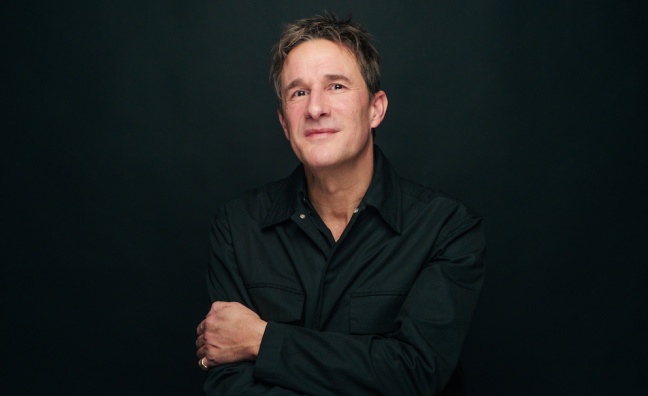
Following previous roles as Ivors Academy chair and Featured Artists Coalition co-CEO, Crispin Hunt has recently been elected president of the PRS Members’ Council.
As the former Longpigs frontman gets started supporting fellow songwriters, he outlines priorities including AI regulation – arguably the biggest issue of the moment – unearthing UK talent and fixing the data problem in an extended online version of his Music Week interview…
You’ve served at various trade bodies over the years. Why were you keen to take on this role?
“I’ve been working to represent our community for a long time now. I love PRS, it’s an extraordinary organisation. Collecting societies are fantastically important, more so now than perhaps they’ve ever been, because there are a lot of challenges to the livelihoods of its members. I’m completely excited to get into helping our membership and our community try and navigate all of the complexities of the modern music business.”
What does it mean for you personally to be able to represent the membership of PRS For Music?
“PRS is incredibly progressive and fantastically transparent, but we have a vast membership and we need a conduit between the membership and the organisation. It’s very important that there is a writer who’s a go–between for the membership and the organisation. So it’s a great responsibility, and I’m very humbled to have the chance to do it. If I have any kind of hope with this role, it’s to challenge the perception, which is unhelpful, that PRS is ‘the man’ because, really, we’re the people. I’ve had a long career in music and the only [organisation] that’s kept me alive has been PRS. So I’m very grateful to it, as a writer and as an artist.”
Have you got a sense of the members’ priorities?
“I’ve got a lot of very clear ideas. But what I want to do first of all in this role is go out and ask the members what they need us to do. I know that AI is a concern, data is a concern, buyouts are a concern and streaming revenue is a concern. There are many concerns in our community and we can address those. I really look forward to getting stuck into that. There are also personal issues that the writers need us to deal with. I very much look forward to making PRS members understand that we’re a community and we should look after each other.”
How can you create that closer connection?
“The PRS Connects [series of events] are incredibly important initiatives. I also think that the Members’ Council should hold surgeries so we can meet people, and it’s essential that they’re not just within the M25. Our membership is global, so we’ve got to go out and listen to what people’s concerns are. PRS is a very big organisation, and with 175,000 members it’s difficult to make sure that you’re attending to every single member. The membership team is superb and works incredibly hard, but I hope it will be really useful to have a fellow writer that [members] can contact. I intend to be open to writers contacting me directly and making sure that they can have a voice for their concerns inside our organisation.”
Do you think there’s a case now for greater collaboration between global collecting societies to better protect songwriters?
“I certainly do. I think there’s going to be a need for societies to work together. There’s going to be an awful lot of duplication going on at the moment where societies in different regions are spending a lot of money – and fundamentally that’s writers’ money – on building different versions of the same technology. And that seems counter-intuitive really, it’s not for the greater good
“I've been spending a lot of time working with an organisation called CIAM, which is the writers’ annex of CISAC. I know CISAC very well, they're doing a fantastically good job, but I hope to be able to support them in bringing people together. I know a lot of the writers from different societies all around the world, and traditionally, there's been a sense of competition. We've got to remember that, fundamentally, we're allies – we're not competitors. We've got bigger fish to fry than each other. There are large fish coming after our livelihood, so we need to have some very definite unity. I've already done an awful lot of work through CIAM on an international basis. Music is a business of relationships, and I really hope I can use those relationships to help build better trust within all the societies, and confidence that we can help each other out and that we're not out to eat each other.”
Technology is a wonderful thing – but we've got to be careful
Crispin Hunt
Following the UK streaming inquiry and various reforms, do you think the value of the song within the ecosystem has been recognised?
“That was a really interesting time for the industry. I’m a songwriter, so obviously I would like to see songs get a commensurate amount of the value that there is in music. PRS is striving as hard as it possibly can to maximise the value of the rights that we have. But it’s a really difficult environment. There’s a lot of value in music at the moment and some recalibration would be helpful.”
PRS is part of the newly launched Creative Rights In AI Coalition. Is this a key moment for music?
“We’re at a real inflection point. AI is going to be an extraordinary and amazing tool. I don’t think that the creators of the world are contesting technology at all. What they’re contesting is exploitation. With a little bit of sensible regulation, we can reach a point where both creative industries and AI technology using creative industries’ work can flourish. It should be a partnership. It’s especially important in the UK, because we are very good at being creative. We punch above our weight. We have fantastic authors, filmmakers and musicians. We lead the world. And I think it’s very short-sighted of the British government to allow the copyright industries to be disadvantaged for the sake of a technology that we don’t yet know is going to benefit the UK.”
How worried are you?
“I’m not too worried about it, because I don't think music is maths. I think if music were maths, there would be millions of Mozarts who’d studied Mozart. But, you know, music can be described by maths, but music is magic, and it will be dangerous to humanity if we lose that magic. That's my sort of philosophy.”
Will you feed into the debate on behalf of members?
“I hope so. PRS has a very big voice within all of these debates, in any case, and that's really important, because we represent a huge amount of people, and we also represent huge amounts of their rights. Copyright has been sullied a little bit. But actually copyright is a creative worker’s right. It's not a battle between the copyright industries and Silicon Valley. It's about the people who want to have a future in being able to trade in their creativity. If we let that go for the sake of technologists – technology is a wonderful thing, but we've got to be careful.”
You mentioned the strength of UK creativity, but are you concerned about the increasing competition for UK artists?
“There are a legion of extraordinary UK artists out there. I think it’s quite a good thing that we’ve got global competition from Latin America and South Korea. We can’t rely on Anglo-American repertoire dominating the world any longer. Music is going to be far more impressive and interesting if we’ve got influences from all over the world. It’s been a difficult time [for UK talent] recently, and I don’t think we’ve been as good as we could be about enabling those talented people and finding those talented people. I think our industry is particularly brilliant at picking winners. I just think we’ve got to maybe look harder for who the winners should be, and maybe not look in the usual places.”
Finally, PRS For Music has been working on its data initiative Project Nexus. Can that help address the ongoing industry problems with accuracy of data and royalties?
“Project Nexus is incredibly progressive, incredibly vital. There’s definitely a data problem in the industry. We’ve been talking about data for 25 years, but I think now is really the time where we have to get it together. I’m very proud of PRS for taking a lead on that and there’s a lot of work we need to do with data. It’s not always an easy thing – I know this from being a writer myself – to have to ask somebody for their identifiers before you start to try and create something magic, but we’re just going to have to get used to that. There are some really good studio-based technologies that are making it pretty frictionless. The potential for extraordinary accuracy in the digital world is really exciting, but we need to capture that accuracy.”
 FOLLOW