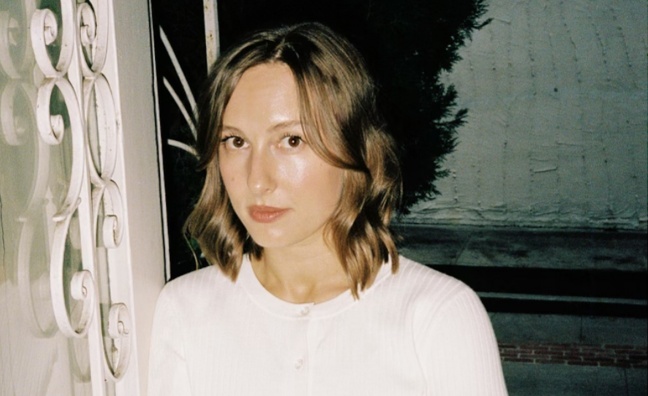
Interview by Karen Bliss
Since signing to Warner Chappell Music in 2020, life has been moving fast for Cleo Tighe.
Now based in LA, where she says people are “a little better at just being friends with everybody, compared to England”, the songwriter has spoken to Music Week about her relentless ambitious streak, which now extends to making music under her own name.
After cutting her teeth in Manchester alongside Delphic and then as part of The Six, Tighe broke out via a cut on Clean Bandit and Jess Glynne’s Real Love and his since written on tracks by Charli XCX, Mimi Webb, Kygo and Ava Max, Twice and Megan Thee Stallion, David Guetta and Kim Petras, Calvin Harris and Rag’N’Bone Man and many more.
“I love it so much,” she says of her new Californian home. “I moved here after getting divorced and I've managed to also get heartbroken twice since being here – I hate to admit that it helps with songwriting, but it does! [Laughs].”
As well as sharing plans to record her first music under her own name, here, Tighe opens up about her craft, studio life, remuneration for songwriters, AI and more.
Going back to the start of your career, wasn’t your original intention to be a recording artist?
“Yeah, it was because that's what you think when you’re a kid. But, recently, I think I need to put music out on my own before it feels like it's too late. And, I also think it would help going into rooms and be able to give other artists all of me, and if I feel like I've done something for myself as well. So that childhood dream is screaming at me recently. I've tried to tell it to shut up so many times now, but it's getting louder.”
How are your writing sessions going at the moment?
“There are so many, I'm honestly trying to do less. My mum's been kind of sick, so I went into some sort of rebellion after that and was like, ‘I don't want to work anymore. I'm not writing any songs!’ [Laughs]. I don't know if it was depression or if I was just rebelling. But now it’s back to normal, loads of sessions. And I absolutely love it. I can't imagine doing anything else. But, I think, writing relentlessly is sometimes quite strange because if you don't live, then you don't have anything to write about. So I'm trying to get the balance better, maybe three days a week would suit me and then the rest of the days I just go and live. Sometimes, I think as creatives, we can forget that living is also creative.”
That sounds like a useful idea to bear in mind…
“Yes and, also, when you're going through something, it's really hard to then tell someone else's story, when you feel like you haven't got yours out, which probably goes back to putting my own music out. Maybe I just have to do that so that I can give more to others.”
I don't think AI will ever be able to replace how it feels to be a human
Cleo Tighe
What impact has signing to Warner Chappell Music had on your career so far?
“I don't think I could ask for a better publisher. Honestly, Paul Smith [VP A&R and global creative] is like a dad to me. And when I signed to him, I had just left a writing collective and I'd also just left two different management companies. He just took me under his wing and kind of managed me for a little bit. I don't know if I would be where I am today if he hadn't just been like, ‘It's okay, we'll figure out the management thing. But, for now, let's just see what we can make work without a manager.’ That was amazing. And then when I moved to LA, Gabz Landman [SVP, A&R], she's become one of my closest friends. I moved here as she moved to Warner Chappell and she became my point person here. So now I have Paul and Gabz and they're the most supportive people I could ask for. I love Warner Chappell and I think that my career is what it is because of them.”
Have you told them that you want to put out a solo album?
“Yeah. Paul Smith is maybe the biggest fan of this idea. I also think it's rare that a publisher would care about you doing that because they're probably just like, ‘What about all the artist sessions that you need to do?’ [Laughs]. But Paul and I went for dinner the other night and he was like, ‘Oh, you've been threatening me with an artist project for the last three or four years. Can you please just do it?’ Gabz is also a huge supporter of that. I was at breakfast with her the other day and she was just like, ‘Do you want to do it?’ and she messaged a record company there and then to set up a meeting.”
You’ve written on songs across many different genres, what will your solo work sound like?
“It always just ends up leaning kind of folky and country. There must be some trapped country artist in me somewhere from a past life. I was born in London and raised in Manchester, so I don't know where that comes from.”
Have you written in Nashville?
“I have been to Nashville and I love it so much. But whenever I work with writers in Nashville, I'm like, ‘Wow, I have so much to learn.’ [Laughs], So I feel like when I'm in Nashville, I spend a lot of my time just watching and being like, ‘Okay, I'll remember that for next time.’ [Laughs] Those are the best writers I have ever worked with. I grew up loving Bob Dylan and Dolly Parton and now I'm obsessed with Kacey Musgraves. She has somehow got me through literally every turmoil in my life. A lot of the stuff I've written for myself is all about learning — learning to let go and learning to accept life and learning that the bad things in life are what you need and we all came here to experience being human, so those things are just an example of living.”
Do you have dream collaborators?
“Right now, for me to actually do it, I need to have very low expectations because as soon as I start dreaming too big, I'm like, ‘No, no, no, no, no. I can't do it. I can't do it. I can't do it.’ So, for me right now, I'm going to put something out and I'm just going to see how I feel about it. I don't need it to do anything crazy. I just need it to be what it is to begin with.I actually think my dream collaborators, it sounds really cringy, but they're my friends. I had a realisation the other day when I broke up with my boyfriend; I have so much love around me and all of these people want me to just go and do this and they can all help facilitate that. My artist project will just be a labour of love with my friends. So, for now, that's my plan.”
Moving on to songwriting more generally, where do you stand on the remuneration debate?
“I'm obviously aware of all of that and it is frustrating. It really is. I try really hard to not focus on the negatives because I live under the Hollywood sign and I pay for an apartment with my own money that comes from making music and there are people in the world that have a lot less than I do. So my life is good and I made that from making songs. Would it be nice to be paid properly? Yes, it really would. And I do think that something needs to be done about that. I would be lying if I said I didn't look at it and feel disappointed by the way songwriters get treated. But at the same time, you can spend too long in the negative and forget that it's actually amazing what we're doing. I'm really lucky to be where I am. So maybe I'm a bit naive, but I just always feel very lucky to be able to do this. Hopefully one day we'll all be paid properly. But until then, I'm just going to keep enjoying it.”
Do you worry about AI?
“As soon as I'm in a session and someone starts talking about AI, I honestly feed off other people's fear with that. As soon as someone else sounds scared about it, I'm like, ‘Oh God, we have to stop talking about it. I can't talk about it.’ But then RhymeBrain [online dictionary] is just another version of AI, really, and I use that when I can't think of something and I'll make a sentence out of whatever rhyme I choose. I think we can use it to help us. I don't think AI will ever be able to replace how it feels to be a human. That only comes from us. So I'm not too worried about it.”
Is there a particular genre that you feel is going to be the next big thing?
“I spent a lot of my university years listening to Bollywood music and the melodies and the inflections and the notes they use are just some of the most amazing melodies I've ever heard. And a few months ago, Gabz asked me if I would do an evening session with an artist called AP Dhillon. I was like, ‘I have to do this. This is maybe my dream session.’ I got there and we just had the best time, I was willing to stay forever. We did five different songs. All I had to do was melodies and he takes them away and [writes] lyrics in Punjabi. It was amazing. I know people are talking about that being the next thing. And I'm like, ‘I hope I can ride that wave because I've just been so obsessed with that side of the music world for a long time.’”
Writing on K-pop records must have opened doors for you as well?
“It has opened doors for me for sure. I didn't realize how big K-pop was. I think. I've had a song recently with Twice and Megan Thee Stallion called Strategy” that I did with my best friend Boy [Matthews], which was really fun. It's crazy how popular it is. It’s also very rewarding to do music where people still buy physical copies because you're like, ‘Wow, people actually really want to have this and hold it.’ And also, you make more money from it, which is nice.
Finally, the age-old question of representation in studios remains an important conversation. How is your experience of the studio landscape?
“I have so many guy friends in music who make me feel very special. It's rare that I go into the studio and feel like a woman, but when you are in a room of men that treat you like a woman, you notice. I also think it is good that you notice, because it means it's not happening all the time. Sometimes I feel like I was the woman put in the room so that I could demo the vocal for the song that the men want to write and that's frustrating. Also, unfortunately, men just don't always know they're doing it and they want their own ideas over a female's idea. But I think 90% of the time, I feel like an equal in the room.
“The thing I would say that actually is really bad – and I don't know if this will ever go away – is that the competition between women is really bad. I mean, I have so many best friends that are women and who are songwriters and we all have the same conversation, which is that it always feels like there can only be one of us. It's always, ‘Oh, she's the next Julia Michaels’ or whatever. Nobody ever says that about a guy, ‘Oh, he's the next Ed Sheeran,’ or, ‘he's the next Lewis Capaldi.’ But with a female, she's the next this or that. Why can't there just be more of us? Beyond even competition, that creates an energy that we can't all have it. And that's sad because it's not true, I think that's a feeling created by a man.”