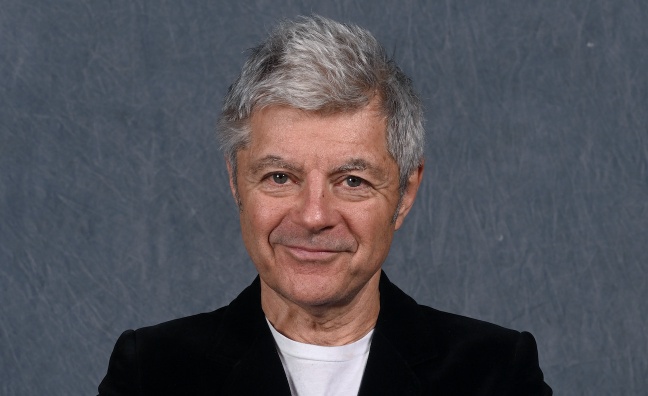
Music PR godfather Alan Edwards has shared anecdotes about superstar clients David Bowie, Mick Jagger and the Spice Girls as the paperback of his memoir, I Was There, hits the shelves.
The founder and CEO of public relations firm The Outside Organisation, Edwards has worked with a who's who of entertainment royalty also including the likes of Prince, Michael Jackson, Amy Winehouse, The Who, Luther Vandross, David Beckham and Naomi Campbell in his 45-year career.
Here, he looks back on how it all began, revisits a handful of his most unforgettable celebrity encounters and reveals his one nagging regret...
First of all, what compelled you to write the book?
"I saw a very early Bowie gig on the Ziggy tour with 150 people and I realised it was some sort of cultural history. In that era, you were seeing incredible new bands literally every day of the week so I thought, 'I'll write it down' and then I crafted it into stories over the years, which I often used on press trips or hanging around in hotel corridors with journalists waiting for people to turn up. Everyone said, 'You must write a book.' So finally, I thought, 'Let's get on with it!'"
How emotional was the writing process?
"There are two things about the process. On the physical side, it was a lot of work and I put down some stories about three years ago – I had my favourite Robbie story, my favourite Spice story, my favourite Who story – and then I built the book around the stories. The first draft was much too long; it was 170,000 words and I had to chop it down, so it wasn't the most efficient way. But it was quite an emotional experience, because you reflect on things and you look back and you think, 'Maybe I could have done that better. Maybe I should have been more sensible.' And then you have moments where you're quite sad, because you realise a lot of the people you worked with are no longer here. But overall, it was a happy and wonderful experience.
"It meant that I dug into, for instance, my punk roots, so it was really nice reconnecting with Hugh Cornwall, the Pistols, The Damned and all those people from my past. I was talking to them and double checking things and we all realised how much we had in common and what a great adventure we'd all lived."
What was the music PR world like when you entered it?
"Firstly, I worked for Sounds and Record Mirror, which were music papers, and my very first job was selling some ad space for them. I managed to progress to reviewing all the pub rock bands: Dr Feelgood, who I saw hundreds of times, Kilburn And The High Roads, Average White Band. No one else seemed to want to be at Dingwalls at two in the morning so I got to go to all these shows and I was loving it. I was never going to bed, and I was seeing a great act every night of the week. Then Keith Altham offered me a job. Keith was the doyen of PRs and he looked after half of Woodstock: The Who, Eric Byrd and Alvin Lee, Marvin, Mark Bolan, etc.
"I wasn't exactly overpaid, but Keith was quite old fashioned in a way. He was a real stickler and I had to be there bang on time every morning. But there were only, as I remember it, five or six PRs. It was a cottage industry, if that, and it had come over from America in the '60s. You had people like Andrew Loog Oldham, who'd obviously been an incredible quasi manager/PR, and then later on, Malcolm McLaren in the '70s.
"When I started working for Keith, I was possibly dealing with 20 publications, whereas now you're dealing with hundreds in a day and, of course, it wasn't international then. Keith would send me out with a box of records and say, 'Take them around the papers.' I'd go to all these publications and sit down with a couple of people, play the record on a turntable, examine the sleeve, discuss it, have a couple of cans of beer and then go on to the next paper. Keith wouldn't expect me back for a few days – and God knows what state I'd be in by then – but the job was totally manual and it had a very different charm."
I accidentally became a pop guru and ended up representing every pop group that moved
Alan Edwards
Do you have a favourite era?
"I've got a few favourite eras to be truthful. The punk era was fantastic because I was at the crossroads of everything and it was so exciting working with your first bands: the Guildford Stranglers, who then cut their hair and became The Stranglers. I came up this idea of doing a fanzine and I seemed to go to every single gig; it was like being part of the band, so the whole process was great. And then I was suddenly repping Blondie, Buzzcocks and The Damned. I thought this was the Storming of the Winter Palace and that everything was changing. It wasn't just a job. As well as the great music, I was really emotionally involved.
"In the '80s, I got hired by Jagger and the Stones and then, of course, Bowie going into the Serious Moonlight tour, so that was another level and suddenly you're working with acts that are global. David was a pioneer and so were the Stones – they were playing stadiums all around the world. Everybody does it now, but it was thrilling to be on that wave in the early '80s.
"And then, again, the Spice Girls were great fun and I accidentally – a bit Forrest Gump-style – became a sort of pop guru and ended up representing Westlife, Ronan Keating, Atomic Kitten, All Saints, every pop group that moved. I was very much in the back room working as more of a management consultant with David Bowie at that point and the last thing I really wanted was to be on this pop circus. But of course, it happened.
"[Then Virgin Records boss] Paul Conroy hired me, and within 24 hours, I was flying out to Rome to see the group and I remember I got a call from my then lawyer who said, 'Alan, what are you doing in the Via Garibaldi?' And I said, 'How do you even know I'm in Italy?' He said, 'It's on Sky News, they're tracking your progress for a meeting with the Spice Girls.'
"In the next 48 hours, we went shopping at Gucci in Paris, as you do, then to a disco in Madrid, all on a private plane. It was like being with The Beatles: everywhere you went there were screaming crowds and photographers. And of course, I pretty quickly got down to the serious business of getting the media working, because they'd been very protected up until that point. I was convinced that each of them, individually, was really smart and fun in different ways, so I started arranging for journalists to meet them one on one. So it was a very long answer, but I can't say there's one phase that I've loved more than others. I'm lucky – they've all been great."
Why do you think you hit it off with David Bowie?
"It's hard to know, isn't it? It's just like life: you can know some people for 20-30 years and there's not much of a relationship. But with David, we seemed to just click. One thing that we had in common was books. He had this lust for life, to quote Iggy, and I suppose I had the same and was a vociferous reader, so we were always exchanging tips about new books. He was really into things like Peter Ackroyd and I'd come up and say, 'Have you read Jake Arnott?' So we had this whole relationship based on that.
"I went out on the first really big tour with him, Serious Moonlight, in Australia. And Australia was a long way away in those days because you didn't have social media, so you were out of contact with the UK. Phone calls were very difficult because of the time difference and I felt I was a slice of London for David. He was always saying to me, 'What's going on? What new bands are happening? Who's playing in Soho? What's this journalist on the NME think?' I was almost a walking newspaper."
It's quite funny to say, but Mick and David taught me an enormous amount about PR
Alan Edwards
You played a key role in landing Bowie's famous Glastonbury 2000 headline slot. How important was that performance to his legacy?
"Oh, it was completely pivotal, a watershed moment. In that period leading up to Glastonbury, David had been quite happy just doing albums that he wanted to do, like Outside [1995] and Earthling [1997]. He loved touring. Being on the road, I think he was always at his happiest – there was a certain anonymity there and he just loved being a musician. And he was recently married to Iman, so his life was really good and happy and comfortable.
"Along with [agent] John Giddings, I dropped a story in the Sunday Times. It was supposed to be a speculative paragraph about Bowie playing Glastonbury. Nobody really wanted it, including David and Glastonbury, but it went big in the paper and they had a meltdown with the phones at Glastonbury. Everybody knew the name Bowie and it caught everyone's imagination. I think it was the biggest Glastonbury they ever had because the fences were a bit flimsy.
"David, on the day, was actually very relaxed and realised he had to do the greatest hits. It wasn't going to be okay to experiment with new songs, so he got in the zone and went and did it. I ended up on the stage because there was a dispute going on with the BBC about how many songs they could film, so I was there wrangling a few feet away from David. And then you look out and it's like the Battle of Agincourt: crowds disappearing on hills, banners as far as you could see. I remember David walked off stage that day, and it was almost as if he didn't know where he was. It had been an out of body experience.
"About three days later, I was walking around London with him and everything had changed. He was David Bowie the superstar again and I guess he was energised by it, and so were the audience. It was one of those moments where generations came together and realised [he was] probably the greatest British solo artist of all time. It meant that everything was different for that latter phase of his life."
And Mick Jagger was something of a mentor to you, also?
"Yeah, he was, both he and Bowie. Mick taught me this thing of really being prepared for interviews. He'd essentially want a dossier on the journalist he was talking to, so he'd want to see the last two or three features they'd written, which was a lot harder then because you couldn't just Google it. I had to cut them out of magazines and post them to him. When we were out on the road, he'd want to know what people were thinking of the show straight afterwards and registering it all, and maybe reflecting it in the set list.
"I had to be at the very top of the game with Mick. He was always very charming and great company, and [knowledgeable] on anything from the latest England football match, to politics, to a new band coming up. He and Bowie had a lot of similarities in that respect. Although I learned a lot from Keith Altham, and there were others like Harvey Goldsmith and Shep Gordon along the way, it's quite funny to say, but Mick and David taught me an enormous amount about PR.
"I remember in about 1982, there was a press conference at Le Beat Route in Soho. Soho was a bit more off limits those days – less touristy and a bit edgy – and Le Beat Route had been part of the new romantic scene. The press conference was happening there for, I guess, the '82 tour and it ended up with Mick introducing me to the journalists and I was laughing afterwards thinking it was supposed to be the other way around. So I learned incredible lessons from both of them. What a privilege. It wasn't like I'd gone to school, but in retrospect, that's exactly what it was. They trained me."
Yungblud is in that mould of the Bowies and Jaggers. It's not a job to him, he's living it
Alan Edwards
Switching to an artist at the opposite end of their career, you recently started working with Yungblud...
"I'm always interested in new artists. There's not a day that goes by where I haven't got a link or a tape, but I think it was last summer that I met Yungblud. We ended up talking about every kind of subject and I was so impressed by his passion, his energy, but also his free thinking and innovative ways. At the end of the meeting, I said to him, 'I've been waiting to have this meeting for years,' and he said, 'What do you mean?' I said, 'Such an exciting and different artist, not just doing it by the book.' And of course, I'd heard the new music too and his new album's a double album, so it's so fresh and so brave.
"It reminded me a little bit of Bowie. When I started working with Bowie, it's hard to remember, but he was a massive cult act at that point. Low and Heroes had come out, but I think Low had only sold 100,000 copies and he'd actually been dropped by the label, so I was involved just pre-Let's Dance coming out. So he went from being one of the coolest cult acts in the world to superstar, and it's an extraordinary experience. And I kind of felt that with Yungblud, it feels like he's on the cusp of real greatness. His work ethic is incredible. I've been lucky to work with some really brilliant, creative people and one of the common factors is that they live it and every day of the week, every week of the year. Yungblud is in that mould of the Bowies and Jaggers. It's not a job to him, he's living it."
Away from music for a moment, you're credited for helping to create Brand Beckham. At what point did you realise David Beckham could transcend football?
"Straight away, really. Victoria had introduced me to him and I went up for a meeting. He invited me back to his digs, which was where footballers used to often live in those days with a landlady. They weren't on a million pounds a week from day one. I don't know if it was Salford, but having come from London it felt like I was in a Hovis ad, with cobbled streets and things like that. Just to put it in context, I remember David didn't have enough money and asked me if I had any coins for the meter to put the lights on. And then he said he'd prepare dinner and we couldn't find a can opener for the baked beans.
"I'm sitting looking out the window – I think it was December – there's snow swirling and I'm thinking, 'What am I doing here? How quickly can I make it to Piccadilly to get the train back to Euston?' And then David started talking. Now, I had worked with a couple of players before then and it had always been about, 'Can you get me into such and such a club,' or 'I'd love to get this suit from Paul Smith.' But David said, 'I've got a vision for football. I hate homophobia, I want to campaign against that. Racism is an anathema to me, I'll do anything I can to help stamp that out. I'm very interested in women's soccer, I think that can grow exponentially. I can also see a big future for football in America.' And I'm sitting there, my jaw's hit the floor and I'm scribbling this stuff on the back of a cigarette packet.
"He had this entire vision and it's so prescient. It's as if he was prophesying all that and I was in a state of excitement. I got on the train back to Euston and I just knew that I'd been in the presence of some sort of greatness. Now I'm not talking about his ability with his feet and all of that, which goes without saying, but wearing a PR marketing hat, it was pretty obvious this was someone completely different to everyone else."
I don't know that the industry values storytelling as much as it did. I think the world values it more than ever
Alan Edwards
What about disappointments, does anything stick out from your career?
"U2 – how I didn't sign their publishing for £4,000. I went to see the bank manager, Mr Graham, at Natwest in Archway Road and I remember him peering through his glasses imperiously, 'You want to borrow £4,000 to sign a pop group and you've got a £3.50 overdraft. Are you mad?' So I couldn't raise the money, and for many years I hoped it had just been a figment of my imagination because it used to keep me awake at night, I was very depressed about it. But I bumped into Paul McGuinness a few years ago and the first thing he said to me was, 'Do you remember when you could have signed the group's publishing for £4,000?' And I realised it had actually happened."
Are there any good Prince stories you can divulge?
"Oh my god, loads. What an enigma he was. Prince was actually very shy and found it quite hard to talk to people. He often really struggled to do eye contact. I'd be called for meetings on occasion, and he'd be looking at the floor, or he'd address the questions to a member of his entourage.
"I was there for nearly all of those 21 shows at The O2 [in 2007], plus there were shows at the Indigo and rehearsals before, and they were some of the greatest concerts ever staged in London. A lot of the time, Prince wouldn't really talk to anybody, but when he did talk to you it was for a long time. One night he said to me, 'Do you want to come for dinner?' And he'd invited Rob Hallett as well, who was the promoter. So we go to the Dorchester and sit down in the restaurant. Rob's got a big plate, I've got a medium plate and Prince has got this tiny little bowl with a few morsels on it. Then we go upstairs to his room and he decides to change.
"We're on the internet and he's looking at some stuff about Egyptology. And we spend an hour up there. Then he decides he wants to go to a club. He wants to go to Boujis in Kensington, so he changes again – this is the third change of clothes by now. We go to Boujis and I'm sitting in the VIP room with Prince. He didn't drink. I mean, maybe he's drinking a Diet Coke, but there was no alcohol that I remember.
"By now, it's four or five in the morning, and Prince is talking further about Egyptology so I thought, he's my client, I better start taking notes, even though we were in semi-darkness. So I get out my notepad and start scribbling and it's pretty unintelligible. And then Prince comes around to me and he stops and looks down at my writing. I think, 'Oh my god,' but he says, 'Alan, that's a funny thing. You write exactly like me. You write in hieroglyphics too, don't you?' I said, 'Yeah, absolutely. That's what I do!'
"But what a great artist. I'd love to see a Prince film or documentary. I don't hear enough about him, because he really was a genius. I was lucky enough to sit in on those rehearsals and he'd be playing 16 or 17 instruments. And then you remember he'd written the songs and is performing them and dancing. They had 150 songs rehearsed for those shows. He was a veritable Mozart, one wonderful, wonderful artist."
How would you sum up music PR in 2025?
"The industry has changed out of all proportion and sometimes I do feel like the gatekeeper without the fence. It's now so fast and it's so global, but I still think the essence of it is storytelling and in some ways, this is a golden age for PR, because I can be putting out a release about a Nick Cave show and within minutes I'm getting a call from someone at the Sydney Morning Herald or the San Francisco Chronicle, so you can really shape things.
"At the end of the day I'm happy working on all kinds of platforms; I'm as happy on Instagram as I am dealing with the Daily Star or Music Week. But it's still, in essence, can you shape a story? Does it hook people in? Does it catch people's imagination? I don't know that the industry values storytelling as much as it did. I think the world values it more than ever."
Lastly, what do you hope people take from reading your book?
"It's not just my story really, it's the story obviously of the musicians, but also agents and managers, other PRs and especially journalists, and we all had the greatest fun. We were privileged to see brilliant music, often to 50 people in a pub and that sort of thing. But I also talk about some serious subjects; I talk about mental health in music and things like that, so I hope people get a lot out of it.
"These were the greatest of times and I'm still doing it and still living it, so I'm sure there will be many more but hopefully this captures the atmosphere of having been there for the last five decades."
I Was There: Dispatches from a Life in Rock and Roll by Alan Edwards is published in paperback by Simon & Schuster
PHOTO: Dave Hogan