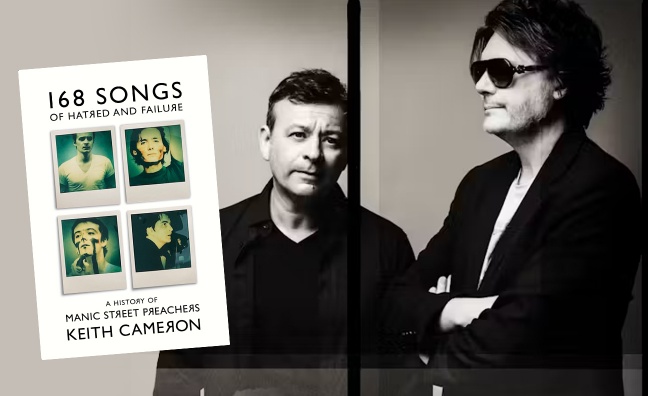
One of the best music books of recent memory arrives today.
Released via White Rabbit, 168 Songs Of Hatred And Failure: A History Of Manic Street Preachers sees highly-respected journalist and broadcaster Keith Cameron join the band to trace their triumphant, often heartbreaking story through the years. It does so, however, through the unique lens of 168 key songs in their catalogue. It's a deft decision that not only illuminates their career, but also the many historial and literary tributaries that have informed their art.
“Every single Manics song is about ‘something’, and a great many are portals to hidden or unsuspected worlds of art/literature/politics,” Cameron tells Music Week.

With this approach, Cameron – a contributing editor at MOJO, with a rich portfolio including bylines for Sounds, NME, Guardian, the Times, the Sunday Times and more – offers revelations as the band join him to charter a course from their rise to fame, the devastating loss of their talismanic guitaritst/lyricist Richey Edwards, and beyond. Not only will readers encounter stories involving a host of familiar industry faces, from the much missed Philip Hall to their crucial ongoing relationship with Rob Stringer, you’ll also find out about Nicky Wire’s profound hatred of Chelsea FC, and the chippy-tastic reason James Dean Bradfield once diverted their tour bus from Swansea to a Brigend housing estate.
A lot of the music the Manics have made since their big commercial moment has slipped by relatively unnoticed, which as a fan seemed unfair, as I consider that their 21st century output is some of their best
Keith Cameron
Another huge strength of the book – a credit to both Cameron and the band – is the unflinching candour on display throughout. Be it the Manics opening up about dealing with failure, lyrics they regret writing or the loss of people closest to them, the admissions contained within distinguish it from so many of the safer, band-sanctioned projects out there. It is little wonder Nicky Wire had said, “No-one understands the inner workings and shared aesthetics of Manic Street Preachers like Keith Cameron: the humour, the misery, the eternal doubt, the culture-alienation-boredom and despair.”
Suffice to say, 168 Songs... will offer essential reading to hardcore Manics fans, but it also serves as a brilliant moment for reppriasal for everyone else, particular in the way that Cameron treats their latter day material with the same respect and forensic detail as classics like A Design For Life and Faster.
Here, Cameron takes us inside how the project came to be, how the band got onboard, and reflects on the legacy of the Welsh titans...

Author Keith Cameron (Photo: Steve Gullick)
First off, congratulations on the book. The obvious place to start is: how does the idea come together as a book with the Manics actually onboard?
“In 2018 my agent gently pointed out that it was five years since my Mudhoney book [Mudhoney: The Sound And The Fury From Seattle] came out, and I realised I really ought to get another on the go before I forgot how these things were done. He asked who I’d interviewed most over the years, and I reckoned it was probably Manic Street Preachers. I had enough archive material to do a book right then, but didn’t want to undertake a project of that scope – I wanted it to go deep and do their art justice – without new input from the band. I emailed their manager Martin Hall, who basically said, ‘Sounds great, you’ve got their numbers, ask them.’ I called Nicky and he said, ‘Yes.’”
In your intro you observe that there’s a sense “that the Manics’ musical achievements are taken for granted, a byproduct of the fact that they never broke up, even at a time when their situation appeared utterly broken”. Was this the main reason why their story was in need of being restated so emphatically?
“That was definitely a large part of my motivation to do a Manics book. Longevity in any sphere of life isn’t very exciting. As we grow old, we tend to become less visible. Pop music is no exception – in fact, it’s probably more extreme, because pop is all about the new and the now. Bands who stick around a long time tend to become part of the furniture and people just tend to assume they’ll always be there. I felt that with the Manics, a lot of the music they’d made since their big commercial moment had slipped by relatively unnoticed, which as a fan seemed unfair, as I consider that their 21st century output is some of their best. Their music has always been very distinctive, even when they’ve been in the throes of self-reinvention. The Manics have some singular musical characteristics that are baked into everything they’ve done: James’ voice, an uncanny sense of melody, and a questing intellectual energy.”
You could have approached this as a normal band history but instead you elected to tell their story through a detailed account of 168 songs. What was it about that approach that appealed to – and quite possibly terrified! – you?
“I didn’t particularly want to do a straight biography, partly as it would have meant turning over ground that had already been well covered by previous books – in the case of Simon Price’s Everything, brilliantly so – and also because my agent suggested the market for band biographies is pretty much saturated by this point. To be blunt: a less conventional approach would be more likely to get a better publishing deal. Because I wanted to re-focus attention onto the Manics’ music, a song-by-song approach made sense. The only question was, how many? My initial idea was to do 70 – because there was an aborted Manics album project that had the working title ‘70 Songs Of Hatred And Failure’, and I always thought it a shame that had never got used. Nicky agreed it was a good idea to use that title, but insisted we change 70 to 168, because it has significance in Manics lore, thanks to the Motown Junk lyric: ‘Stops your heart beating for 168 seconds, stops your brain thinking for 168 seconds.’”
What song – or songs – improved most for you, personally, after you took full stock of what the band had to say about it?
“There are lots, but I’ll mention one. Let Robeson Sing had always struck me as a fairly modest, tasteful approach to a worthy subject. Beautifully done, but quite dry. Yet that point of view illustrates how I was guilty of taking both song and its subject for granted. In properly listening to the song for maybe the first time, and then talking to James and Nicky about it, I felt its true power, and came to appreciate the scope of Robeson’s life and achievements – his radical socialist activism, his bravery during the McCarthyite era – as well as his profound connection to the workers movement in Wales. He was one of the most important figures of the 20th century, and the song awakened me to that. Plus, I also discovered a link between Robeson and Richey Edwards.”
Understandably, the vivid, often funny, sometimes deeply upsetting, recollections of Richey that are shared will be a big focus for some. What did you learn about Richey from writing the book?
“Hearing them talk about Richey in the context of his words and the band’s music helped remove him from the media realm of tragic myth and honoured him both as an artist and a person. It emphasised that he was both funny – humour is a huge and underacknowledged part of the Manics’ psyche – and fiercely self-aware, even amidst his lowest moments: the album Journal For Plague Lovers is testament to this. On a specific level, it was good to finally clear up the mystery of whether he is or isn’t on No Surface All Feeling – that song’s genesis has puzzled me for a long time.”
The accounts of bringing the Journal For Plague Lovers project to life and turning Richey’s unused lyrics into songs was fascinating – it was such an emotional process for them to go through. Where do you stand on that album personally?
“The interviews for those songs were the most difficult for James and Nicky – it took them back to a very painful time. Those songs clearly speak to the dire situation Richey was in, yet still he was driven to create, and that album is the greatest tribute they could pay to their friend.”
Throughout the band’s life it seems there were certain pivotal and make-or-break career moments. What in your mind was the crucial decision they made, or direction they took, that means that they’re still here today?
“I know it sounds perverse, given that the record has become synonymous with Richey’s internal politics, but I think the reason they’re still here today is The Holy Bible. If they’d followed Gold Against The Soul with another attempt at commercial expedience, rather than following their truest artistic impulse, I’m not sure how many more albums there would have been.”
This is one of those rare rock books that paints a band’s label in a positive light. Sony’s Rob Stringer is a recurring character in it championing them and there’s that beautiful moment when they finally revive and finish My Brave Friend in memory of their late Sony product manager Jim Fletcher. Were you surprised at just how integral the label has been in keeping them afloat during the worst times?
“Not surprised as such, because I’d spoken to them often enough to realise how intensely they – and Nicky especially – connect with the logistical reality of being a rock band. Having Rob Stringer in their corner definitely helped them out of some dicey situations, but then again he saw The Clash when he was at uni, and they share the enthusiasm of true believers.”
Returning to that earlier notion of Manics being “taken for granted”. One of the most striking things to me is how you breathe life into their most recent years – and highlight that so many of these songs have stories worth digging into. Which of those songs (or albums) do you think deserve to be revisited and held up like some of their more familiar classics?
“I think Futurology will one day come to be recognised as one of their greatest albums. And from that record: Between The Clock And The Bed and Europa Geht Durch Mich are classic Manics, inasmuch as they’re clearly influenced by the band’s musical heroes, yet incomparably their own work.”
Finally, it would be remiss not to ask: of the 168 songs here, if push came to shove, which one would you nominate as your own personal favourite?
“An impossible question, but if I can only have the one… Faster. It still thrills and scares me every single time.”
168 Songs Of Hatred And Failure: A History Of Manic Street Preachers is out now and can be ordered via White Rabbit here.
 FOLLOW