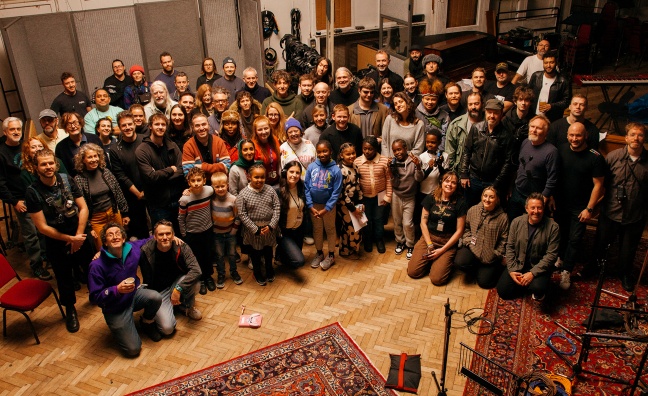
When Ian McAndrew stood on stage at the Music Week Awards in May last year and announced that he was planning a new album to raise money for War Child, he had no idea what was about to happen, not really.
The Wildlife Entertainment CEO (pictured above in Abbey Road with the Help(2) crew) had just received The Strat award, presented by Alex Turner of the Arctic Monkeys, who surprised his manager on the night by turning up to hand over the trophy, flanked by McAndrew’s esteemed colleague Emma Greengrass.
What’s happened since has left McAndrew and the rest of the team that has worked on the Help(2) project in something of a state of disbelief, not least because James Ford, who was enlisted as executive producer for the record, fulfilled his role while battling leukemia, attending sessions via video call, often from a hospital ward.
 Alex Turner, Emma Greengrass and Ian McAndrew at the Music Week Awards
Today, Help(2) – the 23-track album featuring an all-star cast including Arctic Monkeys, Olivia Rodrigo, Fontaines DC, Damon Albarn, Graham Coxon, Pulp, Wet Leg, Sampha, The Last Dinner Party, Cameron Winter, Kae Tempest and many more – is set to debut at No.1 in the compilations chart, 25 years after its Britpop-powered predecessor also rocked the industry.
“When you've had the privilege that I have to work in a business like this for as long as I have, you get to a point where you think you've got to step up,” McAndrew begins, as Music Week encounters him in his office during release week. “You’ve got to step up to use that opportunity, that platform, to do something positive. And what you learn is, as these opportunities present themselves, you've got to step up a bit more.”
Released on War Child Records with operational support from Beggars, Help(2) – which also features a contribution from Oasis in the form of a seven inch live recording of Acquiesce from last year’s Live ’25 run – was recorded largely at Abbey Road, where sessions were filmed by the project’s creative director, filmmaker and Academy Award Winner Jonathan Glazer, whose team handed the cameras over to a group of young children.
The creative around the campaign, says McAndrew, was part of a plan to approach Help(2) “like we would do a major artist project”.
“The streaming income that flows through the long tail is the thing that provides a more reliable flow of royalty earnings, supports the charity, and provides a much longer term benefit than in the physical business, which tended to create a huge amount of revenue or interest in a relatively short period of time,” he says. “So we're hoping that in the modern business we're in, we'll see a longer tail on this project that's going to not just raise money, but create awareness as well.”
You’ve got to step up to use your opportunity, your platform, to do something positive – and what you learn is, as these opportunities present themselves, you've got to step up a bit more
Ian McAndrew, Wildlife Entertainment
Rich Clarke, head of music at War Child, tells Music Week that the record is “testament to the collective spirit and power of the music industry”.
“Incredible things happen when we come together and maybe that doesn’t happen enough,” he says. “There are 520 million children affected by conflict right now, that's one in five on the planet. We are privileged to work in the music industry and have a great deal of influence, and it’s our responsibility to use that for good. This album is proof that we can make a difference and create something that has immediate impact and legacy for children affected by conflict.”
With A&R driven by Transgressive co-founder Toby L, alongside McAndrew, Greengrass and Ford, the sessions featured the kind of moments that would make even seasoned industry folk rub their eyes.
Olivia Rodrgio, McAndrew tells us, “turned up on the Friday to record, and James attended that session I think while he was having a blood transfusion”.
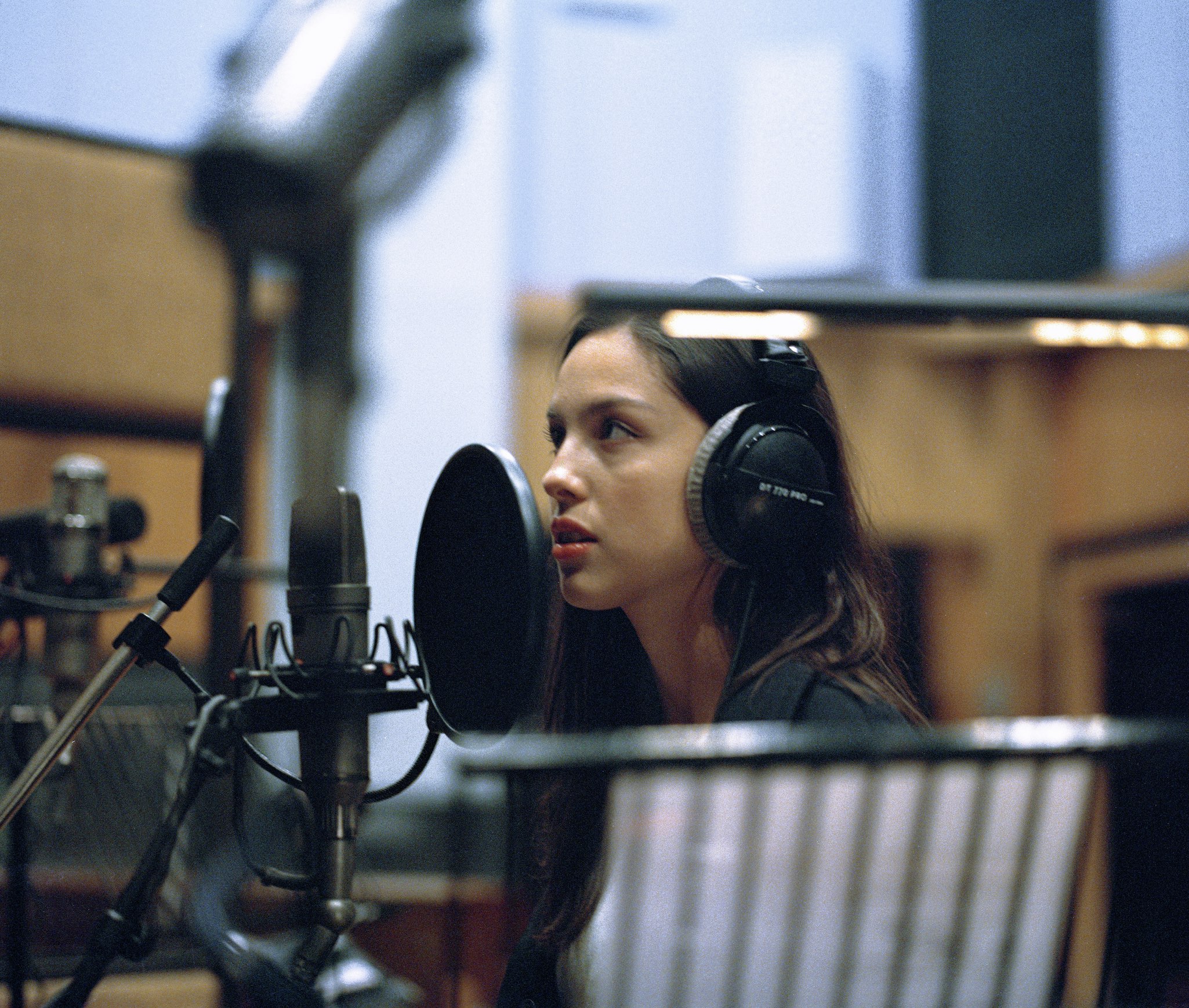 Olivia Rodrigo
“I think she'd expressed an interest in working with James, and we were able to coordinate her time in London to be when we could get her into Abbey Road,” he explains. “The whole session was recorded very quickly in the morning. It was a bit old school. It was in the big studio one at Abbey Road and there was a great band, with Ed Harcourt and Graham Coxon. They recorded live and it was all done by lunchtime. It made me think of what the Beatles sessions must have been like, very efficient and professionally done. It was amazing, actually. Olivia is obviously a huge superstar, and quite frankly, the experience of seeing her working that day underpinned why. She's a true pro and is fantastically talented.”
McAndrew – who sought advice from his old friend Tony Crean, who worked on the first Help album – also tells the story of heading to Abbey Road on a Saturday morning to meet Cameron Winter of Geese, who turned up alone to record his contribution, Warning.
Olivia Rodrigo is obviously a huge superstar, and quite frankly, the experience of seeing her working that day underpinned why
Ian McAndrew, Wildlife Entertainment
“I went down to welcome him as I don’t think he’d ever been to the studio before,” McAndrew recalls. “He turned up and didn't have anything with him. So we provided a piano, and he also wanted a cellist to accompany him and Amy Langley, who'd been working on the other recordings doing strings, agreed to come in, and together they recorded that song.”
But the first band in the studio were Arctic Monkeys, whose Opening Night is also the first track on the album, and was the initial offering released from it earlier this year. This was particularly fitting for McAndrew, whose work on Arctic Monkeys’ Live At The Royal Albert Hall – proceeds from which also went to War Child – spurred him on to spearhead Help(2) in the first place.
In the first part of our special review of the campaign, which also features Ford and numerous other members of the team who worked on the project, McAndrew traces the story of how Help(2) came to be.
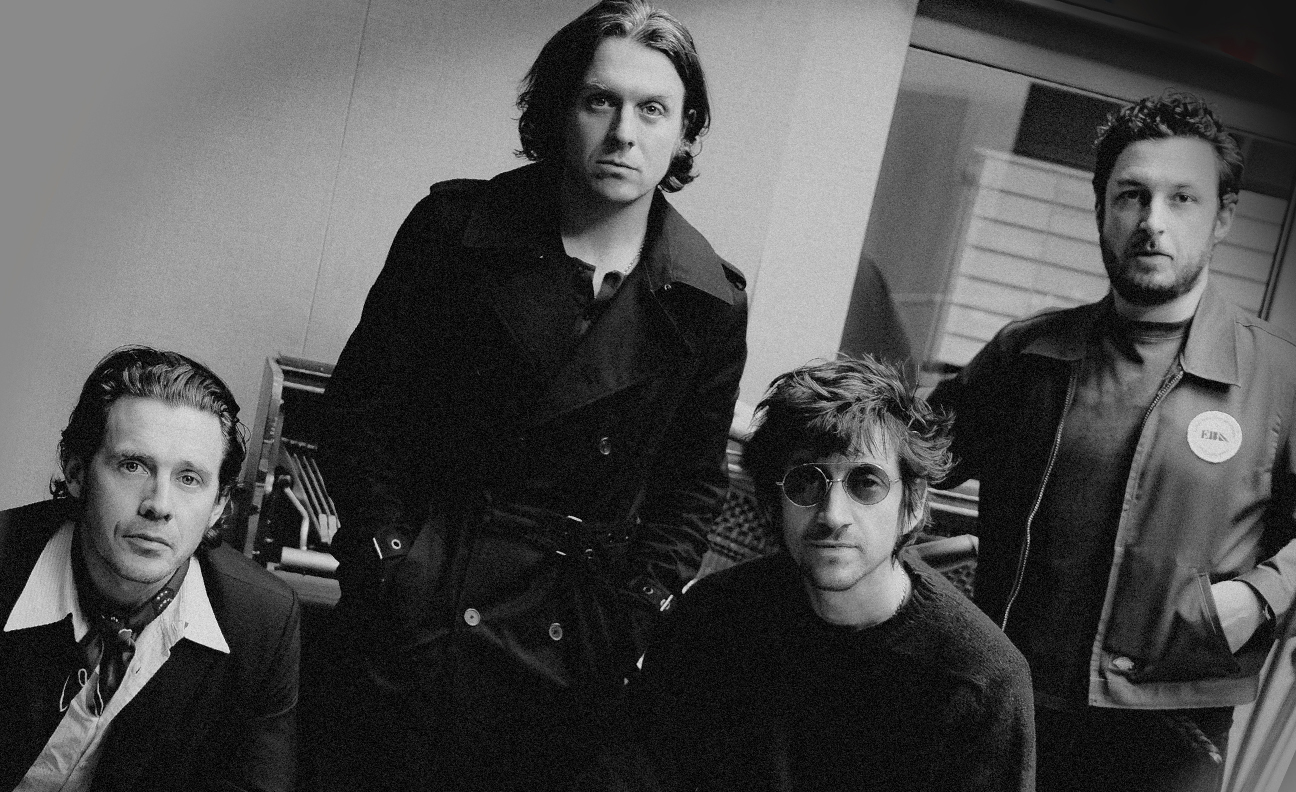 Arctic Monkeys
When you stood up on stage at the Music Week Awards last May, how far along was the album at that stage?
“It was still in its relative infancy. Originally, the plan was that we would get a record together to coincide with the anniversary of the 1995 release. James Ford had agreed to become the executive producer for a record, which was key, but soon after accepting, James was diagnosed with leukemia. Obviously it had a massive impact on James and his family, most importantly, and we wanted to pull back a second to allow him the time to assess what was going to happen. We decided quite early on that we would wait for James to get better. And so we put the record back to 2026. So by the time the Strat Award came along, James was definitely at a better place.”
What happened after your announcement to the industry that night?
“I was really making a public declaration to say, ‘Look, we're gonna do this thing, and we're gonna need all you lot in the room to get behind this, because it's gonna involve a broad industry support.’ And it has involved a broad industry support, and that's been great, actually. People have really stepped up and contributed. After the Music Week Awards, a lot of people who were there contacted me and said, ‘We heard what you said in the speech, and we just want to let you know that we're here to get involved when you need us.’ That was really touching and encouraging, because obviously there's no obligation to contact anyone after those things. And a lot of those people, I must say, have been involved in this project, people working in PR, DSP platforms. Them putting their hands up obviously then meant that we needed to get on with this thing and so the pressure to start engaging with artists began.”
Who was first out of the gate in that regard?
“In our capacity as managers, we started close to home. And of course, James Ford has been such an incredible part of our story at Wildlife. There’s Arctic Monkeys, where he’s been involved in the production of all their records. And more recently James had produced Fontaines DC’s Romance album. We started with Arctic Monkeys and Fontaines DC. And Arctic Monkeys hadn't done anything since concluding their world tour of The Car in 2023. So I contacted the band, explained the situation, and they were very quick to agree to participate. Fontaines were on tour, they were much busier with the promotion of their Romance record. But regardless, they made a commitment to be involved. Having two principal acts involved at that stage allowed us to go and approach other artists and give them the comfort of knowing who else was involved.”
It must have been handy having Alex Turner on stage with you when you announced the Help(2) album?
“I was totally unaware he was there. My colleague Emma did an amazing job in planning that without my knowledge, because Alex was abroad at that time, so he had to come in to attend. I was obviously hugely flattered and grateful, I know he's not at all a fan of standing up at award shows, so I was particularly touched that he was present on that day. I'd already planned to discuss War Child and I was happy he was there to listen to why we were doing it. I also think it made the conversation later about his involvement that much more straightforward! [Laughs].”
How did the sessions at Abbey Road develop?
“Abbey Road were fantastic. They gave all the studios for free. Originally it was a three day session but it extended beyond that and we kept asking them for more time, and they graciously kept agreeing to it. However, two or three days before the session was about to start, James’ manager contacted me to let me know that he, unfortunately, had had a relapse and was not going to be well enough to attend. Arctic Monkeys were the first band in the studio, and James actually joined via Zoom. I've got to give particular recognition to James, because he was facing huge personal adversity and a great personal challenge, and despite that he honoured his commitment to be part of something. That was really important, because I think it had the effect of making all the artists and everyone involved really step up. And it was a great experience, that time Abbey Road, and on the last day everyone went down the pub locally, and it was great having all those different artists congregating together and celebrating the moment. It was a special moment for everyone that was involved.”
Oasis obviously didn’t record their contribution at Abbey Road, how did their participation come about?
“We announced it late, but their commitment was made really early on. To be honest with you, we were mastering the record at Metropolis with Matt Colton just before Christmas, and the original idea was that we were going to include that track on the album. But it just didn't quite fit with the musicality of it, because it was obviously a live recording. We were scratching our heads and I gave a call to the management and said, ‘look, guys, it’s not quite fitting in musically.’ And Emma had this idea of making a special seven inch of it, and slipping it inside as a real sought after artefact. Because we know the fanbase for Oasis would be hugely engaged by that. They were happy to agree.”
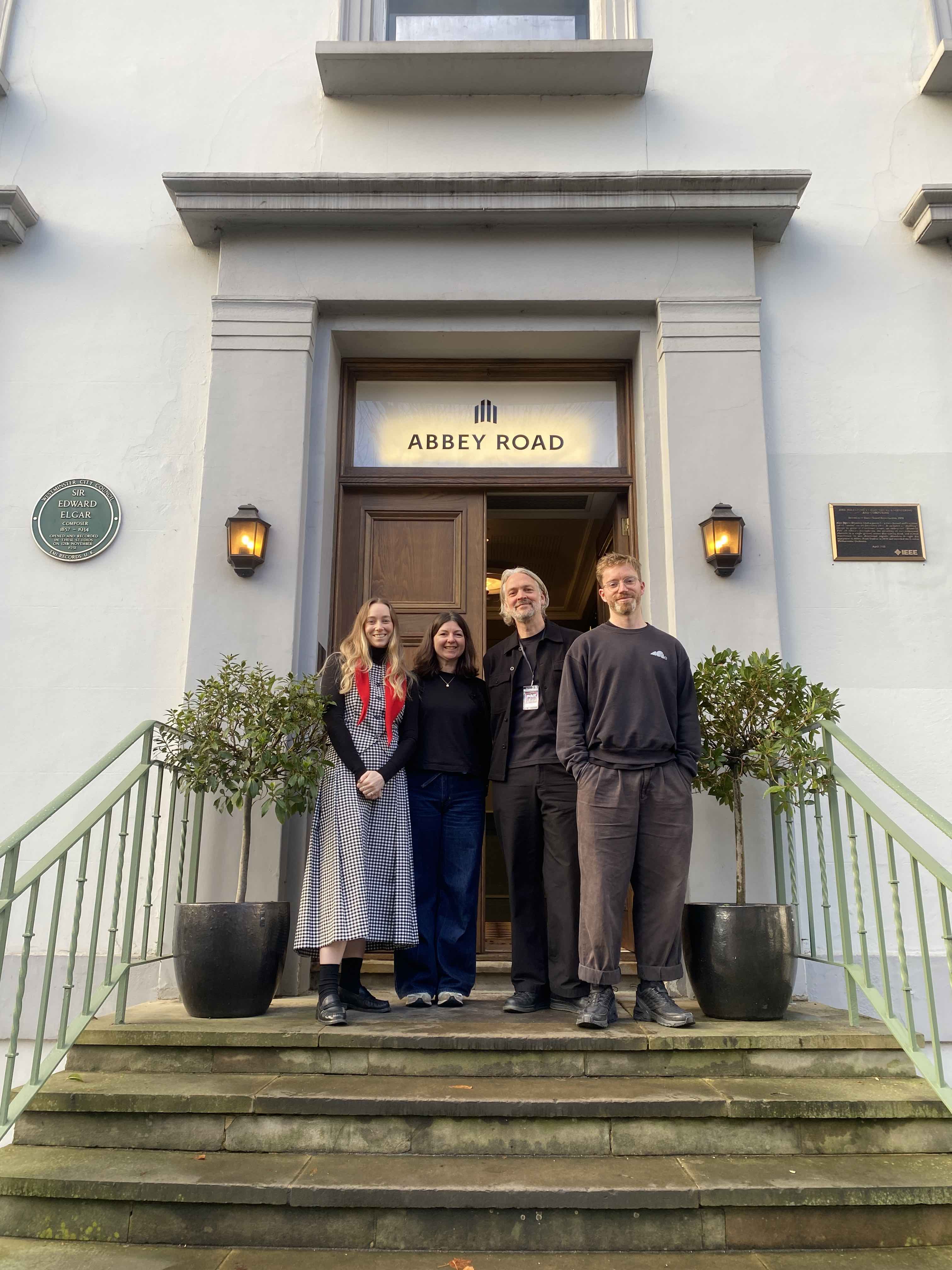 Team Beggars outside Abbey Road Studios
How did Beggars get involved?
“Domino Records were the partner for the Arctic Monkeys War Child album, and they gave up all their time, resources and everything, to make sure that the most money possible flowed through to War Child. I really enjoyed working with Domino as I always do, but on this occasion, I thought it would be a bit unfair to go back to them and ask them to do it all again! So in an effort to spread the love, as it were, while also maintaining a level of neutrality in the industry broadly, I went to speak to [CEO] Paul Redding at Beggars and it was a yes straight away. I know that Paul went to speak to [founder] Martin Mills, and then came back very quickly and said, ‘Yeah, we'd love to be partners in this.’ I said, ‘Well, it's gonna be a lot of work, and you're not gonna make any money out of it. In fact, you know, it might cost you money, but it will be a brilliant thing to do.’ And they went, ‘great.’ And they have been brilliant. That was a great decision and they've been fantastic.”
Beggars CEO Paul Redding describes the process of working on Help(2) as both “life-affirming” and “challenging”. The company has previously supported War Child through its charity committee and via donations around its 49th anniversary party last year.
What this has clearly demonstrated to me is that when we want to be, the industry can be united
Paul Redding, Beggars
“What this has clearly demonstrated to me is that when we want to be, the industry can be united,” Redding adds. “Major record companies and independents have worked together. Managers, lawyers, all elements of broadcast media, recording studios, press, DSPs, retailers and global suppliers all came together with the sole aim of making this album a success, ensuring that the maximum amount of money would be paid through to War Child.”
Emily Kendrick, general manager at XL, and consultant Helen Kennedy were part of the Beggars team driving the campaign.
“The breadth of the artists included on Help(2) and our approach speak to a desire for the project to reach beyond being too UK-centric, and the need to recognise the wider cultural and social impact,” explains Kendrick. “Beyond fans of each of the individual artist, we needed to grow the recognition of War Child beyond the UK, there was far more of the legacy storytelling to be done and we tried to keep that messaging succinct.”
Kendrick also notes "great interest from international media, from TV in Sweden, Italy, Slovenia; broadsheets in Germany, France, Spain, Turkey and the US; music publications in Japan, Netherlands, LATAM; to radio in Belgium, Australia, Mexico."
“At the beginning, we were less worried about where our content ended up and more concerned with it being a unique story,” adds Kennedy. “We knew the music and artists involved would help us reach as many people as possible, and by involving Jonathan Glazer before the recording even happened, we were able to craft a narrative for the project that audiences could understand.”
We can sometimes get bogged down with the day-to-day of running a music campaign, but this was a much more collaborative and career affirming experience
Helen Kennedy, Beggars
Kennedy calls Help(2) “certainly the most unique project I’ve ever worked on”.
“Talking about the meaning and importance of the album at Abbey Road as it unfolded really helped us figure out how we were going to tell the story, and seeing it come to life in the control room made our creative decisions much clearer,” she adds. “We can sometimes get bogged down with the day-to-day of running a music campaign, but this was a much more collaborative and career affirming experience.”
XL’s Scott Wright, who worked on the creative team, heralds the importance of the concept behind inviting children behind the camera.
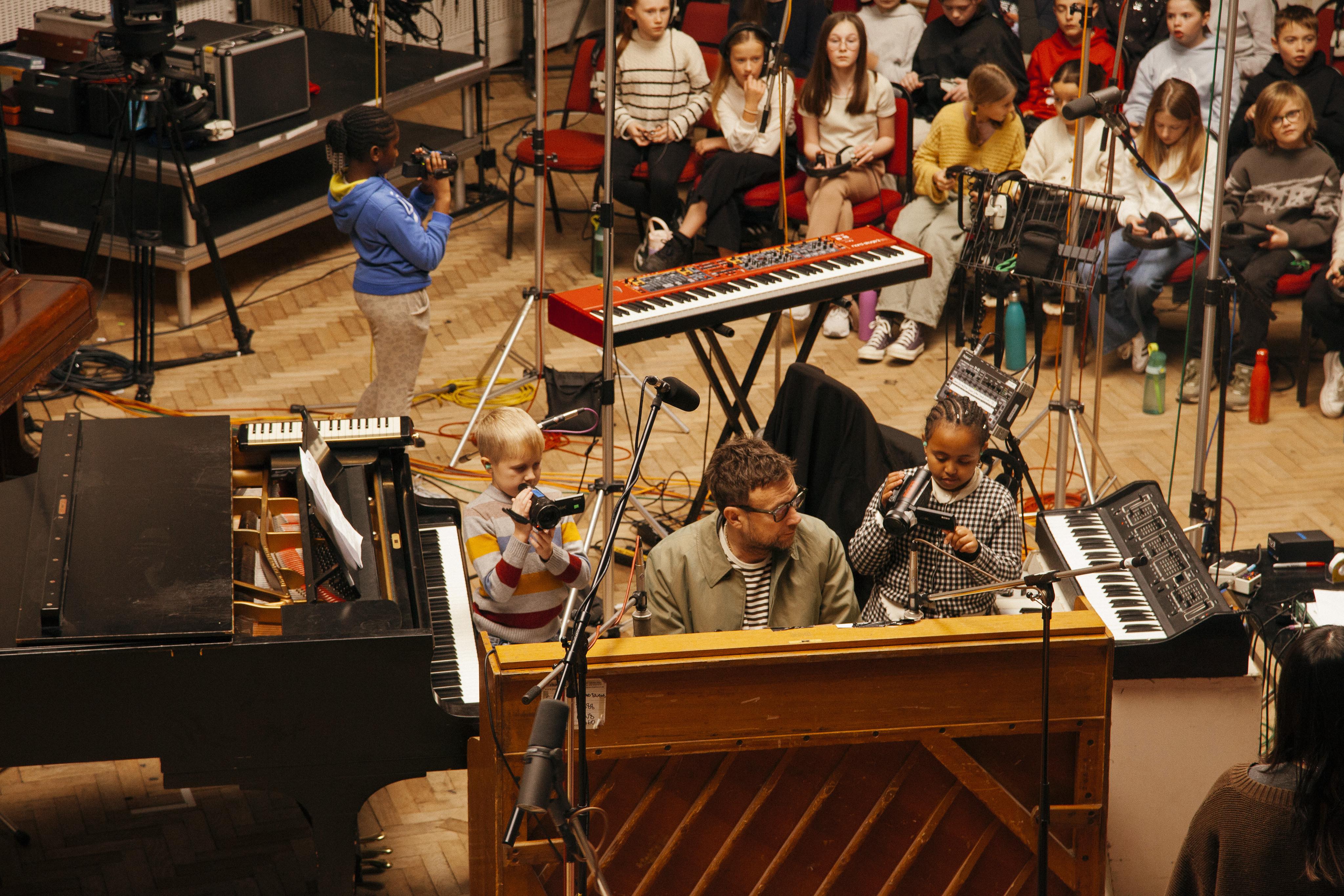 Damon Albarn and friends
“Through a conversation between Jonathan Glazer and Mica Levi, they developed a brilliantly simple concept: this is an album for children so it should be documented by children,” he says. “The team at Academy Films assembled an army of seven-to-nine-year-old camera people and let them loose at Abbey Road Studios. At the same time, they worked closely with War Child to find children to film themselves in Gaza, Yemen, Ukraine and Sudan. This footage was used to make the video for Olivia Rodrigo’s The Book Of Love, which is very moving and perfectly captures what the project is all about.”
That song was the final one to be cut to tape during a breathless recording process, which Toby L is still reeling from.
“We recorded that song live and mixed it on December 17, the entire album was mastered the next day, then sent out to the pressing plant in Germany on Friday, then it was the Christmas break!” he remembers, highlighting just how frantic the endeavour was.
As well as paying tribute to producers Marta Salogni, David Wrench, Loren Humphrey, Animesh Raval, Catherine Marks and the various engineers who worked on Help(2), the Transgressive co-founder salutes the music itself.
“Hopefully this album demonstrates what an incredible time in music it genuinely is, and what a remarkable community exists out there right now in the industry as a whole,” he says.
Beyond fans of each of the individual artist, we needed to grow the recognition of War Child beyond the UK
Emily Kendrick, XL
During those early A&R meetings, the team set upon some ground rules, namely that “the record had to be countercultural in spirit, while reflecting the modern music landscape."
“We wanted to go further afield on this occasion,” says Toby L. “With international music being so readily available now via streaming, we wanted the tracklisting to mirror that, whilst still having a sense of emotional cohesion.”
He describes reaching out to artists as “truthfully, the most anxiety inducing part”.
“Everyone we reached out to was supportive, but asking everyone to donate a unique master recording in a relatively tight time period was easier said than done,” he says. “We kept telling each other that once we achieved some sense of critical mass, then it would surely all come together, but the first few weeks were definitely the toughest. Creating a bespoke compilation album in an age where anyone is able to create their own playlist is definitely its own challenge.”
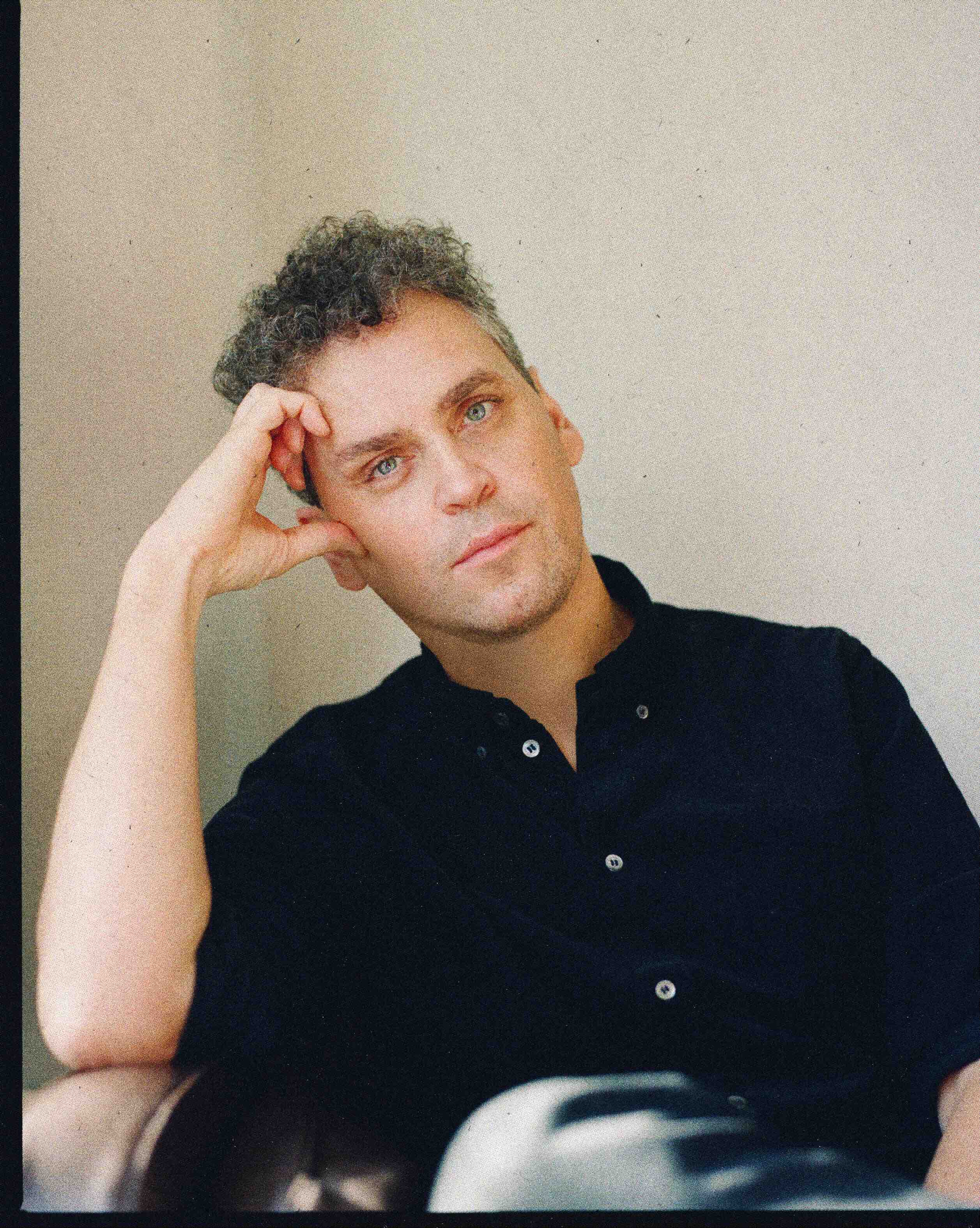 James Ford
Fortunately, underpinning the whole operation was James Ford, who has connections with many of the artists featured. He joins Music Week from his home studio, which is fittingly bathed in sunshine.
“It’s been a rollercoaster of a year-and-a-half of leukemia treatment, but I’m currently good, so I'll take that,” he begins. “I'm feeling good, getting back to work and I’ve got a fair amount of projects lined up, which I should probably keep to myself for the minute. I’ve managed to keep my hand in making music, I did the War Child album, finished off the Gorillaz record and I actually did my own album that I wrote on the ward during the chemo session just on a laptop, which is coming out on Domino later this year. A lot of that was for my own sanity, really.”
Creating a bespoke compilation album in an age where anyone is able to create their own playlist is definitely its own challenge
Toby L, Transgressive
Ford describes working on Help(2) as a vital part of his path back towards health.
“For me to feel connected to the real world and music and to be useful, and have something to focus on that isn't health results was very good for my own mental state, if you know what I mean,” he says. “It helped me out a lot. It was a really nice process.”
With that, we delve deeper into how he set about helming the sound of the record…
How do you look back on the making-of process now the album is out?
“It was kind of heartbreaking for me to have set up something like Abbey Road, with basically all the people that I love and respect in the industry all being in the same place at the same time, and me not being able to be there. It was like some weird, cruel sort of joke. But my family went down, my little boy and my wife, and just the stories that I heard from them were amazing. They were hanging out during the big session with Damon [Albarn] and everyone. It was akin to me missing a festival I'd organised or something, it was very strange. But in that particular week, I nearly died without wanting to put too fine a point on it. I was, like, right on the edge. And now I'm suddenly back out, and it's sunny, and it's just very surreal, life is very weird in that way. The thread of this War Child album definitely led me through one of the darkest periods of my life, which definitely wasn't the intention when I first got involved. It was much more altruistic than that, but then when it came down to it, it was something that I really needed myself, it helped pull me through and gave me a reason to get up in the morning. It’s really strange how these things come around, and nothing's ever quite how you expect it to be, you know?”
Was there ever a world in which you wouldn't have done it?
“Because my health had been up and down, I set it up in a way that involved lots of other great producers and engineers and people that I knew could carry it if I had to step out of it. I was still involved, but remotely, quite a lot of the time. With the Arctic Monkeys track and a few of the others, I got sent the parts after they’d been recorded and ended up mixing them and sorting them out, some of it here at home, but some of it actually in the hospital. The Arctic Monkeys track was pretty much finished off with me on headphones on a laptop, and Al [Alex Turner] recording stuff remotely and sending it to me and me arranging it. It was quite a bizarre experience, but really enjoyable to be forced to collaborate and work in different ways and find ways around things.”
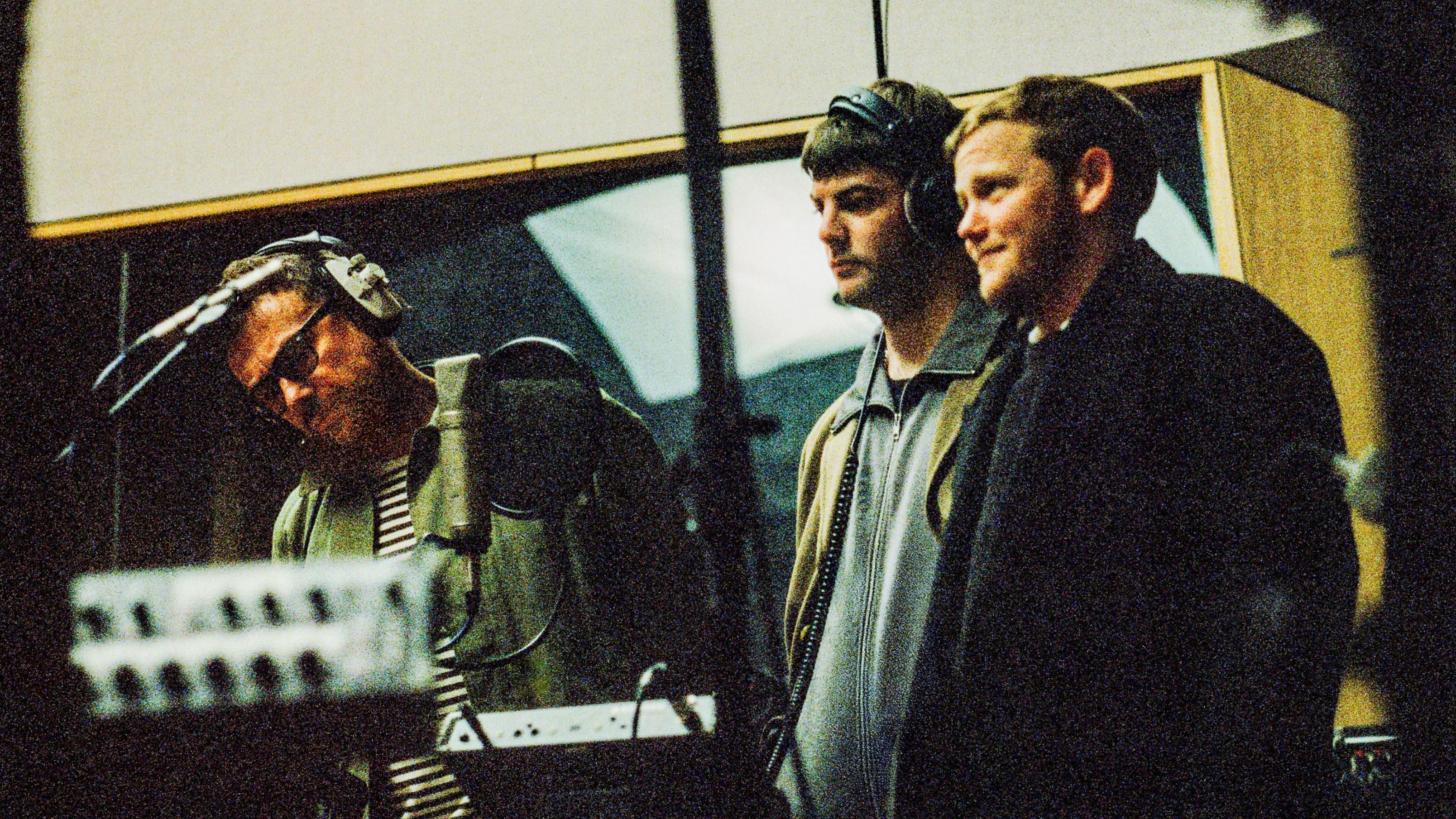 Damon Albarn, Grian Chatten and Kae Tempest
It’s almost incredible to think you’ve ended up working on music with a band you’ve been associated with for so long in that kind of context…
“There's an overarching surrealness to the whole thing, I feel like I've stepped into an alternate timeline or something. When you're isolated in hospital, it feels like you're in space. It's hard to describe to someone who hasn't gone through a heavy illness like this. But then, you know, you see the real world going on without you, essentially, and it's a very strange feeling. With the Monkeys especially, we’ve always made music in the same room together, so to suddenly be this detached head on a laptop in that scenario is very surreal and very strange, but you just get on with it. It presented a bunch of different challenges and a different way of working, which actually was really interesting, and makes you make different decisions. Often as a producer, you're trying to find different ways to approach making music to keep it interesting. This was forced upon me, but it has been very fruitful in a lot of ways.”
How did your existing long relationship with Ian, the Wildlife team and their artists help pave the way?
“They're such great people with their hearts in the right place, but they’re also just very good at doing stuff, making things happen, they have a lot of weight behind them as well. I was really excited when I knew Ian was involved, because I just knew that would smooth the whole process out. We have a longstanding trust, and, I suppose, a shorthand. It's the same with artists that you work with over a long period, there's just things that are… you don't have to explain yourself as much, you know? Everyone's already halfway down the path that you're trying to push the boulder down. It was the same with Toby, we were so aligned creatively that it was really easy. There were barely any disagreements or falling out over what should or shouldn't make the record. We would quite often make lists and have ideas in isolation and put them together, and they were almost identical. It was a really smooth, and honestly, quite joyous process.”
What did you learn about your craft?
“It's a rare opportunity to have an excuse to get different people together and reach out to people that you admire and respect. And there's a reason to ask people to do something, and a reason to get different artists in a room together and collaborate with different producers, which doesn't often happen either, as a producer. It was a great thing to hang a bunch of creative choices around, as well as, obviously, the fundamental thing of it being beneficial to help children in war zones. It was a no brainer, really. It all just came together really, really well, and as soon as it ended we were like, ‘how can we do something like this again?’”
With the Monkeys especially, we’ve always made music in the same room together, so to suddenly be this detached head on a laptop in that scenario is very surreal
James Ford
And are there any life lessons you can share?
“Things just seem so much of a rollercoaster, even now, I can't predict what the next few months are going to be like. The whole experience has made me very viscerally attached to life and to the good moments that happen and spending time with family and friends and nature, and also just spending time on musical projects that I really love and think are really valuable. All the wasting time on other things just gets cut to the side. I hope I can continue to take some of this mentality forward into my life, because it's a big perspective shift.”
How do you feel when you listen to the album?
“People always bemoan things and say, ‘Oh, music was better back when…’ but I think there's so much amazing music around at the minute and so many talented people. It was a big ask to get people to write and deliver songs in a short time frame and essentially give it all away. It's a big thing for people to do, especially when musicians are struggling more and more. The joy and the effort that people put into doing that, in a really open and selfless way, restored my faith in humanity to an extent. When you read the current news cycles and see the darker bits of what humans can do, it was a great reminder of the sense of community and spirit that people have. That has a value in itself of just attempting to put something positive into the world in such an overwhelmingly negative news cycle. People were so up for that. I think a lot of people feel disenfranchised and helpless. What can any individual do to actually move the world in a positive direction? I think the only thing you can do within your own community and sphere of influence, is just do the most positive things you can think of, and approach it with open-heartedness, and I feel that everyone involved did that. It was an amazing feeling to be a catalyst for that and hopefully there'll be lots of other projects that continue in that same spirit. The music industry is quite isolating, in a lot of ways, there's an element of competition and it's a tough world out there, but people weren't worried about the commercial aspects of it. It was just a very different vibe, people went really out of their way to make it happen, and I'm very proud of what we achieved.”
Ian McAndrew echoes those sentiments entirely, as our story comes to a close.
“I felt that people were putting aside any commercial and competitive considerations to really want to participate in something for all the right reasons,” he says, by way of conclusion. “And that has been the most rewarding part of this process for me, people participating, giving their time freely and being really invested in it. I know from talking to many of them how rewarding it's been for them to feel part of something that's doing something so important – and that's the artists as well as all the people working behind the scenes. I think there's been a genuine collective sense of pride and a sense of accomplishment and sense of spirit that defies the usual work that we all are involved in.”
PHOTOS: Adama Jalloh, Lawrence Watson, PHC Films, Josh Renaut, Pip Bourdillon, Steve Gullick
 FOLLOW