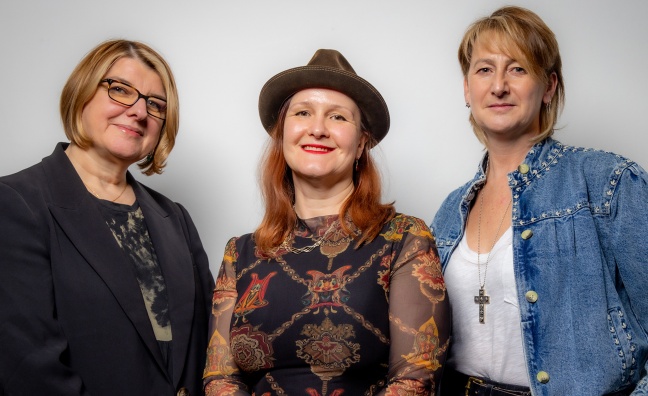
The Music Managers Forum's new all-female leadership team have delivered a message to the industry as they kick-start the next phase of the organisation.
Eleven Management Niamh Byrne and Jill Hollywood, founder and MD of Echo Beach Management, were appointed as the organisation's chair and vice-chair, respectively, last October, succeeding Paul Craig and Kwame Kwaten, who stood down after completing two three-year terms.
In an exclusive interview in the May issue of Music Week, the duo are joined by MMF CEO Annabella Coldrick to set out how they plan to guide the association into a fresh era.
“A lot has changed since I started at the MMF nine years ago,” said Coldrick. “I took over from Jon Webster as the first ever female chief exec. Diane Wagg had been a female chair, with a male vice chair. I think we had 16 board members who were all managers and only two women; now our board is more than 50% female, plus our chair and vice chair.”
It is the first time in the MMF’s 32-year history that three women have led the world’s largest lobbying group and educational hub for music managers.
Byrne – who, alongside Reìgine Moylett, co-founded Eleven Management, where the roster includes Blur, Gorillaz, Damon Albarn, The Wæve and The Clash – explained her motivations for stepping up to take on the chair role.
“There’s a need for women to step forward because we’re not naturally inclined to do so, and that’s certainly why I’ve accepted this position,” she said.
What I’m hearing from the members is an undervalue of the role of the manager in this ecosystem
Niamh Byrne
Byrne elaborated on her ambitions for the MMF, stressing that it was important for management to be "accessible to all".
“Annabella has done a fantastic job of changing the membership," she said. "It’s beginning to feel like something that represents all of us. But I hope through our tenure, we will encourage more development in those areas and reach far wider genres and communities."
She continued: "What I’m hearing from the members is an undervalue of the role of the manager in this ecosystem. There are much more innovative ways of doing things and we’re shouldering more and more responsibility and trying to fix the problems, yet our remuneration hasn’t changed.
"So, it’s about more recognition for the work and the role of the manager beyond just traditional deal-making. They need to be experts in everything. We are fan managers; we are data controllers; we’re marketing managers; we’re digital strategists; we’re creative and we do production. So, it’s a multifaceted business that we run and it’s very skilled and knowledgeable.
"I’d like to push that to a wider range of people because I don’t think people see what we do. Largely, we’re in the habit of presenting solutions and quietly solving things in the background.”
Echoing Byrne's point, Coldrick suggested the wider music business did not value managers enough at present.
"I’m sick of having record labels say there are bad managers out there," she said. "I say, ‘Well, support them.’ Help them get the knowledge they need, rather than complaining that you don’t have enough good people. Help make people good. It will benefit everyone in the industry if you’ve got great, well-educated, supported managers.”
If we can do anything as three women running this amazing organisation, we can help spotlight incredible women doing great work
Australian executive Hollywood's company represents producers including Jacknife Lee, Cam Blackwood and Lorna Blackwood, Johan Hugo, MyRiot, Davide Rossi and Ash Howes
“I’ve been in the UK for 30 years, and there have always been iconic female managers around me,” said Hollywood. “But if we can do anything as three women running this amazing organisation, we can help spotlight incredible women doing great work.”
The trio also tackled issues around AI and how it affected their trade. Hollywood said there was a grey area between "what we consider to be good and helpful AI and what we consider to be bad AI".
"Producers have been at the forefront of embracing new digital technology, and so much about new technology has democratised production in a great way," she said. "However, we, as a community, are really worried about the potential of the watering down of the copyright rules in the UK. We feel that creative IP should be valued and that allowing generative AI to train their models on the history of music shouldn’t come for free.
"We’re looking at new business models going forward and I worry that if we start decreasing the value of IP by taking away some of the protections, that would be problematic for us trying to find people to invest in the creation of music.
"A big part of the MMF campaign has been to be pro-AI, while saying it must be the music makers’ right [to allow consent], not just the record labels’ or publishers’ right. Some of them will be incredibly innovative and develop cool services, maybe with AI tech, but it’s that ability to control how it’s used and how you’re paid.”
The full interview with Byrne, Hollywood and Coldrick appears in the latest issue of Music Week.