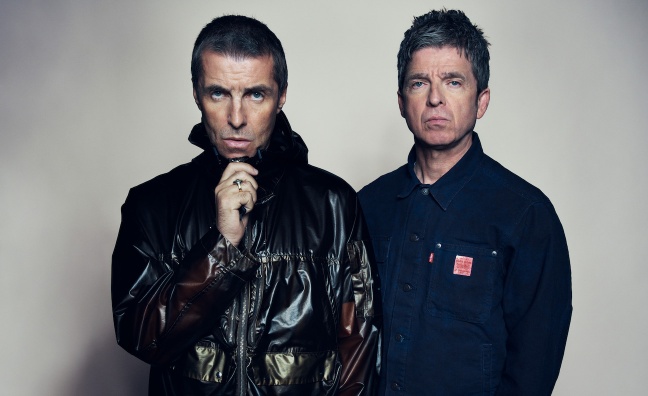
Oasis co-manager Alec McKinlay says there are no plans for the band to release new music, with their hugely anticipated reunion marking "the last time around".
The Ignition and Big Brother Recordings director made the disclosure as part of an exclusive interview in the June edition of Music Week, which features an 18-page Oasis special paying homage to the group's legacy. Big Brother and Oasis won the Catalogue Marketing Campaign category at the Music Week Awards last week.
The Gallagher brothers will reunite on stage for the first time since 2009 on July 4 when they launch their Live ‘25 tour in Cardiff.
Asked if there will there ever be a new Oasis album on Big Brother, McKinlay said: "This is very much the last time around, as Noel’s made clear in the press. It’s a chance for fans who haven’t seen the band to see them, or at least for some of them to. But no, there’s no plan for any new music.”
The Oasis Live ‘25 tour was the biggest concert launch ever seen in the UK and Ireland, with over 10 million fans from 158 countries queuing to buy tickets last summer. The executive explained how the team had been able to keep the band's comeback a closely guarded secret.
“The group of people who knew about it in advance was very limited,” said McKinlay. “We were working with people we trusted.
“We’d obviously been planning it for a while and the moment when it went live was a little bit of a step into the unknown in terms of how big the reaction would be. When it all hit home, it was just phenomenal. The reaction was very much one of, ‘Finally, some good news after all the nonsense that’s been going on in the world.’”
Probably the biggest and most pleasing surprise of the reunion announcement is how huge it was internationally
Alec McKinlay
The sold out 2025 tour will comprise 41 shows between July and November, spanning the UK & Ireland, North America, Oceania and South America. McKinlay admitted to being blown away by the level of interest globally.
“Probably the biggest and most pleasing surprise of the reunion announcement is how huge it was internationally," he said. "Honestly, we knew it would be big here, and that doesn’t take much intuition. But looking outside the UK, we knew they had a strong fanbase, we did all the stats. We were quite cautious about what that would mean when it came to people actually buying tickets but we were just bowled over by how huge it was.
"We could have sold out half-a-dozen Rose Bowls in Pasadena and probably eight MetLife stadiums in New York in a day. We saw the ticket stats, we were watching what was happening and the demand was way beyond our expectations.”
Back in February, Big Brother Recordings marked the 25th anniversary of Oasis' fourth album Standing On The Shoulder Of Giants (788,960 sales, OCC) with a limited-edition vinyl reissue. The record prompted the inception of the label after Creation Records co-founder Alan McGee informed the team that he was selling his stake in the iconic indie a few months before the LP's release date.
McKinlay said Big Brother was subsequently formed "at very short notice".
"It’s well known that Oasis were actually signed to Sony worldwide and licensed through Creation in the UK, and at that point Alan McGee decided to shut up shop which, from the band’s perspective, was not exactly ideal.” he said.
“We had to consider how to turn what was potentially a negative situation into a positive one. Of course, we had Sony coming to us and going, ‘Look, you can have any Sony label you like.’ But we sat down with Noel and Liam and it was almost instinctively clear that a major label as the home for Oasis in the UK was not the right fit. It just didn’t feel right.”
They are the biggest independent rock’n’roll band in the world. Nobody with their kind of history sits well on a major
Alex McKinlay
Being on a major in their home country would have been at odds with the spirit of the band, declared McKinlay.
“They are the biggest independent rock’n’roll band in the world,” he said. “Nobody with their kind of history sits well on a major. It was in their DNA then and it is to this day.
"I don’t want to be negative about major labels because they’re huge investors and huge players in the industry, and they can be the right thing for many artists at the right time. But particularly with an artist who has a number of albums out and are not new anymore, it is often difficult to keep the attention and energy high at a major record company in the long term.
“We said [to Sony], ‘Look, give us the licence you gave Creation, we’ll set up a label and release the record. Thankfully they agreed and supported us, and Big Brother was born.”
McKinlay explained the Noel and Liam Gallagher were fully onboard with the plan.
"They were aware of everything we were doing. Noel in particular was across every key decision we made, as much as they had been with Creation," he said. "But they’re both very good delegators and willing to trust us to get on and do our job.”
Setting up their own label was a huge plus for the group in the long run, he added.
"It was massive," said McKinlay. "Over time, it became clear that having that degree of independence and that ability to constantly prioritise what you wanted to do was a huge thing for the band. We were in a position where, post-Be Here Now, there was perhaps a little bit of a feeling that Oasis had had their moment, and it was our role to go, ‘No, really, this is just the start of the next phase.’
"If you look at what happened over the next 10 years, over the next three albums, each sold more than the last. From Standing… to Heathen Chemistry to Don’t Believe The Truth, you had sales increasing, continued No.1 singles, continued airplay success, and that was reflected in the band’s own touring success as well. The biggest tour they did was in 2005, so all of that was helped by having their own team who were constantly on board in a way that you would never get even with another indie. You had 100% attention all the time.”
We did a few things with them when they were at their height that were widely reported as being industry firsts
Alec McKinlay
McKinlay stressed that with every campaign, the team made sure they were at "the cutting edge of whatever technology, media or movement was happening" at the time.
"Every campaign had something that was an industry first, or we were making sure that we were doing things that perhaps other bands of their ilk weren’t doing," he said. "This is pre-streaming, and we had a very good relationship with Apple and iTunes and worked that very well, and with MySpace we did a few things with them when they were at their height that were widely reported as being industry firsts. But at the end of the day, it was about the music and how it came across.
"In those days, the key thing was staying on Radio 1 and the band did – every single was on the A-list and was heavily supported. You could see it every time they toured, you’d look at the front 10 rows of the crowd and they were always kids.”
Oasis' 1994 debut album Definitely Maybe (2,849,624 sales) returned to No.1 in the UK last August – 30 years after its release. And McKinlay said the gameplan for Big Brother remained consistent even after the band split up in 2009. Oasis albums have just been released in spatial audio with Dolby Atmos on Apple Music.
"We were very conscious of the need to maintain the legacy and always had plans in the offing for what we’d do on the various anniversaries," he concluded. "I think that has been the key to supporting the sales of the catalogue, that it’s an ‘always on’ campaign, always something coming up.
"It did take a while to adapt after the band split, but the first anniversaries were coming around pretty quickly. In fact, they’d already come around, but it all seemed like the natural thing to do.”
Subscribers can read the full interview online and in the latest edition of Music Week.
- Music Week's June issue also includes an exclusive interview with Big Brother Recordings' GM Clare Byrne and head of creative and retail marketing Sarah Mansfield, while a selection of top names from across the industry as they reflect on their favourite Oasis tracks.
PHOTO: Simon Emmett