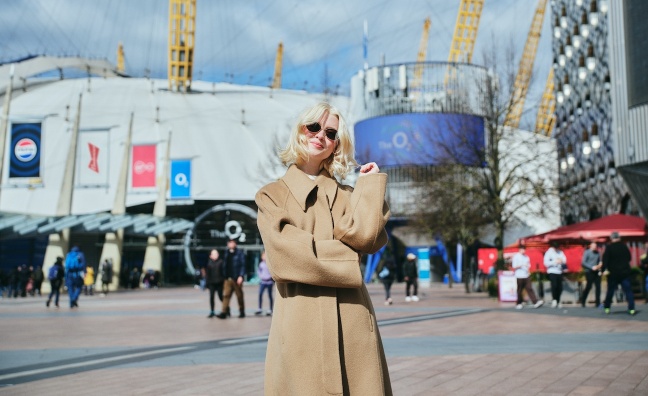
The O2's boss Steve Sayer has told Music Week the iconic London arena is using its impending 20th anniversary as a launchpad for its next decade, with Maisie Peters confirmed as the first artist in the 2027 programme.
The O2 won the Venue Of The Year category at the Music Week Awards last week.
Running throughout next summer, the landmark anniversary series will include multi-night residencies, one-off performances and exclusive shows spanning "rising stars to global icons".
Maisie Peters will perform her debut headline show at the AEG venue on Saturday, May 8, 2027, in a booking that The O2 says signals its ongoing commitment to presenting artists "from grassroots to the global stage”, as it ushers in a new era of headline talent.
“We're seeing this as a real opportunity to set the venue up for more success for the next 10 to 20 years,” Sayer, the arena’s GM and SVP, told Music Week. “I honestly think we're at the top of our game. We've invested heavily in the venue and the experience of the artists, the fans and our premium guests, and we've done that consistently over the last 10 or so years, and I feel like our programming is as good as it's ever been.”
He continued: “I think we're riding the crest of a buoyant time for live music. It wasn't that long ago that we were talking in the industry about where the next headliners were coming from, but there’s now an explosion of interest driving that supply of new artists, and an insatiable social demand for live. And I think The O2 is so well positioned to capitalise on that.”
It was a conscious programming decision to ensure the first headline artist was fully representative of what The O2 is world famous for, and what's fuelling the growth in the industry right now
Steve Sayer, The O2
Next year will also mark more than two decades of partnership between the venue and headline sponsor O2, which has sold more than four million Priority Tickets to shows at the venue to its customers via its Priority platform.
“We couldn't be prouder of our partnership with AEG and everything we have achieved together at The O2," said Gareth Griffiths, director, partnerships and sponsorship, Virgin Media O2. "Now, we look towards the future and artists like Maisie Peters who are at the top of their game and will truly define live music for the next 20 years; the perfect first artist to celebrate this milestone with us next year.”
The O2 has hosted more than 3,000 shows and welcomed over 100 million visitors since opening with Bon Jovi in June 2007.
Radiohead made further history at the venue last November, breaking its all-time attendance record four nights in a row on their first live dates in seven years. The band surpassed Metallica's previous record with a new high of 22,355.
Here, Music Week sits down with Sayer for an exclusive interview to discuss the birthday celebrations, the booming residency trend, the rise of female and non-English speaking artists, and how The O2 guards against complacency…
How does it feel to be gearing up towards this 20th anniversary milestone?
"It's a huge moment in time for everybody at AEG connected with The O2, as well as our partner O2. We've been planning for it for 12 to 18 months, but in the last six to nine months – mainly driven by Christian [D’Acuna] and Emma [Bownes] on the programming front – we've really started to put our plans in place. Maisie Peters is the first of many to be announced for the programme to celebrate the birthday, and those announcements will run through the rest of this year."
What does reaching this point say about where the arena sits in today's landscape?
“We want to celebrate the milestone, reflect on the incredible history we've had in a relatively short space of time, but we also want to use it as an opportunity to look forward and celebrate all of those newer artists and different genres that are now becoming the mainstay of our programming. That's why announcing Maisie Peters as the first artist – a young, female, British, rising star – is perfect for us.”
Was it a conscious decision to launch the programme with a young British artist?
“Absolutely. We didn't know when we set out on this journey that Maisie would be the first to announce, but we intentionally wanted to book and work with those first-time headliners that are breaking through. The industry has had incredible success over the last three or four years with female artists selling out arenas, selling out stadiums and headlining festivals, and The O2 has been at the forefront of that. So it was definitely a conscious programming decision to ensure the first headline artist was fully representative of what The O2 is world famous for, and what's really fuelling the growth in the industry right now.”
Are you seeing changes in how artists are planning arena runs in London?
“We've definitely seen in the last few years a rising trend of artists wanting to do long multi-night runs. If you look back at The O2's history, going all the way back to Prince's 21 nights [in 2007). Monty Python did 10 nights when they reformed [in 2014]. More recently [in 2023], we've had Elton John doing 10 nights on his farewell tour, Usher doing 10 nights last year, Ariana Grande doing 10 nights this year, and Olivia Rodrigo doing 11 nights next year. It's very much part of our core DNA. Artists and their teams see the opportunity to plant themselves in a major market and really focus on delivering the best possible experience for fans who will travel to those shows.
"There are only so many artists who are going to be able to sell out 10 consecutive nights at The O2, but it feels like more artists are going to have the ability to do that. So what we're trying to do as a venue is better support those artists – making the experience as comfortable as possible, but also thinking creatively about how the whole site can be activated. We're talking to a number of artists who are scheduled to play the birthday run about what an aftershow could look like. Prince, famously, would play the arena and then play an aftershow in Indigo At The O2, so that's a great example. We're looking at what fan activation villages we can build. Because we've got control of the whole site, we can really work with artists to curate the whole experience and that will be a big part of the birthday programme. We're hoping to really bring the whole site alive, almost giving artists the opportunity to take over The O2 for a night.”
What's been the biggest shift in what's expected from a successful arena show during your time?
“The shows are getting bigger, more complex, more technically brilliant, and that has definitely changed a lot in the last few years. The pressure on venue teams to get these huge productions in and still turn it around night after night is enormous. And expectations from guests and fans has changed a lot – fans know what good looks like. Since the pandemic, we've really seen that shift. There's a real demand for premium experiences, and fans are prepared to pay extra for those, but there's an expectation that the service and experience is commensurate with the ticket price.
“What's probably accelerated all of the above in the last three or four years is the influence of Gen Z on both fandom and artistry. They're the tastemakers, changing the game in terms of what people want to listen to. But that audience is also engaging and behaving in different ways to 20/30 years ago. The demand for merchandise, the importance of merch – for many of these artists, it's central to the culture and ecosystem of the show. We're also seeing that younger audiences are drinking less alcohol, and that means we've got to think about our soft drink range and how we evolve and innovate. The focus on welfare, particularly with younger fans, has always been there, but it's become a lot more prevalent. We're not just seeing first-time headliners, but first-time fans coming, which is brilliant for The O2 and brilliant for the industry.”
The rise of non-English language artists has been another major market trend, hasn’t it?
“Definitely. K-Pop is basically mainstream pop music now. BTS played their first arena shows at The O2 [in 2018] and from that point, K-pop has grown exponentially. The audience profile for those shows probably looks very different now than it did then. In any given year, we could have six, eight, 10 shows from K-Pop alone. We've had J-pop, Taiwanese pop, Latin music in all of its myriad of forms. Karol G played a couple of years ago – I would say for 90% of the audience, their first language was Spanish – and it was a joyous show.
“I was at Rosalía last week, which was absolutely outstanding, next-level stuff. She sings in about four or five different languages, principally born of Latin music, but you can't pigeonhole her into one genre. That's an early contender for show of the year. These genres that might have been considered niche only 10 years ago are now almost core genres for us, alongside rock, pop and hip-hop. Every night it's an incredible array of world-class artists from very different backgrounds. That is really what's fuelling the industry right now.
“I cycled in the morning of that first BTS show. It was autumn, but it was a lovely sunny day. I got there at about 8.30am and there were queues everywhere. We've never seen early queuing on that scale, before or since. The other thing I remember about those shows was the light sticks. Everybody bought these light sticks for £35-40, and they had to have them. That was the first time our merchandising record was broken for a long time – a huge number driven by these light sticks. And then with no support act, everybody was in the bowl an hour and a half before BTS came on stage. They played music videos back-to-back for 90 minutes and, even for the videos, the noise levels, the screaming, were like nothing you'd ever seen. And when they came on stage, it must have been a bit like The Beatles. Absolute hysteria. Tears, hyperventilating. It was an eye-opening experience.”
What have been the toughest moments of your tenure?
“It's when you get impacted by something that's out of your control and you've got to quickly react. The dark days of the pandemic were particularly a low point. The challenge for me personally was a bit of a mental reset about, how do we lead the team out of this? How do we reopen The O2 and come back stronger? I'm very proud to say, looking back on it and where we are today, we've absolutely done that.
“When the storm blew a hole in the tent [in 2022], that was a major catastrophe. Thankfully, nobody was hurt or injured, and having to figure out how to get back up and running in the space of seven or eight days, safely, was both a difficult moment and a really interesting project. But it's partly my personal outlook on life – it's a privilege to do what we do. The O2 is a very special place and a very important asset in the world of AEG. We're always pushing the boundaries, always pushing forward. That’s why we wanted the birthday to be all about celebrating our past and an important milestone, but very much looking ahead and setting the venue up for success for the next 10 years.”
Lastly, given The O2's privileged position as the biggest indoor arena in London, how do you guard against complacency?
“We can't afford to be complacent – we can't rest on our laurels. That's why we're investing so heavily in the venue, in our CapEx plans, continuing to deliver amazing service levels for artists and their teams, and making sure the fan experience is as good as it can be because we want to maintain that market-leading position. When new venues get built, it does focus the mind to ensure that we up our game a little bit – we're 20 years old, and we feel like The O2 is just hitting its stride, but it's important that we're not complacent and keep a very close eye on what fans are looking for from the live music experience.
“It's about being across what fans, partners, premium guests and artists expect – but also just looking at what's happening not just in live music, but right across the spectrum. What's happening on the high street, in bars and restaurants, what trends exist outside of live music. We spent a lot of time looking at what festivals were doing three, four, five years ago and what we could learn from how that experience was evolving. We're constantly taking different influences and bringing it back to what we do best – delivering amazing events with high-profile artists and ensuring 22,500 people have an incredible, safe and secure experience.”
PHOTO: Marc Sethi