While there are bullish predictions for concert ticket sales in the next decade, Shain Shapiro, founder and chairman, Sound Diplomacy & executive director of the Centre for Music Ecosystems, says we need parallel investment in the conditions that allow live music ecosystems to form…
According to Goldman Sachs’ Music In the Air update, live music revenues are expected to double to $67 billion by 2035, with demand for tickets outstripping that for museums, gambling, and other forms of entertainment.
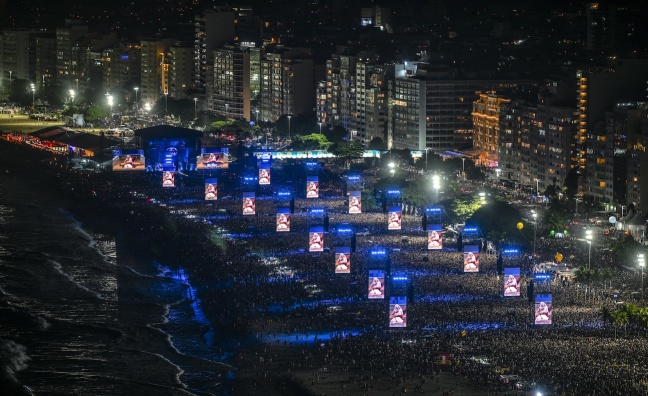
This is reinforced by the consistent announcements of new stadiums and arenas where global tours once had little presence, such as Lima, Lagos, and others, as well as by the fact that the world’s largest-ever outdoor concert featuring Lady Gaga took place on Copacabana Beach in Rio (pictured), not in the United States.
These predictions have led to a groundswell of investments, such as Helios Entertainment’s $300 million fund with the IFC, the private arm of the World Bank, and France’s national cultural funder, Proparco, as well as a slew of announcements from the African Export-Import Bank’s Creative Africa Nexus (CANEX) program.
However, beneath this optimism lies a more sombre truth. Many emerging markets expected to supply these fans – and their wallets – lack the infrastructure to turn concerts into touring economies, and simply building stadiums, arenas, and large infrastructure projects won't solve this challenge. In most countries, live music is not an industry. It is a cultural activity – vibrant, essential, and beloved – but not yet supported by the infrastructural, regulatory, and economic systems needed to turn talent into jobs and live shows into income.
This is because touring is infrastructure, and most countries don’t have it. A successful run of shows requires paved roads, reliable electricity, hotels, a variety of equipped venues, functioning immigration systems, a trained staff to facilitate the events, and audiences with disposable income. Without this, artists may still perform local shows, but they cannot tour sustainably, especially if the power supply is erratic, it takes eight hours to drive what should take three, or there’s a lack of cabling, trussing, or monitors at the venue when they arrive.
Consider Africa: It has enormous talent, the world’s youngest population, and native digital adoption, including widespread mobile financial infrastructure. Yet, touring in most of the continent, whether within a particular country or across borders, even ignoring crises and political challenges, remains extremely difficult.
A Nigerian artist, especially one focused on small to mid-sized venues as they develop their career, cannot tour the country as an American artist can tour the United States, even though both countries have populations exceeding 200 million. It does happen, as Boy Llona showed, but this is more of an exception than the rule. In reality, one can play in eight to ten cities, such as Lagos, Kano, Ibadan, Abuja, Ede, and Port Harcourt. Imagine touring the US and only being able to play in New York, Los Angeles, Chicago, Austin, Houston, Nashville, and a few others.
In most countries, live music is a cultural activity – vibrant, essential, and beloved – but not yet supported by the infrastructural, regulatory, and economic systems needed to turn talent into jobs and live shows into income
Shain Shapiro
In Latin America, distances, topography and limited transport infrastructure often require tours to fly between cities, increasing costs and limiting capacity to the top end of the chain. These barriers explain why there has never truly been a “global” tour. Even Ed Sheeran’s last run, which included a first ever concert in Bhutan and stops in Qatar, Bahrain and six dates in India, required his stardom to pull it off. Layer in weak copyright enforcement, which limits access to public performance royalties and rising costs due to climate impacts and inflation, and it becomes more challenging.
Whether we realise it or not, no artist is born stadium-ready. Every act begins in the same place: from their bedroom to a classroom, a small venue, a supportive local community, and within an ecosystem that supports them and allows them to build momentum. Without that, the industry becomes too top-heavy, dependent on fewer and fewer artists who can command the biggest stages, which explains why the average age of festival headliners continues to increase.
But there’s another way. Instead of seeing live music as a single issue, we should think of it as a pillar of international development and a new vertical for accelerating trade, rather than aid. And here is where there needs to be a change in tune, mindset, and tactics. If live music is to grow globally, it must be truly global. That means everywhere. What we need is parallel investment in the conditions that allow live music ecosystems to form, along with the right partnerships and policies to ensure they do.
This should become the work of both live music firms and development institutions, because together we can create new touring markets and jobs. This means not just thinking about bums in seats, land yield, and pints of beer, but also urban renewal, poverty reduction, infrastructure improvement and digital expansion, and how live music can deliver these outcomes, in addition to providing entertainment and leisure. Social return on investment could be quantified, thereby increasing access to the finance needed in markets that lack this infrastructure, if a more holistic approach were deployed. This finance would be structured to facilitate long-term, patient investment, much like development finance.
This change will unlock investment, opportunities, and new artists and sounds. And while it may be naive to think that delivering social impact also increases share price, in this case, it can and it must. One depends on the other if the next billion fans are going to come from new markets rather than established ones. But it’s not just artists who are needed; audiences, support staff, transport options, accommodation, and broader community cohesion and safety are also needed.
To achieve Goldman Sachs’ predictions, which we should all strive for, we need to build touring circuits where they don’t yet exist, alongside stadiums and arenas. We need to measure and invest in live music as we do with schools, roads, and hospitals.
Couple that with strengthening copyright systems and enforcement so music can literally pay for rents and groceries, and we’d see live music expand. Doing this, turning live music into a key tool for international development, is how we do this. It can, at the same time, support and reward communities and shareholders, whether in Abuja or Austin.
PHOTO: Mauro Pimentel/AFP via Getty Images