The Music Venue Trust has some reasons to be cheerful following its 10th anniversary.
The government has backed a report by MPs on the proposal – led by Music Venue Trust CEO Mark Davyd – for a voluntary levy on stadium and arena shows to support the grassroots sector. Trade body LIVE is now moving ahead with the launch of the Live Trust to administer the funding initiative.
According to the latest Music Venue Trust annual report, the financial injection from such a levy will be a much-needed boost for grassroots music venues (GMVs).
One of the most concerning problems for the sector is the slump in touring circuit stops over the last few decades. The decline in live opportunities comes at a time when breakthroughs are getting harder to come by for UK artists.
The report highlights the “huge decline in locations on the UK’s primary and secondary touring circuits”. In the 30-year period between 1994 and 2024 those touring locations have shrunk, with an average tour in 1994 including 22 dates and the equivalent tour in 2024 consisting of only 11 dates.
Furthermore, touring in 1994 was spread across a range of 28 different locations across the country. In 2024, just 12 locations, all of them major cities, remained as primary and secondary touring circuit stops, acting as regular hosts to grassroots tours.
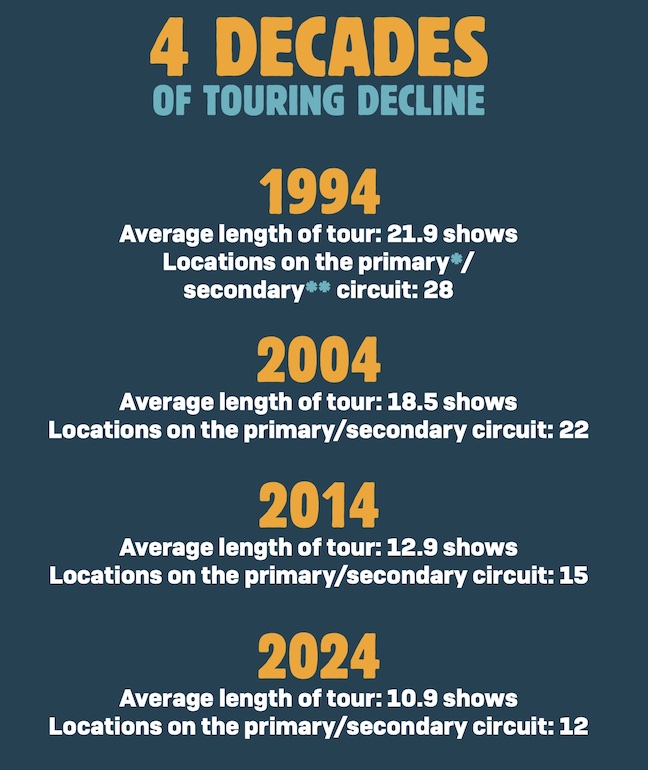
The primary touring circuit is defined as locations receiving more than two-thirds of national grassroots tours. Secondary touring including locations receiving more than one third of national grassroots tours.
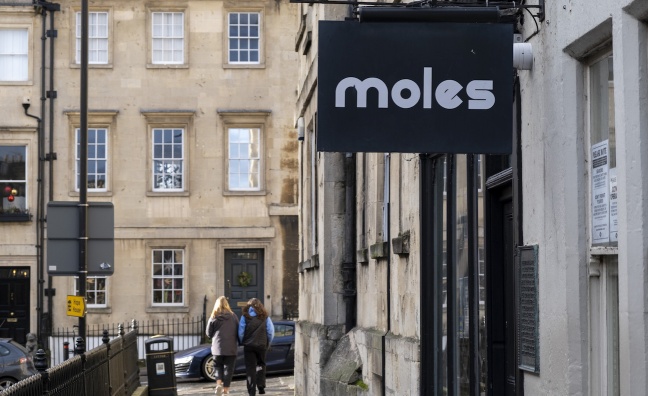
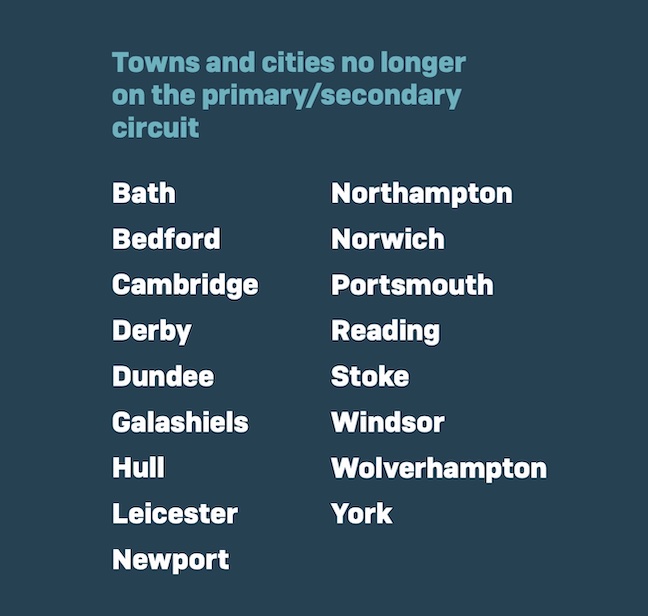
Cities and towns such as Leicester, Edinburgh, Bath, Hull, Norwich, Windsor, Wolverhampton and Stoke on Trent among others have dropped off the primary route over the last few years. Bath Moles (pictured) closed at the end of 2023 after 45 years.
For some areas, including Scotland and Wales, it means that swathes of the country have been cut off altogether, resulting in people having to travel further or simply being unable to access live music at all.
The result, as outlined in the report, is a decrease in the total number of live music shows (down 8.3% since 2023) accompanied by an even steeper decline in ticket revenues (down 13.5% since 2023).
This additional decline in the value of tickets sold relates to a significant decrease in the number of high value tickets for national touring acts that have been replaced by more local and regionalised events with lower per-ticket values.
“These statistics suggest that public demand for music remained high but isn't being serviced by national tours,” stated the MVT report.
A very broad consensus has been built among politicians, industry, artists and the public that grassroots music venues must be protected
Mark Davyd
Mark Davyd, CEO of Music Venue Trust, said: “The 2024 Annual Report recognises that after 10 years of work by MVT a very broad consensus has been built among politicians, industry, artists and the public that grassroots music venues must be protected, supported, encouraged and nurtured. In 2025, we have to see that consensus bring forward positive, practical interventions in the real world.
“Venues, despite all the very welcome good intentions and acknowledgements they are receiving for their vital work, are still closing, still under extreme and totally unnecessary financial pressures, still failing to be recognised, as everyone agrees they should and must be, when government designs policy, taxation, and legislation. It isn’t good enough to keep saying how much we all value them, we’ve got to practically do something about it. We need action not words.”
MEMBERS HIGHLIGHT FINANCIAL CHALLENGE
There are positives in the report: in addition to the anniversary and the progress on industry support for grassroots music, Music Venue Properties (MVP) has now secured freehold ownership of five grassroots venues.
But Music Venue Trust’s survey of the 810 members of the Music Venues Alliance (MVA), who employ over 30,000 people throughout the GMV community, reveals the scale of the challenge for the sector.
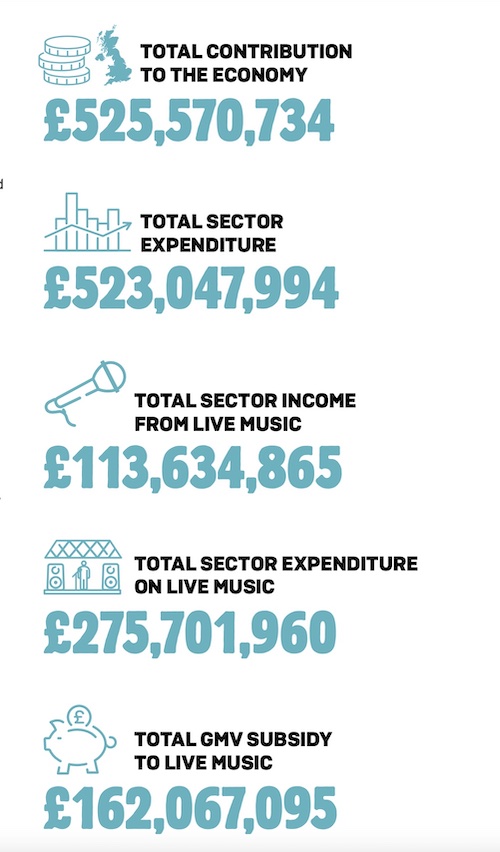
The survey found that they staged over 162,000 live music events comprising almost 1.5 million individual artist performances given to a total audience of just under 20 million. The total direct value to the UK economy from these events was £526m, according to the Music Venue Trust.
However, on average, grassroots venues operated on a profit margin of just 0.48% (£3,114 based on average turnover) with 43.8% of them reporting a loss in the last 12 months.
“This means that the sector as a whole effectively subsidised live music activity to the tune of £162m,” said the Music Venue Trust.
In 2024, the average total turnover of a typical GMV was £648,852. With 78.4% of income coming from food & beverages and other income, that left 21.6% being generated through ticket sales,for both live music and non-music events.
Music Venue Trust described that as a “dramatic change in sources of income”, with a marked decrease in ticket income. Ticket prices were stagnant in 2024, averaging £11.48, compared to £11.42 in 2023.
Average turnover by venue increased by 8.1%. Total sector turnover saw slower growth as a result of venue closures, up 4.7% to £525,570,734.
VENUE EXPENDITURE
The expenditure of the average GMV totalled £645,738, an increase of 8.1%. GMVs spent £253,622 (39%) of their expenditure on staff/freelancers and £340,372 (52.7%) on live music provision.
An additional £7,702 per venue was paid in licence fees to PRS For Music (1.2% of total turnover, 5.4% of ticket income. Music Venue Trust noted that revenue for PRS For Music “exceeds the Copyright Tribunal stipulated rate of 4% as a result of fixed tariffs, such as Tariff P, failing to address declining event numbers”.
Venues with a capacity lower than 400 were those most likely to be making a loss in 2024. Those situated in areas with populations under 200,000 reported an average loss of 1%, while their counterparts in more populated areas exhibited a profit margin of 1.3%.
Additionally, venues with a total turnover under £500,000 were more likely to have a negative profit margin (averaging -2.7%) compared to those with turnovers exceeding £500,000 (averaging 3.1%).
When specifically considering the expenditure and income related solely to live music provision, the average GMV incurred a yearly loss of £198,956.
Some 33% of these venues are now registered as not-for-profit entities – a 29% increase in not-for-profit registration since 2023.
AGENT OF CHANGE
In addition, MVT’s Emergency Response Service dealt with 200 emergency response cases, a 19% increase from 2023, representing 24.9% of the membership facing a threat of permanent closure.
The service offered financial, planning, licensing, noise, acoustics, and legal advice to venues across the UK. In disputes involving planning issues, a 97.7% success rate was achieved.
The adoption of the ‘Agent of Change’ principle, which states that the responsibility for mitigation of the impact of a planning application falls to the agent of change and not to existing businesses to modify their practices, have been “vital factors in protecting GMVs from redevelopment threats”, the report added.
GRASSROOTS VENUE CAPACITY
According to the 2024 report, the average venue capacity was 309. There was a slight decrease in capacity utilisation, down 1.4 percentage points from 2023 to 39.6%.
Ticketed events saw a capacity utilisation of 38.6%, equating to 122 attendees per event.
An annual average of 23,964 audience visits were made per venue, a decline of 15.4% since 2023. The number of events put on by the average GMV declined sharply to 196, down by 12.5%.
The sector delivered 162,092 events in total, 67.5% of these events were live music.
The total number of ticketed live music events being put on by the entire GMV sector declined by 8.3% to 91,149.
In 2024, the weekly number of events staged by the average GMV declined by 11% to 3.8; 2.6 of these events were live music, 79.6% of such events being ticketed live music.
Each live music event saw an average of nine artists perform, earning average total fees per event of £666.72.
Other artform events, such as comedy, theatre, dance, and film rose significantly in 2024, delivering more than 22% of the total programming in the average GMV.
Some 57,000 (35.2% of all events) free-entry events were enjoyed by more than six million people in 2024.
Subscribers can read our new column from Music Venue Trust CEO Mark Davyd.
PHOTO: Bath Moles in 2022 (Mike Kemp/In Pictures/Getty Images)
 FOLLOW