The Music Venue Trust has issued some stark numbers in its latest annual report
The organisation, which represents hundreds of UK grassroots music venues (GMVs), has revealed that the grassroots music sector contributes more than £500 million annually to the UK economy – but it remains structurally fragile, with venues operating on average profit margins of just 2.5%.
The UK GMV sector currently comprises 801 venues across England, Scotland, Wales and Northern Ireland.
More than half (53%) of the UK’s GMVs showed no profit at all in 2025, with government changes to national insurance and business rates resulting in a loss of 6,000 jobs – a 19% contraction in the overall workforce. The charity described the tax burdens as “unsustainable”.
The good news for the sector is that 2026 sees the arrival of Grassroots Levy funding (from £1 on arena and stadium tickets) for a series of targeted initiatives (see below). But MVT says much damage has already been done.
According to the report’s headline findings, the majority of GMVs are now “one financial shock away from crisis”, while the national touring circuit continues to contract. It follows the prior year’s report on the slump in touring circuit stops.
Over the past year alone, 30 GMVs permanently closed, and 175 UK towns & cities, home to an estimated 25 million people, no longer receive regular touring shows by professional artists (classed as the ‘significant touring circuit’ by the Music Venue Trust), according to the report.
Once-regular destinations, such as Leicester, Hull, Portsmouth, Plymouth, Stoke, Newport, and entire regions across Wales, Scotland and the South West, are not receiving significant tours.
“The UK touring circuit continued to contract during 2025, consolidating into a small number of major cities and leaving much of the national network without regular access to professional touring activity,” stated the report. “What was once a nationwide ecosystem linking hundreds of towns and cities is now a series of isolated clusters connected by a handful of touring routes."
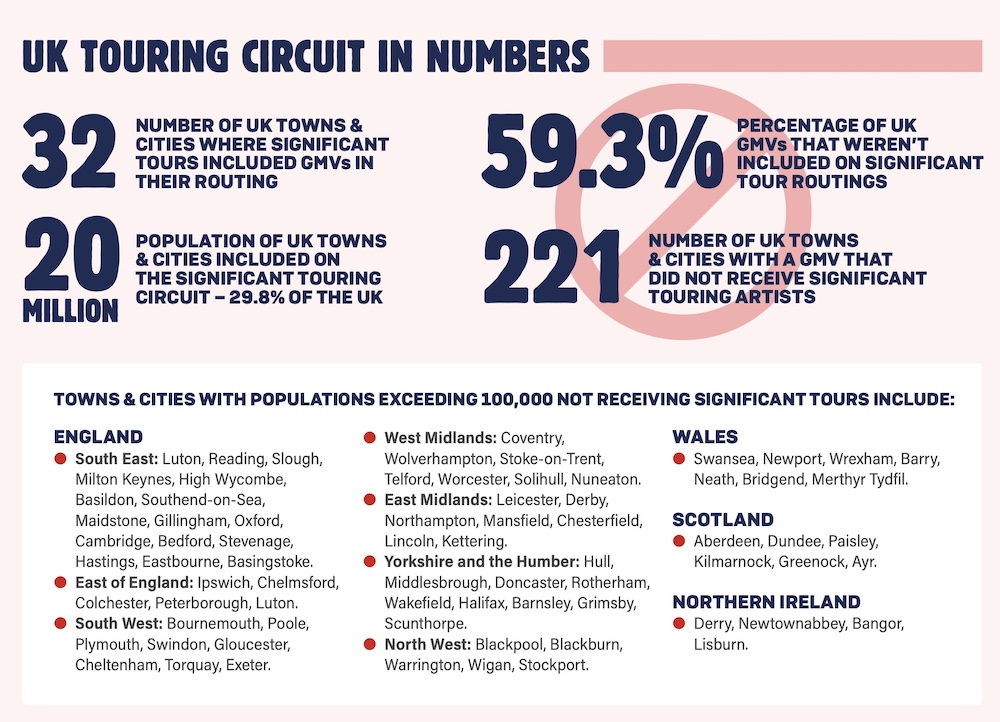
MVT’s analysis shows that 59% of GMVs – 475 venues – now operate with no major promoter activity, effectively severing them from the professional touring economy. This absence means that for a majority of venues, national tours no longer visit and local promoters lack the scale or resources to fill the gap.
As a result, audiences in more than 175 towns and cities no longer have access to a reliable supply of national touring artists.
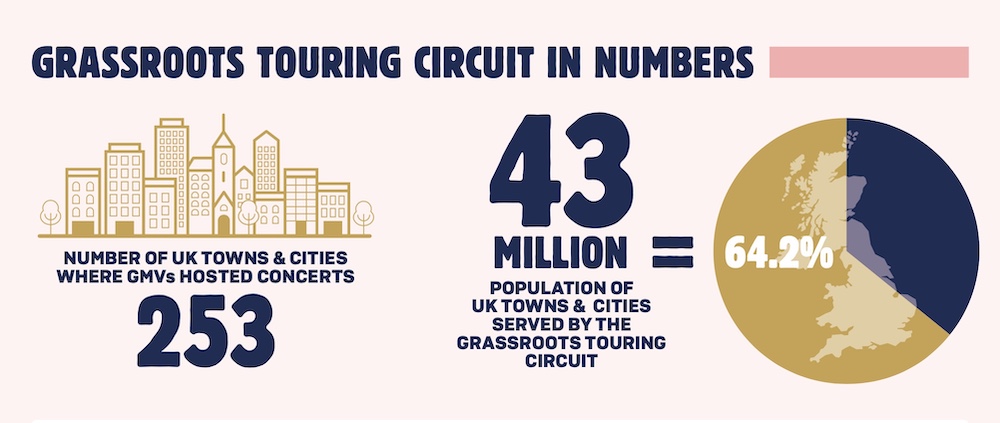
According to the report, venues service communities in 253 towns and cities. Major national promoters use MVA (Music Venues Alliance) venues in just 32 of those locations. It means that 221 towns and cities do not receive significant national touring artists (though independent promoters do operate in 46 of those locations).
The primary and secondary touring circuits are now largely confined to London, Manchester, Birmingham, Bristol, Glasgow, Leeds, Liverpool, Sheffield, and a few other urban centres.
“This retreat breaks the essential pipeline between artists and nationwide audiences, starving communities of access to new music and culture on their doorstep and removing the opportunities that once sustained developing talent,” stated the report. “For the venues left outside the remaining circuit, the impact is economic as well as cultural: fewer shows mean lower bar sales, reduced local employment, and declining cultural participation.”
MVT warns that the collapse in touring access is “starving emerging artists of essential development opportunities, undermining the talent pipeline that underpins the wider UK live music and recording industries”.
The charity identifies financial viability as the primary cause, concluding that current economic models for grassroots live music are no longer working.
GRASSROOTS LEVY LIFELINE IN 2026
Amid the depressing stats, there is hope for the sector offered by the introduction of the Grassroots Levy this year.
The Enter Shikari model (a £1 levy on an arena or stadium show) has been adopted by acts including Coldplay, Diana Ross, Don Broco, Ed Sheeran, Gorillaz, Katy Perry, Kneecap, Lorde, Mumford & Sons, Pulp, Radiohead, Sam Fender, Stereophonics and Wolf Alice.
It resulted in 8.8% of the tickets on sale at this level in 2025 containing a version of the Grassroots Levy, with dozens of artists already confirmed as adopting the model in 2026.
Tours and shows below arena and stadium level – by Mr. Scruff, Getdown Services, Frank Turner, The Last Dinner Party, Olivia Dean, The Hunna, and Bury Tomorrow – also built a contribution to the grassroots sector into every ticket. In November, Sam Fender announced that he was donating his Mercury Prize Award winnings to MVT.
Meanwhile, The O2 recently signed up to a funding commitment.
Speaking in November 2025, Culture Minister Ian Murray said: “My ambition is to see the voluntary levy in place for as many concerts as possible and, as a milestone in that progress, for at least 50% of tickets on sale for stadium and arena shows in 2026 [to have adopted the levy] by 31 December 2025. Following this, I would like to see this target brought as close to 100% as soon as possible.”
Speaking at the launch for the annual report held at V&A South Kensington, Mark Davyd, Music Venue Trust’s CEO, laid out a comprehensive plan of action.
The future of British music depends on stabilising and rebuilding the grassroots touring network
Mark Davyd
While expanding its frontline Venue Support Team and Emergency Hardship Relief Fund to prevent avoidable closures, MVT will also invest £2 million immediately into a number of targeted programmes designed to permanently reduce costs and improve sustainability.
These projects include Venue MOT, Off The Grid, Stay The Night and Raise The Standard, which focus on infrastructure resilience, operational improvement, energy efficiency, and enhanced artist and audience experience. Collectively, these initiatives aim to reduce operating costs while strengthening venues’ long-term viability.
A centrepiece of the plan is the development of Liveline, a fully funded national touring programme in partnership with Save Our Scene and the Association Of Independent Promoters, designed to address the root causes of the touring crisis.
“By covering venue costs, reducing promoter risk and guaranteeing artist fees, Liveline aims to restore a viable touring network to towns that have been excluded from professional live music, reconnecting artists with audiences across the UK,” stated the report.
Mark Davyd, MVT CEO and founder, said: “The future of British music depends on stabilising and rebuilding the grassroots touring network. The arrival of Grassroots Levy funding in 2026 will provide the opportunity to take a radical new approach and that is exactly what we intend to do.
“For 10 years Music Venue Trust has explored the best ideas from around the world, worked with our sector to understand what would make the biggest difference to them, and brought forward innovative, groundbreaking ideas that we can now deliver practically. This is no longer just about rescue, it is about working with our partners and colleagues, including the crucial role to be played by the LIVE Trust, to deliver investment and reform that restores the infrastructure that music careers are built on.”
CALL FOR A LIVE MUSIC COMMISSION
Alongside its own interventions, the charity has also set out a clear set of demands for government action, calling for fundamental tax reform to address pre-profit taxation, permanent legal protection for venues through enshrining Agent Of Change in law, and the creation of a permanent Live Music Commission to implement the Fan-Led Review and provide national leadership.
The music industry itself is in the last chance saloon with regards to the levy; if voluntary industry action does not deliver by June 2026, the government must legislate
Mark Davyd
The charity also says that if a voluntary industry contribution mechanism cannot be proven to work by June 2026, the government must legislate a statutory Grassroots Levy to secure sustained investment into the sector.
Mark Davyd added: “We have reached the limits of what venues can absorb on margins of 2.5%. This sector has done all it can to keep music live in our communities, it now needs permanent protection, structural reform, and leadership that recognises grassroots venues as essential national infrastructure. That obviously needs to come in the form of a coherent strategy from government, but they are not the sole solution. The music industry itself is in the last chance saloon with regards to the levy; if voluntary industry action does not deliver by June 2026, the government must legislate.”
Additional recommendations arising from the report include reforms to unlock investment via tax reliefs, coordinated action to reduce post-Brexit touring barriers, and ensuring that public funding schemes, including the Music Growth Scheme, explicitly support the grassroots talent pipeline.
The Music Venue Trust Annual Report 2025 can be viewed in full here.
PHOTO: Bedford Esquires
 FOLLOW