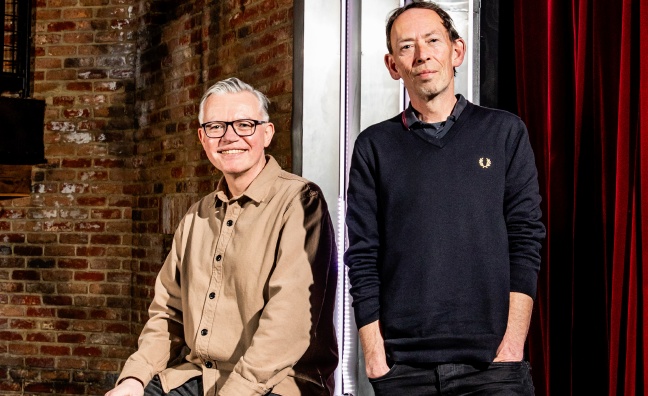
LIVE CEO Jon Collins and chair Steve Lamacq have issued a rallying cry around the “three Ts”: touring, ticketing and the Trust.
The trade body, which represents 15 live music industry organisations, launched the Live Trust in mid-January with a remit to deliver funding to those working across live music, with an initial focus on the grassroots music sector.
To begin with, the scheme will receive its funding from a voluntary contribution of £1 per ticket from arena and stadium shows with a capacity of over 5,000. Collins and BBC Radio legend Lamacq elaborated on the inner workings of the "transformative" initiative in an interview in the March edition of Music Week.
“The mechanics are pretty simple," said Collins. "It’s if you’ve got a show at a larger arena, stadium show, build a pound into the ticket price and then let’s disperse that money. The money then comes into the Trust.
"We’re not going to run 1,000 grant schemes with 10,000 applications. We’re going to be working with the schemes that we know work already, and turbo charge their work because we can push more money into them. That’s things like the Featured Artists Coalition’s Step Up programme, the Music Venue Trust’s Pipeline Investment Fund. Those mechanisms already exist, it makes no sense for us to duplicate them but we can be the catalyst in receiving the funds.
"Fundamentally, what we’re trying to do is not take a pound off any one person. We’re trying to say, ‘Can we carve out a pound within that ticket price that can then go towards funding activity that supports right across the industry?’”
Lamacq said the pair had been talking around the subject for over a year prior to the launch.
“A lot of what we were doing at the start was talking to our board members and people around the live industry about their thoughts on grassroots music and grassroots venues and how we could help support them," he said. "We were testing the water, seeing how much people in the industry really appreciated what was going on and what grassroots venues contributed to our musical ecosystem.”
I’d hate for people to think that grassroots venues are closing because no one wants to go to them. It’s not, the desire to go and see live music is very much still there
Steve Lamacq
Lamacq, who joined LIVE (Live music Industry Venues & Entertainment) in 2023, commented on the well-documented struggles of the grassroots scene, but stressed that public demand was not an issue.
“It’s obviously very tricky for a lot of promoters at the moment, for all the reasons that the Music Venue Trust will tell you about – rent is increasing, energy prices are sky-high – and it’s hard for artists to tour because it’s so expensive to go out in a van these days," he said. "Despite all of that, though, gigs are happening out there. I’ve been to four new showcase gigs so far this year and they’ve all been full. I’d hate for people to think that grassroots venues are closing because no one wants to go to them. It’s not, the desire to go and see live music is very much still there.”
Collins, who became LIVE CEO in 2022, said that it was "really challenging" for artists to tour right now.
"There are dimensions to it," he explained. "If you’re talking about the sort of emerging and mid-tier artists, it’s like, ‘Can you make the economics of touring stack up when it’s so expensive to hire a bus, put petrol in it, and with how many years of the cost-of-living crisis as well?’
"Everyone is conscious of how much money is in the customer’s pocket, so how far can you take tickets to actually try and cover those costs?”
Collins also reflected on the lessons of the dynamic pricing furore around the on-sale for Oasis reunion tour last year.
“There’s a lot of confusion around what dynamic actually means," he said. "It’s not normally the case that tickets are being adjusted in real time based on demand. First of all, 99.999% of shows wouldn’t create a level of demand where you’d be looking to do that.
"There was an exceptional circumstance last summer where one of the biggest bands on the planet, that no one thought was coming back, suddenly was coming back and it created a societal event where the whole world was trying to get hold of tickets. And then you had a billion bot attacks on that."
Being able to vary the price of a ticket is something that’s gone on forever more
Jon Collins
He continued: "Being able to vary the price of a ticket is something that’s gone on forever more, like the early-bird festival ticket. I don’t think anyone is saying that you shouldn’t be able to move the price of the ticket around. I think the issue is, how visible is what you do and is the customer able to see how those changes are happening?”
The Labour government, which made action on touts part of its manifesto, launched a public consultation last month, setting out a range of measures in the ticket resale market that aim to better protect fans, improve access to live events.
While Collins warmly welcomed the move, his attention is focused on its proposal to introduce a cap on the price of ticket resale – with the consultation seeking views on a range from the original price to up to a 30% uplift.
“We’re delighted that Labour recognise that the key metrics to remove touts from the industry are removing the ability to profit and then limiting the number of tickets [listed for resale] to be the same [maximum] as what’s in the primary sale," said Collins. "Where we’re all going to be focusing our interest now is that the consultation says between 0% and 30% as the cap. Thirty per cent does not remove the incentive to tout tickets. If anything, it actually means you need to get more tickets because the profit per ticket is capped, so that’s not going to resolve any of the issues the government wants to tackle.
"We are going to be focusing on bringing that number down, ideally to single figures, but I would imagine this is going to play out in the 0-10% space.”
The full interview with Collins and Lamacq appears in the current issue of Music Week – subscribers can read it here.