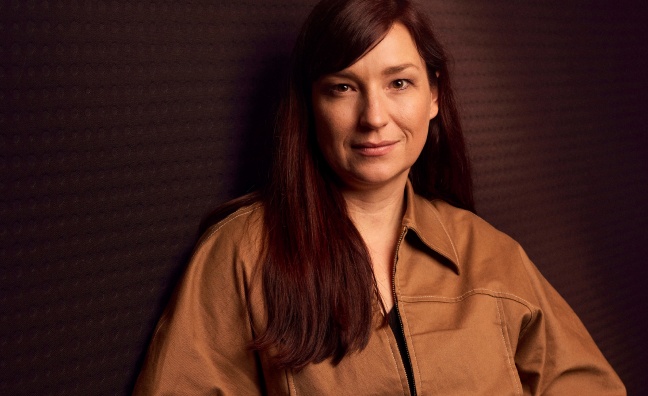
Live Nation’s Anna-Sophie Mertens has spoken to Music Week about the rise of country music in the UK, including her key role in the growth of the genre this side of the Atlantic.
Mertens was speaking following her victory in the Live Music Inspiration Award at the 2025 Music Week Women In Music Awards.
As SVP, touring at Live Nation UK, she works with an array of talent including Olivia Rodrigo, Ariana Grande, Lewis Capaldi, Myles Smith, Chris Stapleton and more.
A member of the Country Music Association board, she also launched Highways Festival in the UK.
Mertens has just taken part in the Country Music Association’s first international summit, which took place in the same week as Country To Country Festival in London, Glasgow and Belfast.
Here, she reflects on the growth of country music in the UK, key highlights in her own career and where the genre can go from here…
What’s your ethos as a promoter?
“I don’t think it’s specifically a philosophy of promotion, but I do think the key to everything is about just showing up, delivering, and sticking to your word. And if you can’t, then be transparent. If you have something that needs to be delivered by Thursday, but for whatever reason you can’t do that, then hold your hand up, explain why, and that you’ll get it to them for Friday. As long as you stick to your word and people can trust you with responsibility, it’s always going to lead to more, bigger, and better things. As I said before, that is my number one mantra – it’s what I’ve always worked to and what I pass on to anyone I am mentoring or when I talk to students. And it’s not just for business; it works in the rest of life too.”
Looking at country as a genre, where do you think it sits in the UK right now, and where can it go?
“I sit on the Country Music Association’s board of directors in the US, which is a huge deal, and sometimes some people outside of country music don’t necessarily understand. There’s 60 or 70 of us and it’s all the top label heads, people from streaming services, from live, from touring and production. We all sit in a room together three or four times a year, and we talk about how to move country music forward in the US, but also internationally. We leave our professional hats at the door and we literally come together for the greater cause that is advancing country music. They do a huge amount of research, and the streaming growth is far higher for country music than for all other genres. That shows us there are a lot of fans out there who are only just discovering country music and starting to get into it.
“There’s huge potential for the genre. But there are still challenges with playlisting, and radio or streaming can be more difficult. Radio 2 has always been a great supporter, but we’re also starting to see Radio 1 getting interested in certain artists. There still are a huge number of misconceptions around the genre; people might just think it’s all country and western, boots and hats – but it isn’t. It’s filling a gap where there might have been soft rock or folk music.”
Highways is a standout moment in the calendar, and in my opinion, the Royal Albert Hall is the most beautiful and iconic stage in the whole world
Anna-Sophie Mertens
Are there any more plans in the offing for the genre in the UK?
“There’s a new festival we’re launching, State Fayre, in June in Chelmsford. It will be a place for rock music, Americana, and country, and we’re really pleased we’re doing it. We’ve got Kings Of Leon, Alanis Morrissette and The Lumineers, and then this incredible undercard of rock, country, and folk artists. Then there’s this female artist called Sierra Ferrell, who I’ve been working with for many years and who is just incredible. She’s having a bit of a moment right now, because Mumford & Sons took her out as a support in the US and the UK. So again, I think there will be fans that will be exposed to Sierra.
“Another fantastic thing – what we call our fourth headliner – is a barbecue and food element. We’ve partnered with Fume, who are a big barbecue festival [brand], and who will have their own food pit on site. It’s all about creating huge and incredible experiences for the fans.”
You were also behind the launch of Highways – how do you reflect on its evolution?
“Oh, Highways, my first baby! It’s become a real staple in the calendar for country and Americana. This year will be the first time we’re running for three nights, and we have the legendary Emmylou Harris closing on Sunday. She is apparently doing a farewell tour, so we probably won’t get to see her again – it’s really special to be a part of that. Highways is a standout moment in the calendar, and in my opinion, the Royal Albert Hall is the most beautiful and iconic stage in the whole world. When artists play there, they suddenly realise just how special it is.”
It took you several years to get Chris Stapleton to the UK for his first show in 2016. How did it feel to pull that off?
“It’s the most joyful thing. He’s just one of those artists where his music is so, so good, and then you see him live and it’s just magical. It’s him and his wife and they sing to one another for two-and-a-half hours with these incredible musicians on stage and it’s phenomenal. I had the chance to see him a few times, mostly in America, but I was like, ‘You have to come over. You just have to come over. The fans are dying to see you.’ And then finally he did… The shows were just incredible. It was so important to me that they had a good time while they were over here, as they had never been before and had been hesitant to travel very much. He played all these extra encore tracks at all of the shows. I spoke to his team, and they told me that means he’s having a really good time. He played a song he doesn’t play very often, one he only ever plays when he’s having a really good time. So the UK got a good experience, and the fans were fantastic as well because they really gave back to him. I think they realised it was quite a special thing to be in that room.”
Radio 2 has always been a great supporter, but we’re also starting to see Radio 1 getting interested in certain artists
Anna-Sophie Mertens
From new headliners to huge stadium shows and festivals, last year was a landmark one for live music in the UK. Why do you think that was?
“People have really come to value the live experience. Covid was quite a few years ago now, but I think it showed us that the live experience cannot be replaced. There is nothing in this world – no virtual reality, no livestream, no recorded material – that will ever replace that euphoria you experience at a live event. I think that’s the main factor, combined with artists and festivals being even more intentional about the experience in terms of production values. Coldplay have been doing that for a long time when they first brought in the flashing wristbands. That’s a huge thing, and it takes your breath away. Then there’s how artists design the show. Not everyone needs a huge stage or a major production. It’s about designing the flow of the show, the video screens, the lighting, the staging elements, the B stage, but also thinking about doing a bit with a full band and then doing an acoustic thing.
“Gracie Abrams did this great thing where she had a stage set up like a bedroom, and she would go onto that for a couple of songs and it completely changed the mood for a minute. Then there’s pre-show messaging. Again, with Gracie, that meant everyone turning up with white bows in their hair, because that’s what you do if you’re a Gracie Abrams fan. It makes the fans feel more connected; it makes you feel like you’re part of something. And I think that’s what’s shining through and making fans want to go to events, because you know you’re going to get something really fantastic.”
Finally, festivals and arena shows are doing well, but how does that affect the grassroots circuit?
“I can say that we put a huge amount of shows into small venues. We continue to deliver on that pipeline in terms of working with grassroots venues and with artists from their very early days. I think it’s just the wider economic landscape that is probably tricky for them. I’ve never run a small venue, so I can’t specifically speak to those aspects. However, I’m sure that, in terms of the cost of living, energy bills, and all of those things rising, that’s going to be the biggest challenge for them. But they are a hugely important part of the ecosystem, and it’s crucial to have them with us.”
Subscribers can read the full interview with Anna-Sophie Mertens here.
PHOTO: Gary Morrisroe