The government has confirmed its plans – heavily trailed in advance – to make it illegal for tickets to concerts, theatre, comedy, sport and other live events to be resold for more than their original cost.
Increasingly, touts are buying large volumes of tickets online, often using automated bots, before relisting them on resale platforms at hugely inflated prices. If the government’s measures work then that is an effective ban on touts – similar to the law introduced in Ireland.
The plan for resale limited to face value to prevent such profiteering follows a consultation process.
Following many years of campaigning on the issue, a price cap has widespread industry support from artists, companies, trade organisations and industry figures, including Coldplay manager Phil Harvey, Ed Sheeran manager Stuart Camp and Music Week Awards Strat winner Ian McAndrew, CEO of Wildlife Entertainment (Arctic Monkeys, Fontaines DC, Wunderhorse).
Crucially, under the latest measures, secondary market platforms will not be able to hike service fees to compensate for the loss of their share on the sale of inflated tickets.
“The proposals will stamp out this practice, improving access for genuine fans when tickets originally go on sale and ending rip-off pricing on the resale market,” said a statement.
The new rules announced today make clear that:
Ticket resale above face value will be illegal – this will be defined in legislation as the original ticket price plus unavoidable fees, including service charges
Service fees charged by resale platforms will be capped to prevent the price limit being undermined
Resale platforms will have a legal duty to monitor and enforce compliance with the price cap
Individuals will be banned from reselling more tickets than they were entitled to buy in the initial ticket sale
Culture Secretary Lisa Nandy said: “For too long, ticket touts have ripped off fans, using bots to snap up batches of tickets and resell them at sky-high prices. They’ve become a shadow industry on resale sites, acting without consequence.
“This government is putting fans first. Our new proposals will shut down the touts’ racket and make world-class music, comedy, theatre and sport affordable for everyone.”
Business Secretary Peter Kyle said: “The UK is home to a brilliant range of music, entertainers and sporting stars – but when fans are shut out – it only benefits the touts. That’s why we’re taking these bold measures to smash their model to pieces and make sure more fans can enjoy their favourite stars at a fair price.”
The new rules will apply to any platform reselling tickets to UK fans, including secondary ticketing platforms and social media websites. Businesses who break the regulations could be subject to financial penalties of up to 10% of global turnover from the Competition and Markets Authority (CMA), under new powers introduced the Digital Markets, Competition and Consumers (DMCC) Act 2024.
Platforms such as Viagogo argued against a price cap, suggesting that it could push consumers towards social media and unregulated sites.
According to analysis by the CMA, typical mark-ups on secondary market tickets exceed 50%, while investigations by Trading Standards have uncovered evidence of tickets being resold for up to six times their original cost.
Government analysis suggests that these measures could save fans around £112 million annually, with 900,000 more tickets bought directly from primary sellers each year. Inclusive of all fees paid, the average ticket price paid by fans on the resale market could be reduced by £37.
Dynamic pricing was also part of the consultation. The government has today welcomed the commitment from the Society of Ticket Agents and Retailers (STAR) who are convening the sector to establish best practice, including on price transparency.
This action will build on the recent announcement by the CMA (Competition & Markets Authority), who secured commitments from Ticketmaster to improve pricing information, following the Oasis ticket sale. This includes giving fans 24 hours’ notice of tiered pricing, providing clearer price information during online queues, and ending misleading ticket labels.
In future, the CMA will be able to respond even more swiftly and robustly (including imposing fines of up to 10% of global turnover) to breaches of consumer law, following the introduction of its new enforcement powers under Part 3 of the DMCC Act.
Here, Ian Murray, Minister of State, DCMS and the Department for Science, Innovation and Technology, speaks to Music Week about the government’s plans to stop fans being ripped off in the secondary market.
Some people would argue that ticket resale should be left alone as a free market for people to spend how they choose, why have you decided to intervene?
“It's not a free market. That’s the reason we're doing this because it's fleecing fans and ripping them off; bots have been using systems to gain access to large numbers of tickets. As soon as tickets go on sale, people are waiting in queues while bots are taking them up, and then they're being resold minutes later for many multiples of face values with huge fees on the back of it. So it's a whole cottage industry that has grown up in the resale market that's ripping off fans and undermining live performances. And it's something that we promised that we would do in our manifesto, because the fans are losing out.”
It's got to stop ticket touts and criminal activity from fleecing fans and undermining live music
Ian Murray
Some of the problems in secondary ticketing could perhaps be solved by better enforcement of existing laws. What persuaded you to go all the way and announce a ban on touts?
“There is some consumer protection law, but not in this particular area. Because the whole point of putting a price cap on, and putting service fee caps on, is to provide a secondary resale market for people who have legitimately bought tickets to performances, and can no longer use those tickets and want to sell them on. So having those legal obligations in the resale market is really important to be able to say to fans, ‘If you buy a ticket for a concert, you're buying it at a reasonable price and there will be a healthy resale market for those tickets that you can no longer use; and that other fans will be able to buy it for a reasonable price on the other side'. So it's just about saying that the whole market here has to be about fairness. It's got to be about fairness for fans. It's got to stop ticket touts and criminal activity from fleecing fans and undermining live music and live performances full stop.”
Was the voice of the artists important in this decision?
“Yes, I think artists themselves have been very much at the heart of this, because they want to protect their fans. Their fans are essentially their customers and that's why they perform. In the last few days, we’ve had Ed Sheeran, Coldplay, Mumford & Sons, alt-J, there's been a whole number of major artists that have said it's a really strong step forward, because it's protecting their fanbase and doing the right thing by their fans, and that's what performers want to be able to do.”
And your proposals will also make sure that platforms don’t just increase service fees…
“Yes, there's obviously legislation to come, and there will be a percentage cap on service fees as part of that, but there will have to be a process in terms of getting that legislation together. So there's four elements: the price cap on resale in terms of the original price; the service fee cap as well In terms of resale; there's prohibition in not being able to sell more tickets than you're able to buy; and there will be legal obligations to enforce it. So when you put all that together as a package, you’re essentially protecting fans, protecting performers and protecting tickets.”
 Ian Murray
Is there a concern that it will mean more ticketing fraud ends up happening via social media?
“Well, you'll not be able to do that if you're restricted to buying a limited number of tickets, and therefore you'll only be able to sell the number of tickets that you're able to buy. So it should also put consumers much more at the forefront of this, because consumers can therefore be confident that if they're buying a ticket, they're buying it from a legitimate source. They're buying it within the bounds of legislation in terms of the caps structure, and they're buying it from a legitimate reseller. So all those things should make protections better for consumers, rather than more complicated.”
And what will the requirements be for platforms in terms of monitoring all of this?
“There will be legal obligations to the legislation. There will be legal obligations to make sure it's enforced. The CMA are already doing a lot of this enforcement with the Digital Markets Act in terms of some of the stuff that's going on at the moment. The CMA have pretty wide-ranging fines, and they can fine up to 10% of global revenues on this so that could be multi-million pound fines for platforms who don't abide by the legislation. So there would be pretty hefty fines. The CMA also have the ability to levy criminal sanctions as well for repeated breaches. So hopefully that, as a package, will mean that the secondary ticket market becomes something that's much more focused on fans.”
Have you got a sense when this new law banning touts might be enacted?
“The legislative programme is obviously very busy, but we'll do this as soon as we possibly can. There has to be a legislative process, it has to go through Parliament, we will need laws to do this. That is a fairly slow process, but it has to be done properly. There will obviously have to be consultations around this as well to make sure we get it right.”
Over the years, regulators have had to take action in relation to secondary ticketing platforms. Are you confident this will work?
“Absolutely. And if you look at the [action taken] on the recent issue on dynamic pricing and Oasis, which is slightly different from reselling. So there are issues that the CMA can look at at the moment, and the Digital Markets Act that's just come into force across the UK gives the CMA much more teeth to be able to deal with this kind of stuff. So from a fan's perspective, the whole issue around transparency of ticket pricing, when you are entering a process to buy a ticket, whether it be in a queue or whatever, is really important, and the CMA have dealt with that. And then the resale market is what this is about, which is really about protecting fans and making sure genuine fans can get to concerts without price gouging from bots, and from criminal activity in a lot of instances.”
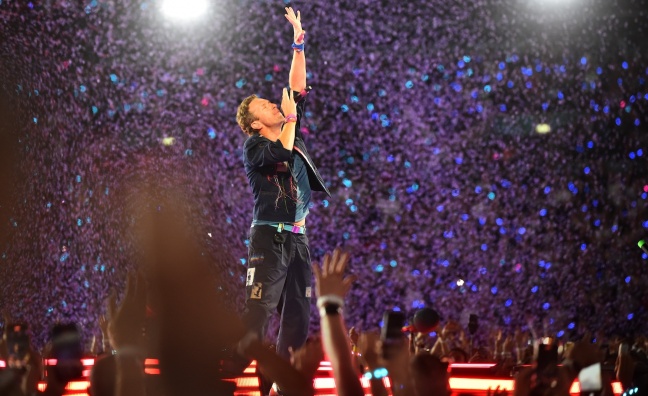
MAIN PHOTO: Coldplay at Wembley Stadium (Jim Dyson/Getty Images)
 FOLLOW