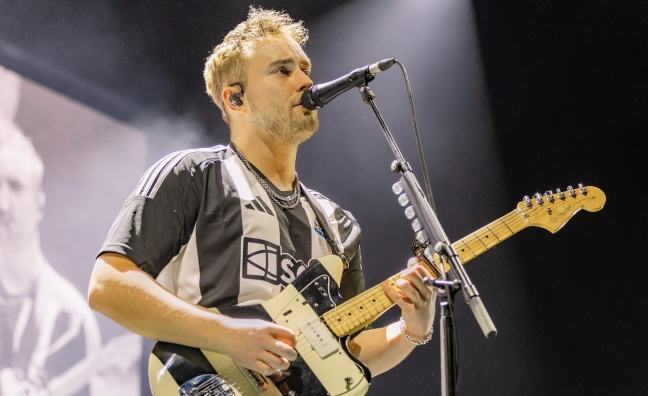
“This is the best day of my life and I know this will be the best gig of my life, and the best night,” says a misty eyed Sam Fender as he walks on stage in Berlin.
His long sold out show at the 4,500-capacity Uber Eats Music Hall was always likely to be a special night, but the fact that his beloved Newcastle United had won their first trophy in 70 years a few hours before stage time means that it has become a landmark event. The team played in shirts with Fender's People Watching album logo on the back.
No wonder that Dirk Dreyer, general manager of the AEG-operated venue, is grinning widely as he looks up the result on his phone at the end of the game. “It will be a good night,” beams the executive, ushering us into the venue he joined in April 2020, two years after it opened.
The Uber Eats Music Hall is situated on the Uber Platz, across the road from the East Side Gallery, the last remaining section of the Berlin Wall. It sits, surrounded by bars and restaurants, next to the Uber Arena, which will host Sabrina Carpenter a few days after our visit. The Music Hall itself welcomed Jamie xx just before our arrival, while The Last Dinner Party, Fontaines DC, Lewis Capaldi, Dermot Kennedy, Tate McRae and Olivia Rodrigo have all played. Jack White was its first ever booking, and even Bob Dylan has returned on two occasions. Tonight though, the throng in the square is there only to worship at the altar of Sam Fender.

With various stadium shows and festival appearances looming, this constitutes an underplay for the chart-topping singer from North Shields, indeed when he walks on stage, he’s almost within touching distance of the front rows of the vast dancefloor. Even from the very back on the higher tier, you feel right on top of the action, something Dreyer says is very deliberate.
“We’ve caused quite a stir in the live scene here,” he says. “Berlin’s existing mid-size venues are not purpose built for live music, they are former theatres, cinemas, warehouses or sports venues, and those are the downsides for those venues. We entered the market with a venue that is purpose built for live music in terms of production capabilities, acoustics and the artist experience. It also sets new standards for guest experience.”
The pure heart and emotion of Fender’s music reverberates with extra intensity in Berlin, the lights are low, the PA is cranked loud, the floor shakes and the crowd is boisterous. Near the back, someone in a Newcastle shirt drinks beer from a jug. Elsewhere, tears roll down cheeks as the music pounds.
Backstage afterwards, Fender gratefully receives the gift given to every artist who plays (a ‘piece’ of the Berlin Wall) and tells Music Week how excited he was to get the name of Newcastle defender Dan Burn (another local hero) into the lyrics of Little Bit Closer.
His agent, CAA’s Paul Wilson, is also chuffed with how the night went.
“It’s my first time at this venue and overall it’s been a great experience,” he says. “Excellent for sound and production and the big standing floor helped create a party atmosphere. The band and crew said it’s one of the best shows on the tour.”
Outside, people are reeling, as if touched by a kind of religious experience. Dirk Dreyer, still beaming, departs, his last duties done. A teenage DJ and party organiser who became a record executive turned hotel manager, he sees his role at the venue as a chance to combine his ardent passion for music with his love of hospitality (“I know that coffee should be hot and beer should be cold, not the other way round!”).
He is equally passionate about the venue’s charity work and sustainability initiatives, which include donations from guestlist tickets (which go towards local charities as well as a project encouraging refugees to form bands) and a ‘Fame Forest’, where a tree is planted for every act that plays the Music Hall or Arena.
And, as we discover when we sit down for our interview the morning after Sam Fender’s show, Dreyer is keen to uncover the secrets of a venue that is fast developing a reputation as a must-play for UK acts…

Dirk Dreyer
If last night’s show was anything to go by, it seems things are going very well for the venue so far…
“We had an incredible year last year with 138 events, which is a record, but every year in a young venue is expected to be a record-breaking year. I’d say that 2024 was the first year not affected by Covid, I had the feeling that a lot of artists had the urge to tour, the diary was full, not only at our venue and the Arena, but there were shows everywhere every night in Berlin. The good thing is that people still have hunger for shows, they’re still buying tickets and prioritising that over restaurants or holidays. I’m super happy, but we are still in the process of building a legacy for the venue. Many visitors are still coming here for the first time and we’re not established over decades, but at the same time, bands are now returning to play. Bob Dylan was here for his second run of shows last year, Architects and The War On Drugs have been back, Steve Hackett is playing for the third time in May.”
How is the venue perceived in the industry?
“We are very close to the nightlife strips in Berlin, we’re really part of the nightlife scene. We were well greeted by everyone, but of course you have to hustle to convince promoters to go off the beaten track and try a new venue. But it’s getting better and better, we have a very strong team here. The Music Hall is part of the Arena campus and most of the staff work for both so we have a very high level of expertise and skills in all departments. The artists recognise this, and visitors also realise that there are no amateurs here.”
We are still on the ramp and there are so many stories that we haven’t told yet
Dirk Dreyer
What is your booking policy?
“We keep relationships with mainly the local promoters and they organise the concerts in terms of promotion, ticketing and marketing. We keep good relationships with bookers and agents too. We work with a diary and we work with requests, but of course we try to get certain acts, try to make the promoter aware if we think something is a good fit, if we hear someone is touring. We aren’t limited to a certain genre or style, we have a lot of emerging artists and we’ve realised we have a lot of international artists. Other mid-size venues in Berlin have domestic repertoire and German hip-hop artists playing, with lower ticket prices and lower production standards, but we’ve become the favourite for international artists. Some of those now arena level artists that were on the way, like Tate McRae, Olivia Rodrigo… A lot of international artists prefer to play with us because of our reliability, production standards, safety and security standards, just the experience everyone has.”
You’ve had a significant number of British and Irish acts play the venue – what do you think attracts them?
“Berlin has 30 million overnight stays a year, I guess about a million from the UK alone. We have excellent connections with the UK, it’s affordable, accessible, you saw it yesterday, there were plenty of people from Newcastle! For UK acts, it’s a typical career step. You choose the biggest potential market in terms of record sales, streams and live. Germany has a very good infrastructure, all the big players operate here. It’s a good ground for artist development and there are plenty of clubs and grassroots venues, too. It’s not an easy thing, but it’s the most accessible next step outside the UK from my perspective.”
Would you say the venue has had a particularly good start?
“The bar was very high from the opening concert, which was Jack White. It started as a side project of the Arena, then began to gain an identity and got a dedicated team. Our booking director Aissata Hartmann-Sylla has been here since day one and she’s an icon of the German and European promoter scene so that has helped a lot. But there are still so many things that we can do, we are still on the ramp and there are so many stories that we haven’t told yet.”

What do you think makes the venue stand out most?
“Like I said, it was purpose built for live music, so the architects and designers had what pleases an artist in mind. In terms of production, there are no limits, you can put as many LED screens and lights in as you want, you can build a stage as big and wherever you want, you can have a catwalk or a B stage... Then, from a business perspective it’s not only the location, it’s the view, the sound, the air circulation… All that makes it an enjoyable experience.”
Do you have one single message to the UK industry?
“If you want to bring your artist to the best-sounding, coolest venue in the must play destination of Berlin, call me. [Laughs].”
And what would be your dream booking?
“Two of the artists on my bucket list might turn up this year, some Dusseldorf electro pioneers and a UK rave veteran band…. My favourite band is Depeche Mode. I remember we once had a request for ‘No Name DG’ and it turned out it was Dave Gahan. He was playing a solo show but it never happened because it was during Covid.I’m a 90s raver, really so Chemical Brothers, The Prodigy, Underworld, Massive Attack, Faithless… Those would be a perfect fit. They should not play anywhere else, I’m serious, they shouldn’t play in a theatre, they should play in a massive, dark, black box…”
PHOTO: Pedro Becerra/Stageview
 FOLLOW