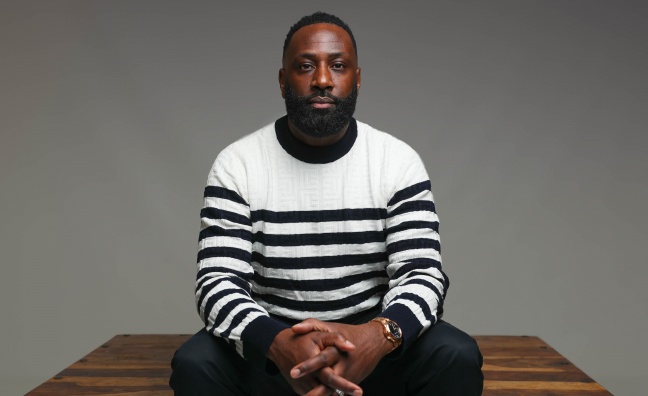
"I don’t want to sound like a wanker,” said Riki Bleau in the new issue of Music Week. “But when it comes to audiences, culture and trends, I’m supremely confident that I will spot what’s coming next. From my Channel U days to now, I’ve done it too many times for it to be lucky.”
The Since ’93 co-president invited us into his office to share his life and times in the industry and open up like never before about his path through the business. It’s a journey that has taken in success with an array of acts including Emeli Sandé, Sam Smith, Aitch, Cat Burns, Tyla, Tems and many more.
Below, in the first of a series of extracts from the interview, Bleau reflects on his partnership with co-president Glyn Aikins, who he began working with at the start of his career, and discusses how they have established Since ’93 as a Black music powerhouse.
How did you actually end up going into business with Glyn?
“I started Since ’93 in 2016 and Sneakbo was my first signing, I licensed his first record, Too Cool (Right Here), to Virgin. Glyn was coming to the end of his contract at Universal, and he came to me and said, ‘Look, I want to start a label – would you do it with me?’ And I was like, ‘Well, why not? I’ve done everything else in this business; that’s probably the last bit I haven’t really tried.’ It was just a natural progression. Because we had done so much together – good and bad – it felt like a perfect relationship. People thought that we knew each other outside of music because of how well we got on, but it was a relationship that was born in this business. It was born from the fact that, between success and failure, nothing had changed. We had got a bit of a rhythm going, and when we spoke to Jason Iley [Sony Music UK & Ireland chairman & CEO], he backed the vision entirely. I can’t speak highly enough of how much he has supported us to build Since ’93. It’s been brilliant.”
People make the mistake of thinking you’ve got loads of time, but that’s something you don’t have at a label
Riki Bleau, Since '93
Why is it that you work so well together?
“There are things that Glyn understood about the nature of this business that I had never experienced. My thing has always been, ‘Get the job done – the result justifies us.’ But when you’re in these systems, it’s not just a result. You’ve got to make the people involved feel good while also worrying about the result. A really good example is working with Fredo. If he phoned and asked if he could shoot a video in Dubai in three days’ time, the system’s gonna tell you no, because the system cannot get you money that quickly. So in those instances, I would give him the money and then get it back. I just thought I was being helpful, but what I didn’t realise is that I was sidelining some of the marketing team, because that’s their role, their responsibility. If the artist has all the money directly, they don’t get to manage or control the situation in the way they need to. I didn’t realise I was pissing them off until one day I was like, ‘Why is this person annoyed with me?’ and Glyn explained it, and I went, ‘Ohhh, I get it.’”
With early signings Fredo, Loski and Aitch, you really hit the ground running…
“We had a lot of warmth, which you’ve always got to have at a label. People make the mistake of thinking you’ve got loads of time, but that’s something you don’t have at a label. You’ve got to have something going on, or very quickly the doubts set in. People need something to be excited about. You’ve got a team of people, you’ve got to have them motivated, especially when you’re a venture within a machine. Myself and Glyn have always prided ourselves on having a broad taste, and what the likes of Fredo and Aitch allowed us to do was develop artists in the background, like Cat Burns, who we signed in lockdown. It’s funny, we’ve gone from a very male-dominated roster, to flipping it the other way with Tems, Tyla, Qing Madi…”
Read the full interview in the new issue of Music Week, out now. Subscribers can read it in full here.
 FOLLOW