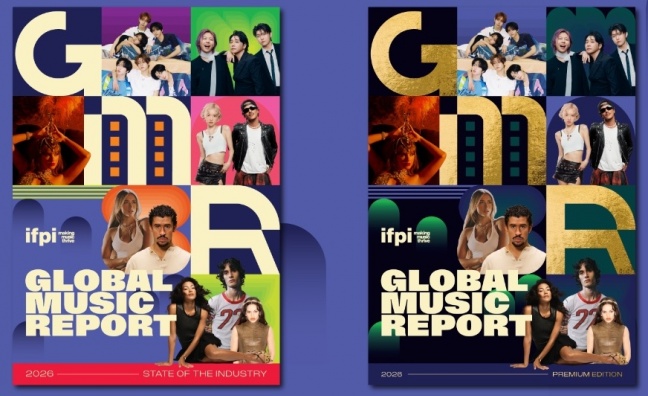
With the launch of the IFPI Global Music Report 2026, industry executives once again flew into London to tackle some of the key findings and themes from the study.
It was another good year for the industry with 6.4% year-on-year growth in 2025. Crucially, that was spread across the global industry.
“I think the statistic that really stuck out for me is that 57 of the 58 markets tracked [by IFPI] grew this year [2025], so this isn't a couple of markets dominating and growing for the entire industry, it is happening in every market in the world… It truly is a global story,” said Dennis Kooker, president, global digital business, Sony Music Entertainment and a familiar face at the IFPI panel.
Here, Music Week breaks down the key areas of discussion in this year’s report…
AI DEALS & INNOVATION
The annual IFPI event was nicely timed around more developments in AI – positive news on the UK government responding to artists and rights-holders’ concerns about a text and data mining exemption; and Sir Lucian Grainge’s appearance at the Nvidia GTC event.
At her second IFPI event in charge (and almost exactly two years since her appointment was announced), CEO Victoria Oakley noted how AI opportunities have developed in the past 12 months.
“We really do now have in place a dozen licensing deals announced over the past year, 20-plus further partnerships and collaborations between record labels and rights-holders and innovative AI companies, and no doubt more to come,” she said. “We're at the beginning of an exciting and complicated journey here but what it's showing is that music and AI, they don't just co-exist but they can truly collaborate, and that creativity and technology can be real partners.”
There's a ton of room for us to continue growing this business
Dennis Kooker
Complicated is a key word in that comment, though, and the nascent AI and music sector requires copyright frameworks to remain in place if it is to flourish.
“Even today, we have news from the UK who are thinking again about how they might regulate this space, and really wanting to make sure that creativity can be protected, rather than steaming ahead with a TDM exception,” said Victoria Oakley. “So I think governments are understanding that what we need is a marketplace to be allowed to operate freely and for licences to happen.”
“First and foremost, I think there is a really big opportunity here if we get it right,” said Sony Music’s Dennis Kooker, who connected the AI opportunity with music’s continuing market growth.
“There is an opportunity to continue to grow and expand the market,” said Kooker. “And why does that exist? Because, ultimately, we know consumers want to interact more with the artists they love, with the music they love. And if we really realise generative AI's benefits to the music industry, to artists and to songwriters, ultimately it's going to be making that deeper connection even deeper.”
Kooker also identified the historical role of technology in growing the industry over the past few decades – with AI being the latest innovation. Of course, that comes with the need to ensure that there are solid licensing agreements and robust copyright provisions.
It feels that we are on the brink of this wave of creative innovation for the music industry now with AI
Alfredo Delgadillo
“We've seen artists embrace it from a creative standpoint,” added Kooker. “So, all of those things combined are the reasons that you step back and think that this could be a really great opportunity. Obviously, this has to be done in a way that the products are being built for all of those benefits [to the music industry], and ultimately growing a market and that artists are getting paid, so that the investment is rewarded.”
“It's exciting, and it feels that we are on the brink of this wave of creative innovation for the music industry now with AI,” said Alfredo Delgadillo, CEO & president of Universal Music Mexico.
FOCUS ON SUPERFANS
The role of AI in fan engagement is also connected to the focus in recent years on superfans – whether that’s physical products or digital access.
Making the link between AI and fans, Kooker said it could further serve the “desire for authenticity”.
“Ultimately, it's creating new experiences with the music you love, with the artists you love, which I hope will then lead them back to wanting to engage even more with those artists and listen to more of the original music,” he told the IFPI audience. But he stressed that it must come from the artist and not be an AI tool impersonating them.
With recent sales volumes for Harry Styles, Taylor Swift and others, physical music’s growth (up 8% year-on-year globally) underlines that superfan strategy.
“I think what's really striking is that physical is back,” said Oakley. “We've often talked about vinyl – vinyl is very strong again this year, its 19th year of consecutive growth. But physical overall has shown a return to growth after declining last year. I guess one of the many things that underpins that resurgence is the return of the superfan. That's a term that we have bandied about in previous years. But I think in this last year, superfans have really cemented their position as a key component of the global music landscape.”
Superfans have really cemented their position as a key component of the global music landscape
Victoria Oakley
Samira Leitmannstetter, senior vice president, EMEA regional marketing, Warner Music Group, directly addressed the question of why superfans have become a key target audience and whether they ever went away.
“I don't think it's a comeback,” said Leitmannstetter. “It was always there. I think it's the change of narrative and the industry and how we started being obsessed with it and talking about it. I think superfans were always a thing. When I was a child in the ’80s, I was a superfan. I was a massive superfan of boy bands.
“It’s how we started [to have] a focus and a spotlight on it. I do think it became more visible with social media and with the ability of [artists] creating content themselves. And it’s the power they are holding with creating a narrative, with tapping into culture and then contextualising music within their own communities.”
Audiences and fan communities can be drivers of success at key moments.
“What I think the challenge is, is to not look at these cultural moments and the connection to the community as an isolated, viral moment, but take these moments and be ready for this as amplification for a long-lasting sustainable artist career, an artist brand proposition,” said Leitmannstetter. “This aspect of sustainability versus a short moment of virality is very key for artists. Because the key thing is to stay connected to these communities, stay connected to what is important to them and make sure to really nurture and sustain the cultural relevancy the artists have within these communities.”
LANGUAGE BARRIERS BREAK DOWN
When it comes to fandom, language may no longer be a barrier either. Spotify has recently reported on the global rise of music that isn’t in English – including Bad Bunny and BRITs winner Rosalía.
Sony Music’s Dennis Kooker noted Rosalía’s impact as a “transformational artist building that story, and yet at the same time keeping her authenticity… but taking it to the global stage”.
Bad Bunny won the Album Of The Year Award at the Grammys – a first for a Spanish-language release – and IFPI named Apt by Rosé & Bruno Mars as the most consumed single globally last year.
“It's the first time that the IFPI Global Single Chart has been topped by any artist outside of North America or Europe, and the first time a winning single has featured non-English lyrics,” said Oakley.
Sustainability versus a short moment of virality is very key for artists
Samira Leitmannstetter
Mexico has risen two places in the IFPI Global Report rankings to become the 10th biggest market, while Brazil is up one place to No.8. The market moves underline that growing reach for Latin American artists.
“Music is embedded in the daily life of the country, of the people on the streets, in the cars, in every corner you can listen to music,” said Universal Music Mexico’s Alfredo Delgadillo. “What is new is not this local repertoire's relevance. What is new is this new entrance in the Top 10 of worldwide markets for Mexico. The transition from physical to digital allowed the local culture to build and to be consumed internationally.”
He highlighted acts such as Los Tigres del Norte – “our Rolling Stones”.
“Our job is to connect strategy, to connect global infrastructure and culture,” added Delgadillo. “In Mexico and other parts of LATAM as well as Latin US, we are building hubs supporting local structure and local culture.”
Mexico has also helped to amplify acts internationally, such as Colombia’s Sebastián Yatra.
Meanwhile Warner Music Mexico and Warner Music Latina in Los Angeles have worked to build a unified US–Mexico team designed to support the growing reach of música Mexicana, including artists such as DannyLux and Edgardo Nuñez.
Warner Music’s Samira Leitmannstetter noted that artists including Alex Warren, Benson Boone and Teddy Swims made an early impact in Nordic countries.
“Music consumption is becoming so fluid,” said Leitmannstetter. “We see it with artists like Rosalía as well. Language is not really a topic anymore. You can have a Spanish speaking artist’s repertoire breaking through in China… At the same time you have artists collaborating across multiple markets, so it’s multiple language repertoire. I would say that’s an opportunity but a challenge at the same time.”
STREAMING GROWTH… AND FRAUD
Sony Music’s Dennis Kooker welcomed the headline growth of 6.4% – an increase in the rate of growth since the prior year although lower than other annual results in the past decade.
“Growth is really, really strong,” he said. “It's good to see that the growth rate this year [2025] increased again. If you look at the underlying trends that really build that growth story, there's every reason to believe that there's a ton of room for us to continue growing this business.”
Referring to the growth in paid subscription revenues (up 8.8%), he added: “From my standpoint, any time we can convince consumers to open their wallet and pay for something, that's the most meaningful intention that we can get. And you can see it within the numbers, as far as the make-up of paid subscription makes to the overall business, just how important it is.”
However, the one problematic area of streaming growth is the associated increase in streaming fraud. IFPI’s Victoria Oakley said the industry needs to tackle the issue of bad actors using AI to upload a huge volume of ‘fake’ tracks, which are streamed on an industrial scale, sometimes by bots or streaming farms. It means the fraudsters can then access the pool of royalties available to music on the platform, so there is less money to share between genuine artists.
“It shouldn't be happening and it can be stopped,” said Oakley. “We are being very clear that companies at every stage of the streaming value chain, whether that's labels or distributors, platforms or aggregators, must all take further proactive steps to prevent, to detect and then to act on fraudulent activity.”
 FOLLOW