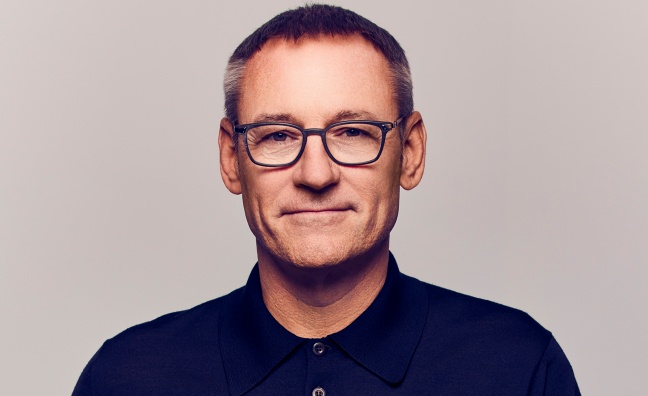
For over 30 years and counting, Sony Music UK & Ireland’s chairman & CEO Jason Iley’s name has resonated in the music business world, both nationally and internationally. His is a career that has involved working with superstar artists across a host of senior roles in different companies, from Universal to Jay-Z’s Roc Nation. And with time spent as BRITs chair, an MBE, a MITs Award, and ushering in a raft of acclaimed progressive initiatives, there are many strings to his bow. Now, in light of his latest achievement – masterminding the BRITs’ game-changing relocation to Manchester – it’s the perfect time for Music Week to salute his incredible career with the top honour at our ceremony: The Strat. Ahead of the sold-out Music Week Awards, Iley invited us into his North London home to talk about where he’s been, where he’s at, and where he’s heading next…
WORDS: GEORGE GARNER PHOTOS: NEALE HAYNES
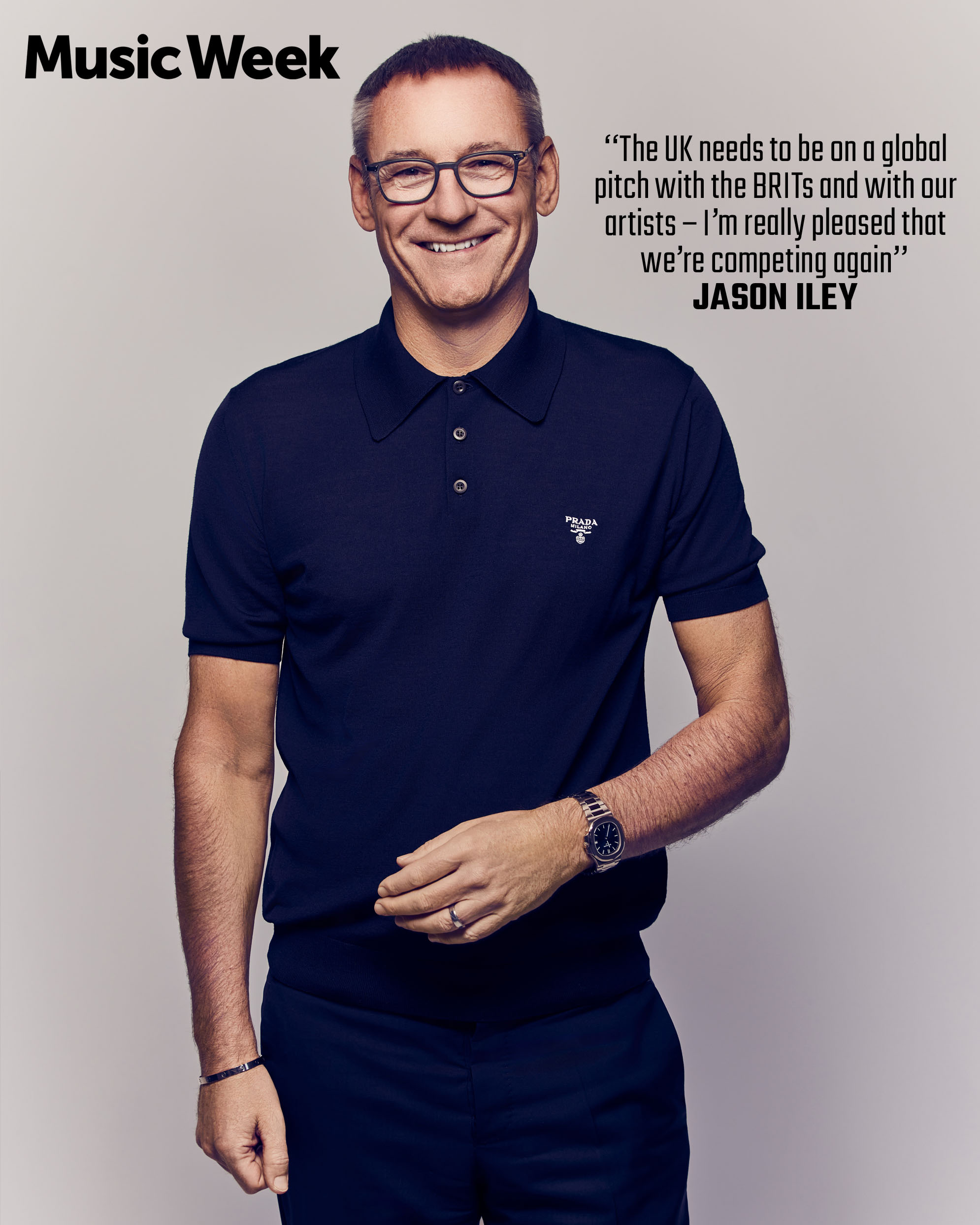
The first thing you notice when you pop round to Jason Iley’s North London home is that it’s outrageously clean. Scrap that – it’s immaculate. Dust has never existed here. Nor any smudge, stain or speck of dirt. It’s all very much befitting of the Sony Music UK & Ireland CEO & chairman’s reputation; an executive known not just for his predilection for smart, all-black Prada apparel, but also his hyper-attention to the teeniest, tiniest detail on anything he’s involved in. Given the exacting cleanliness, it only makes sense for Music Week to offer to remove our trainers upon entering. “Shoes off would be great,” Iley smiles, as our host ushers us straight into his kitchen for a cuppa.
En route, there’s nothing lining the hallways that directly speaks to his storied transatlantic career in music – one that’s seen him work with everyone from A(dele) to (Jay-)Z, via U2, Harry Styles, Rihanna, George Michael, David Bowie, Bruce Springsteen, Michael Jackson, Elton John and too many more to count. There are no platinum discs or signed instruments mounted on the walls or hallways. A music obsessive he may be, but he insists no unreleased Jason Iley acoustic demos are lurking in the house. Alas, any budding artist career he had was shot dead while playing drums in school. “I must have been about 11,” he recalls. “I remember at the end the teacher said to me, ‘Don’t ever go into music.’ Although I have to say… I was truly fucking awful.” What there is instead of musical memorabilia is an array of beautiful sculptures and artwork. “I’m just lucky I don’t also collect cars,” he quips of his obsession with art. Another non-musical addiction, he explains as our tea brews, is his Peloton, which he uses religiously every morning before heading to Sony’s UK HQ.
With cups of tea freshly acquired, we end up in Iley’s front room where we settle down on the sofas. He is unpacking the wavering fortunes of his beloved Chelsea FC when we suddenly realise what’s been distracting us: his red desk lamp off to the side of his sofa. It’s big. Seriously, imagine the biggest desk lamp you can and it still won’t be big enough. Spanning from floor to ceiling, it towers over the sofa. “And we’ve had to move that between three houses over the years,” Iley laughs, looking at this most unique bit of home decor. Yet, in many ways a desk lamp – an item so evocative of long hours in the office, burning midnight oil and poring over details – chimes perfectly with the work ethic that has brought us here.
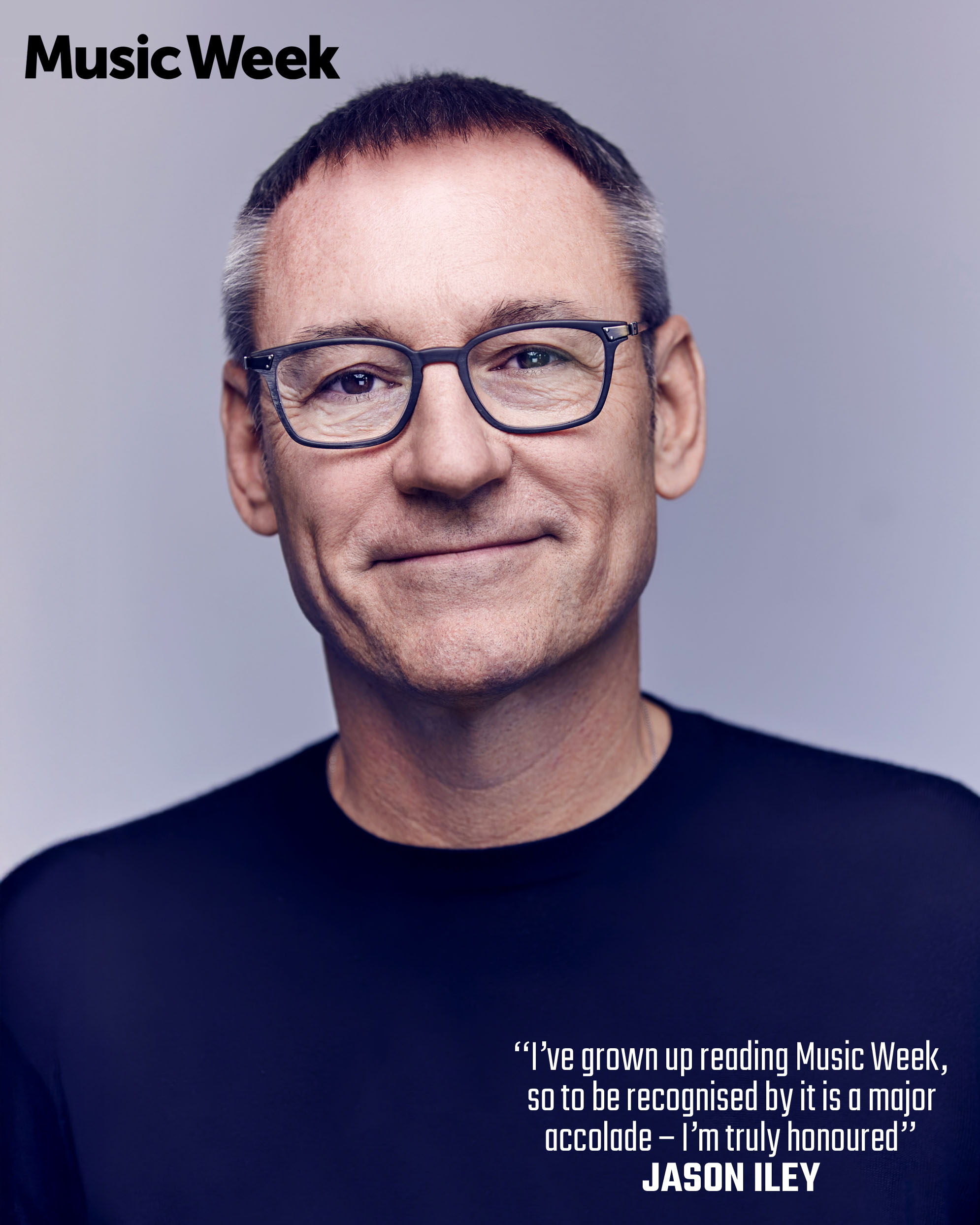
Earlier this year, Music Week informed Jason Iley that he would be the latest recipient of The Strat at the Music Week Awards, in turn becoming part of a lineage of game-changing legends who put their personal stamp on the music industry. “I’m completely over the moon,” Iley says, relaxing deep into his sofa. “I’ve grown up reading Music Week, so to be recognised by it is a major accolade. I’m truly honoured and I just need to thank everyone who’s helped me. I’ve been really lucky in that I’ve had some amazing mentors in my life.”

As one of the most respected music executives in the world, the trail Iley has blazed is well known. In 1994, after editorial and agency roles, he interviewed for Rob Stringer (now Sony Music Group chairman/Sony Music Entertainment CEO) as a budding product manager at Epic. He got the job and hasn’t looked back since, moving on to senior roles at Universal (Polydor and Island) before becoming MD, then president, at Mercury Records and later being hand-picked by Jay-Z to head up Roc Nation. In 2014, he was appointed to the influential position of leading Sony’s UK & Ireland operations, one which he still occupies today.
As Sony Music UK CEO – not to mention a tenure as BRITs chair under his belt, a MITS win and an MBE – Iley has long since left a lasting impact. Still, even with all of these accolades in his rearview mirror, this Strat win is the first to arrive in the wake of one of the biggest milestones of his career. In 2025, he boldly moved to relocate the BRIT Awards outside of London for the first time in its near-50-year history. In 2026, it came to pass in the most grandstanding way imaginable. The triumph of this year’s Sony-helmed ceremony at Manchester’s Co-op Live not only broke down the doors for the region in the process, but also resulted in one of the event’s most critically acclaimed and successful instalments ever. Prior to being greeted by him at his gate today, the last time Music Week saw Iley in person was when we glimpsed him on the dancefloor at the Sony BRITs afterparty. Not in the darkened corners talking shop but rather, drink in hand, standing in the front row for Mark Ronson’s DJ set. “We didn’t finish ’til 4am, literally,” he says. “I woke up with a terrible hangover, but the night couldn’t have gone any better.”
The afterglow of that spectacular night continues. Time and again today, he is full of praise for the Sony team (“Stacey [Tang, RCA co-president] was the chair and she handled it all with such class,” he salutes), the BPI, the city of Manchester and all the artists who made it the grandstanding moment it was. “Those 10 artists literally put everything into the show,” he says, recalling watching their rehearsals leading up to the event. Yet it’s easy now to forget what a gamble it all was. Earlier this year, Stacey Tang told Music Week about the genesis of the BRITs’ big migration. “It was Jason’s decision to move to Manchester,” she said. “The council opened up the city for us in terms of [his] vision for evolving the awards and making it feel exciting.” Today, he reflects with great pride on his bold move.
“When I chaired the BRITs from 2017 to 2019, my takeaway was, ‘How do we improve it? How do we make it important from a global perspective?’” lley recalls. “And so when it came back around [for Sony to return as custodians] six years later, my initial reaction was that we can’t just keep it at The O2 because, however much you try to push things, you’re still in the same environment. I had a meeting with some executives and said, ‘We’ve got to shake it up – we should consider moving it to somewhere like Manchester.’”
And how did that go?
“It was met with tumbleweed,” Iley grins. “I had another conversation with one of my peers who I really, really trust over lunch and that person said to me, ‘Why on earth would you do that?’ Suddenly I thought, ‘Oh my God, am I doing the right thing?’ I was really worried because we know London works: we’ve done it, it’s tried and tested. Moving to Manchester was ‘unknown’ and people were questioning it.”
Regardless, Iley pushed for it to happen. Today, he speaks with great fondness for mayor Andy Burnham and council leader Bev Craig OBE and how they responded when their initial pitch fell short of his expectations. Never one known to skirt around the truth of the matter, here Iley’s gift for straight shooting came to the fore.
“I set up a call with Andy and said, ‘I’m gonna be really, really honest with you, London’s come up with a really great strategy and Manchester hasn’t,’” Iley recalls. “I told him, ‘If you want it, you’ve got to come up with something really, really great so I can convince everyone else to do it.’ He appreciated the candour and came back with, ‘We will do a Manchester takeover.’ Andy and Bev totally embraced it. I remember being on the way to Manchester before the ceremony and someone sent me a picture of the BRITs logo in the traffic lights – it was the coolest thing.”
That feeling only grew when Iley witnessed the event in full swing.
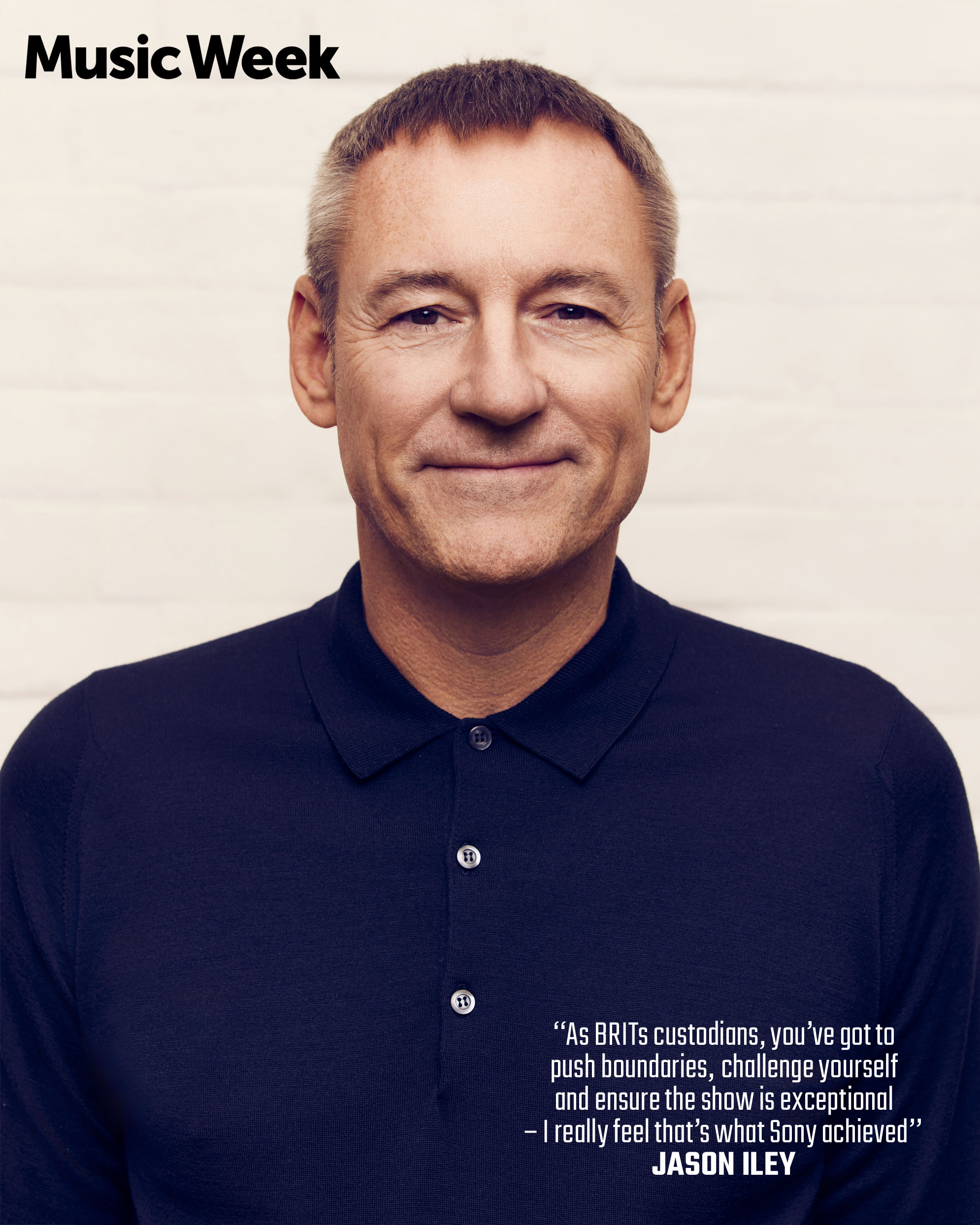
“I’ve never seen a stage of that size – not even at the Grammys,” he beams. “Honestly, I think it’s the biggest and most creative stage I’ve ever seen at any awards ceremony. You can’t just sit there and say, ‘It’s okay, let’s tick along.’ We needed to make the change. Being the custodians, you’ve got to push boundaries, challenge yourself and ensure that the show is exceptional. I really felt that Sony leant in and that’s what we achieved. I’m super proud of every artist’s performance, I thought they were fantastic – and the global social numbers were bigger than the Grammys.”
Indeed, the BRITs 2026 also secured record-breaking digital engagement, with over 250m organic video views in the 48 hours following the show, a stunning 275% increase from the previous year.
From basking in the afterglow of the BRITs, Iley moves on to reflect on his career at large. Here, Music Week hears tales of working with everyone from Sir Lucian Grainge (“His biggest lesson was always to surround yourself with great people”) to his longtime champion Rob Stringer. “Rob and I talk endlessly,” he says. “He backs me on every decision I want to make and, equally, at times, if I’m struggling, I can call up Rob and ask for his advice.”
Then there is his career at Roc Nation alongside Jay-Z. “We were super close,” Iley says. “We had a very honest, open relationship, laughed a lot – he trusted me and I trusted him.” Iley fondly recalls having lunch with him at the Mercer hotel in New York one day. He was halfway through eating his salmon when Mr. S. Carter asked him a question.
“Have you finished yet?” Jay-Z asked.
“Well, almost…” Iley replied.
“Come on, I want to go,” said the rap legend. “I’ve got lyrics in my head that I want to lay down.”
And that, dear readers, is how Iley abandoned his salmon and wound up in the studio with Jay-Z when he recorded the Watch The Throne classic No Church In The Wild.
Working this closely with artists is another thing that has defined Iley throughout his career. And it continues to yield big results. Our most recent cover star Myles Smith, who is fast approaching five billion streams, is just one Sony success story – and notably a star who has repeatedly praised Iley in the pages of Music Week for his advice, care and hyper-attention. Other recent Sony highlights from the past year, meanwhile, include Central Cee scoring an OCC No.1 album, as well as the highest-charting US album for a UK rapper ever. And you can add to this, too, a No.1 for Wolf Alice, plus for Jade’s rapid rise as a solo star and Skye Newman’s breakthrough singles last year, to name but a few. But Iley’s impact is not just measured in chart metrics.
Since arriving at Sony, he has presided over a radical culture shift at the major. Sony UK’s £15,000 Women In Music Award-winning childcare support scheme and equal parental leave (up to 52 weeks of leave for all parents, regardless of gender or route to parenthood) is one of the most famous calling cards in this regard. But there is also in-house mental health support for Sony’s artists and staff, the Women In Leadership Training scheme, Positive Influence sponsoring and mentoring scheme, sponsorship of Digital Catapult’s Black Founders Programme and awarding £2.8 million to 29 UK initiatives across anti-racism, music education, community empowerment and criminal justice reform as part of Sony Music’s $100 million global Social Justice Fund.
And he is still shepherding Sony Music UK & Ireland as it enters a new era with AI firmly at the top of the headlines (“There are great possibilities from new tech, but we need the right policies from government – including upholding copyright – to ensure the future of the industry,” he says). For another, there is Sony’s new partnership with fellow Strat winner Max Lousada and Julie Greenwald’s new label 26.2, which has set up operations in London and New York. “I’ve worked alongside Max throughout my career,” he tells Music Week of his fellow British Strat veteran. “He’s a brilliant exec, super creative and I’m delighted he’s going to be working within Sony.”
With that, it’s time to make the most of this rare audience with Iley to discuss the current state of the UK music business, leadership, and lessons from the frontlines of working with some of the most legendary artists of all time…
How do you feel about the resurgence of British music at the moment, especially in light of this year’s BRITs?
“Obviously, right now, it’s great. We had a couple of anxious years, but now you look at Olivia Dean, Myles Smith, Raye, Lola Young, Central Cee, Charli XCX, PinkPantheress, Sienna Spiro – and then on top of that, Harry Styles, Ed Sheeran and Adele. We’ve got our domestic acts working on an international level – it’s fantastic. Clearly, I’m totally, utterly delighted because we don’t need those quiet years. We need to break acts. And the reality is that the moment we put out a record on a Friday, we’re now competing on a global pitch with Rosalía, Olivia Rodrigo, Bad Bunny, SZA, Sabrina Carpenter, Chappell Roan – whoever it may be. That’s the level; that’s the standard. And that’s why we have to be on a global pitch with the BRITs and with our artists. So I’m really pleased that we’re competing again. It’s got a slight added issue now – I know some A&R executives are a bit concerned that anything that has a heartbeat here, the Americans are suddenly like, ‘Are you on this? Are you on that?’ I know acts are starting to sign to the US, but I’m quite relaxed about that.”
So, what’s your game plan with that development?
“It’s no different from what we’ve seen throughout history. We have to have confidence that we understand our culture and artists. Hopefully, the smarter lawyers, managers and acts will also realise that and carry on signing to the UK – and if that’s in partnership with the US, too, that’s totally fine. Artists who sign directly to the US, or who have signed to the US in the last 12 months or so? We’ll see where they are in the next 12 months. Because, similarly, I’m not going to try and sign an act out of America and pretend I understand everything about American culture. When I moved to Roc Nation, I was immediately competing with executives who had worked there for 20 or 30 years and understood every single thing about every area of the market. You’ve got to trust in the people that live and breathe their territory. I’m confident that the right acts will realise they still need their UK footprint. I actually had a conversation with one artist and their manager about this recently…”
How did that play out?
“I said to them, ‘Why do you want to sign to an American label? For the next two years, what’s your strategy?’ and they replied, ‘Well, we need to figure out the UK…’ That was my thought exactly: you’ve got to lay the foundations in the UK first, and if you’re signing to the US, who’s laying those foundations? I then asked them if the A&R executives from the US were actually going to move to the UK to set them up. The answer was, ‘Well, no…’ That’s my point. You’ve got to believe in the culture of what we do, and have confidence.”
To that end, do you think anything has shifted in the past year or so in terms of the A&R focus? Have execs been spending more time in the studio, rather than looking at trends?
“I think Olivia Dean’s a perfect example of that. You’ve got to take your hat off to Jo Charrington, Emily Braham and Willem Ward; they went back in the studio with Olivia on the second album and made a really, really great record. And great records work.”
It’s reassuring in a way, isn’t it? That for all the ways music has changed, an undeniable record can still cut through…
“Yeah, and they have with Olivia. And then Lola Young came out with a huge song that will be around for years to come. Myles Smith’s had two No.1 records in America [on Top 40 Radio] and has done nearly five billion streams. With Central Cee, that’s nearly four billion streams and a No.1 in the UK. I’m old-fashioned, in a sense – even going back to when I was younger – A&R has to be king. The records have to be the best they can possibly be. And then marketing people like me, or publicists, or digital people come in, and we only look like gurus if the records are great. I remember when I was younger, I was a goal hanger to the A&R offices, because whether it was at Epic, Polydor or Island, what I used to do, as a marketing person was literally hang outside the A&R offices to hear what they were signing, see what I thought was best, and make sure that I was a product manager [laughs].”
Going forwards, what do you want to see the British industry do more of? And what do you want to see less of?
“Well, clearly I’d like more hits on a global basis. It’s funny, I look at our last eight, nine weeks and we’ve had something between eight and 10 in the Top 20 every single week and my current stress will be, ‘Well, what are we doing over the next eight to 10 weeks?’”
From our past conversations, you’ve always been wired this way – you seem far more interested in looking ahead than ever celebrating in the moment. Is that a fair assessment of the way you operate?
“When people get all excited about, ‘What are the week-one album sales?’ I’m like, ‘What will the sales of the album be in week five?’ That’s the key to it. You always have to think longer term. And what do I think we should do less of? Execs shouldn’t worry. They should just keep focused on spending more time in the studio and continuing to make better records, because the acts I just listed are proof that we can make great records and sell on a global basis.”
In terms of British music as a whole, what are you looking for from the government right now?
“There’s been so much time, effort and inquiry drilling down into what we do, and every minute I’m spending on politics is a minute I’m not spending with my artists. There’s a better understanding of the music industry now, but if the government is trying to make big changes to it, and it has serious cost implications for us, then that could mean less investment in artists, less investment in marketing. What we don’t want to happen is that the UK just becomes an international distribution centre for repertoire coming from America, and you just allow and hope that US executives sign UK acts, and they might break them. I don’t want the UK to be like that, which has happened elsewhere… That’s far too risky from where I’m sitting.”
You sound up for the fight…
“Should the majors have made some improvements before the Broken Record campaign brought some of the issues up? Yes, I think the campaign was right to challenge on some points. Sony already had an industry-leading approach to writing off unrecouped balances and we’re proud that we’ve improved this further since. But, as I said, it still needs to be economical for labels to invest in and sign new talent. I’ve got a good relationship with Andy Burnham, who’s helped us a lot with Manchester. We’re in contact – I spoke to him the other day – and he couldn’t have been more supportive of the BRITs. And so far, my experience of him has been a good one. The key with Andy is he loves music. So, yeah, that’s my view of politics.”
With your eye for detail and business acumen, you could have pivoted to, say live, publishing or whatever else you wanted, but you’ve stayed in recorded music. Why is that?
“The reason it’s been record companies over publishing or live is because we’re at the heart of it. We create everything: we sign the acts, we make the records, we come up with a creative campaign. We take the act to market and those other areas then benefit from our success or failure, but we are, first and foremost, in charge of the global strategy. I’ve been really fortunate throughout my career to have worked numerous international acts, but going back to my young self as a marketing manager hearing the act from the A&R teams, then the record being made, going and making videos, deciding who will design the sleeve, who will be the photographer, then coming out with the strategy to take the act to the market, that’s where the real buzz is. Those other areas of the business don’t touch that. Well, they touch it later, but we originate it. So that’s the key. Without wishing to be too controversial, I think the other areas are more comfortable and sit and wait and we do the work [laughs].”
Your relationship with Rob Stringer has been long and successful since he interviewed you for your first job at Epic. What was your first impression of him at that time?
“The first thing I remember when I went into Rob’s office was that he had all the point-of-sale for the Manic Street Preachers’ The Holy Bible album artwork by Jenny Saville. I remember walking in and thinking, ‘We’re gonna get on really well here.’ Obviously, we did because he gave me the job and over many years, we have a very open, honest, trusting relationship. We really connect on music and on the artistic side of what we need to do for our artists. When I took over the chairmanship of Sony, Rob said to me, ‘The only thing is you’re going to really miss the label side of it all.’ And it was true. But then we put the Wolf Alice record [2025’s The Clearing] out, and it’s like we’re both product managers again getting involved in the artwork and the videos [laughs]. Poor Polly Withington was dealing with Rob and me, who think we’re the product managers, when she was really the creative genius and already had it all sussed out in a beautiful way. But it’s quite interesting that we still love that element of being involved. The challenge for me in my role is you have to trust and let the labels do their thing. Music’s still the most important part. As I said earlier, if we get the records right, the rest of the company works. If we don’t get the records right, then we’re in trouble. It’s always got to be about the art, the music and the artists first.”
Moving from one peer to another, what did you take away from working with Jay-Z?
“You were talking about me and the long game, but Jay sees further than anyone else. He was always focused on doing the right things and had that ability. And the other thing in reference to Jay is that he was confident, and always confident enough to say no. So, what I say to artists when we’re signing them is, ‘Look, my labels are going to hate me saying this to you, but have the confidence to say no.’ The label is going to say ‘Can you do this and that?’ and there’s going to be parts of it that don’t feel right. So I tell them if it doesn’t feel right, say no, and I’ll back them, as much as that might be to the annoyance of the label. Artists need to trust their gut instinct. Jay had that incredible gut instinct – if it wasn’t right, he wasn’t going to do it. I think there’s an intrinsic knowledge and confidence that the most successful artists have as to what the right thing is to do. And my ultimate view on this is that when we have new joiners start our company, every month I sit with them and say: ‘Our number one job description is to realise the vision of the artists, and the day that any of you think you’re more important than the artist, you’re not gonna be part of Sony.’ Artists put so much trust in us to help and support them – we’re here to do our best to make them global superstars.”
You’re Sony’s longest serving UK CEO, but what’s kept you at Sony for so long? What is it about the company that’s held your interest?
“When the Sony job was offered, I was at Roc Nation and I remember saying, ‘I don’t want to move back to the UK if it’s only going to be a three-year type deal.’ And the other thing that I thought was really important, from a Sony perspective, was that the previous chairman had been there for two and a half years, and the one before that had been there for three and a half years. When a president takes over a record label, the first thing they do is drop all the acts the previous president signed. So what was happening with Sony was that they were suddenly going right and then, the next minute, they’re going left. My view was that the company needed consistency for a period of time, it needed direction. Fortunately, I’ve been empowered and supported to do that. And if I look back over the years, I don’t think the company is the same today as it was when I started.”
Can you tell us how?
“If I look at what we’ve done with diversity and inclusion within the company, we have more female executives in my leadership team than men. There are also the policies that we brought in throughout the company – that’s hugely down to Liz Jeffery [VP, People Experience]. My conversation with her is always, ‘What can we do next?’ We’ve got great teams, great leadership, great marketing people, we’ve got great A&R people. But what more can Sony do that makes a difference? So, young executives think, ‘Okay, we’re going to go to Sony Music because we understand their culture. We understand that they’re going to look after us. We understand they put their artists first, they believe in art – and they’re all the things that add up to what I hope is a great company.’ And, similarly – and this is what Rob does with me – it’s important to empower executives and say, ‘How do we make Sony great?’ We have an annual internship programme, and at the end of each year the cohort presents their ideas to us, and they’re just incredible. We’ve implemented lots of different ideas because of those intern presentations. They’ve come up with great ideas, and we’ve empowered and supported that. I’ll always continue to try to challenge our execs and our managers to keep pushing the boundaries. And at the same time, we’re good to our staff. It goes back to, again, holistic support and wellbeing. We know a lot of global companies reacted to mental health issues post-COVID, but we were doing it in 2016. We wanted to do the right thing. A lot of people – artists and execs – during my lifetime who suffered from mental health issues just disappeared and left the industry, and that doesn’t need to be the case anymore.”
Regarding Sony’s game-changing childcare policy in particular, what was the industry response to that?
“There have never been as many senior female execs at Sony as there are today, and we’ve seen better retention because of the policy. It can also be accessed by men, and we’re seeing that have a ripple effect well beyond Sony Music. Our hope is that it will continue to help support female executives returning to work after having children. I think that’s why it resonated so much. When I started at Sony, it was male- and white-led, and that isn’t a reflection of what our artists are. And now, as I said, we are super diverse, and we’ve done the right thing.”
Anyone who makes it in the industry can’t go through it without some bad days, some challenges, some setbacks. What keeps you going during the times where it’s not going to plan?
“The beauty of the music industry is that you can have your diary mapped out for the week, and then you come in and that whole diary can be turned upside down because you’re dealing with artists. I liken it to this: I think the 350 people that work for me could all go and work for Coca-Cola tomorrow, but the same 350 people that work at Coca-Cola couldn’t come and work in music. That’s because they’re dealing with a fixed commodity, and we are dealing with art and artists, so you never know what’s going to happen on a daily basis. Of course, we’re fortunate enough that we have lots of highs: the highs of seeing artists chart or perform or just spending time with so many great, smart people. And the lows? The lows are challenging. I mean, when we had a couple of years of the [UK] industry not breaking acts, that was tough because we want to be on the pitch. I found that difficult because when my boss says to me, ‘I’m looking at Mexico rather than the UK,’ I want him to look at the UK rather than Mexico. He’s not doing it to poke at me – it’s just a matter of fact. And going back to the politicians part, he doesn’t mind where he gets his success from, as long as it’s working. So if the UK starts to retract, then the investment goes elsewhere. We’re all ambitious, and we all want to have success and hit records. So that’s the toughest part – when things aren’t going well. But that’s tough for everyone.”
What do you do as the leader in those instances?
“You just need to tell people to be patient.”
Does that include yourself?
“Yeah, I suppose so. But that’s the benefit of having a good boss – Rob doesn’t need to remind me because he knows I’m already monitoring what’s going on in our market and taking initiative to make sure things succeed. That’s why he’s a great boss – he understands that no one puts more pressure on me than I do myself. You just have to stay confident that there’s always another success waiting around the corner.”
Sticking on the subject of leadership, part of your remit is not just finding the next superstars of tomorrow, but also finding the next generation of executives. When it comes to developing executives, how do you like to lead on that front?
“When I started at Sony, I remember asking the head of HR, ‘Show me who the future leaders and executives are of the company.’ And it was like I had asked some outer-space question. I look at every aspect of all of the company and know, if a marketing director leaves, which product manager can step into that space. We look at every aspect of the company to make sure we’re future proofing it.”
Is that why you take the time to meet the new starters every month?
“It’s so important, and it’s important for them to understand what we’re trying to do with the company. From a personal point of view, I am continuously learning, too. I am by no means perfect. And it’s not just about learning from senior executives from around the world. People think that mentorship is about the people above you, whereas you can have mentorship from people ‘below’ you – in either age or ‘stature’ – that have really smart ideas. You’ve got to be listening to all the people, the whole team, because so many people have amazing ideas. As I said, the interns have some fantastic ideas that we’ve embraced. So, leadership and management is an evolutionary process – we are continuing to learn on a daily basis, and just hope we all keep getting better at it.”
On every level, your job must be mentally, physically and emotionally demanding 24/7. What’s still fuelling you at this point after 12 years in charge?
“People in music are really, really lucky to live their hobby, right? We all grew up loving music, and we’re fortunate enough to work with the best acts in the world. I mean, if I look at my time with U2, I travelled the world with them. We get to spend time with some of the most creative, smart people. And I’ve always felt comfortable with artists. I’ve always had very honest, open conversations with them about what I think is right and what’s wrong, and fortunately that’s resonated and connected with them. You look at the trust with Jay-Z or U2, or today with Myles Smith, Cat Burns, Jade or Skye Newman, they come and sit in my office and talk to me about their music. It’s just natural.”
Do you have any golden rules when it comes to dealing with artists?
“You have to be honest with them. Artists are putting their lives in our hands. If you can’t be honest and say, ‘You don’t have the songs yet,’ and then they put the record out, and then afterwards, you say, ‘I knew you didn’t have the hits,’ they’d be like, ‘Why the fuck did you not tell me that?’ I pride myself in having those difficult conversations, and artists will either listen or they won’t. And it’s similar, in essence, with my staff. I’m there to push them, challenge them and make sure they push boundaries. You’ve got to be honest. But going back to your point about where I get the energy to still do the job – I look to my summer ahead watching Rosalía, Harry Styles, Tame Impala and Paul Simon perform. And that’s just a few that I can think of right now…”
Finally, as we’ve established, you’re always looking ahead and rarely permit yourself to look backwards. With The Strat will you allow yourself a moment to just feel pride instead of, ‘What’s next?’
“It’s funny, because I’m honoured by The Strat, and I was honoured by the MITS, but when I’m told about these things, I still feel a sense of apprehension because I think that an executive should be back of house rather than front. I’m more than happy being back of house and making sure that I support my artists. I have a weird thing about accepting awards – it takes a great deal of thought for me. I just feel that everything should always be about the artists!”
 FOLLOW