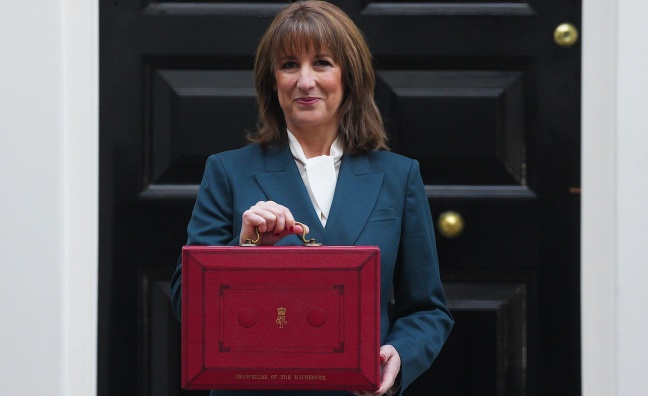
The music industry has delivered its response to Chancellor Rachel Reeves’ Budget.
The Office for Budget Responsibility (OBR) predicted that the UK economy will grow by 1.5% in 2025, upgraded from a 1% forecast in March
Inflation is predicted to average 3.5% this year, before falling to 2.5% next year, and returning to the Bank Of England’s 2% target in 2027.
Among the key measures that will affect small and medium enterprises (SMEs) are an increase in the legal minimum wage for over-21s – a rise of 4.1% in April to £12.71 per hour. Wages for 18 to 20-year-olds will go up 8.5% to £10.85 per hour.
National Insurance (NI) and income tax thresholds will be frozen for an extra three years beyond 2028. Employer National Insurance contributions were increased in the previous Budget, taking effect in April this year.
Growing efforts on sustainability for touring could be hampered by a new mileage-based tax for electric vehicles and plug-in hybrid cars to be introduced from 2028 The new tax is about "half the fuel duty rate paid by drivers of petrol cars", according to the Budget Responsibility (OBR).
Greater Manchester, West Yorkshire, West Midlands, South Yorkshire, Liverpool City Region, the North East, and the Greater London Mayoral Strategic Authorities will receive £13 billion in funding to invest in skills, business support and infrastructure.
Gee Davy, CEO of the Association of Independent Music (AIM), commented on the continued challenges facing small businesses that play a vital role in the UK’s music industry.
“We welcome the Chancellor’s clear commitment to improving conditions for workers, especially young people,” said Davy. “But SMEs – the talent engines of the UK – including those in the hugely diverse independent music sector, risk being unable to help deliver this vision. While headline figures for the UK music industry look strong, grassroots and independent businesses and entrepreneurs – which release the majority of the UK’s new music – are under strain after years of rising costs post-Brexit and Covid, compounded by increased employment costs. Many are battening down hatches or downsizing just to stay afloat.
“Targeted support is needed now to prevent decline, and would deliver huge cultural and economic returns. A tax relief for new music creation, modelled on the successful film scheme, and unlocking unused apprenticeship levy funds for salary support would empower the independent music sector to create jobs, skills and growth across music communities throughout the UK.”
Her remarks come in light of UK Music's recent findings that music contributed £8 billion to the UK economy in 2024 with music export revenue reaching £4.8 billion.
While headline figures for the UK music industry look strong, grassroots and independent businesses and entrepreneurs are under strain
Gee Davy
Music Venue Trust CEO Mark Davyd – who outlined the potential impact of the Budget in his Music Week column – described it as a missed opportunity for the sector.
“This Budget is yet another episode in the long-running saga of failures to seize opportunities to support grassroots music venues,” he said. “The government's rhetoric on their support for this vital sector is completely undone by the reality of their business rates decision. Abandoning the current 40% rate relief for a far weaker 12% reduction in the rateable value multiplier is a tax hike hiding under the claim of ‘lower bills for everyone in 2026/27’. Abandoning the existing rate relief simply results in higher bills next year than this year, no matter what HM Treasury spreadsheets claim or what impact on that rise transitional relief might have.”
He added: “Nothing on VAT on tickets, nothing on investment, nothing on tax reliefs, nothing on cutting energy bills [for business], intervening on rent, addressing Agent of Change flaws, or any of the multiple opportunities everyone keeps bringing to the government that they don't act on. The government currently insists on taking 20% from the Grassroots Levy in VAT. Maybe at the very least we could have a conversation about how wildly inappropriate that is?”
This Budget is yet another episode in the long-running saga of failures to seize opportunities to support grassroots music venues
Mark Davyd
There was some encouraging news for entrepreneurs and start-ups with an increase in the Venture Capital Trust (VCT) and Enterprise Investment Scheme (EIS) company investment limit to £10 million.
In her Budget speech, Reeves said: “We are widening eligibility for our enterprise incentives so scale-ups can attract the talent and capital that they need.”
AIF CEO John Rostron said: "The UK's independent festival sector is one built by entrepreneurs and so we welcome The Chancellor's announcement of a consultation on how the tax system can better back business founders and investors. We look forward to seeing how this government will add to initiatives such as the Music Growth Fund to drive more investment into the UK music industry.
“We also welcome a rise in the national minimum wage. While we appreciate that this will put greater onus on businesses, ours is ultimately a people sector. We believe that fair pay creates greater access to culture, which is at the heart of everything our members work towards."
Kath Easthope, CEO at Boardwave, which supports start-ups to keep them in the UK, welcomed measures to encourage scale-up, VC and enterprise investment schemes.
“This shift sends an important signal: the UK wants to back companies that are building at speed, not just starting out,” said Easthope. “With global competition for talent and capital intensifying, that clarity matters.
“As founders, we're excited to see a budget that finally understands scale-ups. Expanding the remit of the EIS and VCT schemes so that scale-ups can benefit is exactly the kind of intervention high-growth companies have been waiting for. It will make a material difference, giving Britain’s most ambitious businesses the confidence to scale, succeed and stay in the UK.”
PHOTO: Carl Court/Getty Images
 FOLLOW