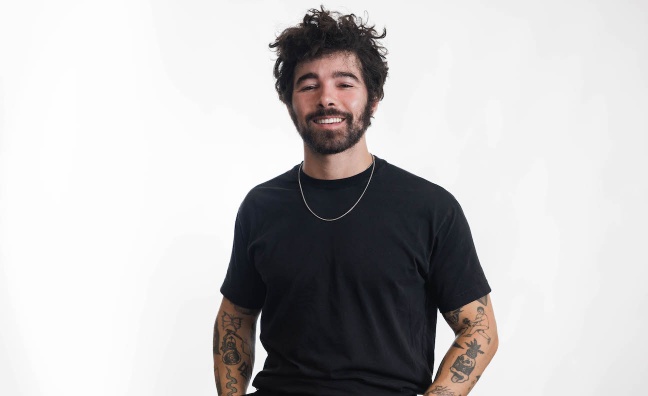
Broke Records played a key role in the breakthrough for Embrace It by Ndotz, which has amassed almost 250 million streams on Spotify alone.
The US label founder Andre Benz spoke to Music Week last year about the set-up for the US label, which partnered with Flystr8 and Chosen Music on the Top 20 UK campaign for the London-based rapper. The partnership has continued in 2025 with new Ndotz track Tic Tic.
The streaming impact of Embrace It was fuelled by TikTok virality, along with energetic marketing across social platforms.
Benz has been a frontrunner in the field of music and digital marketing. He created the YouTube channel Trap Nation for electronic music in 2012, aged just 15. He then founded record label Lowly, aged 18, to spotlight talent from his Trap Nation discoveries.
Trap Nation developed into a portfolio of YouTube channels, The Nations, with a combined audience of tens of millions. Create Music Group acquired a majority interest in 2012.
Benz’s most recent label launch is Broke Records, which also partners with distributor Create Music Group. Broke has a JV with Ndotz label Isekai, which launched recently and has also worked with viral sensation Stepz.
Other artists who have released via Broke include Blackbear, Sainte, Adore, Kenny Allstar with Headie One, Camelphat & Rhodes, Cult Member and NCTS.
Here, following the success of Ndotz, Andre Benz discusses his vision for Broke, the power of platforms for music and aligning digital marketing and A&R…
What’s your background in terms of the labels you’ve developed, including Broke?
“My background is in building brands and businesses, mostly in music. So 12 years ago, I built this company called Trap Nation. Through that venture, I was in this weird position that I was being pitched by a lot of labels. So I just saw the industry from a different perspective – not as an artist or a label, but as somebody who actually markets and promotes a lot of the music. I didn't feel like most labels, especially in today's ecosystem, really were doing much besides being the middleman – they weren't doing the digital marketing for the records themselves, they were onboarding agencies to do it.
“So we thought this was a great opportunity to start an independent label that really handles everything from A to Z in terms of the digital marketing, working with the artist, very hands-on. I lead a lot of the marketing initiatives for everything, I also do a lot of the A&R. I'm very in touch with everything that's going on. The whole premise of Broke, essentially, is that we want to become the best independent record label in the world for breaking the next generation of artists and hit records. That's kind of like what our mission is right now.”
Did a space open up in terms of the artists, whereby maybe the traditional industry wasn’t reacting in the same way?
“Yeah, I think generally the opportunity for us was that people move quite slowly on things in music. People get pretty comfortable. So we just came in, we move super fast at everything we do. That even shows with [Ndotz]. We were there first, we worked with the artist first, and we understood how to market that music very well. So it gave us that opportunity to push that record and sign it, and now it's obviously huge.”
In terms of digital marketing, what is it that you think makes you better than other companies?
“Yeah, that's a good question. I don't think I can do it better than anybody else. The reality of marketing is that it's just creating opportunity. All you're doing is creating a chance for somebody to be heard by the right people or the right person, and it's our job to make sure that we increase those chances and make them as high as possible. How do we increase our probability of making sure that a video does really well? Honestly, it just comes down to putting in the work. You have to listen to a song, find a creator, find a page or find anything that is going to use that song.
“Our job is to make sure that the people that are following that person are going to engage with the song. It's a lot of work to go out there and test things over and over again and fail nine out of 10 times. Not every video we get works, but the one out of 10 that does, those are hit videos – 10, 15 million views. Then we’re like, okay, that worked because of these reasons – now we need to lean into that. I don't think a lot of companies want to put in that work. So I don't think we're better than anybody else in that aspect, but I think we put in the work and it shows.”
We want to become the best independent record label in the world for breaking the next generation of artists
Andre Benz
How challenging is it to adjust and stay on top of the changes at various platforms, which are key to your campaigns?
“I always love it when massive paradigm shifts happen in the music industry. I wouldn't be here if, 12 years ago, had not decided to view YouTube as a serious player. That allowed me to create this big channel, and I created a business out of it. Inherently, YouTube is one of the biggest music platforms now in the world.
“With TikTok now, it's the same thing. There have never been more hit artists being broken off TikTok, Instagram Reels and all these different social platforms. Maybe it will last another few more years, music being consumed the way it is. Maybe TikTok changes the algorithm. Who knows? But I think for us, whatever the next step is, I always welcome it, because I think I've always done a really good job in those scenarios when these massive paradigm shifts happen. And I hope the next one that does happen creates a whole new wave of opportunity and better models for artists. The more competition that exists, the more people that are competing at an elite level to service music to consumers, means it is ultimately just better for artists.”
What was driving the success of tracks like Embrace It, is it the marketing or the organic viral impact of the song itself?
“It's a combination of both. A lot of the marketeers are also A&Rs [at Broke]. And if you're the best digital marketeer, you're also inherently the best A&R, just because you understand music consumption at its core, how people consume music. So that's just a really important part. But yeah, it's just being really fast on the artist repertoire side, and then on the marketing side, being able to turn around posts on social media almost instantaneously. That formula is very efficient.”
So do you think certain barriers have broken down? A&R has traditionally been seen as its own self-contained discipline.
“This is the breakdown with traditional record label models that I see. You have all these key stakeholders within these larger label models that you have to sell [the idea] to believe in an artist, right? But when you work on a smaller start-up, where the A&Rs are also the marketeers, and everybody's so hands-on, we can sign a record and turn around content in less than 24 hours. We can find a record, do a deal, ingest it, market it in less than 48 hours. That’s the timeframe from getting a deal out to getting an advance paid to starting marketing, whereas most traditional record labels, you're talking three, four weeks, sometimes even longer to do those processes. So that's the big flaw – but I think there's pros and cons to both models.”
Are there established labels that you do think are adept at this approach?
“Empire do seem to have been quite good at turning things around quickly. Empire, 10k Projects, 300 does a pretty good job for sure.”
Where do you fit in the market with all the services deals and traditional deals and distribution deals that are now on offer?
“I believe we're a better partner than anybody else, because I think digital marketing is the most important thing for artists right now, period. I think people that say otherwise are lost and they don't understand what actually is moving music. Traditionally, A&R is super-important, but I think it's super-important only at a certain stage in your career. For a lot of the artists we target and go after, we believe we can get to that stage. With the Ndotz record, people were assuming we must have this 50-person team. But it was just eight people working the record in the US.
“When we go out and compete with major labels, I believe we're a better fit than any of the other labels. I think we can compete with any of those labels from a deal standpoint, but also a performance standpoint as well. I truthfully believe we can work that artist better than Republic records. I think that shines through, not just on the results, but also the passion that we pitch to artists.”
 FOLLOW