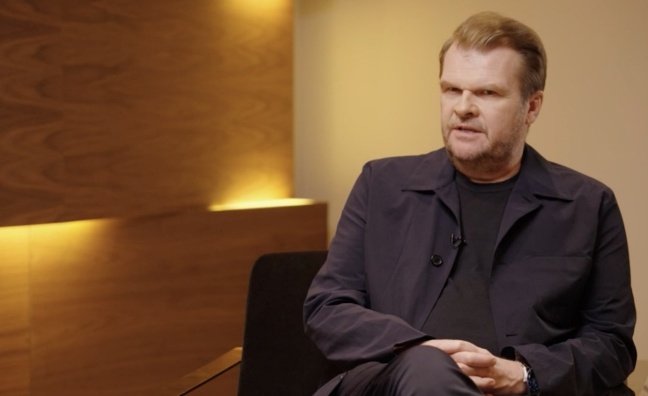
Sony Music Group chairman Rob Stringer has delivered a presentation for investors and taken part in a ‘fireside chat’ to expand on some of the key topics.
The Sony Music boss was speaking amid a positive backdrop for the major, including record revenue results. Sony Music Group’s revenue grew at an average of 14.7% annually over the past four years – ahead of a market rate of 11.3%.
Sony Music Group has completed more than 60 acquisitions and investments totalling over $2.5 billion in the past year.
Stringer used the presentation to applaud the success of Sony Music artists across labels and distribution operations including Beyonce, Tyla, Tate McRae, Future and Bad Bunny, as well as Sony Music Publishing clients Charli XCX and Chappell Roan.
Here, Music Week has pulled out five highlights from the presentation…
DISTRIBUTION 'MARKET LEADER'
The rise of artist & label services has been a key industry story in recent years. Sony is a key part of that with both Music Week Awards winners The Orchard (26,000 label partners and counting) and AWAL, which Stringer noted has been more focused on artist services (20,000-plus clients).
“None of our competitors come close to that magnitude of scale,” said Stringer.
“We have minority interests in over half at least of the Orchard’s top 20 clients, and it has recently formed a rapidly profitable admin initiative with our central publishing group,” he added.
Crucially, though, the vast expansion of this area of the business has not resulted in falling margins for the major as competition increases in the sector.
“I think we're a market leader in this respect,” said Stringer during the Q&A with Justin Hill, SVP, finance & investor relations, Sony Corporation of America. “I think we were the earliest to adapt an indie distribution platform into our system. So, I think that we're the most experienced in understanding the relationship between distribution and our general ecosystem. And the answer is that our margin hasn't come down… So, we have a pretty good balance of how all these ecosystems work.”
CATALOGUE CONSUMPTION SHIFT
It’s a truism that today’s hits are tomorrow’s catalogue. Sony Music is seeing the benefits both in classic catalogue and more recent repertoire.
“As the streaming age matures, similarly, the consumer does the same,” said Stringer. “A young lean-forward contemporary music fan of 2015 may well be more of a lean-back one in 2025, listening to hits from more than a decade ago.”
Consumption is growing thanks to the plethora of platforms, both audio and video. Catalogue has gone from around 24% of the Top 200 tracks in 2020 to 50% in 2024.
“This trend is extremely beneficial to Sony Music given our rich, deep working content,” said Stringer. “We are of course perfectly placed to understand the data from this activity, and this has stimulated our desire to purchase full bodies of work of labels and iconic artists.”

Recent additions include landmark deals for Queen and Pink Floyd.
“These acquisitions are based on significant inside track expertise on the history and therefore possibility of these artistic treasure chests,” he added. “They are in no way based on random financial speculative tactics that periphery music and financial players may choose to employ. This is our lifeblood and we are best placed to proceed boldly but wisely in developing this strategy.”
It was a topic on which Stringer expanded during the Q&A.
“I think the re-emphasis on catalogue was highlighted by companies like Hipgnosis and investment funds coming into the marketplace, where quite frankly it's always been part of our structure,” he said. “So, our expertise on catalogue is immense and many people have seen us be very aggressive in the catalogue space. But people have to understand that that is based on expertise. We have 125 years of catalogue experience.”
He added: “We are not a fund buying into something and guessing what the multiple might be or what the earnings would be over a period of time. We have an inside track on those earnings and some of the major investments over the last two years or so have really been based on in-house expertise.”
STREAMING & SUPERFANS
“Paid subscription remains the fulcrum of our business," noted Stringer. “We are constantly pushing to ensure audiences are getting an improved music experience.”
Global subscriber numbers increased 11% year-on-year to 752 million in 2024. Revenue from these accounts was up 9.5%.
“In terms of commercial developments, we are in constant discussions with our network of digital music providers to expand features, add new products and most importantly to advance our offerings to the consumer,” said Stringer. “As an example, this past year, in our recorded music and publishing activities, we finalised hundreds of agreements and renewals including with nearly every top DSP as well as brand new start-ups.”

The Sony Music boss was also quizzed about the prospect of new streaming tiers for superfans.
“Well, I think that the superfan tier is an early development concept... the DSPs almost have to define with us what that actually means,” he said. “We are partners with our artists and creators, but we also don't control every revenue stream. So, it would be a multi-revenue stream-based concept. And so, therefore, we have some of the biggest artists in the world. We have some of the biggest brands in the world. We own name and likeness on some of those brands. So, I think we will be very comfortable with there being a tier that works. But I think we're in the early conceptualisation of those stages and we have to work together.”
MORE PRICE INCREASES
DSPs have increased prices recently after a long spell of no increases while the focus remained on building the subscriber base.
But Stringer was clear that price increases will need to continue – probably around every 18 months – to maintain the value of music. There will also need to be a focus on average revenue per user (ARPU) in emerging markets, as well as new tiers in mature markets to boost ARPU.
“There is a need for prices to rise and new tiers to be introduced that truly reflect the successful maturity of streaming, especially compared with what we see in SVOD services,” said Stringer. “Music should not be ‘free’ or a ‘cheap bargain’ still after a decade of such positive value for money proof of concept in mature territories. And there should be flexible pricing structures that are appropriate for high growth countries – particularly if they are sometimes hampered by inflation or differing national economic transactional methods.”
On the ad-funder tiers, Stringer said: “We would like to see the free tier be more closely looked at in terms of whether there actually was a free tier in some of the more mature markets, or whether there was a different structuring of how we would get revenue from the free tier, not just via advertising, but also by hopefully trying to convince the consumer in those tiers to upgrade to a subscription.”
The Sony Music boss also addressed commercial relationships with short-form video platforms. It follows the public licensing row and subsequent agreement between Universal Music Group and TikTok.
“We would like more data, and we would like to see more transparency… we're working on that every time we have deal negotiations, there are different types of deal negotiations with the way we would have with the mature DSP platform,” he said. “But there's room for improvement. And I'm sure actually there's probably room for improvement on both sides. But certainly from our end, we would like to have a more sort of symbiotic relationship with those platforms.”
AI CREATIVITY & COPYRIGHT
Sony Music has taken a strong stance in defending artists and copyright when it comes to AI. In the UK this week, the government managed to pass its bill in Parliament including AI regulation, though without a key amendment backed by music creators and the industry.
Stringer underlined the importance of balancing creative opportunities with the protection of copyright.
“We are excited by this and have actively engaged with more than 800 companies on ethical product creation, content protection and detection, enhancing metadata and audio tuning and translation amongst many other shared strategies,” he said. “AI will be a powerful tool in creating exciting new music that will be innovative and futuristic.”
He looked ahead to “deals for new music AI products”, as well new subscription ideas with fair revenue sharing arrangements.
Those people who have paved the way for this technology do have to be fairly treated in terms of how they get recompense for that usage in the training model
Rob Stringer
“But, these positive steps are weighed down by the lack of recognition of copyright by much of the tech sector and government policymakers in many countries and regions,” added Stringer. “The training of these models to allow such movement cannot simply be laissez-faire and disrespectful to the fact that intellectual property has clear-cut rights. These should not be abused, and moving forward, a clear remuneration system should exist.”
During the Q&A section, he expanded further on the AI issue
“I come from a creative background originally, so I'm incredibly optimistic about it being an amazing creative tool for artists and songwriters and anybody creative,” said Stringer. “I think that it is going to break the boundaries of what you can do in blending music together to be something unique and innovative. However, I do think that what AI is based on, which is learning models and training models based on existing content, means that those people who have paved the way for this technology do have to be fairly treated in terms of how they get recompense for that usage in the training model.”
 FOLLOW