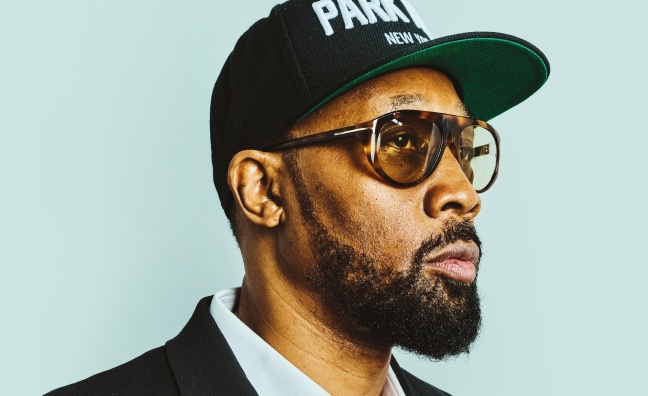
As a group that forever altered the sound of hip-hop and rewrote the rules of the music business to suit their own needs, the Wu-Tang Clan have long been venerated for the myriad ways in which they changed the game. But in recent years, the Staten Island collective’s architect, RZA, has masterminded a series of power moves – each one escalating in ambition – not only to enhance their legacy, but also to culminate in their epic The Final Chamber global tour. Here, alongside CAA’s Cameron Kaiser, the Wu’s “Abbott” tells Music Week how they grouped together to take their live business to a whole new level more than 30 years into their storied career…
WORDS: GEORGE GARNER
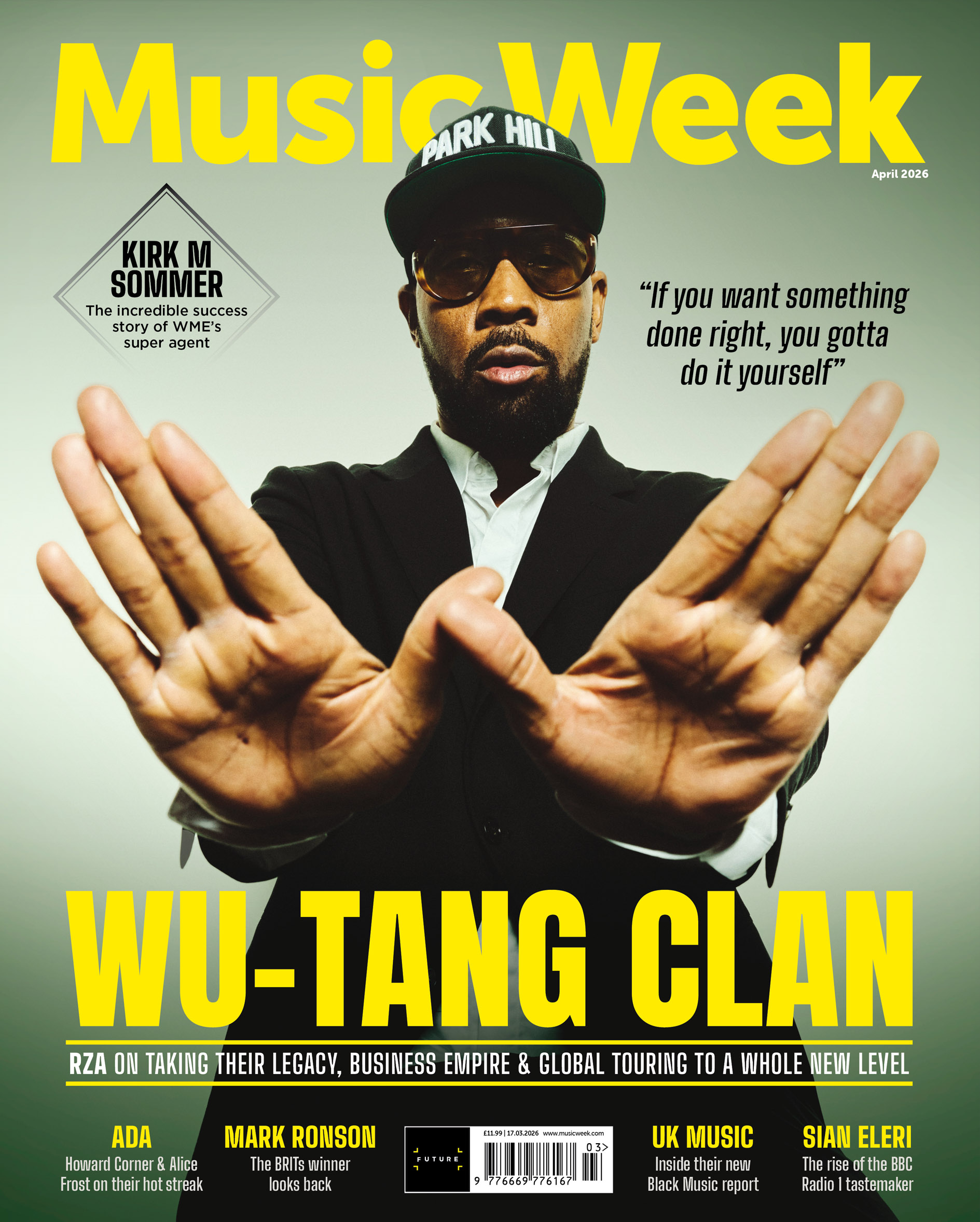
COVER PHOTO: BRYAN DERBALLA/CONTOUR GETTY
It wasn’t a normal concert. Then again, they rarely were back in the day.
“Yo, Dirty was shooting the fucking ceiling,” laughs RZA from the hills of Los Angeles as he regales Music Week with the story of one of the Wu-Tang Clan’s craziest live performances. And to think, their much-missed member Ol’Dirty Bastard putting bullet holes into the roof of the Culture Club one night wasn’t even the whole story…
“That was a wild night, bro,” he continues. “Listen, so many bottles and chairs [were thrown]. I don’t talk about it totally in full detail… I mean, I was fighting. And then after the big fight, we still performed – that’s the gag of it! But we were kids, not knowing. It wasn’t organised in a way that hip-hop has been blessed to be now.”
This is one of many memories coming into sharper focus as the group that changed hip-hop forever with their iconic 1993 debut, Enter The Wu-Tang (36 Chambers), continue on their ominously titled “The Final Chamber” global tour.
“It’s a conundrum because Wu-Tang is forever, right?” muses RZA. That is, indeed, what the group – completed by GZA, Method Man, Raekwon, Ghostface Killah, Inspectah Deck, U-God, Masta Killa, Cappadonna and, on tour, ODB’s son Young Dirty Bastard – promised us with the title of their 1997 double album. No matter how dicey things occasionally looked along the way, the Wu stayed true to their word as they sold 40 million albums, spawned multi-platinum solo careers and branched out into everything from Wu-Wear clothing to video games, comics, books, films, soundtracks and documentaries. And all of this while weathering tragedies – including ODB’s passing in 2004 and, after our interview with RZA, the death of close affiliate Oliver ‘Power’ Grant in February 2026 – plus a host of private and not-so-private wars of words with each other. What, then, does “The Final Chamber” really mean?
“What we mean by this is to get every Wu member together and go back and touch our fans,” says RZA. “That’s always been a difficult task and we know that the chance of getting all of us together… We doubt that it can happen again. We’ve all agreed that we will make our schedule available to go back out and hit the globe together one more time. Not RZA with four guys, or Meth with five guys: the entire Clan will reassemble like Voltron. Everybody agreed that this is what we were doing. We put this plan in motion close to seven years ago. We talked about it and now we’re all living it.”
Yet this grandstanding global tour offers more than the chance to hear, say, RZA deliver some of the greatest lyrics in hip-hop history live, such as ‘You couldn’t punch your way out of a wet paper bag with scissors in your hands’. “One of my uncles used to say, ‘You so weak, you couldn’t bench press a Q-tip,’” RZA laughs of the inspiration behind that particular line. Instead, it is the sum total of one of the most complex, multifaceted plans concocted in recent music business history. Not that this should have come as a surprise.
Wu-Tang was conceived according to a five-year plan devised by RZA. After suffering the ignominy of being dropped by Tommy Boy after his debut EP as Prince Rakeem flopped, he assembled the Clan and promised its members that if they trusted his vision for that duration, he would change their lives. Throughout Wu-Tang’s career, his business acumen has repeatedly proven game-changing, perhaps most notably in parlaying their initial success as a group into a host of solo deals, with each member on a different label. The result? Every major label, while competing with each other, were all united in one regard: promoting the Wu brand.
In conversation, RZA is every bit the engaging mind you expect – at times he’ll punctuate his sentences with an emphatic “BONG!” for effect; at others, he’ll go into such depth he’ll charmingly chide himself (“Forgive my long answer!”). Yet rarely does he get so animated as when he talks about how and why Wu-Tang decided they needed to ratchet things up in recent years. We have Netflix to inadvertently thank for it, the 2016 series Hip-Hop Evolution specifically…
“Watching Hip-Hop Evolution, not only was it like we weren’t given our flowers, it’s almost like they tried to skip over us for whatever reason,” he reflects. “I don’t know what the hell was going on, but I was like, ‘Yo, they had LL Cool J and Biggie but not Wu?’. Hold on, yo, no disrespect, but if Wu don’t come, you don’t get B.I.G., you don’t get Nas, you don’t get the energy of the East Coast having a say in the trajectory of hip-hop because [at that point] it had already made a left turn to West Coast success. It went pop, too. We wasn’t getting that five borough, New York foundation energy. So, when they tried to skip us, I was like, ‘Well, if you want something done, you got to do it yourself.’ And I got on a mission.”
RZA’s reaction was a “relay parallel plan”.
“We’re in the middle of two five-year plans,” he explains. “One five-year plan is already completed, which was the documentary [Showtime’s 2019 series Wu-Tang Clan: Of Mics And Men], the TV show [Hulu’s drama series Wu-Tang: An American Saga], and the re-establishment of Wu as a prominent pillar of hip-hop culture – not just a member, a pillar.”
All were very successful in their own right, but the missing piece of the puzzle was the Wu-Tang live experience. In truth, it had never quite been taken to the level that RZA always dreamed of. Not that they hadn’t come a long way, regardless…

"Our first paid gig was in Brooklyn,” RZA smiles of their somewhat inauspicious start as a live act. “It was like some fucking community centre shit. Bro, they paid us $200 for the entire Wu-Tang Clan. The show ended with a shootout. We gave the entire 200 bucks to ODB because he was the only one who had a child at the time and he needed milk and Pampers.”
Even when big-paying touring opportunities eventually came knocking, the Wu couldn’t always keep things on the rails. Burgeoning solo careers, extracurricular activities, internal beefs and more would all play a part in leading to some high-profile combustible moments, none more so than pulling off a huge tour with Rage Against The Machine in 1997. Since then, Wu-Tang have done successful tours, just not at the level they were capable of. In, say, 2015, it wasn’t unusual to see Wu-Tang playing in theatres. Nothing to be ashamed of, but perhaps not where you’d expect to see one of the biggest-selling hip-hop groups of all time.
Playing a big part in rectifying that was CAA. Enter: their agent Cameron Kaiser.
“I don’t necessarily know, prior to us coming on board, what was wrong,” he reflects. “I think perhaps it lacked a vision of what it could become. The first thing I ever did with them, which really started this resurgence, was take them to Australia to do exclusive nights at the Sydney Opera House [in 2018].
I believe we were one of the first hip-hop acts to do that and they sold them out. It was about being very strategic and not going into any other market – just doing Sydney, just doing the Opera House. It was a great way to start it off, and then from that point, the rest is history.”
The 2019 Gods Of Rap tour was another crucial milestone, with Wu-Tang headlining multiple arenas on a bill with Public Enemy and De La Soul – including a show at Wembley Arena.
“Chris Wareing, who is still a promoter today, was at SJM at the time and it was our idea to figure out how we get these guys into arenas: let’s package them up, let’s create a brand, and that’s where we were so successful,” reflects Kaiser. “Positioning them as a headliner of Gods Of Rap put them in that light as a main attraction.”
From there came the 2022/2023 co-headliner with Nas, the NY State Of Mind tour, which put them in even bigger arenas, including a phenomenal display at The O2.
“RZA then came to us and said, ‘Hey, we’ve never done a Vegas residency, let’s go do a Vegas residency,’” remembers Kaiser of what followed. “And that’s not your typical Vegas attraction, right? But we went and we pulled it off – it was the first hip-hop residency.”
Having started in 2025 with American dates, The Final Chamber will see Wu-Tang return to the UK with one night at The O2 – this time as solo headliners, with Havoc from Mobb Deep supporting – and one at Manchester’s Co-op Live. The full Clan are in. That much was non-negotiable. Every week, RZA says, they hold a “Wu Wednesday” business meeting. He had long held to a business principle that he calls the “Rule Of Four”. In a group as big as theirs, he wrote in the 2004 book The Wu-Tang Manual, if four members are against something, “then it’s serious” and you need to change your plan. He still generally abides by it, but for The Final Chamber tour, everyone needed to be in.
“For this one, if two guys don’t want to do it, we don’t do it, right?” RZA says. “Because this is serious, this has to be real. I remember there was a few years I wouldn’t tour with Wu-Tang myself. I wasn’t even busy, I was in a different mindset. We had fell out a little bit, and I needed some time to figure out things and I didn’t go on tour, and it was really diminishing at the time. And then I decided to try to rekindle my relationship, and we rekindled the energy. If you miss one ingredient, it ain’t that motherfucking stew. A cheeseburger isn’t a cheeseburger without that slice of cheese. Put that slice of cheese on? Now it’s a fucking cheeseburger!”
The success of the tour also makes for an interesting counter-narrative to headlines widely shared last year when it was reported that no rap songs had made the Top 40 on the US Hot 100 charts for the first time since 1990.
“It goes in peaks and troughs, right?” Kaiser says. “A few years ago, every single festival had a hip-hop headliner, but look at what rock is doing – rock is back in a major way. And a lot of nostalgia is doing really well across every genre – rock, R&B, especially hip-hop, too. It’s amazing to see what Clipse is doing, what Wu is doing, and Public Enemy.”
The odd thing is, for a group supposedly on their “Final Chamber”, there is precious little evidence of the Wu brand slowing down. Just as they challenged norms with their one-off, single copy album/art piece Once Upon A Time In Shaolin selling at auction to controversial businessman Martin Shkreli for £2 million in 2015, last year they released the Wu project, Black Samson, The Bastard Swordsman, with 5,000 individual bespoke covers. Repeat: 5,000. Individual. Bespoke. Covers. Given this vaulting ambition, it all makes the words “Final Chamber” seem that bit more peculiar.
“We don’t feel our time has passed, but we are getting older,” says RZA of the decision. “GZA’s three or four years older than most of us. He basically was like, ‘Yeah, I think I could run around one more time.’ Sitting down at 60 is pragmatic in America. Of course, we see some of our great rock bands go into their 70s, and I seen BB King when he was in his 80s. He played The Thrill Is Gone and the crowd went bananas. But about 30 minutes later in the set, you know what he did? He played The Thrill Is Gone. He actually realised that he played it earlier and said, ‘Well, we’re gonna do it again.’ The crowd loved to see it twice, but you wouldn’t do that in your 30s or 40s [laughs].”
That said, RZA says The Final Chamber could still take three years to wrap.
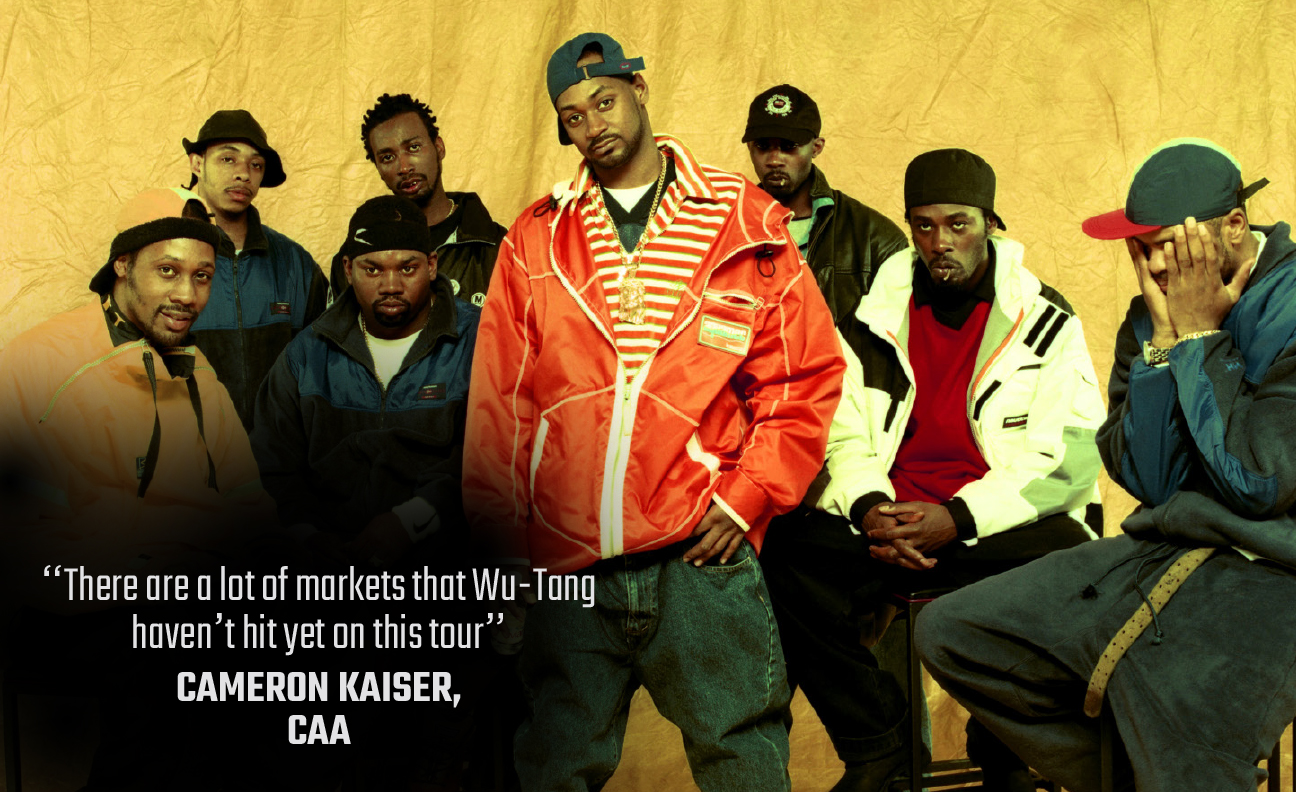
“There are a lot of markets we haven’t hit yet,” adds CAA’s Kaiser of the tour. “We just confirmed what I believe is their first-ever show in Japan, which is amazing because of how much Wu-Tang, as the group and brand, speaks to Japanese culture, right? It was a long, long time coming and we just announced we’re gonna go play a 20,000 cap arena.”
But whatever you do, just don’t call it a farewell tour…
“Farewell? No, not farewell,” corrects RZA. “We don’t want to say it like somebody’s going to pass away. But we do know that the fans, let’s be honest, have never really seen us at this level, this magnitude. With the production, the vibe, the set list, the musicality… It’s all matured. This will be what we always wanted to give you, but didn’t have the ability.”
Here, RZA aka Robert Diggs aka The Abbott aka Prince Rakeem aka The Scientist aka Bobby Digital aka Ruler Zig-Zag-Zig Allah aka Bobby Boulders aka RZArector reveals more about the past, present and future of the Wu…
So many people would have been broken or dejected by being dropped after their first EP. What did you take away from that Prince Rakeem experience, not just as an artist but also as a businessman?
“Well, of course, I was shattered. I was shattered professionally, personally and maybe even artistically, at the failure. What hurt me even more was when I was locked up [RZA was accused of shooting a man in 1991 and claimed it was self-defence – he was acquitted of all charges on April 23, 1992], I needed $10,000 bail. I reached out to my manager to reach out to the label, and the news was, ‘No, we’re not going to continue with him.’ My sister took her life savings and put the money up and I got out and, I don’t know if I shared this part of the story before but I’ll share it with you, because it’s important: when I bailed out, I went sober, bro. I didn’t smoke, drink, or do any type of criminal shit. I turned a leaf and I started making the tracks that you hear on 36 Chambers. Before I’d had a lot of blunts and all types of fucking shit. This was like, ‘No.’ I started making shit sober. One thing I realised is that I was on my own professionally and artistically. I realised, ‘Yo, the only way that I’m going to make
it is to rely upon myself.’”
From there, Wu-Tang Clan changed the way hip-hop artists negotiated their contracts – how do you see that legacy panning out for the artists that followed in your wake?
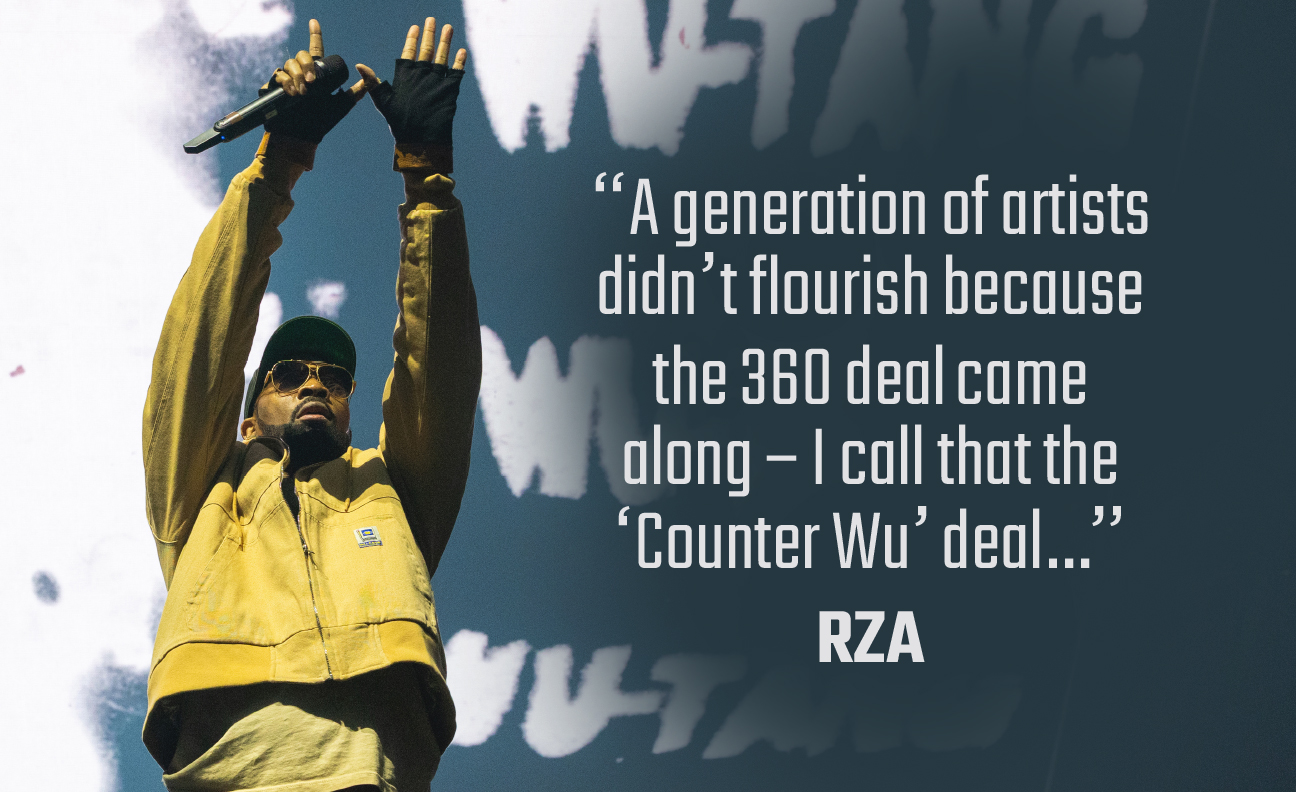
“A couple of things happened, good and bad. On the good side, artists and labels realised that you could band together and use one element to spark another – to have a brand and a crew and use it to sell multiple products. We went into fashion, skateboards, comic culture, kung fu movies. It enlightened the industry, like, ‘Wait a minute, we could actually take this guy – not just his music, but what he likes – and package that along with it.’ On the negative side, though, the 360 deal comes out – and that means, ‘We’re going to pay for your album, but we want to control your touring, your merchandise’ and all the other ancillary businesses that Wu was flourishing with. There was a generation of artists that didn’t get to flourish with that because the 360 deal came along. The 360 deal to me, I call that the ‘Counter Wu’ deal. But that counter attack, which I inspired – I never had to suffer it.”
You’ve always found a unique way to balance the demands of art and business. There was a lot of controversy about the Once Upon A Time In Shaolin project, but the intention behind it, that art should be worth something, seemed remarkably pure. Where do you think we are as a business with the value of music?
“The pendulum goes both ways. At one point, it was beneficial to the artist, and a lot of artists grew. Then at one point it became detrimental, and less of us grew when music became devalued. I’m just using numbers as an analogy here: it’s not back to feeding 1,000 people, but it’s back to feeding 500-600 people. I think that it’s going to grow, but the true growth is in live. If an artist is able to build their fanbase, they won’t get money properly from the record sales and from the label, as we did; they’ll have to get their money from the fans themselves. In the early phases of Wu, we were able to get off the Rage Against The Machine tour and still succeed economically. Now, the money remains on the streets, and if an artist understands that and uses IG, TikTok or X or whatever to grow a fanbase, they can build up enough people to sustain themselves as a musician through live. It’s going to be very difficult to do it just through units, as we did.”
With the Black Samson project, it was fascinating to do a unique cover for every single album. Do you think there’s a future that’s more about making music a bespoke experience for the individual?
“Definitely. I mean, Once Upon A Time… was the foundation of that idea. The devaluation of music was something that I was fighting against, but I didn’t have an answer. One of my students, Cilvaringz, from Amsterdam, was into thinking of the art commissioning idea, which came because we travelled Europe and Egypt together. I had one idea, which was, ‘What if the artist took the music and put it into a physical form?’ At the time, I was thinking of a piece of jewellery, like a bracelet that you wear on your wrist, and you could connect it to your phone or Bluetooth and it’s personalised. I still think that’s a strong idea. But once you mass produce it, it becomes assembly line – the value goes down if you make it twice. If it’s only one and you can’t have it, now you have a different type of value – it’s a psychological value, which is better, sometimes, than a physical value. I decided to go with the psychological value. Now, of course, people got mad at that etcetera, but I was like, ‘I don’t mind you being mad at me, but think about what you’re doing to the artist.’”
On the subject of thinking big, Rosalía’s album Lux was widely – and rightly – celebrated for being recorded in multiple languages. Way back in 2003, you did something similar in scope with your World According To RZA project where you worked with rappers from many different countries. It seems you were way ahead of the industry on embracing global crossovers…
“First of all, Rosalía’s album is dope and beautiful, and it’s such a breath of fresh air. I actually have this conversation with my wife, sometimes I say, ‘If I’m blessed as an artist to be a little bit ahead, then that’s my blessing.’ When I thought of the World According To RZA, that was an artistic action of something that I already had done physically when Wu-Tang first came to Europe in ’97/’98. I was writing cheques to fans backstage. I’d give a kid $5,000 and say, ‘Yo, hip-hop needs to be here, y’all make your own hip-hop, we want to hear your voices.’ And I’ve done that to maybe 10 locations. I did it because I was saying to myself, ‘If somebody would have given me $5,000 back when I needed it, it wouldn’t have took this long for me to be here.’ I thought that maybe I could spawn some energy in the world, and then eventually, by the time we get to World According To RZA, it’s like, ‘Okay, now let’s go back and check and see what is there.’”
We saw a lot of headlines last year about hip-hop’s decline in the charts in the States. Is that a concern for you, or is that just normal before culture resets itself?
“It’s definitely normal. Music is something that stimulates you and gets you excited, like a good bag of weed. But after you’re smoking so much, you don’t feel it no more. You need something else. You got to mix it with something. But I also believe that even if it’s not showing up in the Billboard Top 40, it’s showing up in every other form of culture. Who are the No.1 artists on Billboard right now? I bet you’ll find hip-hop infused into their music, right? And if it’s not in their music, it’s in their image, their video dancing. You may not find it as the No.1 music seller at this moment, but I bet you the person who is No.1 has hip-hop in their DNA. And if you now go to fashion, right, it’s being run by hip-hop, like with Pharrell. I do have a strong feeling that it will find its way back again when an artist from hip-hop, of the culture, finds a way to translate it in a way that we haven’t seen.”
Last year, Mass Appeal did an incredible job with legacy-enhancing albums from Big L, De La Soul and Mobb Deep. If we turn for a moment to ODB, is there anything remaining to be done with his legacy?
“Wu-Tang had a TV series, but to me, ODB deserves a movie. I think a movie about ODB will re-energise his legacy, his contribution to the culture. I don’t have the dominant control to make this happen or not happen – I’ve made some trek into it, but I don’t know if it’s going to happen. You don’t get Missy Elliott if you don’t got ODB. Busta Rhymes said ODB freed his mind – you don’t have to fucking be just two turntables and a DJ, you could be [makes wild ODB-impersonating sound] instead.”
Finally, what’s been required of you as a leader to make sure the Wu didn’t fall apart when there’s been so many challenges and words exchanged over the years, even recently in some of the Wu autobiographies?
“Well, there’s a Biblical prayer that says, ‘Give us this day our daily bread’ and ‘Forgive us our trespasses as we forgive those who trespass against us.’ I think that’s a beautiful four bars right there from the book. As long as one of us believes, there’s a chance for all of us. And I’ve never lost it. I don’t know who has, if you speak to other members you may hear another member say, ‘I never lost it.’ You may hear them say, ‘I did lose it.’ I’ve never lost it. I never lost what Wu means. I said to Raekwon once, ‘If it was like in the kung fu movies where Wu is like when they hunt down the Shaolin warriors and kill them all, they’re not going to let you go, bro – they’re going to say you’re one of us.’ This is what we accepted. This is that tattoo that’s on my body, the only tattoo on my body. I don’t even believe in tattoos. I will never let it go, as long as I’ve got oxygen in my lungs. Being blessed as The Abbott means that I can always go and rekindle that flame in someone else. There’s always a flame. You just go ahead and light another wick. For me, it continues to burn. The future now is us trying to touch as many places, see as many fans as we can, and share The Final Chamber with them.”
 FOLLOW