During this year’s Women In Music Awards, we inducted a host of trailblazing industry executives into the Roll Of Honour, in association with TikTok.
They join a huge list of previous honourees, including some of the leading names from across the business like Kanya King, Sarah Stennett, Emma Banks, Charisse Beaumont, Rebecca Allen, Stacey Tang, Shani Gonzales and Mary Anne Hobbs, who have been selected since the awards began in 2014. The Roll Of Honour aims to shine a spotlight on the variety of individuals who are leading the charge in the music industry and consistently using their platforms to support women, or focus on empowerment and gender disparity.
Following the Women In Music Awards ceremony, Music Week is running Q&A interviews with all of this year’s Roll Of Honour inductees.
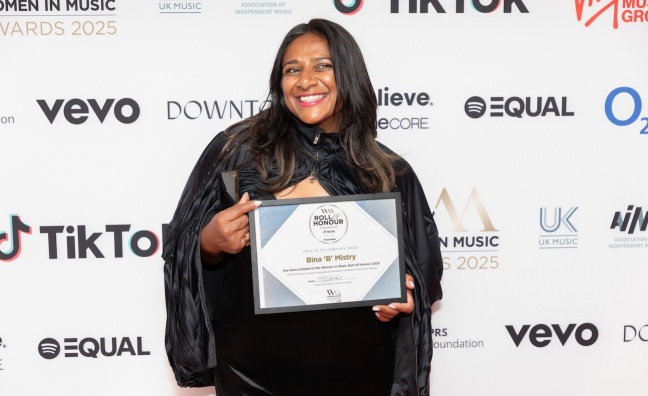
With over two decades of experience, Bina “B” Mistry’s career spans the evolution of the music industry – from her early days in pirate radio and record shops to key roles at PRS For Music, Warner Chappell, Peloton, iTunes and, notably, the global launch of Apple Music. Drawing on her deep expertise in music publishing, royalties, and streaming, Mistry is dedicated to helping creators navigate the complexities of copyright, ensuring they are paid fairly and properly credited for their work.
In 2020, she founded Music:Defined, a consultancy that demystifies “the business behind the music” through masterclasses, mentorship, and one-on-one guidance. By breaking down opaque systems around copyright, licensing, metadata, and splits, she empowers creators and executives alike with actionable knowledge and confidence to take control of their careers. Now a vital resource in an industry that often feels impenetrable, B’s vision is simple but powerful: every contributor credited, every royalty rightfully collected, and every decision made with confidence.
A proud British-Indian executive and an advocate for diversity and equity, Mistry champions fair representation in music while addressing the challenges faced by women and people of colour in the industry. She actively mentors emerging talent and supports cultural initiatives like 2Funky Arts’ The Record Store and Black Music: England’s Tastemakers, which celebrates the legacy of UK Black music record shops.
B is also a mentor for the PRS Foundation’s Power Up initiative for Black creators and executives, helping to tackle racial disparities and create a more inclusive music ecosystem. B’s advocacy also extends to policy and education. She serves on the UK Intellectual Property Office’s Metadata Education Group, helping to shape national standards, and is an ambassador for PRS For Music’s Get Paid Guide, ensuring creators receive the royalties they deserve.
She also leads artist development initiatives for social enterprises, using music education as a tool for social change and guiding independent creators to build sustainable careers.
Described by colleagues as a “music industry master,” B is known for turning complexity into clarity. She reminds creators, “you’re a business,” and has helped countless artists uncover missing income and unlock new revenue streams. Through her work at SoundCloud, PRS, and Music:Defined, she continues to reshape the industry, ensuring creators of all backgrounds are empowered, educated, and equipped to take control of their careers...
How do you feel about joining the Music Week Women In Music Roll Of Honour?
“I’m genuinely honoured. I’ve been reading Music Week since the ’90s, so to now be recognised for my contributions to an industry that both Music Week and my brother introduced me to – one I’ve wanted to be part of since I was a kid – is a real privilege. It feels like a full circle moment. Looking at the incredible women who’ve been honoured over the years, and being included in this celebration of female excellence in the industry is just dope.”

How do you look back on your early years getting into the industry?
“Looking back, I had no idea what I was stepping into, or what to expect. I imagined it was all bright lights, parties and street teams (remember those?!), but the reality has been so much deeper and more rewarding than I could’ve imagined. I was surrounded by music growing up, but the idea of actually working in the music industry felt impossible, like something out of reach. I’d watch music videos on TV and listen to the radio without realising there was an entire world behind the scenes, a career waiting to be built. It wasn’t until my teens, spending time in record shops, talking about music, digging through the crates and spinning on pirate radio, that it really clicked: I didn’t just want to listen to music, I wanted to be in it. I wanted to be surrounded by that energy, feeling and passion every day.”
How did you find your first job?
“I found my first job through a newspaper ad, at a time when I wasn’t even sure what I wanted to do in music. And honestly, I’m glad I didn’t have it all figured out – it gave me the freedom to explore and find my path organically. It even took me back to university. My journey has moved with the industry itself from physical to digital. I grew up on vinyl and then built my career on digital is how I summarise my journey. One of my early passions was championing independent artists. Back in my pirate radio days when the R&B and hip-hop scene was heavily dominated by US artists, I made sure to shine a light on UK talent, especially the independent voices, by giving them a platform. That mission has followed me through to now with my consultancy Music:Defined, where I support independent creators. So, when I look back, the message has always been there. I’m here for the underrepresented voices, for the independent creators carving out their own paths, and for the young girls who look like me, dreaming of doing the same. Now I know – without a doubt – this is where I’m meant to be.”
Did you have a mentor during those early stages?
“No, no mentor. Unlike today, where you can reach out to people in the music industry regardless of their title or company thanks to the internet, we didn’t have that kind of access back in the day. You had to figure things out for yourself. There was no one in the industry who looked like me, no obvious role model for me to follow or even know there was a path to follow. That then made me question whether there was even a place for someone like me in the industry. But I’ve come to realise I have this innate quality: if I want something, I go after it – regardless of how unclear the path may be. And that’s exactly what I did. I carved out my own way in the industry, found my niche, built a business, and now I’m proudly being inducted into the Women In Music Roll Of Honour. I’m now the mentor I never had to those looking to explore this industry and find their own way.”
The Women In Music Awards shines a light on inequality and deep-seated issues around this area in the music industry. Can you share any personal experiences or points of view on this topic?
“WIM Awards have played an instrumental role over the years, and they are so important because they validate the voices that are often pushed aside. It’s subtle but deeply ingrained. The WIM Awards spotlight both the challenges and the achievements, so I salute the platform and everyone behind it that has made it happen. The industry needs more platforms that not only highlight inequality – from the underrepresentation of women in executive roles to the lack of recognition for women producers and engineers – but also push for structural change. It’s clear the system isn’t equal. We need to raise awareness, talk about inequalities and ensure this message is heard by all… Awareness isn't just for the women in the industry, trust me, we’re aware, but for everyone.
“It wasn’t until later in my career that I looked back on events and realised that certain things were not quite right, and I was able to look back at them from this new perspective. One of my vivid memories is being invited into a room with an artist who had come into the office to play us their upcoming album. At the time, I was new to the company and the only person of colour in the office. I felt accepted by the ‘cool’ music team and that my dreams of ‘working in music’ were finally coming to fruition. In hindsight, the only people of colour in that room were myself and the artist. Usually, it was more of an open invitation to those in the office to go to the listening room, but that time was different – invite only. I had been invited in as a token. Realising this, made me question and think about all the other times. Including the time I was being compensated significantly less than a member of the team with a handful of years in the industry versus my legal background and decades of experience. The difference? Gender and colour.
“Before I joined SoundCloud, I was ready to take an extended break and some time out to focus on my business, Music:Defined, but when SoundCloud called about this role… I looked at the executive leadership team and the hiring manager for the role [and there was] a significant representation of people of colour. This was enough for me to take the call and subsequently take the job. Having representation at senior levels is so important. I never did get that extended break! Change will come. We must be consistent with elevating diverse voices and holding the industry accountable.”
I’m here for the underrepresented voices, for the independent creators carving out their own paths, and for the young girls who look like me, dreaming of doing the same
Bina “B” Mistry
How would you sum up your message to artists and creators about knowing their worth financially in the industry?
“The industry has evolved. You no longer need a record label or publisher to release music or build an audience. You’re in control now, but that also means you’re responsible for understanding your worth and protecting it. Getting paid fairly for your time, talent, and creativity isn’t a bonus – it’s baseline. Dedicate time to learn the business side of things, ask questions, and don’t be afraid to walk away from deals that don’t feel right. If something sounds too good to be true, it usually is. Know your value, and don’t settle for less. Your breakthrough will come when you least expect it, and it may look different to what you were expecting. Don’t be waiting for it. Always take opportunities that feel good and align with your creativity, you never know what will come from it. While I don’t advocate for not getting paid for your time and creativity, sometimes you have to make savvy decisions. Promotion doesn’t pay the bills, but will it put you in a room of potential opportunity? Will your name be spoken in the room thereafter? Will you leave a lasting impression? What will be of more value to you: spending a thousand pounds on a lawyer to read a contract for a low value deal, or spending that on a fun music video to promote your latest track? This is why I set up Music:Defined. While there are so many tools out there to distribute your music, get it heard, help you get more streams, create content and build a community, you need a sustainable business if you’re going to do this full time and need to understand how to make informed decisions. The music business is nuanced. Understanding copyright, rights, splits, royalties and metadata can be overwhelming, and I know what is important for creators to know – what the bare minimum they should be doing to get paid is, [how to] protect their music, what questions they should be asking, and how to identify the red flags. Music:Defined supports creators to navigate the music industry and provides them with the foundation to thrive in this industry.”
How do you think the remuneration debate will move forward in the next year and beyond?
“I hope we see more progress than we’ve had in recent years, but I’m not convinced we’ll reach the level of change that creators and performers truly deserve. While legislative changes may help, one of the biggest barriers remains a lack of transparency across the industry, and that can only be addressed through better education and access to information. Creators and performers need to fully understand their agreements with rightsholders, so they can truly advocate for themselves in a system that wasn’t built with their best interests in mind. In my opinion, we should fully overhaul the remuneration concept for creators and replace the unnecessarily complex economic regulations in agreements with a simple one-pager that everyone can understand.
“Because change won’t come quickly enough or achieve what we really need it to, it’s important that creators take back some control. At SoundCloud, we see this shift towards a creator-led industry happening in real time, and we’re building an ecosystem that supports this evolution. We empower creators not only to release music but also to grow communities, control relationships with their fans, monetise fandom, and secure multiple revenue streams. Streaming alone isn’t enough, so we’re focused on everything from distribution and physical media to merchandise and creator tools that give creators more ownership and agency over their careers. SoundCloud is the blueprint for a web3 economy, and blockchain could still be the solution for creators.
“I’d love for us to stop trying to fix a system that is clearly broken and start again. Let’s start with the streaming model. Why is there still such a disparity between record labels and publishers? Why are songwriters, the backbone of the industry, still underrepresented? The recent move by The Ivors Academy to secure daily expense payments for songwriters from UK major labels is a small step in the right direction, but it’s nowhere near enough. If we truly want change and fairness, let’s scrap it and start again!”
What would you say is your biggest achievement so far?
“My career – and being inducted into the WIM ROH, of course! I always dreamed of working in music but I’m not creative and I’m tone deaf, so there was never an obvious path for me. And yet, here I am: a music lawyer. An Indian parent’s dream, ha! But the road to get here wasn’t easy. Coming from a single-parent family, I put myself through university – twice – before completing law school and entering a profession that has historically been reserved for the privileged. I’m proud to see the legal field becoming more diverse, with increasing representation from all backgrounds. I always say I’m not your typical lawyer. My proudest achievements are being able to hold my own in rooms where no one looks like me. To be seen as an expert in my field. To have my voice heard. To share my expertise and knowledge with independent creators. And, importantly, to be a voice for those who are often underrepresented. I’m incredibly proud of how far I’ve come.”
What advice would you offer young women about enjoying a successful career in music?
“While the industry is tough and it can take a lot to thrive and to find your place, sometimes you need to step back and evaluate. Be open to changing the direction of your career… If you had told 25-year-old me that I would be a lawyer, I would’ve laughed in your face. Allow yourself to explore new paths in the industry, and don’t be scared to compromise or take on something that feels unreal or not quite what you had imagined for yourself. Don’t be scared to make mistakes as we don’t always get it right. Fight for what you want, and always take meetings and opportunities that come your way, or even ask for a meeting! If you stop learning and developing in a role – get out, regardless of how comfortable you feel. Surround yourself with people in your desired space, and those that are different to you. If you’re not enjoying it, leave.”
What’s the best advice you’ve ever been given?
“Maybe not advice, but my lessons over the years have taught me to always take that call or coffee invite as you never know what it could lead to. I nearly didn’t take the call from SoundCloud, but I’m so thankful I did – look where I am today. I’ve achieved one of my goals of working with creators and being the lead music lawyer at a platform. It can’t get any better! Also, relationships and allies in this industry are super important – don’t burn bridges and take time outside of work and doing that deal, launch or campaign to connect with your counterparts. And finally, you belong in that room.”
Is there a young woman you'd like to shout out who you think is a rising star in the industry?
“There’s no individual woman I want to shout out, but this industry is about sisterhood, so I want to big up a few women who are using their voice to fight for change. Nadia Khan (Women In CTRL), Eve Horne (We Are The Unheard), Grace Goodwin (Genie), Charisse Beaumont (Black Lives In Music) and Raye (singer-songwriter). This is just a snapshot of the women fighting the fight, sharing their stories, highlighting inequalities and championing for change. They are all stars in this industry, and I hope we all continue to listen, speak up for ourselves and others, and be the change we want and need.”
Similarly, is there a young woman artist whose music you're enjoying right now/excited about?
“Laila! A young American artist with a phenomenal voice and presence. There was something about Laila! that stopped me in my tracks when I first heard her voice, and having the pleasure of hearing her sing live at Grammy House in NYC earlier this year solidified that this young lady is special. Laila! was discovered by SoundCloud’s A&R talent identification team and was quickly signed to SoundCloud’s joint venture alongside Sickamore’s IIIXL Studio. She was also chosen for SoundCloud’s Ascending campaign – SoundCloud’s monthly global artist development program designed to give emerging artists the momentum they need right before their big break. Each month SoundCloud selects a new emerging artist with organic traction, and they shine a spotlight globally.”
Finally, what’s your biggest lesson from 2025 so far?
“Balance and reflection. No matter how much you love your work, always take time out for the other good stuff in your life and have fun! It’s cliche, but life is damn short… Do what makes you happy. And, taking time to reflect on what you’ve achieved, built and accomplished. We’re so focused on building and bettering ourselves daily, striving to do more, but we rarely look back to see how far we’ve come. Speaking to Music Week has allowed me to do this.”