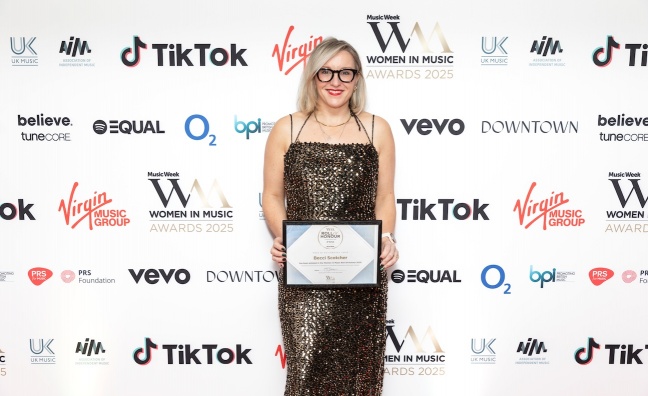
During this year’s Women In Music Awards, we inducted a host of trailblazing industry executives into the Roll Of Honour, in association with TikTok.
They join a huge list of previous honourees, including some of the leading names from across the business like Kanya King, Sarah Stennett, Emma Banks, Charisse Beaumont, Rebecca Allen, Stacey Tang, Shani Gonzales and Mary Anne Hobbs, who have been selected since the awards began in 2014. The Roll Of Honour aims to shine a spotlight on the variety of individuals who are leading the charge in the music industry and consistently using their platforms to support women, or focus on empowerment and gender disparity.
Following the Women In Music Awards ceremony, Music Week is running Q&A interviews with all of this year’s Roll Of Honour inductees.
Becci Scotcher is a highly respected music executive with more than 20 years’ experience spanning partnerships, programme development, communications, and international export. Currently senior grants & programmes manager at PRS Foundation, she oversees more than £3 million in annual grants, ensuring that diversity, equity and inclusion are embedded across all funding activity.
Under her leadership, PRS Foundation has exceeded its 50/50 gender pledge, launched new intersectional approaches to supporting underrepresented creators, and introduced socio-economic monitoring across its programmes. Today, 45% of the Foundation’s music creator grantees identify as belonging to the global majority – a testament to her determination to tackle structural inequalities in the sector.
A driving force in export, Scotcher has built a reputation for delivering major initiatives that open international doors for UK talent. She played a pivotal role in hosting Womex 2013 in Cardiff – the largest international cultural event ever staged in Wales – and went on to lead Wales’ international showcase presence for seven years. She also played a central role in Gorwelion:Horizons, the first multi-nation export partnership bringing together all four UK nations, and was responsible for developing Womex’s first official app to promote showcases and trade activity.
In 2024, Scotcher spearheaded the launch of UK Sounds, a new national export brand designed to amplify and champion UK music globally. Debuting at SXSW, the initiative unites export partners and provides a collaborative platform to strengthen the UK’s position on the world stage.
Alongside her programme leadership, Scotcher has played a central role in key funding and communications campaigns. She relaunched Help Musicians’ #HearForMusicians hearing health campaign, boosting uptake of its scheme by 116%, and created Do It Differently, which went on to become the organisation’s most successful programme.
At PRS Foundation she has overseen the roll-out of new initiatives including the PPL Momentum Accelerator Programme in Wales, Yorkshire and Tees Valley, the Prelude partnership with Amazon MGM Studios, and the Early Career Promoter Fund. She also guided the Foundation’s emergency response during the pandemic, and introduced evaluation reports celebrating 10 years of Women Make Music and PPL Momentum, and the latest International Showcase Fund impact report.
Her board positions with the European Music Exporters Exchange (EMEE) and Manchester Music City, plus her work as a mentor for SEWEM (Sino-European Women Entrepreneurs in Music), further underline her commitment to cross-cultural collaboration and empowerment for underrepresented communities in the industry.
From securing broadcast coverage by booking Future Of The Left at the Wales Millennium Centre to celebrating the international success of grantees such as Little Simz, Nova Twins, Steph Marziano and Violet Skies, Scotcher’s career reflects a consistent mission: to empower creators and their teams, break down barriers, and strengthen the UK’s reputation for musical excellence worldwide.
How do you feel about joining the Music Week Women In Music Roll Of Honour?
“I know many people say this, but it truly is an honour and a bit of a ‘pinch me’ moment. To be nominated is honour enough but to be chosen and recognised by your peers is a wonderful feeling. It also makes me want to take a step back and think, ‘Woah, this girl from Cardiff has done pretty well’, and I feel very grateful to be in such esteemed company!”

How do you look back on your early years getting into the industry?
“Being a working class woman from Cardiff has really shaped my perspective and it’s safe to say that my journey in the music industry has been a winding and multi-faceted one, it was a lot of hard graft, perseverance and many, many different experiences and roles. Like most women in the industry during the early 2000s, the only roles which I felt I could make an impact in are ones which are, still to this day, seen as the ‘softer’ roles in areas such as marketing and PR.
“I quickly realised, that’s not the case and I’ve worked across labels, tech, non-profit, live, licensing and PR, in roles covering PR, marketing, sponsorship, event curation, artist booking, event and conference production, domestic and international development, programme development, business development, sync, campaigns, content creation, and developed talent development programmes.
“I did start thinking about PR, though, and I joined one of the first ever music industry degree courses in London at London Met at the time, landed a dream summer intern role with Chrissie Yiannou who ran the incredible PR company Positive Nuisance (Sick Of It All, Give Up The Ghost, The Offspring, Walls Of Jericho to name a few) who was really supportive. But ultimately at the time, I couldn’t afford to do lots of unpaid internships in London until I found the right ‘fit’, and I felt I couldn't dedicate a life in London at the time so moved back to Wales.
“A lot of opportunities are what you make them, but I think I would have loved to have had more opportunities to stay in Wales and develop a career earlier on, than seemed to be available at the time. I didn’t know many women or gender diverse individuals working in music (other than bands) in Cardiff and it did feel hard to garner traction. I do truly believe that you shouldn’t have to move to pursue a successful and sustainable career in music, and we need much stronger opportunities and equitable investment across the UK to enable people to achieve those goals. Also at the time, if you were not based in London, it felt a bit like a closed shop for roles since we all know it’s not just your skills, but your network and a bit of luck!”
Did you have a mentor at that stage?
“Nothing formal but Chrissie for the time I worked with her, and in Wales, I do need to shout out Lisa Matthews-Jones, GM of Welsh Music Foundation at the time, and Eluned Haf, head of Wales Arts International, who were super-supportive and encouraging. They were the ones who really kick started my international work and career, placing a lot of trust and belief in me to lead a lot of the Womex 13 delivery. I’ve been lucky enough in many of my roles to have women managers, which I think is fairly unusual but hopefully less so now.”
The WIM Awards shines a light on inequality and deep-seated issues around this area in the music industry. Can you share any personal experiences or points of view on this topic?
“I have experienced my fair share of misogyny, belittling, micro-aggressions, and ageism but I’ve also seen and heard a lot from across the sector. We need to be much more proactive in ensuring a safe environment for us all to work in, no matter your gender, ethnicity, age, sexuality, background and the whole range of intersectional representation. I’ve seen women pitted against women, or women being described as ‘difficult’, which would be lauded as confidence coming from a man, and it would be applauded. I think women exist in this duplicitous role, where we are meant to be nurturing but not too much, but if we are not ‘soft’ enough then we are ‘difficult’ or ‘challenging’.
“Music is seen as a young person’s game, and whilst we need to focus on the future, there is an incredible amount of talent – over 30s – on the executive and creative side, across all areas of the sector – I include here also all the non-profit work too – who are being counted out. Additionally, I’ve been in some unsafe environments, and the challenging but needed work of organisations and initiatives like the Musicians’ Union, Safer Spaces and Saffron Records is incredible but we need to keep moving forward. Mechanisms to report incidents, removing the widespread use of NDAs and the ability for people to feel empowered to call out behaviour knowing there will be some kind of action is important, without the stigma of reporting it. I look forward to seeing CIISA become fully operational, as it’s much needed.
“Even though I think it is changing, slowly, there is still an element of the old boys’ club – cliques can exist in any group or sector of people, but it can feel at times, like a closed shop or there is a sense of pandering to the ‘women’ in the room. We can’t do this alone either, we need everyone in the sector onboard to tackle inequity and inequality, this means the men in the room too! I am hopeful though; we have some incredible women and gender diverse individuals doing incredible work.”
I do truly believe that you shouldn’t have to move to pursue a successful and sustainable career in music
Becci Scotcher
You’ve worked on the PPL Momentum Accelerator programme – how would you sum up its importance to the industry?
“This goes back to my experiences of growing up in Wales. In London, the ready access to peers and key industry figures makes it much easier for people to connect with and forge longer lasting relationships than outside of London. Though it’s changing – with initiatives in the North of England, for example – the fact that the London-based industry was less inclined to go across the UK to find talent, when they did before, means much less opportunity and visibility. Not everyone can afford – either in time or money – to come to London every month to go to networking events, gigs etc. and it is unfortunately true that you need to be visible to be on someone’s radar.
“Additionally, the IP drain to London means that that revenue is not flowing back into those scenes, communities or areas of the UK making it much harder to have a sustainable career, since the money and talent is flowing out of the area. This means that the playing field isn’t level, those outside of London must work harder to gain access to those rooms, people and audiences. I’m not saying by any means being in London or the Southeast of England is easy – the cost of living is extortionately high – but it’s the easier access to industry and peers which I think makes all the difference.
“So, having a programme which not only supports the music creators but also those industry professionals who are building scenes, is key. It gives them the opportunity to stay where they are based, if they so wish, and build together. They are the future of our sector and we should support them to flourish wherever they wish to be.
“The example of English Teacher is an obvious one here, they were supported via PRS Foundation’s Talent Development Network organisations Music:Local, then supported by our PPL Momentum Accelerator Fund, enabling them to work with a producer who they wouldn’t be able to afford without additional support. The crucial catalyst enabled them to make their Mercury Music Prize winning album, This Could Be Texas – the first band outside of London in a decade to win a Mercury Music Prize. Their journey clearly shows the need for regular investment into scenes and communities outside of London, at the right time and via the right mechanism – that could be via talent development organisations, like PRS Foundation’s network of Talent Development Partners, or through direct funding support.”
Your career has touched heavily on the wellbeing of those in the industry – are there enough measures in place to safeguard this? What needs to change?
“As I mentioned earlier, the music industry can be a hard place to forge a sustainable and healthy career in. I do think that because music is seen as an industry that lots of people are willing to work in – even for free – means bad behaviour and practices continue. As a freelancer, the financial instability, lack of benefits, irregular work, and late or unfair pay, while also dealing with high competition, blurred work–life boundaries, and limited protections against exploitation or harassment means there are a lot of areas which need to be addressed.
“I’d love to see change in the creation of fairer pay structures, accessible healthcare and benefits, stronger unions/collective bargaining, clearer contracts, timely payment systems, and more inclusive, transparent pathways for sustainable careers so freelance music workers aren’t forced to trade security for creative opportunity. I think industry-wide schemes which not only support the mental wellbeing – Music Support and Music Minds Matter – of people in the industry but also the physical – things like hearing for example. We all know that we should protect our hearing, but many can’t afford to have specialised ear protection or don’t even think about it.”
Can you name the one thing you’d change about the business?
“I’d like to see more opportunities for emerging industry professionals and artists to explore international careers. We’ve seen the positive impact of Keychange bringing women and gender diverse artists and industry professionals together and into new territories across Europe, Canada and now USA and how breaking into new markets offers so much potential. Growth is the focus of our government, but we need to give people the tools and opportunities to grow their businesses, and often, they’re priced out of these opportunities or aren’t aware of how they can access that information.”
What’s your biggest achievement so far?
“There are a few things I’m proud of, one, is delivering Womex 13 – which contributed £2.9m to the local economy, that really was the catalyst for all my international work.
“Secondly it was being appointed onto the board of EMEE (European Music Exporters Exchange), a non-profit association made up of 35 national and regional Music Export offices from 29 countries. Being connected with our European counterparts and colleagues is so, so important and I’ve learned so much. It’s a real privilege and an honour to be working to strengthen the European music sector.
“Launching UK Sounds, a new collaborative initiative, to support, amplify and champion music export from the UK. It’s something I’d been thinking about for a long time, and to see it come to fruition was so satisfying.
“Finally, in PRS Foundation’s 25th year, continuing to go beyond PRS Foundation’s 50/50 gender pledge, ensuring that we think intersectionally – given the rolling back of DEI initiatives, it’s even more important to double down on these areas to ensure all the hard work in moving the dial, isn’t lost.”
What advice would you offer young women about enjoying a successful career in music?
“Don’t define yourself by others, you’re on your own path so forge in the direction that makes sense to you. Build your own network and connect others, it might not be the right fit for you, but it could be for someone else. Remember the music industry is a small place, so be nice, be kind and pay it forward without any expectation of anything back. I would also say, you have every right to be here, as much as the next person; imposter syndrome is a real thing but try and not let it define you. Finally, don’t be afraid to make mistakes, the only way to grow and learn is by making mistakes, everyone makes them!”
What’s the best advice you’ve ever had?
“Keep building your career through meaningful partnerships, champion equity at every turn, and let your passion for connection be the driving force behind your impact.”
Is there a young woman you'd like to shout out who you think is a rising star in the industry?
“I have a few I’d like to shout out: Cils Williams, an incredible agent working with Korean bands (Balming Tiger, Sailor Honeymoon); her knowledge of the UK and Korean markets is second to none. Indy Brewer, She manages the fantastic Balancing Act alongside other roles with East City Management and Something, Something. Katja Thalerová, is a tour de force in the European music sector, working at LALA Slovak Music Export Office, Sharpe Festival and Conference, and booking several Slovak bands. Aja Garrod-Prance used to work with me at PRS Foundation, and is now GM at the Scottish Music Industries Association. And all the women who I work with at PRS Foundation, Fiona Harvey, Elizabeth Sills, Alison Williams, Hannah Bashir-Eviston, Tilly Fletcher, Ellie Ripley and Palak Rannkka.”
Similarly, is there a young woman artist whose music you're enjoying right now/excited about?
“India Blue, based in Glasgow, has an incredible soulful, Charlotte Day Wilson kind of vibe and has an EP due out this autumn. Twst, artist, songwriter and producer originally from Wales but now based in London. Her hyper-pop sound is incredible live and has such powerful energy on stage, making everyone in the room wanting to get moving. We were really pleased to support her to showcase at SXSW in Austin this year. I’d also love to shout Miss Kanina, the first independent Aboriginal woman to ever be nominated for a debut single at the ARIA Music Awards. Blending hip-hop, neo-soul and R&B, she shares stories of resistance and empowerment and is captivating live.”
Finally, what’s your biggest lesson from 2025 so far?
“Ever since the pandemic, everything seems to be moving at hyperspeed. Slow down, take a break, nurture your relationships (both work and personal), look after your body and mind, and show gratitude.”
PHOTOS: Louise Haywood-Schiefer / Panni Renner