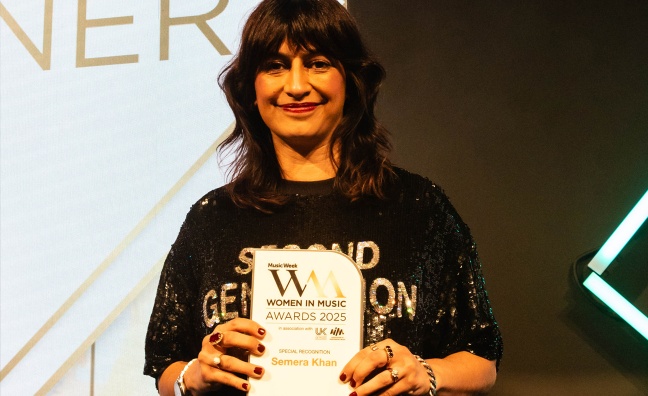
At this year's Women In Music Awards, we celebrated the achievements of 13 game-changing executives and artists as the industry came together to honour their work. Music Week has spoken to all 13 winners to tell their stories. Here, we chat to Polydor's creative director Semera Khan, winner of this year's Special Recognition award...
WORDS: ANNA FIELDING
Modern artists need more than just album art and music videos. Live visuals, short-form video, behind-the-scenes glimpses and more are required across multiple platforms in multiple formats. Driving all of this for Polydor Label Group is Semera Khan, winner of this year’s Women In Music Special Recognition award.
“I’m always on the go and always thinking about the next thing, so it’s really nice to be forced to sit still and zoom out, to appreciate everything I’ve worked on and all the artists that I’ve worked with, everything we’re done together," she says. “I feel like the Women In Music Awards highlight people who aren’t really seen, or often seen. It’s good to shine a light on people who don’t always get recognised at the usual awards.”
Khan is Polydor’s creative director, having worked with Universal Music Group for over 13 years. She has created campaigns for Lana Del Rey, The 1975, The Rolling Stones, Sam Fender and more, bringing each artist’s vision to visual life.
“I think for artists it’s the music that comes first and then it’s the creative,” says Khan. “They write the songs but then, very quickly, it’s, ‘How does that look?’. We need to think about what their world is, what the message they want to get across is. And we know how important the visual aspects are to them. It’s about how they come across to fans, how they reach new audiences and get them to understand what they’re about… I’ve often heard people say that, ‘I didn’t really get it until I watched the video.’ You can help people to connect.”
Visuals, says Khan, help an artist tell a wider story. “It explains what their taste is, what the story is, even down to their political leanings. It’s all-encompassing,” she says.
Khan has pulled in an amazing roster of talent to work with Polydor’s artists, including Kristen Stewart, Nicholas Hoult and Sydney Sweeney for The Rolling Stones, and Andrew Scott and Adolescence director Philip Barantini for Sam Fender.
The video for Fender’s People Watching was shortlisted for best casting at Ireland’s Shark Music Video Awards. And it’s not Khan’s only hit: she’s been awarded the UK Music Video Awards’ Best Commissioner prize twice and holds a place on the Women In Music Awards’ Roll Of Honour. Nonetheless, receiving the Special Recognition award has left Khan “overwhelmed”.
Her focus, as ever, remains on the work she does with others: her team, her collaborators and – most of all – the Polydor artists.
“I've often heard artists say that when they're writing the songs, or when they're recording the songs, they're thinking about the creative, they're thinking about the artwork,” she says. “What's going to be the album cover, what's going to be the video or what's going to be the press image?”
And Khan can provide them with answers to all of those questions..
What was your route to your current position? How did you start out?
“When I was at uni I worked at Brixton Academy and I ended up covering for someone on reception for a while. I have always loved music, it’s been part of my journey from the age of five, as clichéd as that sounds. So working at Brixton Academy in my last two years of formal education was quite something. I did the cover and I thought that I would send my CV out to every single record company I could think of. I managed to get an interview with a small label called Food. It was Blur’s label and they were going through Parlophone at the time. I walked into the office and it was a little like my bedroom with the same posters everywhere.
“Andy Ross, the MD, gave me the biggest opportunity and I worked there for a couple of years. I got experience across the label. I assisted in marketing, I assisted in A&R. There wasn’t a creative department as such, everything on that side went through Dilly Gent at Parlophone. She was doing Blur and Idlewild and all sorts of cool bands. Music videos were always a love of mine from an early age, and so I put in a call to her and asked her if she'd meet me and give me a little bit of an explanation as to what she does and how she does it. She was kind enough to let me sit down with her and she told me literally everything that there was to know about commissioning music videos.
“From there I went to the Oil Factory, which was one of the biggest production companies in London at the time with a real A-list of directors. Then I worked my way up in the creative department at EMI and then I went to Sony to work with Mike O'Keefe. That was a game-changer for me because I felt I really learned how to do my job properly. He was the Don Dada of music videos at the time and he took me under his wing. It was at Sony that I started working with bigger artists like Calvin Harris, Paloma Faith and Olly Murs. And then I came and took my role at Polydor, which is an amazing space to be in.”
Have you had any particular setbacks along the way?
“I’ve been really lucky to have people who have been really encouraging of my department and my role. Tom March and Ben Mortimer were brilliant; when they came into their roles they really saw the importance of creative. They backed my ideas and they supported how I saw the department developing. The creative department has changed over time, as we’ve needed to; we were once only delivering music videos but now we’ve become a 360 proposition, we oversee all things creative; anything from tour visuals and artwork, to live sessions, live filming and music videos, with a huge focus on content. We’ve changed as the industry’s changed and without the backing of people like Tom and Ben, I wouldn't have been able to do that. There will always be challenges and setbacks but there have been lots of people who have been really supportive throughout my career, including Jo Charrington and Orla Lee Fisher to name just a few.”
I'm really keen to explore; mentoring people that don't necessarily get a foot in the door easily
Semera Khan
Recently, you’ve worked on the Sam Fender campaign, which is very eye-catching. What was it like to put that together?
“That's been a really special experience. You make all these plans, but sometimes the right thing just happens and it's magical. So Sam has been on his last two album covers and we wanted to do something different. We were talking about how he saw the album and what the songs were about. And it didn't make sense for him to be on the cover, he wanted something more nuanced than that. I was asking Sarah Mitchell from his management about artists and photographers that he likes, and was there something we could license? It was quite a casual conversation, but she mentioned Tish Murtha. She was a documentary photographer from the 70s. And when I first saw her work, I was like, ‘Oh my God, this is literally a visual representation of his music.’ And there’s also the fact she’s from the North East. Every single image just felt so connected to Sam and his music. It was a no-brainer to approach her estate for the album artwork and the single artwork. We worked closely with designer Matteo Villaci on it, as well as Sam Tozer/Vision Factory on the live show visuals. Sam was very involved too, it was his idea to get Phil Barantini to do the Spit Of You video on the last album, and that connection led to a beautiful working relationship and the Little Bit Closer video on this album.”
Andrew Scott is very much an actor of the moment. How did he become involved with the video for People Watching?
“I'm just always inspired by movies, basically. I’d just watched All Of Us Strangers and it was so, so special – Andrew was so captivating on camera. I was obsessed with getting him in the video. It was a long process of getting scripts in, revising the scripts, working really hard with directors, and getting the idea to a point where I was really happy, and Sam and management were happy with it, and it felt right for the song. And simultaneously, I was going through the process of trying to see if Andrew Scott was available. And when his agent told him about it, he gave us a shout and said, ‘Absolutely. I love Sam, I would love to be in this.’ The song is about Sam's godmother who passed away and the song is about him looking after her in her last days. When we had the call with Andrew, the first thing he said was, ‘I just need to stop you and let you know that I’ve recently lost my mother, and this song means so much to me.’”
You’ve also branched out into directing. Has that always been an ambition?
“I wouldn't say I'm moving into directing, because I don't see myself as a director. I know what looks nice, but there's some incredible talent out there. I wouldn't dare compare myself to them. It just happened naturally. With the [Sam Fender] Howdon [Aldi Death Queue] video, it was a fun thing that I had some ideas for and I was briefing out. But then we had a conversation and we needed to do it ASAP as usual, so I picked it up. With the [Sorry Rach!] video for Stormzy we had an idea, which was quite simple and just for content. But everyone seemed to react really well to it and got really excited. It snowballed and turned into a proper music video. We had an amazing team around us, and I co-directed that one with Emily Jeffery, who works with me. She’s an absolute talent and I'm excited about seeing how her future unfolds. And Stormzy has an incredible energy; on camera you can’t take your eyes off him.”
How do you think the industry is currently doing in terms of representation, both of women and of people of colour?
“I think it’s alright. We could do a lot better. We're always thinking about being inclusive and diverse and not going to the same people again and again and again. But it's hard. It's something I'm really conscious of in my department. I'm really proud of the fact that the people who have come through have been outsiders, in a way. I feel that's something I'm really keen to explore; mentoring people that don't necessarily get a foot in the door easily.”
How do you run your team as a manager?
“Very collaboratively. So for me, it’s always been really important for me there's no hierarchy. I don’t want to make it sound like we're really cool and we're really hippy, but everyone works really well together. We're there to help each other. We're there to ask each other questions. It's very collaborative. It's a team effort, rather than individuals. Creativity is so subjective and it's great to hear other creatives’ opinions on things, just to get a different view. Generally, we're really, really tight. I'm really lucky. I don't feel like someone is someone's boss, or the other person is a junior. We're a gang, to be honest – and that's cool.”
What do you love most about your job?
“Delivering creatives that the artists really love and they're proud of and that really represent them and their music. It's so satisfying. It's so lovely when they're really happy with how everything pans out. And when it becomes successful that’s also really validating for them. The thing I’m most proud of is working with and mentoring young creatives from differing backgrounds and seeing them flourish. I was given opportunities and I would like to continue do the same for others.”
Are there ever moments when you see your work in the wild and think, ‘I did that!’?
“It’s probably Sam’s live shows. To have a had a small part in creating those visuals was truly magical! Watching 80,000 people singing their hearts out at the London Stadium with those massive screens creating an entire world was honestly the best feeling ever.”
Where do you think the music video is in today's landscape?
“They’re still very much key to creating a ‘world’ for the artist and music, it’s just a different process now. We build up towards the music video, rather that that being the only key visual to the campaign. I think it’s exciting that we have so many different platforms now to show off the artists narrative and world and, whatever the format, music videos will always be a part of that process. I also find it fascinating that some music videos as old as 10-15 years are still very much a part of the artists creative – Lana Del Rey, The 1975, Pulp and more have all used their past music videos as part of the visuals for their live shows this year.”