At this year's Women In Music Awards, we celebrated the achievements of 13 game-changing executives and artists as the industry came together to honour their work. Music Week has spoken to all 13 winners to tell their stories. Rising Star Award winner Mofe Sey outlines what it takes to break into the industry, how to craft a successful PR campaign and celebrates her peers also making waves...
WORDS: LISA WRIGHT
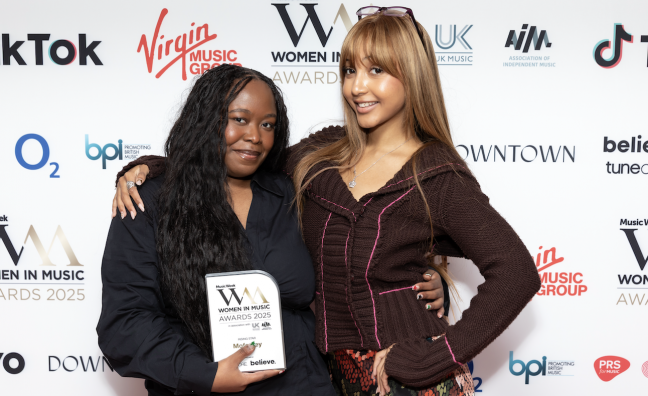
Since joining PR agency Satellite414 as an intern seven years ago, Mofe Sey has helmed some of their most successful campaigns – from bringing in PinkPantheress (above, right) to the company to leading their work with Shygirl. Now, working as a senior entertainment publicist, she’s also the very deserving recipient of this year’s Music Week Women In Music Rising Star Award.
Sey’s work has been categorised by both a thoroughly modern and forward-thinking attitude to the changing role of press, and a determination to champion people of colour and queer musicians in the music industry. “There are so many ways of doing a campaign and PRs can sometimes have a checklist to use their talent as a vessel to tick off their own work achievements,” she suggests. “But if you don’t understand the music, then the press doesn't make any sense. And if the music isn't understood, then the campaign won't be translated well to the audience that you're trying to reach.”
 Mofe Sey on stage at Women In Music with PinkPantheress
Instead, her approach has always been one centred around making her artists feel comfortable, and ensuring that her campaigns are fully tailored to the individuals at their centre. Having also played a key role in campaigns for Rina Sawayama, Chappell Roan, Leigh-Anne, Mabel, Ashnikko and FLO, the success of her roster speaks for itself. With PinkPantheress alone, she's guided her to gracing the covers of The Face, i-D, Paper, Mixmag, and many others – all within four short years.
With an enviable ability to spot talent at a grassroots level, and a careful, considered and empathetic approach to plotting out her artists’ continuing pathways through the music press and beyond, Sey has established herself as a hugely respected figure in the world of publicity whilst also championing change on a wider scale.
“Something that I want to do is to see more women of colour in the press, so I've made it my mission to do that,” she says. “I want to see more women of colour on the covers of magazines and more queer people on the covers of magazines, and I think that’s what I've done with my roster.”
We spoke to Sey about her journey from intern to Rising Star winner, alongside the challenges of breaking into the industry, her advice for budding publicists and how to win the trust of your roster.
How does it feel to be this year’s recipient of the Rising Star award?
“I’m still a bit speechless! I got the call and I was so shocked because I didn’t even know I’d been put forward for it, so I had a rush of emotions when I got told. The directors, CEO and head of press at Satellite414 put me forward for it and I'm glad they kept it a secret because that would have been a lot on my brain! Publicists, we’re usually behind the scenes, but it’s an absolute honour to be recognised.”
You’ve been at Satellite414 since you were an intern – did you always plan to stay at the company and work your way up?
“I don’t think you would've been able to tell the 19-year-old me that I’d even be in the music industry. I was on summer break at university in my first year, I’d applied to so many internships and I wasn't getting anything back, but I really wanted this one because Zayn Malik was their client and I love him! Then I ended up having a full-time role just before Covid and I felt lucky to just have a job. I just wanted to learn from everyone. I was at uni in Sheffield, I had no connections in the music industry, and as a young Black woman just trying to get her foot in the door, I really wanted to make it work. Looking back now, I'm so proud of that 19-year-old girl that was online every day and trying to impress everyone. But also I was so lucky as an intern because I learned from some of the best publicists ever.”
What do you think was the key to getting that foot in the door?
“I was a very online type of teenager and I understood how much ‘stan culture’ was seeping into what publicists needed to do. So many ‘stans’ would be saying, ‘Why aren't they on the cover of this? Why aren't they promoting this song? Why aren't they doing this and that?’ And I would very much be online listening. My role as an intern was to look up coverage for the artists, and how much press they'd been receiving on a song, so I would get all that done in the morning and then spend the rest of the day telling people what the stans were saying and suggesting ideas. At that point in time, press was still being split up by print and online but I just used my initiative. I think I knew what I was good at, and that was being on the internet.”
I don’t think you would've been able to tell the 19-year-old me that I’d even be in the music industry
Mofe Sey
What were the biggest challenges of breaking into the business?
“I think it's really hard. I was so quiet early on in my internship because I didn't want to mess up my only chance to be in the industry. When you're from any background other than, I guess, a white cis man with connections and money, there's an added pressure to just not mess it up; to be a good representation of everyone ever. There's a lot of thinking and second-guessing in the early stages. But then you realise that, a lot of the time, if you're a Black person or a Black woman or a working-class person in the industry, you've gotten here because you're exceptionally good. You're exceptional. And you have to just realise that you've gotten yourself this far, even if it's taken years longer than your counterparts, and you have to keep holding on to that. But it's definitely a hard battle mentally, and it's definitely something that needs to be discussed more so we can have more diversity, both in backgrounds and in race, in the music industry.”
Are there any major learning curves along the way that you’ve had to tackle?
“I've been so blessed with my career progression at Satellite so it’s nothing to do with them, but elsewhere, I’ve had to overcome certain microaggressions every now and again; the moments where you're like, ‘Oh, was that because I'm a woman or was that because…?’ But I think I've been quite purposeful in who I take on as a client for that reason. A lot of my clients are either women of colour or queer artists, and their teams are incredibly diverse because I think that I learnt early on that I don't need to be in spaces where I'm feeling othered. I would rather champion people who are traditionally othered in the music industry and be part of their team. I don't take on anyone that I wouldn't listen to – my artists are in my Spotify Wrapped every single year – but it just happens that they are also incredibly diverse. I think it needs to go hand in hand.”
You brought Pinkpantheress into Satellite414 right at the start of her career and have played a huge part in shaping her story. What do you think the key to that success was with her?
“She was the first artist I ever pitched for and won when I was promoting as a junior publicist with Jodie Luckie, who's now at Toast PR. We were so, so nervous about pitching against some of the biggest names in the music industry at that point in time, but I think what made us the right fit – and what still makes me the right fit – is that I just wanted Pink to feel comfortable. We asked her, what do you want? Where do you see yourself in five years? And then we worked backwards. And it's been four years since then and we're nearly at where we wanted to see ourselves. Our main goal was to make sure that she was at least shortlisted for the BBC Sound Of poll [the singer came out on top in 2022]. We spoke to so many different people, but all in a very PinkPantheress way: not oversaturating it, because the last thing we wanted to do was have her be everywhere so early on and then not have longevity. She was a young Black woman in the industry, so we needed to make her feel comfortable and we wanted to make sure she didn’t burn out.”
How do you go about constructing a PR campaign?
“I think the most important thing [to consider] is how comfortable the talent is feeling. I think the last thing you want is to put someone in front of a magazine that doesn't make sense because it comes across in the interview if they're not having a good time, and if they're not representing themselves the way they want to represent themselves. What I like to do is pair artists with journalists that I think would understand their nuances – whether that's their background or where they went to university. If you know the background stuff is already there, they haven't got to overexplain themselves. I think that it's about understanding that different artists need different types of ideas. Gone are the days when just print was the most important thing, or just online was the most important thing. Now we need to be doing YouTube videos where you're showing your personality a bit more. We need to be talking about the music process because people love knowing about the ideas behind an album.”
What’s the proudest moment from your career so far?
“One of my proudest moments was the i-D cover that we did with PinkPantheress because she never shares any press on social media and that was the one cover that she shared. i-D was one of the things that she had said in that first meeting when I wanted to pitch with her. She said that she would love to be on the cover of i-D magazine and then two or three years later, we made it work. Also working with Shygirl – for her as a Black woman in dance and alternative music to be both championed in the mainstream world with a Mercury Prize shortlisting and then also within the Black music industry with the MOBOs, that was so beautiful, and for me to be just a tiny bit of that was beautiful.”
What advice would you give to people wanting to break into PR?
“I think obviously you have to love music – but there are so many amazing PRs out there in different genres of music where I couldn't do what they were doing, and maybe they couldn’t do what I’m doing. Understanding where your passions lie in the industry will help you because as much as PR is something that can be taught, it's something that's also quite innate.”
Are there any other people in the industry that you want to shout out as fellow rising stars?
“Liv West was the producer and talent coordinator behind Chicken Shop Date for three years and her mind is truly something else; she has such a good knack of pairing the right talent with a project. I came up with Jodie Luckie who’s now senior publicist at Toast and it’s so amazing to see everything she is doing – she truly is the queen of the club! Jesley Faye Fantolgo is an editor at Spotify, and when I tell you Jesley has a finger on the pulse, believe it. And Janay Marie – what she is doing with her agency Tallawah is incredible to witness from afar, and you can tell there is an innate care for every project she works on.”
And finally, what would you hope to see change in the industry?
“In five years' time, I would love to see more women of colour in senior roles at labels, not just in the overflow seats at the back. I would love to see more diversity in PR, radio and TV – both within race and also within accessibility. There should be no reason in 2025 why talent teams are all white. So I would hope that in 2030 that is not the case.”