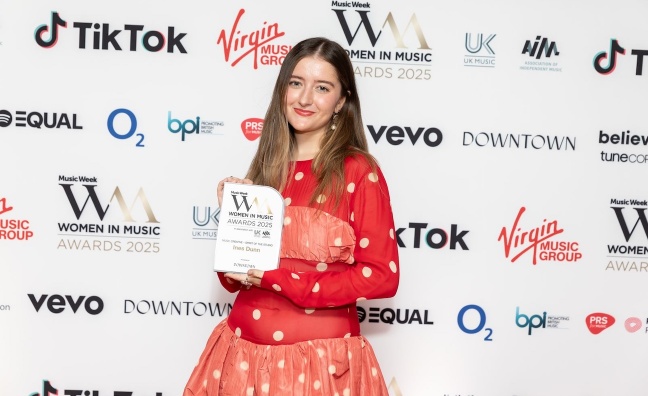
At this year's Women In Music Awards, we celebrated the achievements of 13 game-changing executives and artists as the industry came together to honour their work. Music Week has spoken to all 13 winners to tell their stories. Here, winner of our Music Creative – Spirit Of The Studio award, Ines Dunn, talks accolades and the art of songwriting...
WORDS: LISA WRIGHT
At just 23 years old, Ines Dunn’s list of career milestones already reads like the work of someone decades into their tenure. An acclaimed and in-demand songwriter with a proven track record of penning perfectly pitched golden pop nuggets, she’s already co-written a Number 1 album in Maisie Peters’ The Good Witch, been nominated for two Ivor Novello awards, clocked up tens of millions of co-writing streams, and stands as the youngest ever person to be voted onto the Ivors Senate.
Now, Dunn can add this year’s Music Week Women in Music Awards Music Creative honour to her ever-expanding list of achievements. “This is the first award I’ve won, so it’s nice to feel like you can be nominated and achieve the thing because before it’s always ended at the nomination!” she laughs.
Dunn has carved out a clear pathway based not just on her formidable songwriting skills but also through the choice of artists she works with. Alongside her long-standing partnership with Maisie Peters, she’s helped to pen major breakthrough moments in the early careers of Mette (Mama’s Eyes), Flowerovlove (Breaking News), Mimi Webb (House On Fire) and Griff (Walk). Her secret weapon is her ability to relate on a genuine, interpersonal level with her collaborators.
“It’s about being someone who can understand where the other person is at in their life,” she says. “If you work with someone slightly older, they’ll have life problems that 20-year-olds just don’t have. So it’s nice to be able to say: everything you care about right now is what you should be caring about.”
From beginning her career after being discovered, aged 16, whilst studying at the East London Arts & Music Academy to cementing her place at the top tier of British pop songwriters, we sit down with Dunn to discuss her whirlwind journey so far.
Congratulations on winning this year’s Music Creative award! Tell us a bit more about how you got started as a songwriter.
“I really started at about 16 when my manager came into ELAM, the music college I was at, and was bargaining with the principal to give me a couple of days off to come and do sessions. From there, I signed a publishing deal the day after my 18th birthday and it’s been a steady journey to now. When you come into music that young, it’s a hard thing to get past when suddenly you’re not the youngest anymore and you have to be good instead of just good for your age. It gave me a complex for a while, but I’ve worked through it!”

Who were your early songwriting role models and influences?
“I was obsessed with Haim. And then, in terms of writers, it’s Ali Tamposi, Julia Michaels, Ian Kirkpatrick, Emily Warren… I used to go to Phil Plested’s shows and he’d let me hang out and ask him a million questions. I was a little songwriter nerd – if you could name the songs, I could name the songwriters – so there were a lot of people!”
You’ve been writing with Maisie Peters for several years now – how did that come about and why do you think the partnership works?
“My manager publishes Maisie and we’d met at a couple of different events. When COVID happened, we started going on lockdown walks once or twice a week and we became friends by doing that, which really set the foundation. Maisie’s funny, she’s literally the other half of my brain, so when you find that synergy with someone it’s either gonna be the best or the worst thing ever and thankfully it turned out well for us! She’s not just my best friend but one of my favourite people to write songs with and it’s such a gift to find that in the same person.”
You work with a lot of young female artists at a similar stage of their life and career to yourself – why do you think that works so well?
“When I first met my manager he said, ‘You’re the age of the people that you’re writing songs for.’ And that was always a reassuring thought because then I could just follow the idea of, ‘Would I want to hear this if someone else put it out?’ Now I’m approaching the age where I can’t say that anymore! But I’m a big believer in: ‘If you’ve thought it, other people have thought it.’ I don’t think there’s any thought that’s so unique that it can’t be put into some kind of song form.”
What, aside from personal synergy, tends to attract you to working with a new artist?
“Having an opinion on things. And it could be the most unrefined opinion but having a point of view and not being scared to express it is the main thing. And being fun! Having their own uniqueness – something you look at and know they’re the only one who could pull that off.”
Did you ever have any challenges with feeling like you weren’t being taken seriously at the beginning of your career?
“I definitely was scared of that, and I was putting on a real front for the first few years because the imposter syndrome really sets in. But the artists that are successful in our industry are so young, so to count people out because of their age is a fault on that person’s part. Young people have the most unique thoughts and now people are paying a lot more attention to the perspective of 16- or 17-year-olds. There were a lot of people that gave me the space to be the age I was and have random thoughts and say the things that a young person would say. And there are definitely some songs that should never see the light of day but I was literally a child, so… that’s fine!”
There’s obviously still an imbalance, but I think the women who are there are doing an incredible job at staying there and pushing the threshold forward
Ines Dunn
Where do you think we’re at currently in terms of achieving a better gender balance in studio environments?
“There’s obviously still an imbalance, but I think the women who are there are doing an incredible job at staying there and pushing the threshold forward. All you can hope is that remaining in the room opens the door for the people who are coming up. It is changing, and it’s changing really gradually, but there are brilliant people coming through and standing their ground in big, important spaces. Women are just too good to ever leave. Luka [Kloser] and Elvira [Anderfjärd] who did the Addison Rae record, the difference they will make with what they’ve done and continue to do, that’s gonna change music and the way that young girls think about becoming a musician. Tove Burman in Sweden is amazing; there’s Steph Marziano and Alex Hope; PomPom is great in LA. There’s so many people and all of them are gonna have these really long, illustrious careers. Getting to a place is one thing but staying there to the point where it has an impact is another.”
Are there certain things that make a writing room or a studio environment more nurturing in your eyes?
“I think it’s about creating space and being inviting – me and my manager talk a lot about how it’s one thing to be supportive but it’s another to be inviting and share your world and your contacts or whatever it is with other people. Being more selfless in that and inviting people into your sessions, that’s really important. Also, the older I get, the more I wish I’d asked people for lawyer advice and contract advice and all those things that I was definitely too young to really understand. I just trusted the people that led me blindly and that’s great if they do a good job, but I wish I was a little more clued up. Any chance I have now to speak to younger people and tell them that stuff I take, so people don’t get trapped as they come through.”
You’re the youngest person ever to join the Ivors Senate, which is pretty incredible. How has that experience been?
“It’s been amazing. It’s one of the highlights of the past couple of years of my life. When you can go to a group of people who really care about making a difference, it makes you feel like you’re in safer hands than you realised, as being out in the music industry can be an isolating experience. It’s been so rewarding – to think about the fact that it’s possible to change the way that songwriters can afford to be songwriters has been amazing. The per diems has been a really big thing over the last year. Songwriters only get paid when the songs come out so we’ve been fighting behind the scenes and, over the last year, we managed to get per diems to be non recoupable and mandatory for songwriters. They get £75 a day that they can file to the major labels, which means they’re not out of pocket before they’ve even got to the studio. That was a really important thing for me, and also contract law is a really important thing. We’re working on a lot of AI stuff to see if we can impact the laws in the UK about the AI use of people’s work.”

Big question now: what do you think makes the perfect song?
“Oh God! I don’t know if the perfect song exists? In my student years I’d be very mathematical with songs and now I’m trying to be the opposite, so in the spirit of my newfound desire to be more fun, then maybe it’s boldness that makes a great song, and being brave in every part of it.”
Is there a song of yours that you’re most proud of writing?
“I really love Body Better because that was me and Maisie very much zoning in on a topic that’s [rife in] our age. The great thing about being best friends with Mais is you know about all the dramas; at the time, she was dating this guy who’d gone back to his ex. She pulled up her notes and had written ‘body better better body’ and we got onto the topic of how she was feeling like the other girl had a better body than she did, and it felt like something she couldn’t control. Being a young woman, it’s something you think about a lot and I love that song.”
We’re living in an era of total pop-girl dominance, from Charli to Chappell, Addison Rae, Sabrina and more. What’s it like working in that landscape and being part of it?
“It’s literally the most exciting thing that’s happened to me in my whole life! As a kid, I grew up and idolised a lot of female pop stars and I felt like, for a couple of years, we were in a bit of a no man’s land where it was really hard for girls. But now, everywhere you look it’s just girls! It’s the best thing ever. And it’s really refreshing that there are so many facets of a girl being shown and so many vastly different female musicians. It’s so nice that we’re getting a 360 version of womanhood. Growing up with Taylor and Gaga and Miley and Pink, they were all incredible but they were all slightly packaged the same way, except one was the bad girl and one was the good girl, but that was the extent of it. Whereas now there’s so much more nuance into femininity and masculinity and womanhood and everything.”
Is there anything you want to set the record straight on when it comes to songwriting?
“Just to reiterate that songwriters are the backbone of the industry and we’re not going away. Being on the right side of history and the right side of supporting songwriters is so important, and also of supporting the inevitable female dominance in this industry! Beyoncé was so ahead of her time when she said, ‘Who run the world? Girls!’ because they literally do.”
PHOTOS: Louise Haywood-Schiefer / Panni Renner