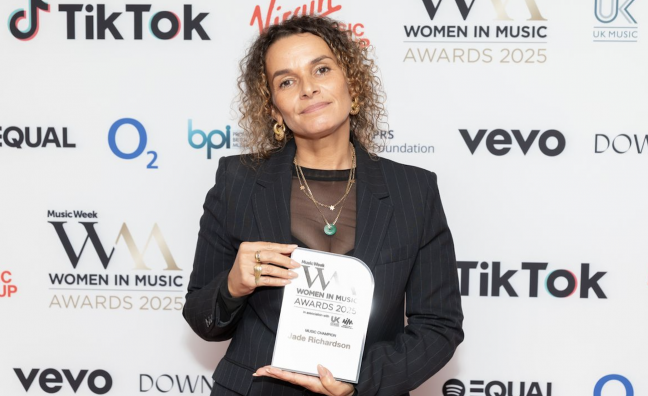
At this year's Women In Music Awards, we celebrated the achievements of 13 game-changing executives and artists as the industry came together to honour their work. Music Week has spoken to all 13 winners to tell their stories. Here, we sit down with Jade Richardson, winner of our Music Champion award, to look back on her journey and achievements to date.
WORDS: COLLEEN HARRIS
This year’s Music Champion, Jade Richardson, has built her career not on self-promotion, but on service – dedicating decades to empowering talent from the grassroots up and helping to nurture sustainable careers in the UK music industry. From her formative years at the BRIT School to an early stint in a girl group, Richardson’s journey into the music business was almost accidental, landing her first role as an A&R scout. She quickly made her mark at Polydor, playing a pivotal role in guiding the career of a then-“unknown” Ms Dynamite. Co-leading the A&R process and campaign strategy for her Mercury-prize-winning debut album A Little Deeper, it was a defining triumph that carried the underground UK garage star into commercial success. At the same time, Richardson was running the P Records imprint with friend Seb Chew.
Beyond the label world, Richardson’s influence on Black British music runs deep. In the early 2000s, she founded Iluvlive, a non-profit live music and artist development platform that began as a London showcase hosted by DJs Ras Kwame and Twin B, giving new acts their first experience performing with a live band. Iluvlive provided early opportunities to artists such as Little Simz, Ed Sheeran, Kano, Wretch 32, Ghetts and Emeli Sandé, long before they signed record deals. Since then, it has expanded to deliver events across six UK cities supporting more than 350 acts.
Around the same time, Richardson joined music charity UD (formerly known as Urban Development), working in education and artist development, drawing on her industry experience and consistent commitment to community development. When she returned to A&R for a five-year stint at Virgin/EMI, Richardson stepped down from running Iluvlive but continued to serve on its board until 2022, helping to guide its growth. Today, it continues to deliver its artist development programme, supporting four acts each year, with Nao among its alumni. The platform’s success also includes managing Izzy Bizu, who won the BBC Introducing Artist of the Year Award in 2016 and later supported Coldplay on tour.
After joining Island Records as A&R in 2018, Richardson launched Jade-Inc., focusing on talent management and mentoring artists and producers such as DameDame, Madara Beatz, Digital Mozart and Khloe Anna. She took part in the Music Managers Forum and YouTube Music’s Accelerator Programme for Music Managers in 2020, and has used her platform to champion underrepresented voices, most notably women of colour. Currently A&R at Warner Records, Richardson was recently featured in BET UK’s Queens Of Music documentary series, which celebrates influential Black women in the British music industry.
A respected figure among peers, we meet Richarsdson to reflect on her storied career, serving her community, and choosing values over validation.
How did you feel when you found out that you’d won?
“I had no idea that I was being put forward for it. So, I was in shock and then full of gratitude to the wonderful woman who instigated this on my behalf and in awe of the fact that they thought I had an interesting-enough story to win.”
What do the words Music Champion mean to you?
“It's sort of what it says on the tin; you champion people in the music community where you exist, and I suppose that's quite fitting for me. I've always felt like my job is to serve my community through the knowledge that I've gained or my years of service, and hopefully make a difference to other people's journeys, whether that be musicians or younger executives. It's always been a double-pronged thing for me. It's not just about signing, managing, or breaking talent; it's also about all the other people that make up the music business and afford artists the opportunity to have a career because they're really good at what they do as well.”
You worked with Ms Dynamite at the start of her career. When you look back at that – in the context of how the conversation around women in music and Black music has evolved since then – how important was the work she was able to do in terms of paving the way for the future?
“Oh, it was essential. Really important. We definitely didn't know at the time that we were breaking down doors and walking down paths that hadn't been walked by people like us. I think that for me, certainly, was the big light-bulb moment throughout lockdown, when all the conversations were going on around Blackout Tuesday. It was just suddenly realising that my whole career path had been, I just thought, challenging because it's a hard industry, but in retrospect, there was so much about what we were doing that was just new. It was just different. It hadn't been done before, so it was hard to navigate at times.”
How difficult was that to sustain, to keep that confidence in what you were doing and the road that you were taking?
“Well, after I got made redundant, after doing Ms Dynamite, I left the music industry because of the trauma I'd experienced, I guess – and I went and worked within the community. I then set up Iluvlive and did various things. So I think most certainly that ‘lived experience’, as they like to call it now, had a massive impact on the path and the shape that my own career took.”
I definitely prefer my life-work balance to feel healthy, and my career path has allowed me to create a world and a role for myself that suits me
Jade Richardson
What motivated your work on projects like Urban Development and the launch of Iluvlive. Why is that grassroots side so important to you?
“I just think it was always about the music, about the talent, and about the people. There was never this big agenda or this big plan. For example, Iluvlive was born out of a frustration of there being nowhere to see Black music in a live environment. So it was just me facilitating a space – because I could see that there was a space in the industry for it. I was being asked to go out daily to watch live music, and there was nowhere to see the music I liked. So it was just like a practical solution. With Urban Development, that was where a job offer came in when I had no work, and it sounded like something fun to do. It was working with people that wanted to get into the music industry, but maybe didn't know how to do that, and I just spent however many years in it, daily, giving them some advice. There was never a big plan.”
Do you feel like you found your purpose in the grassroots, that it aligned with your values in that sense?
“One hundred per cent. I think in the end, as human beings, it's exactly that, isn't it? It's your core values. And I think when I did a podcast in lockdown for the Did Ya Know series, I realised very much then that my purpose has been and will always be serving my community. That was that moment, when I was reflecting on my career path, I could see what my driving force really was. And I think that's the same in anything I do, just in life as a person. I truly believe the secret to living is giving, and you have to share and help to be better as a community. I'm certainly not driven by the power or the accolade of running a corporation to the highest level or getting paid the most money. I definitely prefer my life-work balance to feel healthy, and I feel like my career path has allowed me to create a world and a role for myself that suits me and my lifestyle. I'm so grateful for that, but I'm also aware that it's come from hard work and paying my dues and it doesn't come without its own challenges. I don't know if I'll be in paid work this time next year, or what I'll do when I'm retired, because I haven't had the same trajectory as a lot of my peers who are mortgage-free and probably own their second homes. But you know, we all pick the path that suits us, and I'm really grateful for the experiences that I've had so far.”
What is your proudest achievement and why?
“I think I'm always really proud when I've supported somebody in making a career for themselves, so that they can do what they love and sustain themselves financially, and they're also well received by the public. When the stars align and you've got those things in place, normally it kind of equals success on paper, you've got some sort of commercial notoriety. The artist is able to make a living. The team around you are able to justify their roles, so everybody wants to still pay them, or they get their commission. I think in those moments you feel like: it takes a village, and a village is being looked after. That always makes me feel good, but I don't need commercial accolades or success to tell me that the work I did was worthwhile, and I remind my artists of that as well all the time. You can't live and die by what everyone else tells you. But it's a bonus. For me, as long as you can put your head on your pillow at night and be proud of the work you've done, all the other stuff is a bonus.”
 Jade Richardson with Warner Records & Parlophone Label Group president Joe Kentish
So in light of all that, what does it mean to you to be able to stand before the industry being celebrated as someone who has opened the doors for so many?
“I think that it's been a bittersweet journey to this point for me. You know, me along with many others, have not been acknowledged yet. I think that that's sad and testament to the number of amazing women that get overlooked. And I just hope that whoever right now is reading this thinking, ‘Why has no one noticed the service I've given to the industry and earmarked me for an award’, that they will let people know who they are. But unfortunately, in this industry, it often takes you to have people championing you. It's very much about pushing yourself front and centre and I come from a generation where we were reminded to keep your head down and not make a fuss. I think the younger generation probably benefit more from the awards and things, because their nature is to want to scream about what an amazing job they've done. But I think anyone my age and older, we just weren't schooled like that. So, I know that there'll be a lot of people who haven't had awards, and I just want to say thank you to them, that we do see you, but it would be helpful if you put your hand up and reminded people of the work you've done if you haven't. Like a lot of people told me, it's less about your own ego and more about sharing these really important stories, because if you can inspire 10 people to not give up on whatever dreams or ambitions they have, then your story is worth sharing. I just realised it's less about me and more about an interesting story that I should share, because it was completely unorthodox, completely unplanned. And going back to your earlier question, what am I most proud of? I guess I could say that I'm most proud that I've managed to carve a career out for myself for nearly three decades, that I still have a reputation that hopefully precedes me, and that I'm well thought of – that means a lot to me.”
Lastly, can you share your biggest hope for the future of the music industry?
“For it to become as diverse as possible, as accessible as possible, as transparent as possible, as fair as possible. I think just putting the things in place to protect everybody involved, so that they feel supported and appreciated, and that they can continue to share amazing music and art with the world.”