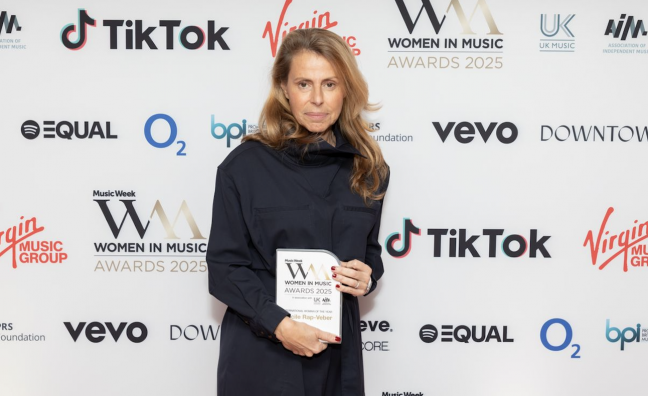
At this year's Women In Music Awards, we celebrated the achievements of 13 game-changing executives and artists as the industry came together to honour their work. Music Week has spoken to all 13 winners to tell their stories. Here, we meet Cécile Rap-Veber, CEO of SACEM, and the newly-crowned winner of our International Woman Of The Year award...
WORDS: KAREN BLISS
Cécile Rap-Veber, CEO of French collective management organisation Society Of Authors, Composers And Publishers Of Music (SACEM) since 2021, leads a staff of around 1,300 employees with a fairly even 50-50 gender balance, she says.
When she was first appointed to the top spot, after joining SACEM in 2013 from Universal Music Group, Rap-Veber tells Music Week, “on my executive board we were only two women and maybe 12, 13 men.”
She is immensely proud of the diversity within the CMO and so much more, including SACEM’s work resulting from its AI report with the Strategy & Innovation Council, and last year’s record collection of €1.6 billion and distribution of €1.4 billion. They also signed up 16 new representation agreements.
For her significant contribution and commitment to culture, she recently received France’s highest honour of merit, the Légion d'honneur (Legion Of Honour).
Rap-Veber was born into a long family history of creators – her father, Claude Rap, was a fashion designer and her mother, France Veber, a journalist and theatre director, “but she managed to get tickets free for concerts”. In the ’80s, Rap-Veber saw the likes of Kim Wilde and Frankie Goes To Hollywood, and, of course, many French acts.
“I developed a big interest for music [from other countries] and in France,” she says, recalling her years soaking up pop songs from the radio, including hits by Madonna and Michael Jackson. Her father used to tape music he liked on work trips to the US, UK and Japan.
 Cécile Rap-Veber with Jackie Alway of UMPG at the Women In Music Awards
“More and more, I was really in love with music and that real passion was confirmed in nightclubs when I was 16, and then I organised parties with a group of friends for almost five years,” she says.
“When I decided to become a lawyer, I chose, maybe because of my family story, intellectual property – I studied for a master's and on top of that, a business master's [Civil & Commercial Law and International Private Law]. By chance, the law office that hired me first specialised in music. All the big stars, French acts, were clients. It really confirmed my appetite for music and the creators of music, and I’ve remained in the industry for the last 30 years.”
After practising law at the Court Of Appeal Of Paris for four years, she was hired by Universal Music France in 2000 where she was director of legal and business Affairs, and, from 2009, director of UMCC (Universal Music Consulting & Content). She was hired at SACEM in 2013 as director of licensing, then became director of licensing & international in 2015, and finally, executive director of licensing, international & operations, until accepting the CEO position.
“Honestly, I was sure that I would never become CEO of SACEM, because for me, it was a role that was really focused on politics and communication [within the organisation],” she tells Music Week. “And at that time, I had absolutely no relationship with anyone in government. Of course, I knew that because of [my working at] Universal Music and the way we promoted artists, how important communication is in a company such as SACEM.”
“I got promoted by my predecessor [Jean-Noël Tronc] about five times, and when he finally quit the job, people told me, ‘Okay, do you want to become CEO?’, my first reaction was to say, ‘That's not for me…'" she continues.
“The chairman of the board told me, ‘We want you’ – and that's because we need someone from the operation and from the business. And now, if I have to convince a woman who thinks that they are not able to do that job, I can tell them that it's not a big deal to connect with people from the institution and the communication. It's very natural.”
Here, we reflect further on the executive's storied career...
SACEM achieved a record performance last year with €1.6 billion collected and €1.4 billion distributed to authors, composers and music publishers. How did you mastermind it?
“What we decided to do over the last 10 years was to first reinforce the coverage of countries that we can directly license. So now we are in many more countries. And on top of that, to reinforce the numbers of partnership and the force of our repertoire. So we went to Korea and convinced the K-pop, KOMCA [Korea Music Copyright Association] repertoire to come with us. I met with IMPEL, which was the umbrella [organisation] for the independent publisher in the UK first, but now [operates] worldwide. I went to [America’s] ASCAP. I went to [Canada’s] SOCAN. I met plenty of partners, convincing them with two main elements.
“The first one was to tell them that French law is the most protective in the world in terms of authors' rights. Collective management was invented during the Revolution, more than 200 years ago, in France. We have a very strong protection of culture in France. And what I managed to do when I first [established] the YouTube deal with Google, despite the fact that it was a kind of worldwide deal, [was that] I fought for them to include that it was [ratified] by French law and the French courts, meaning that if I have to sue Google, it would’ve been impossible in the United States. Imagine the fees of the lawyers. So if I have a problem, then it will be in my country with my law. And to tell the Hungarian, the American, the Korean… come with us and you will benefit from that protection.
“And the second one was that I have always had a big interest in tech and decided to design a tool that is called URights. And that has brought the most important level of transparency in data and revenues for my members and for the partners, meaning that if you have one stream in one country in the world, if you’re a member of SACEM or if you’re a partner of SACEM, you will get access to this information on a portal. One stream, you will know that it was in, for instance, Hungary in February, on Spotify [Premium For] Students and how much you earn, thanks to that.”
Where did your interest in tech begin?
“When I joined SACEM, that [coincided with] the emergence of the digital business and I was in charge of the licensing – all the business, except the news – in bars, cafes, public places... That was not very difficult to understand because I was coming from Universal and [sales of] CDs unfortunately continued to decline. But I was sure that we could improve the business of digital.
“When I joined, there were two elements that were in favour of the development I decided to do within our society. SACEM, for 160 years, used to collect only in France, whereas for digital, thanks to new European rules, we were able to collect with a digital platform agreement in 150 countries. And so, when I joined, the first agreement I had to deal with was YouTube for 150 countries.
"And the second opportunity was that I realised that being alone in front of YouTube [would make things] very difficult to get what I was expecting from these agreements, and that we needed partners to reinforce the strength of our repertoire. Through SACEM's partnership with Universal Music Publishing International, I was dealing on behalf of Universal and the SACEM repertoire. So Coldplay, Taylor Swift… I'm not saying that it's a balanced relationship in that area because Google [which owns YouTube] is so powerful, but it's better than being just SACEM alone.”
What can the UK-based companies learn from your approach?
“We have a different approach. For instance, in the UK, there is a copyright tribunal that can establish a tariff. Not in my country. We are free to deal with tariffs, so we have that freedom and some principles that are more protective.
“Now, I'm not going to say that I am a reference for UK companies. I won't pretend that everybody has learned, thanks to me, a lot of things, but I think that what makes maybe a difference, and why some have chosen to come with us rather to another CMO is good food [laughs], a sense of humour, and we work a lot with a lot of fun. We always try to compete and to be the best. I always try to convince my team that we must be seen as the best. And I have a wonderful team.”
Usually, someone that's heading a CMO or PRO doesn't get acknowledged for these types of awards. This is also international. How does it feel to win it?
“I feel very proud because it's a wonderful recognition of what we've been able to achieve to put SACEM at this level. You mentioned the €1.6 billion and there is more than €1.4 billion in terms of distribution because, of course, collections are important, but distribution even more so. Sometimes you can just focus on money and business. That's not my case. What is really important, and it's typically French, is social and cultural protection and diversity, inclusion. You increase the business and, at the same time, my goal was also to reduce the cost for the members, which we've been able to achieve as well. But I didn't want to do that to the detriment of creators and services, so preserve the services, preserve the protection, social and cultural action, and develop the business. Yes, I'm proud and I'm super happy that Music Week found out it was true.”
I always try to convince my team that we must be seen as the best – and I have a wonderful team
Cécile Rap-Veber, SACEM
Where do you feel AI is heading?
“That's priority number one in our company. So, first of all, in 2023, we initiated what we call a ‘hackathon’, internally. We wanted to be sure that before we face the problem with AI and its creation, we will already be able to manage AI for our own processes. That means that everything you can implement in terms of AI tools for the benefit of your employees must be done.
“So there are 12 directions. First, I invited all the commercial [teams], the VP, from Microsoft; different big companies, and I told them, ‘Tell us what you are able to sell in terms of AI.’ And so they showed everything they had. And then afterwards, I told my teams, ‘Which tool can be useful for you? Can we develop something?’ It was a wonderful experience because sometimes SACEM could be seen as [having] very old ideas. And in all directions, they found specific projects that are currently already developed for some of them, and will be delivered in some months for others. And so, internally, we already use AI to improve our system.
“On the other hand, the first thing that we did, because we have the European law – so it's different from the UK, and different from United States and the rest of the world – [was that] we were the first society in the world to notify to all the AI companies and, more generally speaking, all the digital companies that we notify our opt-out, meaning that you can't train your AI on our works without our permission. And, of course, we started to fight at the European level to try to get some directive or laws, more protective than what was already issued.
“And, unfortunately, that was the first time in our life where we saw our government being much more in favour of AI companies than the creators. That was the case also in Germany. And that's how finally we decided to partner with GEMA and [CEO] Tobias [Holzmüller] and myself; we were in a study about the impact of AI on the revenues of the creators for the future, and Tobias invited me to the parliament in Berlin to present that study. And after that study, Germany finally decided to vote for a legislation that is more protected. And at the end, thanks to that, France finally decided to vote on that. It's a first step where, yes, there is an opt-out and there is a minimum of information that should be delivered by the AI company about their training data. It's the first step.
“And we need to fight much more. I think that in 2025, 2026, 2027, we'll be really focused on that, despite the fact that we must still focus on the value generated by digital, because even if we're talking on a macro point of view, about hundreds of millions of revenue, when you analyse how much a creator earns per stream, it's too low. Still too low.”
Now that you’re the boss, what are some of the things that you have done to ensure women have a secure work-life balance?
“I have a big level of empathy. I feel happy and sorry for people. First, don't do to someone else what you don't want people to do to you. I think that when you defend all the values that SACEM wants to promote – inclusion, diversity, protection – first, do that to your employees, to your team. It's not only words; it's also action.
“In France, we have a lot of trade unions that you have to deal with in companies, so we have a dialogue all year long with them. We have, of course, people that work remotely and it's the case for plenty of countries around the world after the COVID period, but I don't try to do so many differences between men and women because I don't want to [seem to] be more in favour [of one gender over the other]. But what is sure is that when you are pregnant at SACEM, you have specific things. We try to have a policy that’s in favour of inclusion, diversity and promoting women much more than in the past.”
What's your advice to young women wanting to get to the top of the industry?
“I think that, unfortunately, [we can't] rely only on women to promote themselves. It's very difficult, so we have to help them. We have implemented, for instance, breakfast with me, so we can share our experience. I ask them if they face any difficulties. I try to share my own experience and I really try to convince them that, yes, it's possible, they can do it.”