As FKA Twigs celebrates a well-deserved Grammys victory for Eusexua (Best Dance/Electronic Album), here's a chance to revisit our Music Week Women In Music interview with the Inspirational Artist winner from October 2025...
At this year's Women In Music Awards, we celebrated the achievements of 13 game-changing executives and artists as the industry came together to honour their work. Music Week has spoken to all 13 winners to tell their stories. This year's winner of the Inspirational Artist award scarcely needs any introduction – FKA Twigs has blazed a trail through the business like no other. Here, she tells Music Week her story...
WORDS: CHARLOTTE GUNN
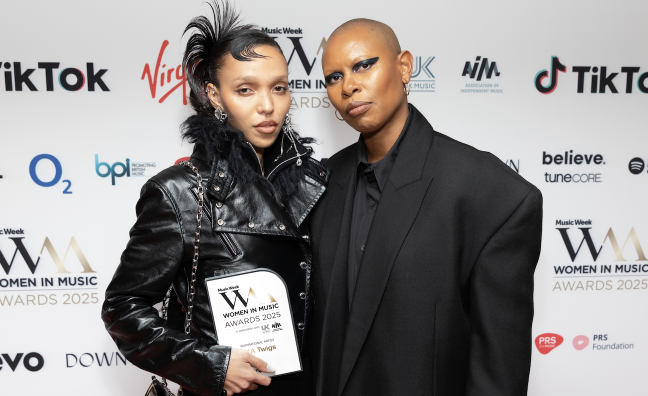
FKA Twigs is the winner of the Inspirational Artist award at the Women In Music Awards 2025.
Not one to fit neatly into the boxes, Twigs is something else entirely: a multi-hyphenate, a world-builder and a dedicated master of her many crafts.
“As I get older, I’m realising that I’m not a pop star,’ she tells us. “I’m barely even a music artist – music is just the medium through which everything else flows.”
This award serves as recognition not only of Twigs’ creative innovation but of the persistence, integrity and quiet leadership she has shown on her path through the business.
This year, via long-term partner Young and US partner Atlantic, Twigs released Eusexua, her first full-length album since 2019’s Magdalene. Mercury-nominated and achieving a career best No.3 in the UK, this set was yet another gear change: a fearless and visceral electronic record, inspired by the clubs of Berlin and the healing and somatic power of the dancefloor. Its follow-up, Afterglow, out next month, further expands on this creative universe. More than just a remix album, it’s been billed as an entirely new project, which is “hungry, raw and ready to be adored”
While continually pushing the boundaries of what artistry can be, Twigs also channels that same energy into advocacy. A passionate supporter of Sistah Space and No More – two organisations working to end domestic abuse and sexual violence against women – she’s more than a figurehead. Her involvement is hands-on, focused on action and tangible results, reflecting the same drive and integrity that define her creative work.
“I’m a Capricorn,” she notes, “So I really like to actively participate, to tick things off a list.”
In the wake of collecting her award, we talk to Twigs about her creative journey, doing things differently and what the industry still needs to do to support creativity in all its forms…
First of all – congratulations! How does it feel to be the winner of the Inspirational Artist Award?
“I just feel really honoured, to be honest. In a way, it reminds me of how long I’ve been working in this industry. And awards like this are the ones that really matter. The ones that have a bit more heart, especially around the predicament of being a woman in music, it’s just really special. I feel really honoured to be recognised.”
Does the idea of being inspirational sit comfortably with you?
“These days, it’s hard to be inspirational because the world is such a harsh place and everyone is held to such a high standard – not only by people that don't like you, but by your fans as well. It’s such an intense and impossible task to be perfect all the time because we're all on the world stage with social media. Being someone in the public eye, you're held to even higher possible standards – to be perfect all the time. I've kind of given up on being inspirational or perfect, and have leaned more towards telling the truth, both in my music and in who I am as a person, even if sometimes that’s a contradiction. As humans, we are contradictory. So I lean more towards telling the truth and hope that people resonate with that truth or find something they can relate to. I just try to be a good person and an honest artist.”
Last year, Tori Amos won this award and she said, “Music is one thing, but the music business is not for everyone. Can we do better for the women of tomorrow?” What is your take on those sentiments?
“I do agree that the music business isn't for everybody, and it’s something that I constantly grapple with. I believed it would get easier as I got older, but that hasn't been the case. For me, it’s actually been the opposite. Since winning this award, I’ve been thinking about it a lot – like, what could make the music industry better for women? And part of the issue – and I was really shocked when I reminded myself of this – is that in the whole of my career, unless I’ve actively sought them out and hired them myself, I’ve accidentally only ever worked with one female engineer in the studio.
“I’ve never accidentally worked with a female producer. I’ve never walked into a session or someone else’s session and there just happens to be a female producer there. I’ve never personally – unless it’s an artist that I know – met a female executive producer of a record by accident. Anytime I’ve worked with women in these roles, it’s because I’ve decided to go into the studio with them, I’ve sought them out – and they’re few and far between, truly.
“So that’s to say, in all of these roles that are the backbone of the industry – the people who grind in the safe spaces where the art is made – I’ve met one female. And I’ve been doing this, writing songs and being in studios, since I was 16 years old.”
 FKA Twigs with her trophy
What needs to happen to see a shift in this area?
“I have a studio in East London – it’s really small and super cute. I don’t usually have any of my awards out, but I keep two of them on display – they’re hidden behind plants and they’re from the Music Producers Guild, they’re industry awards I’ve won specifically for my music production.
“I was in the studio with this producer, and he said something like, 'You know, you’re a singer – you don’t really get involved in all that,' and he meant it as a compliment, honestly. But I thought it was so funny. I didn’t say anything – I just glanced over at those awards and looked at them for a few seconds, reminding myself how much music I’ve made with my bare hands throughout my career.
“Because it’s comments like that – and just the general energy of male-dominated spaces – that can make it so intimidating to be a woman with something to say and something to create in an environment that doesn’t always feel made for you. I’ve definitely felt intimidated in the past to play something, to use my laptop, to try a programme, or just to get something wrong.
“So I can’t imagine what it must feel like for unknown artists, or new engineers, or new female producers working in the industry now. To be honest, it probably starts with more support in education. It comes down to creating more courses and opportunities that encourage women to succeed in these roles.
“As a young artist, I would have felt a lot safer if there had been more women in the studio – especially when I was starting out. Studio sessions, at least in my experience, often go late – sometimes until midnight or one or two in the morning – and I would have felt a lot safer, particularly in my teens and early twenties, if there had just been more women in those spaces – as part of the backbone of the creative industry, behind the scenes.
“So yeah, if it starts earlier, there’ll be a new generation of women in those roles that I didn’t see when I was starting out – and hopefully the next generations can feel safer and more supported. But, unfortunately, women – and as we know, women of colour especially – aren’t given the same grace as others. It’s tougher. You have to get it right quicker, make fewer mistakes, and learn faster.”
Awards like this are the ones that really matter, the ones that have a bit more heart, especially around the predicament of being a woman in music
FKA Twigs
You have a new version of Eusexua on the way – Afterglow. Can you explain the vision and story behind it?
“For me, Eusexua isn’t an album – it’s more of a toolbox. It’s a way of working. My new Eusexua is just my Eusexua – but your Eusexua might be something different. It might be writing, it could be dancing, it could be anything, you know?
“So in that way, having Eusexua as a toolbox allowed me to create a lot of music during the initial stages of the album, and that inspiration continued even after it came out. I’ve still been writing, and there was still so much work and energy there.
“Eusexua as an album was incredibly difficult to choose songs for, actually. But Eusexua as a body of work, once I boiled it down, was a love letter to the way dance music made me feel. It was a love letter to the way my Eusexua made me feel. There’s a pureness and an integrity to it – it’s really honest. But there’s also another side of me that’s playful, and another side that’s a bit more naughty in my Eusexua as well.
“So Afterglow for me is a way to take everything I’ve learned from dance music, and the freedom I found in creating with Eusexua, and smash it together with what comes naturally to me – a lot of deconstructed beats and other musical influences – but still under the umbrella of those incredible raves I’ve been to, and what happens when I’ve left the rave, when I don’t want to go home, and how that experience makes me feel, how sexy that feels.
“So Afterglow is… well, how can I put it? It’s a feeling of pleasure after something really good that’s just happened. And Eusexua for me was something really good that happened, and Afterglow is the reflection, or the feeling of pleasure that comes because of that.”
Throughout your career, you’ve always had ideas that don’t necessarily fall into standard methods of campaign rollout. Have you had to fight to get support to make these a reality?
“I don’t really fit into an album rollout, you know? That’s something I’ve realised. At the moment, I don’t have a traditional management structure because I don’t want to feel like everything I do has to make money all the time. I’ve got so much more to say, and releasing music is just one way of doing that. But as I’m getting older, I’m realising that I’m not a pop star. I’m barely a music artist. Music is just the medium through which everything else flows.
“I want to make movement methods. I want to invent music methods. And I want to use music as this conduit to get out everything I’m feeling inside – for me, and hopefully to build a community around that. I like building worlds, and I like having a community around me of like-minded people. I like asking questions, and I like the way that art can give me answers to those questions. The people around artistic communities can help me figure out life more.
“That’s what I love about creating so much – you meet people, and they help you figure out life. It’s like being parented by this amazing form. And it’s kind of difficult nowadays, because there’s so much critique all the time. Everything’s so heavily criticised all the time.”
Can you describe how you work with Young and the team there?
“No one meddles with what I do. I just make things and hand it in. Artists that sign to Young don’t really need suggestions – if you sign there, it’s because you’ve already got a vision. And of course, they’re there to help if you need it, but you have something constantly flowing, and that’s what they look for in their artists. If you look at the people they have – from Sampha to Jamie xx – they’re artists who are very autonomous in their creative creation, as I am.
"I wanted to sign also to Atlantic because I wanted to be poked. I wanted to be challenged. And that’s been difficult and incredible, and it’s really helped me grow as an artist. Not challenged in a bad way, like, ‘oh, you’re doing this wrong’, but more like, ‘what about working with this person? What about doing that?’ – things I hadn’t thought about before that I might have initially dismissed.
“I’ve been really open to the process there, because there are actually some really cool people – young, creative people – who have ideas. And it’s been good for me to learn the balance. I’m very strong as well, so when I say enough, it’s enough, and I’m heard. But it’s been really good for me to be prodded a bit, because I want to grow.”
At what point do you think you got to that place – where you can stand your ground and you’re heard?
“The music industry can be really manipulative. In my early career, I did things almost because I was tricked into thinking it was my decision. I don’t mean creatively at all – creatively, I’ve always done what I want to do.
“I remember, as a young person, expressing that I was uncomfortable working with certain people and being talked around, to stay within that environment. And it’s just quite toxic. I don’t put up with that anymore.
“There’s definitely a pressure on women to be pleasant and not be difficult. And as a woman of colour, I’ve always been very conscious of not being called a diva, or being difficult, or being too outspoken. When I was younger, I didn’t think I’d be able to have a career if I put my foot down too firmly.
“Sometimes it can be as simple as someone saying, 'You’ve been working so much, you don’t need to do that.' I’ve had to experience what it’s like to do an interview when you’re tired, to not be as eloquent as you’d like, to say something that’s misunderstood, and then deal with the ramifications of being misunderstood on the world stage. And not be able to say anything about it, because there’s no point – no one really cares anyway. You know, it’s fun for people to say you’re wrong. I understand the glee in that – the desire people have to prove a point. I do understand it, because the world is hurting, and there’s this constant need to get one over, or to fix something, or to have a voice.
“But when you’re a small or mid-sized artist, and you’re just tired and shouldn’t have done that promo, it’s hard to be on the other side of it. Still, I take it on the chin. I’m a strong person. But now, if someone wants me to do something and I really can’t, I’ve learned to use my voice and just say no."
Do you think there’s space in the industry at the moment for the next Twigs to come up?
“It’s not really about the next Twigs specifically. It’s about the next artists who are willing to grow and practice in private. For me, a lot of my practice has been about that. I didn’t have a smartphone until my early twenties and I came up in a generation where social media didn’t really take off until then.
“To grow in private has been a huge part of my craft. Growing up in those amazing years, from about eight to 28, I was able to learn dances, learn to sing better, practice my voice and movement, constantly try to get better at playing instruments – and to do all of that without anyone watching, without it being for anything, and without being judged.
“Because the validation now of doing something and immediately getting likes… It's like training a dog. You do something, you get a treat. Do something, get a treat. But that’s not art. Art doesn’t give you treats. Art is just because. You create just because. For me, the joy is in doing it, not in the applause. The joy is in the process – the learning, the being bad at something, seeing the improvement, learning to put your emotion into your craft. That’s art for me.
“There’s the ability to do something on a technical level, and then there’s the ability to do it so well technically that you forget it’s technical – and then you can put your feeling and your point of view into it. Whether it’s poetry, painting, movement, anything – there’s the craft of figuring out what you want to do, and then there’s being a conduit for a message.
“And I don’t believe it’s possible to create a pure expression with millions of people instantly judging you when you’ve barely started. So I don’t think it’s about the next Twigs, or the next anything – it’s about artists creating without being perceived. Creating for the sake of creating.
“Now, the most successful people are often the best at promoting themselves. I’m horrible at promoting myself and I don’t really film myself that often. And when I do take pictures of myself, it’s usually because I’ve got a rash and I’m trying to see how it’s healing, or my dog’s doing something weird and I need to send a video to the vet.
“But I’m not putting anything down. Times change. When I came up, I was discovered by a huge producer on MySpace. And probably there were people thinking, ‘that’s crazy – you should go to a studio, someone should hear you playing acoustic guitar outside the door. In my day, we didn’t have MySpace. In my day, I had to give out a hundred CDs at every record label.’ Times change! But the thing that’s never changed is the ability to self-practice. The ability to self-regulate through practice.
“So I just hope people still have the inclination to get better at something in private, because they want to do it – not for the applause.”
 FKA Twigs on stage at the Women In Music Awards
This award is for campaigning as well as music. Can you talk about the work you do with organisations such as Sistah Space and No More?
“I just actively do things. I like to use my platform for things I feel passionately about – and I have done in the past – and that’s an important thing to do. But I’m a doing person. I like to see actual results.
“So with Sistah Space, I just go in there and say, 'What do you need?' and then try to figure out a way of getting it. Sometimes it’s easy – sometimes it takes a day, sometimes it’s finding some funding, or donating, or doing something like that. Other times, it’s things that take longer – bigger projects, wider issues. So I try to just actively be present, listen, and work on things.
“Sistah Space and I have been working on something really incredible that I can’t wait to tell everyone about, but it’s taken months – honestly, months and months to figure it all out. My way of working can be quite intense – to intensely step forward and encourage everyone else to take one step forward too. It’s a good thing and a bad thing. But I really like to get to the crux of a problem and find a solution. I’m a very solution-based person.
“For example – we need money, where do we get that money from? You need community, how can we build that community? Someone needs help, listen to them, find out what they need, and figure out how to get it. I’m very like that.”
Now, it's looking after the child inside of me, and making sure she feels seen and heard and loved and accepted
FKA Twigs
Is there any advice you could give to younger artists about how to navigate the industry?
“For me, it’s been about surrounding myself with good people, people who truly see me and truly hear me. Now, I mean, I have an amazing partner, and my hairstylist is an absolute godsend as well – not just creatively, he’s a genius, but as somebody who protects me and protects what FKA Twigs stands for. So it’s been about surrounding myself with good people – that’s been it. And just listening to my gut, to how people make me feel, and following that instinct. That’s been really important for me.
“And I don’t know – just going easy on myself, looking after the child inside of me, and making sure she feels seen and heard and loved and accepted.”
Are there any women who have inspired you along the way?
“Michaela Coel is absolutely incredible. She’s been a dear friend of mine and someone I can have really honest and beautiful conversations with. Madonna has been incredibly generous with her time – giving advice, being honest, being fearless, being tenacious. She’s an incredible woman who has gone through so much and is still so bright and so beautiful. Vicky [Walker] – PinkPantheress – is really bold and playful and fun and hard-working. She’s an amazing young woman. Honestly, there are so many incredible women. Julie Greenwald at Atlantic has been such a supporter of mine and has given me so much confidence, she’s absolutely incredible.
“And, you know what, every time I’ve been in a pickle, I’ve always had women give me advice. I’m really bold that way – I’ll just DM someone, even if I don’t know them, and think, they’ve gone through something similar, and I’ll say, 'Hey, can we talk?' And then we talk, and I’m like, 'okay, good, I’m not crazy, I understand what’s happening here.' I believe in constantly asking questions.”
Finally, can you share anything about what’s inspiring you creatively right now?
“The idea of living a dynamic, but soft, kind, playful and generous life – that’s what’s inspiring me. Just the idea of cultivating environments that are softer, more playful, more giving, more loving, more naughty, more exhilarating. That’s what’s inspiring me. Just play.”