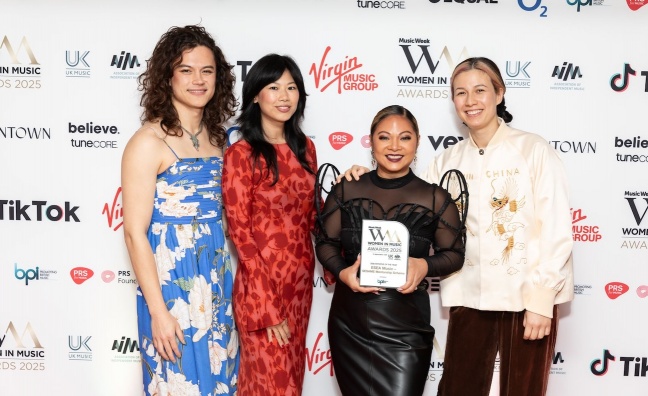
At this year's Women In Music Awards, we celebrated the achievements of 13 game-changing executives and artists as the industry came together to honour their work. Music Week has spoken to all 13 winners to tell their stories. Here, we catch-up with the winners of the DE&I Award, ESEA Music, in honour of their SESAME mentorship scheme.
WORDS: CHARLOTTE GUNN
ESEA Music are the winners of the DE&I Award at the Women In Music Week awards 2025, for their SESAME mentorship scheme.
Formed in September 2021, ESEA Music is a non-profit, community-driven network created by UK-based East and Southeast Asian (ESEA) artists and music industry professionals. Bringing together members from across the sector, the organisation now counts more than 500 participants and continues to expand. Its mission is to strengthen visibility and representation for ESEA voices throughout the UK music landscape.
In 2023, the collective launched the SESAME mentorship programme, which aimed to promote “communication and positivity” for its members, with a particular focus on supporting mental and creative health.
The mentorship scheme has now completed seven rounds, supporting 21 emerging artists and executives through one-to-one mentoring with 21 established industry figures, alongside three intensive workshops.
Most recently, in June 2025, SESAME joined forces with electronic music platform Beatport and Pointblank Music School in London for a full day of sessions covering everything from songwriting and production to marketing, royalties and music law. The initiative was backed by Beatport’s Diversity + Parity Fund.
The programme tackles a pressing issue highlighted in UK Music’s 2024 Workforce Diversity Survey, which revealed that East and Southeast Asian (ESEA) professionals make up just 3.22% of the UK music industry. The survey also pointed to the isolation of ESEA workers from other minority groups, and their ongoing under-representation, tokenism and lack of resources.
In response, ESEA Music and the SESAME Mentorship Scheme aim to change the landscape by creating vital support networks for ESEA musicians and professionals, building solidarity through a national collective, and amplifying the creative contributions of ESEA talent. At the same time, the initiative challenges entrenched gatekeeping and pushes back against damaging stereotypes, from the ‘model minority myth’ to the gendered tropes that continue to affect Asian artists.
Along with producer Rob Chung, the SESAME scheme was founded by Lucinda Tse Hall from BMG, songwriter Aileen de la Cruz and Emma-Lee Moss (the artist formerly known as Emmy The Great). Their commitment to empowering the next generation of ESEA talent has been central to its success.
We caught up with the three women to celebrate their well-deserved win at this year’s Women In Music Awards and talk about the vital work ESEA Music has been carrying out.
How does it feel to win? At this particular awards?
Lucinda Tse Hall: “It was just so unexpected and such a great honour to have SESAME recognised as a collective that’s trying to help people.”
Emma-Lee Moss: “I remember ESEA Music starting in 2021 and SESAME taking shape a year later. For ESEA co-founder, Tiger [Hagino Reid], to have already been acknowledged at the Women In Music Awards and now for this as well, it feels like a real validation for the community.”

Can you outline the founding principles of the SESAME scheme and why it was important for ESEA to do it?
LTH: “The aim was to facilitate a support system that promotes communication positivity, leading to better mental health and creative health. A second tenet would be to push for further equality in the music industry. We were looking for mental health and intersectionality to be at the forefront of how we shape the scheme. We were very mindful of the environment that we were starting off in, in the wake of Black Lives Matter and Stop Asian Hate, which are very US-centric movements. And we were in a mid-COVID world – everyone's mental health was really suffering at that point – so we were trying to find something that would help uplift the community and address some of those issues.”
ELM: “One of the first things we did was reach out to Arts Emergency to research things that helped other people on mentorship schemes. We spoke with individuals who had been mentors and run mentorship schemes, and then we adapted those learnings to our specific community. At the time, we were holding a lot of community meetups. It was a privilege to already have a group of people to interact with and help shape the scheme and its values.
“We started with 10 people but by the time we launched our trial periods, we had 50 and were able to get a lot of feedback. It was very fluid, we matched people based on answers on a form we created. No two people were looking for the same thing, there were no metrics to success. We just went with our gut.”
You've had 21 mentees pass through the scheme so far – can you quantify the impact it has made on them/wider industry?
Aileen de la Cruz: “In the round before last, we had a pairing with an artist and manager and as a result, the manager is now managing that artist and he’s performed at South By Southwest and major festivals.
“I’m seeing a lot of artists that I’m working with taking the initiative to be more self-reliant and self-confident. On the mental health side of things, they’re reaching out to more resources such as Help Musicians.
“But the most important thing is the feedback – people finally feeling heard and seen. From my own personal experience being a published writer for over two decades, you want to be acknowledged. I moved from Canada to England and even though I was already from the music scene, it was like starting a whole new life. Finding out about ESEA Music was a large part of redefining my identity.”
LTH: “On the industry side, we’ve seen someone who was working at one of the larger firms, then move to a major label and now has created his own company. The scheme gave him the confidence to do that. Previously, he’d fallen into the trap of staying quiet, keeping his head down and not wanting to rock the boat. But once he had that confidence, his career completely changed direction.”
As women in the industry, we carry the weight of raising families, running businesses and navigating the constant pressure to stay relevant – all while continuing to push for visibility and recognition as ESEA advocates
Aileen de la Cruz
What does the scheme want to do for those it mentors? What does it need?
LTH: “No two people are looking for the same thing. At the first session, with 10 people, the younger attendees were looking for advice on how to start a career in the music industry. They wanted validation and they wanted support. Now it’s just as valuable for older people to learn from that younger generation. It varies from person to person, responding to the needs of the individuals.”
ELM: “Everything that we do in ESEA Music doesn't have a massive desire for growth markers, in the traditional sense. It's not about making things look as though they're big. On a personal level, having felt alone in the music industry for so long, to discover that you're part of a group of people who are all shouting out, looking out for each other – where young people are coming up and more established people are there to help, in this beautiful synergy – is incredible. Everything is just done out of the care of what we can do for each other.”
What exactly do your roles entail and how do you fit it all in around day jobs?
ELM: “There are no defined roles, it’s all very equality-based between us three and Rob.”
LTH: “I took a step away when I had a baby, so Aileen and Rob really took on the Beatport workshop. But other than that, it’s very fluid. When we have ideas, we get on a call or WhatsApp chat. We all understand what the goals are, so the relationship just works.”
ADLC: “As women in the industry, we carry the weight of raising families, running businesses and navigating the constant pressure to stay relevant – all while continuing to push for visibility and recognition as ESEA advocates. What I love most about our ESEA team is the unwavering support we give one another. We step in when needed, empower each other to lead and work together to ensure our goals are achieved.”
How has what ESEA does evolved since it was founded?
LTH: “Organically, our next steps are really exciting. We will be doing something with the BRIT School, and Aileen will be leading on that. We’re starting conversations with Ronnie Scott’s Charitable Foundation. But again, there are no metrics of ‘we need to do this by this date’; we are responding to the needs of our community. The inequalities in the music industry aren’t going to be solved overnight. It’s a long-term goal of offering long-term support.”
Has the industry been receptive enough to what you're doing?
ADLC: “On the performance side, I played in the Gorillaz shows recently and there were two ESEA female string players on stage with me. It was really nice – and kind of a shock – to see a group of Asian artists with me on stage.”
ELM: “We were also the first people to send ESEA representatives to the diversity task force survey panel. And as a result, two new tick boxes were added. In the UK, the ‘Asian’ category has historically predominantly represented individuals from the South Asian subcontinent, overlooking the diverse ethnicities and cultural identities of ESEA people. Our recent survey, (Re)Orientated, highlighted that 70% of respondents struggled to find their identity within the limited options provided by the 2021 UK government census, such as ‘Chinese’ or ‘Other Asian’.
“To address this issue, the UK Music Diversity Taskforce agreed to the inclusion of two new categories – ‘Any other ESEA (East Asian/Southeast Asian) / ESEA British background’ and ‘Mixed/Multiple ethnic groups – White and East Asian/Southeast Asian’ so that our community can better identify themselves.”
You have the ear of the business as WIM winners – what do you want from the industry?
LTH: “It’s an honour to be named alongside previous winners Power Up and Sony Music. This recognition is a reminder of our interconnectedness and the responsibility that we share to uplift all marginalised communities. Awards like this celebrate not only representation, but solidarity and the power of collective progress, but there is still much work to be done in the industry…”
ADLC: “One key lesson is that representation must go beyond optics – it needs to be backed by meaningful, structural support. Visibility matters, but without access to resources, networks and decision-making power, it risks feeling tokenistic. That’s where mentorship and community-driven schemes come in: they help bridge that gap with tangible support and long-term development.
“We’ve also seen that cultural understanding in the industry is still lacking. Many underrepresented artists, including myself, have had to explain or justify our identity and artistry in ways others haven’t. This creates a psychological burden – one that mentorship can help relieve – but also signals a deeper need for industry-wide education, accountability and inclusive leadership.”
ELM: “I’d love for people to understand that this community and the work we do together is for the long haul. This is a lovely moment of recognition, but the work will continue beyond, and hopefully the results of that work, too. Personally, being part of ESEA Music has been life-changing. I just want those in the industry reading this to know that things like connection, community, representation – these aren’t buzzwords. They have meaning in people’s lives and art. It’s a positive thing for the music industry when people feel free to use their true voices.”
PHOTOS: Louise Haywood-Schiefer / Panni Renner