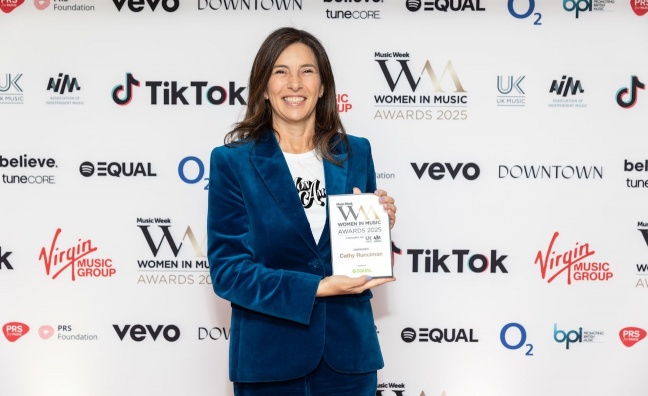
At this year's Women In Music Awards, we celebrated the achievements of 13 game-changing executives and artists as the industry came together to honour their work. Music Week has spoken to all 13 winners to tell their stories. Here, Cathy Runciman, winner of our Campaigner award, tells us about her work as the co-executive director of EarthPercent...
WORDS: ANNA FIELDING
“Music is uniquely placed to inspire audiences to action,” says Cathy Runciman. “We’re currently in a moment where there’s so much disinformation and misinformation that we don’t trust big corporations, we don’t trust government, we don’t trust media and we don’t trust big NGOs either. But there is something truly magical in the trust artists have with their audiences. It’s very powerful. I don’t think there’s anyone who chooses to live a music-free life… through music you have the potential to reach everybody.”
Runciman wants to reach people and engage them with the climate emergency. She’s the winner of this year’s Women In Music Campaigner award, for the vital work she’s done as the co-executive director of EarthPercent.
EarthPercent’s mission is “to unleash the power of music in service of the planet”. Runciman, along with her fellow executive director Joel Gardner, co-founder Brian Eno and the rest of the team, is committed to making a practical difference. They raise money, not just awareness, and distribute it to a network of partners covering climate, biodiversity and environmental legal work. They also work with organisations who focus on the greening of the music business, like Julie’s Bicycle and Live.
But EarthPercent’s biggest hit so far has been the Sounds Right project, working in conjunction with the Museum For The United Nations, Spotify and Music Declares Emergency. Launched in April 2024, the idea behind SoundsRight is a simple one. Artists work with sounds from nature and, on the resulting tracks, nature is credited as a recording artist and receives a share of the royalties. EarthPercent have expanded on this, working with the publishing sector to launch ‘The Earth As Your Co-writer’ to make collecting royalties more efficient and allowing more musicians to include the Earth as a beneficiary.
“Artists have worked with the sounds of nature since forever,” says Runciman. “Bird song, or crashing waves, or the claps of thunder in heavy metal songs. Nature is the original artist, nature was making music long before we were… before we were even putting our hands on the wall to make cave paintings we had the sounds of nature around us.”
 Cathy Runciman with Brian Eno
The biggest challenge, she says, is communicating the dire circumstances that our natural world currently faces. “The science is scary right now. It’s crystal clear and it’s absolutely terrifying. And it can be quite hard to grasp that and to understand what you want to act on.”
Working with EarthPercent allows artists, and the wider music industry, to play a defined role as communicators in addition to contributing their time and money. “When artists release these tracks and tell the story of why they wanted to work with nature as an equal artist, the response was 90% positive,” she says. “And the remaining 10% were asking really great questions like, ‘Where are the funds going? How is this supporting nature conservation?’.
“We are looking at the business structures of music,” Runciman adds. “What does it mean to make real the idea that the Earth is a stakeholder in the music business real? That’s our core proposition.”
What does winning the Campaigner award mean to you?
“I am delighted. It’s an amazing list of previous winners and it’s an honour to have your name added to that list. But actually, it’s not about personal recognition. It shows that work on behalf of this planet is being recognised in music. I carry it as an amazing tribute to so many other women working in this space.”
What led you to working at EarthPercent?
“It was both motivation and career path. My background was in media. I had the great joy of running Time Out’s international business for many years, working with local teams who were creating Time Out businesses in amazing places. After that I went to Open Democracy, so non-profit, political media. Then I launched a project called Atlas Of The Future, along with the Fixing The Future Festival in Barcelona, which was a positive news framing of people doing the work for a better future. We were a storytelling platform, telling amazing social impact stories, and then the event brought people together. What I found over time is that, over and over again, the soil and the roof of all of this was climate and biodiversity. And then someone said to me, ‘You know Brian Eno has a climate charity and is looking for someone to run it?’ And that was a light-bulb moment.”
You’ve touched on this already, but why do you think music is an important method of tackling the climate emergency?
“In the industry when people think about climate work, they think about tackling emissions. When people advocate for the planet they don’t want to do that in front of a burning building, caused by their own work. So the work of organisations on the sustainability side really matters. But with music, it’s also a deep emotional connection, it really touches people, and I think a lot of the artists who connect with our climate work most deeply are people for whom music is not just entertainment. We need entertainment, and entertainment through music is joyous and wonderful and beautiful, but music is much deeper than that. You often hear campaigners say we need to listen to the Earth, but what does that really mean when you think about sounds? There was some powerful research done that said it’s hard to communicate with science and data; what really motivates people is love. And, of course, music is the very best art form to talk about love.”
We’ve talked about artists, but what kind of support do you get from the industry?
“It was an amazing experience to begin with. The people who came forward were the self-selecting group of people within the music business who were most engaged on these issues. I would specifically like to shout out Angus Baskerville at Pure Represents who created his whole live agency with the idea of taking our responsibility to this planet seriously. Then there has been a tougher experience of knocking on doors, which is somewhat confusing to me given what’s at stake. Some doors still feel closed. But I genuinely think the challenge is just how permanently busy everyone is in music. Obviously, there’s a very compelling moral case for doing this sort of work on climate, but there’s also a very powerful business case. It’s what artists want, we’ve seen how positively music fans respond and without a healthy planet there won’t be a business anyway. The live industry is really taking this very seriously now, not least because they see how climate impacts on the outdoor entertainment industry.”
Can you tell us some more about working on Sounds Right?
“It’s a project that really captures the imagination. The creative campaign around it has been absolutely stunning. Sounds Right, as an initiative, won the Grand Prix for Innovation at the Cannes Lions [International Festival Of Creativity] this year and that’s massively to do with the amazing coalition of partners; AKQA did the branding work. But I think you know when something is a good idea because people give you a look and a smile and say, ‘It’s amazing that we’ve not done this already.’ Of course, we should recognise and reward nature for its role in the creative industries and it’s sparked conversations that go beyond music. But music is universal. There are so many genres, so many forms of music. And music's relationship with nature is universal. It has been the thing that has allowed us to work across more genres of music and across more geographies. And then to see how those royalties return, how the income from that music goes back to places.”
There was some powerful research done that said it’s hard to communicate with science and data; what really motivates people is love. And, of course, music is the very best art form to talk about love
Cathy Runciman
What kind of work is EarthPercent looking to do in the future?
“One of things we’re working on, and will be announcing at the next COP, is how do you democratise this idea of working with nature as a musical artist? How do we make it possible for any artist that wants to do this, not for it to be a sort of centrally held idea? We’re not saying we’re the only people who can speak for nature. We’re not trying to own the space. The idea is for all of these initiatives to be as opened up as possible. Our capacity to generate the sort of global impact that we want has to be done through working with platforms and automating the possibilities so that people can own the idea and take it on themselves. It’s a scaling question. And music has huge platforms. Spotify was the global impact partner when we launched Sounds Right. We’re in amazing conversations with all of the major DSPs, all of the big platforms. We respect and recognise how challenged artists feel by the concentration of power in those platforms. But actually, this is such a positive way to address that in one small area, right? We’re also in conversation with all the major labels saying that part of welcoming a new artist to your label should include saying, ‘And when it’s the right time, we’ll do your Sounds Right track.’ And that every artist would think of it as part of their career plan.”
Why do you think climate and biodiversity are such important issues for artists, including your co-founder Brian Eno?
“One thing is the musical connection with the natural world. So tapping into that idea resonates with people and sometimes it takes saying it out loud and sometimes the artist has been saying it through their work repeatedly. But also it comes back to that point I made earlier. There are so many good people working in music who want to do the right thing on this issue, who want to do more, and the challenge is not knowing what to do. Brian founded us with two music managers, Adam Callan and Hiroki Shirasuka. They knew so many people across music who wanted to do the right thing by the planet and just didn't have the time or the understanding to necessarily know what a good impact would look like.
“One of the organisations we have supported from the outset, and will be long-term supporters of, because their work is so brilliant and impactful is ClientEarth. The conversations at the beginning of EarthPercent started with, ‘How could we use music to support ClientEarth and other organisations who are as impactful as ClientEarth?’ We were founded on the premise that, actually, lots and lots of people care but they lack not just time, but expertise. One of our first actions was to put together expert advisory panels of scientists, practitioners, researchers and academics, communicators, policy makers and activists. We have expert panels around each of the action areas that we work in to raise funds or to do advocacy for. They are guiding how the money raised is used. And that is a solution for a lot of people; they want to know their money is going to the right place. It’s not just Brian and me sitting in the background going, ‘Where should we put the money?’ – it’s more rigorous than that.”
Winning this award literally gives you the stage and a microphone. So what can people do to help? What’s the message you want to amplify?
“My number one message is: are you interested in the future of the music industry? What does a responsible, resilient, regenerative music industry look like? What can it be? An industry where artists and teams and music lovers can flourish relies on a healthy planet. I want people to come and talk to us about how they make real this idea of the Earth as a stakeholder in your business. Make it real on behalf of everyone you love today and in the future. Come and talk to us about it, because we've got so many simple and fun and creative ways to get involved. We can match whatever a business or an artist wants to do with a really planet-positive way of getting stuck in.”
PHOTOS: Louise Haywood-Schiefer / Panni Renner