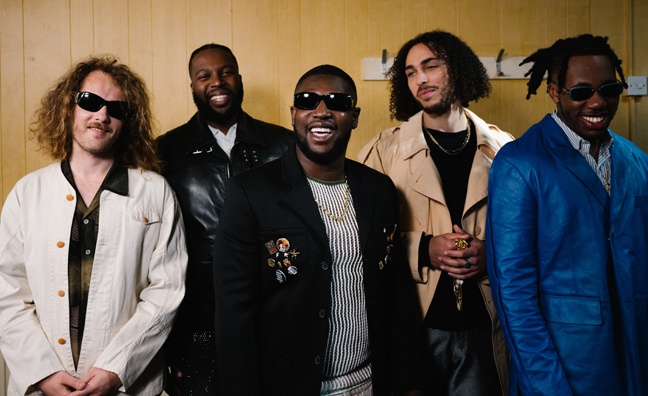
Following their BRITs win for Group Of The Year, here's a chance to revisit our 2024 Ezra Collective cover feature...
We’re almost a year on from Ezra Collective’s Mercury Prize win and, with their follow-up imminent, the hype around their name is intensifying once again. Channelling both The Beatles and Fela Kuti, they recorded Dance, No One’s Watching at Abbey Road and have grand ambitions for its rollout. To find out more, Music Week meets band members Femi Koleoso and Ife Ogunjobi, manager Amy Frenchum, plus Jeff Bell and Zena White of Partisan. What follows is the latest chapter in an indie breakthrough story about identity, perseverance and never compromising…
WORDS: Niall Doherty COVER PHOTO: Amran Abdi PHOTOS: Yout
Ezra Collective make music that demands to be danced to, but it took some time for the message to filter down. Drummer and band leader Femi Koleoso remembers playing an early evening show at London’s Queen Elizabeth Hall back in 2014 and noticing the audience beginning to vibe along with the band’s heady grooves but opting to stay seated.
“We’re on the cusp of a dancefloor,” Koleoso thought to himself. Then there was the occasion at Glastonbury in 2016, when they played a late-night set on the West Holts stage to a crowd of two, both naked, covered in mud, dancing maniacally. Progress of sorts. By the time the London quintet came to tour 2019’s You Can’t Steal My Joy, though, stationary audience members were in the minority. Everyone knew the drill. You danced at Ezra Collective gigs. You danced hard.
As Femi and his bandmates – bassist brother TJ, keyboardist Joe Armon-Jones, trumpeter Ife Ogunjobi and saxophonist James Mollison – travelled the globe with their Mercury Prize-winning second album, Where I’m Meant To Be, they looked out at fevered crowds cutting loose to their infectious blend of jazz, samba, hip-hop, dub and Afrobeats, and realised that the potent thrill of people blissfully losing themselves to the music was the feeling they needed to capture on their next record. All of those ecstatic experiences have been funnelled into their glorious third LP, Dance, No One’s Watching, due on September 27 via Partisan.
“We were making these songs looking at the audience of Ezra Collective and going, ‘What is the sound for this moment in the crowd? What is the sound of everyone together? What is the sound of people?’,” says Koleoso, with Ogunjobi alongside him for their latest interview with Music Week.
Koleoso had spent the majority of his 2022 on the road with Gorillaz, for whom he has been drummer since 2020, and watching Damon Albarn at close quarters made him realise that Ezra Collective didn’t need to wait around before making another record. They could do it on the road.
“I did Gorillaz’s world tour and I saw Damon write [Blur’s 2023 album] The Ballad Of Darren,” he recalls. “I found that really inspirational, his attitude towards, ‘Just keep making, just keep making.’ I’d always admired him in that respect, but when you see it in HD... Every day off, he’s in the studio.”
The drummer got home from that jaunt and outlined the vision to his bandmates.
“It was mad because Where I’m Meant To Be felt like it had just come out,” he recounts. “But I was like, ‘I think we should document this moment we’re having, travelling the world, end of lockdown, back on tour.’ Where I’m Meant To Be was very much a lockdown project and Dance, No One’s Watching is a let-out-of-the-house project.”
“The statement ‘dance, no one’s watching’ is such a powerful statement in terms of freedom,” adds Ogunjobi. “Express yourself how you wanna be and don’t care about what people are saying – you’ve been locked up for two years, so you don’t have time to think about that, life is for living now.”
It’s a record that crackles with the energy of a debut, at the same time as building on everything that has made Ezra Collective one of the most exciting British breakthroughs of the past decade: an intoxicating and restlessly inventive blend of lithe, soulful, forward-thinking jazz.
Recorded over two days at Abbey Road and followed with a handful of pick-up sessions, the album underlines the shape-shifting nature of who Ezra Collective are. They are both the sound of young London, with all the spirit of adventure and youthful exuberance that suggests, but whose music is just as internationally minded, pulling from threads right the way across the globe. Their HQ might be in the English capital, but Ezra Collective have branches all over. It’s one of the reasons that Koleoso wanted to record at Abbey Road.

“I’m a very reference-orientated creative,” he says. “For this, it was a combination of The Beatles and Fela Kuti’s London Scene record, which was recorded at Abbey Road. I was trying to merge the two, the Britishness of The Beatles fused with the madness of Fela Kuti’s Lagos outfit. And we were in Abbey Road, this temple of history.”
It was Partisan founder Tim Putnam raving about the recording of The Beatles’ famous rooftop gig, Koleoso says, that inspired them to make a record that reproduced the electricity of their live shows.
“There is a reason that Ezra Collective are one of the most exciting, transcendental live bands on the planet,” says Partisan’s VP, head of UK Jeff Bell. “Making this record, the goal was always to capture that spirit in a way that their previous albums hadn’t. A big part of that process was recording one version as clean as possible, and another in front of an audience of the band’s family and friends, and then mixing the two together so they seamlessly work in and out of each other. The beautiful thing was that the audience element was actually a surprise for the band, and included some loved ones that they hadn’t seen in years – so the joy that comes through is completely genuine.”
Bell says the other thing that has really jumped out is how the record reflects their increasingly global audience.
“The music evolved over the course of 18 months of shows, literally seeing the faces of fans as far reaching as Sydney, Lagos, Chicago, Tokyo, Amsterdam and Mexico City, all responding to the music being written and performed in real time after being pent-up in a pandemic for a few years,” he says. “That vibrancy is a very powerful thing when harnessed.”
One thing that didn’t need to be harnessed was how to deal with the pressure of making an album in the aftermath of winning the Mercury Prize – by the time of that triumph in September 2023, work on Dance, No One’s Watching had already been completed.
“I don’t think anything positive can happen from something that monumental happening to you when you’re in a creative place,” ventures Koleoso. “I couldn’t think of anything worse than trying to write an album and then winning the Mercury Prize and then trying to get back to that album. Suddenly you’re trying to rewrite Where I’m Meant To Be, trying to relive the glory of what was done. We knew that we were nominated but we’d written the album already. We were just waiting to record it.”
Partisan COO Zena White says the win has been “entirely beneficial” for Ezra Collective.
“It fully legitimised what the community of musicians and artists around them already knew, that they are a once-in-a-generation group that simultaneously take their music seriously and are world-class entertainers,” says White. “It came late in the campaign for Where I’m Meant To Be and raised awareness across the board. Having that to build on with such a strong new album to follow is a dream scenario for any label.”
Whilst Koleoso dismisses the notion of what he calls “the curse of the Mercury Prize”, he does believe success can distract you from what you set out to achieve. “Sometimes what you see is such a monumental win that it takes away from the organic nature of how you created it in the first place,” he says. That doesn’t mean that the band didn’t go out celebrating after. They went partying, Koleoso feeling like a rapper when he arrived at the venue and Hard by Newham Generals was blaring out of the speakers, the champagne flowing, the trophy being passed around. But the evening ended with McDonald’s and Krispy Kremes and, by the next day, everything was back to normal.
“The main objective is always just for us to maintain who we are,” explains Ogunjobi. “We’re a band of five that met in a youth group that prioritised learning jazz music for those who wouldn’t have been exposed to it originally, so we have to hone in on that and maintain that – and not lose sight of who we are and what got us to this point.”
There have been momentary lapses, however. On one occasion, Koleoso allowed himself some retail therapy before he was brought down to earth.
“I had a moment in Germany when I went into the Gucci store and they gave me a sparkling water – you know when they give you sparkling water because they think you’re one of them,” he recalls. “I bought sunglasses but then karma hit and I lost what I bought two days later, I left them on a plane. I felt like God was saying to me, ‘We buy fake Gucci out here, we don’t buy the real thing so keep your feet on the ground.’”
It’s a lesson Koleoso says he’ll carry with him.
“The main thing is not forgetting the things that are most important,” he says. “Like as wonderful as Wembley Arena is going to be, the school assembly we do the week before is more important. And as wonderful as All Points East is going to be, the Tomorrow’s Warriors workshop in August that we got invited to is more important.”
Tim Putnam’s suggestion that the band needed to figure out how to recreate the spark of their live show on an album was the crux of Partisan’s A&R assistance on the record. Ezra Collective were fully DIY for a decade before signing with the label in 2022 and their creative process is still not to be interfered with. “When Partisan signed us, they were well aware of the deeper levels of independence in the way we think,” Koleoso declares. He’s been in sessions with other artists where the label is present and thought to himself, “What are they doing here?”
“That’s super weird,” he says. “I’ve never sent a demo to anyone wanting feedback. If I’m sending it to you, it’s because it’s finished.”
Where I’m Meant To Be represented the first time Ezra Collective released a record with the support and infrastructure of a label behind them, and Koleoso is candid about the experience.
“I think that there was a deep level of ignorance on my part of what to expect when you sign a record deal,” he says. “I thought we would be able to just solely focus on making tunes. And that’s not the reality.”
He adds, though, that there’s no way the band would’ve been able to make the video for God Gave Me Feet For Dancing, directed by Beyoncé and Janelle Monae collaborator Tajana Tokyo, without Partisan’s involvement.
“That’s just the bare facts of it,” he shrugs. “The economy of selling T-shirts to pay for studio time is possible, it works, but then when your ambition gets into the space of, ‘We need to record this at Abbey Road’, that’s a lot of T-shirts, bruv! It’s helpful when you’ve got someone that’s able to back it in that respect.”
The huge success of the past few years has taught Koleoso that the work doesn’t stop.
“Nothing really changes when success gets piled on; there’s just more things that can go wrong,” he says. “But the core values of how you got there doesn’t change. If you think success means you can work less hard, look at Bruno Mars’ tour dates. If you think success is going to make things easier because you’re getting paid more, look at how many bands split up at the height of their success because of money. If you think success is going to make things easier by way of promo, now look at what it’s like to deal with negative promo as well as positive. We’re having more crisis meetings than we had before, because it’s a lot easier to split a tenner than it is to split, say, 10 million pounds, for argument’s sake.”
There was a period following the Mercury win, he recalls, where Koleoso believed the doors to music’s high society would open for them but instead he got a dose of harsh reality.
“I will put my hands up and say I genuinely got deluded by the Mercury Prize,” he says. “I thought getting features would be easier and it’s not easy at all. Maybe it’s even harder. I thought after the Mercury Prize, I would just be able to text Erykah Badu and be like, ‘Get in the studio, babes, we’re making a song!’ But it hasn’t helped.”
But he also knows that roping in a selection of A-listers might be a bad fit. The guests on the new record – London singer-songwriters Yazmin Lacey and Olivia Dean, South African artist Moonchild Sanelly and Ghanaian rapper M.anifest – had a real world connection with the band. No-one was introduced via a manager’s email.
“I’ve just come to really understand that the best music is made with your friends,” says Koleoso. “That’s where we’ll come out best.”
Arsenal legend Ian Wright, also a friend (and fan) of the band, is on there, too.
“Rock’n’roll, innit – we’re mates with football players now!” beams Koleoso. “I never got to play football with Ian Wright but at least I got to put a song out with him.”
Koleoso had also assumed that the Mercury win would make it easier to get Ezra Collective’s music into places it hadn’t reached previously, but again reality bit.
“It increased the amount of exposure we got in the places we already were – for example, our songs do way better on 6 Music than they did before but we were still getting played on 6 Music before, do you hear what I’m saying?” he explains. “But did the Mercury Prize get us Capital Xtra? No. Radio 1? Barely. Did it get us Kiss FM? No. Are we now able to play at Wireless? Are you joking?!”
Moreover, Koleoso thought that by winning the Mercury Prize, the band would be exposed to a demographic of people reflective of who Ezra Collective are themselves.
“I love diversity and I love who we are as a band – I love that there’s four Black Londoners in Ezra Collective,” he points out. “However, when you look at our fanbase, it isn’t really young Black Londoners like ourselves that listen to Ezra Collective. I love that when you go to a Little Simz concert, it looks like Little Simz, all these beautiful Black girls from London that talk like her, live around the corner, they all love Little Simz. They don’t quite love Ezra Collective in the same way and I thought the Mercury Prize win would help that happen. It hasn’t yet, which is fine, because it goes back to what I was saying before. The mission stays the same, we have to keep on pushing.”
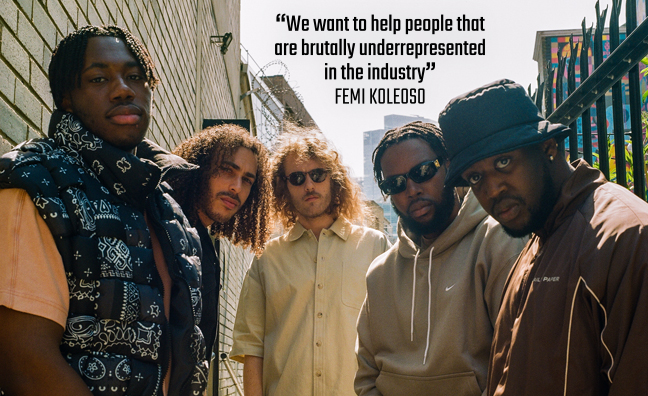
Helping the band navigate each fresh challenge is their long-term manager Amy Frenchum, who Koleoso saluted as their “super-mum” during his Mercury Prize speech.
“It feels like the responsibility and what we were dealing with as individuals and the collective doubled, and I think the same would go for Amy,” says the drummer. “What used to be 10 emails a day becomes 100 emails a day. We’re in the transition phase and I can only commend her adapting to that as quickly as possible. Amy is very much a non-musician version of us. We’ve grown and grown together, and it’s beautiful to see her at this new height, handling it and dealing with it the best she knows how.”
“We’ve achieved a lot of success but it’s nice to have somebody that’s had your back from before,” Ogunjobi adds. “There’s a real sense of faith and trust in the person, that they have your best interests at heart, rather than somebody that’s only come along on the latter part of the journey.”
“I’m really proud of what Ezra Collective signify for the concept of sticking at something and slogging your guts out, even when it feels as if you are against the tide,” says Frenchum. “Lots of young artists feel quite disillusioned, I think, by this smoke-and-mirrors presentation of overnight success. Like artists releasing their first ever song in October and miraculously selling out a 5,000-cap venue by the next January? What kind of cheat code is going on there? I just know that Ezra Collective have been doing this for long enough to truly know who they are and why they are here.”
Frenchum takes care to note that it is very much a team effort.
“I’m really grateful for all of the wider team we’ve built around the band to help make that possible and communicate their music and message much more widely,” she says. “Shout outs to the Partisan dream team, Brace Yourself PR – Ivano, our radio don, and August Agency, who are just press heroes.”
Zena White says the vision tied into this campaign is to achieve the feeling that jazz is for everyone.
“We’ll achieve that by Ezra leading the genre into more accessible places,” White says. “Removing the barrier to entry from the cerebral environment of the club scene to dancefloors, Wembley Arena and festival main stages, all with the sense of community, freedom and joy that is innate to Ezra.”
The band have around 700,000 monthly Spotify listeners and White adds that a big focus is for the new tunes, such as God Gave Me Feet For Dancing, to hit summer playlists.
“It’s about generally developing the success of the band’s ‘singles’, beyond the strength of the live show and the album as a whole,” she says. “This is all the next stage of the journey to the top of the mountain.”
“In its very nature, jazz has always been about pushing boundaries – musicianship, songwriting, performance, culture,” states Jeff Bell. “As a result, it hasn’t always been immediately accessible for a wider audience. The fact that Ezra Collective are appearing on prime-time TV like Graham Norton, and being the first jazz artist to headline Wembley Arena and appear on the cover of Spotify UK’s New Music Friday, shows that the message of ‘Jazz is for everyone’ is getting through. Femi and TJ now even play characters on the CBeebies programme Yukee – if that doesn’t mean the genre is getting into new spaces, I’m not sure what does.”
Despite that, Bell states that the ultimate goal is to see Ezra Collective not within the context of a jazz band, but as what he calls “a truly global force that crosses genre, borders and age”. Frenchum also suggests, intriguingly, that the group will soon sign a publishing deal that “feels right for where we are at currently”.
“Other industry opportunities have been most significant in the brand space,” she adds. “There are loads of exciting moments coming up that tie in with the campaign.”
All of their work, she explains, is with the same ethos in mind.
“Everything we’ve ever done has been with a ‘sky is the limit’ mentality,” she says.
For Femi Koleoso, success for Dance, No One’s Watching is a two-part thing. On the one hand, it would mean congratulatory texts from his friends and family, or, like what happened last night, his dad calling him up to tell him he likes a tune. But there’s also the part of his brain that thinks, “Wouldn’t it be great if we were the first jazz band to win a BRIT Award, or get a Grammy or go to No.1?”
“Those things are also positive because you tap into the dream that a lot of young people are having that you can start something with your bredrens, something with a very small beginning that can go to the greatest heights in the world,” he says, adding that he’s also eyeing up a slot on Glastonbury’s Pyramid Stage in 2025.
He thinks there will be a flood of exciting new jazz and jazz-adjacent artists by then, Oreglo and Olivia Dean amongst them, opining that the scene might have experienced a bit of a dip over the past year or so.
“Maybe 2017 was a peak and 2024 was a bit of a trough,” he reflects. “But there’ll be a big peak in 2025!”

Femi Koleoso is also keen to share his predictions for things a little closer to home. And, as someone you imagine contemplates the group’s failures as much as he revels in their triumphs, he is unhappy at the lack of progress made by the Ezra Collective Foundation, an initiative set up to help young Black women break into the music industry.
“That was one of the biggest failures of last year,” he offers. “We got sidetracked by an influx of work and it meant we got distracted from the goal of that. In its purest form, we would end up taking 20 Black women on tour, they would learn all the different roles, and then we would help them into different roles in the industry so that they can have jobs and that pipeline hasn’t happened in the way I would like it to have done. More than anything, it was an infrastructure issue.”
It didn’t deter the drummer from trying to effect positive change in other ways, though.
“The aim hasn’t changed,” he says. “It just meant that we had to just focus on schools and workshops while we were on tour because that was the easiest thing, me waking up two hours earlier and going to a local music college. It’s still on my mind, but it’s definitely nowhere near where I want it to be.”
He does think there has been a slight improvement in industry representation – a ‘yes’ with a small ‘y’ is how he describes it.
“When we recorded at Abbey Road, there were three Black women that were runners and that has never happened before in my career – I remember seeing it and being like, ‘This is a slight change’,” he says. “But I don’t want to celebrate it until I feel like we see absolute equality, which is not the case at the moment. You will still go to the headquarters of almost every record label in the country and there will barely be a single Black woman there.”
The cost of touring is another thing that Koleoso is rolling over in his mind.
“It’s a disaster but it’s just something else on the list to be navigated through,” he says calmly. “A lot of people don’t understand it, so that causes a problem. I see that on Twitter a lot when people are like, ‘How can you be losing money when you’re doing Wembley? That just means you’re bad at finance.’ And it’s like, ‘OK, you just don’t quite understand the issue.’ You’re staring down the barrel of, ‘Do I fleece the ticket prices and break even, or do I make a loss?’ And when you’ve made such a big point about accessibility, you can’t then justify a £300 concert ticket. I’m still willing to make a loss to give the music to the UK. But beyond those shores? I’m not sure what is going to be possible.”
Again, it all comes down to balance. One way to make it work financially, he says, is trying to streamline Ezra Collective across multiple revenue platforms.
“Like, when you get paid a lot of money for a PG Tips advert, you have to think of it as a reward for your touring,” he explains. “Even though it’s not the same pocket. It’s survival. Survival is big festival bookings and syncs. If you hear Ezra Collective on a film or in an advert, I don’t have a moral attachment to those moments; that’s where it becomes about the highest bidder. As long as the advert itself doesn’t morally clash with me – I wouldn’t let our music be used for a weapon advert – but whatever drink it is, who cares?”
In 2022, Femi and his brother TJ told Music Week that one of the band’s core mottos was: “What did you do with what you’ve got?”. He says it still stands. “In line with what I was just talking about, there was no moaning about tour finances,” he says. “It’s all about, ‘This is what we’ve got, let’s see if we can make it work; this is my coin, what can I do to get the most out of it’, and that’s why it’s always in the direction of the next generation.”
But, he adds, there are also other mottos in Ezra Collective, too, and Femi’s most repeated is one borrowed from Dr. Seuss: “There is no one alive who is you-er than you.”
“That’s my favourite quote in the world,” he enthuses. “Because we mustn’t fall into the temptation of playing the Ezra Collective music we think people want. We have to continue to be true to who we are. We need to be ourselves and if we do that, it will be rewarded.”