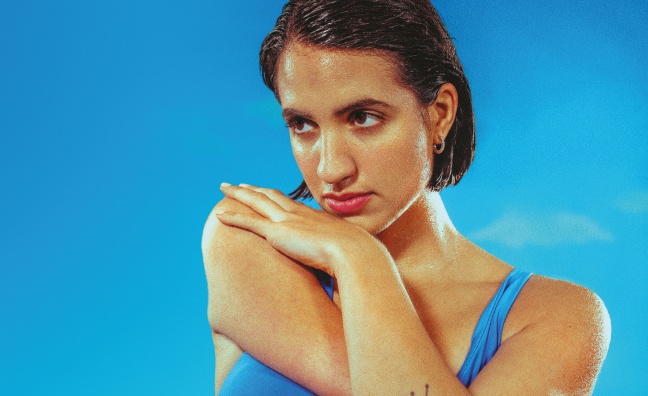
For those who have followed the career of Victoria Canal closely, January 2025 brings a watershed moment, as she releases her debut album, Slowly, It Dawns. Here, Music Week meets the singer, plus Parlophone, Second Songs and her management team at Deep Feel Talent Co, to tee up the campaign and discuss the magic of songwriting, why viral success is becoming a myth and what it feels like to play in front of over 100,000 people alongside Coldplay…
WORDS: ANNA FIELDING
At first, Victoria Canal couldn’t really get to grips with the size of the crowd. She was playing the piano part on Coldplay’s Paradise, a song she hadperformed many times before, happy to knock out a quick cover for friends or the customers in a bar she used to work at. But in June this year, she was in a different environment altogether, playing alongside Coldplay on the Pyramid Stage at Glastonbury. The band would also invite Laura Mvula, Little Simz and actor Michael J Fox on stage at various points during an epic headline set.
“I couldn’t process it at the time,” says Canal. “I was just focused on getting it right for Chris [Martin]. The stakes were high, he’d invested in me by asking me to do it, so I just thought that I would focus on what I needed to do and on making him happy. It was only when I came back on for the encore, with Michael J Fox and all those guys, that I really got to look out and see how many people were there. But it was almost impossible to understand, as though your brain hits 1,000 people and then can’t process any more.”
Canal is now starting to see bigger crowds as an artist in her own right. Her debut album Slowly, It Dawns is due for release on January 17 via Parlophone and Music Week finds the singer in the midst of a run of dates.
“Two nights ago was the first date of the UK leg,” she says. “I felt at the start of the US leg that I was still finding my feet with the new music, but now I’m really settled in.”
Two days after our conversation, she will play “my biggest gig to date” at Earth in East London. Canal is visibly excited about all of her shows, but cheerfully mentions the capacity of the London one a few times. The venue can hold 1,200 people, just over brain-processing size.
Still only in her mid-20s, Canal is the kind of artist who will always put the work in, who isn’t afraid of slog, rehearsals or commitments. She put out her first EP, Into The Pull, in 2016, offering up the first taste of her candid, experimental take on pop music, driven by lyrics inspired by identity, sexuality, body dysmorphia and disability (Canal was born without her right forearm due to amniotic band syndrome).
Subsequent EPs Victoria, Elegy and last year’s Well Well – featuring Black Swan, which won Best Song Musically And Lyrically at the Ivors, where Canal was also named Rising Star in 2023 – further raised her profile. Meanwhile, she gained the mentorship and support that she had always sought from the worlds of pop and rock. The most notable example is the aforementioned Chris Martin, who introduced Canal to Parlophone and still keeps in touch.
She has worked with Hozier and The 1975, while the collaborators on her new album include Låpsley, Jonny Lattimer, Kevin Farzad and Eg White.
“Victoria is such an incredible artist and we feel very privileged to be working with her,” says Parlophone MD Jen Ivory. “Everyone is aware of how difficult it is for new artists to break through at the moment, but in Victoria we have a really special talent who is a world-class songwriter and musician with an amazing voice. We have every confidence she will enjoy a fruitful career.”
Ivory says the label is seeking to offer Canal the “freedom to continue to develop and create music that is authentic to her”, while offering advice to help her cut through.
“Working with Victoria has been a masterclass in patience, perseverance and work ethic,” says her manager, Andrew Leib of Deep Feel Talent Co. “Her ability to network and build community has been invaluable to her career growth. I’ve never seen anyone put herself out there, both online and in social settings, quite like Victoria, and it’s paid dividends in ways other artists would pay millions for.”
“I feel like everybody in the industry, especially if you have managers, publishers and a label, is waiting for the one golden moment that will send you to the moon,” says Canal. “And in a few cases that happens – look at Chappell Roan, for example.”
Indeed, the singer feels such moments are becoming ever more scarce.
“What I’m seeing, especially as the market becomes even more saturated and the algorithm becomes harder to understand, is that I’ve had so many viral moments, and not one has changed my life forever,” she says. “They’ve all been a stepping stone towards the career that I want for myself. A lot of artists like me feel this pressure to find that one moment that will change their life. But it’s actually about consistently trying for those moments that just move it a little bit further forward.”
Those “moments” consist of songwriting, recording, touring and rehearsals. But also of trying to create the kind of online presence that can lead to those golden viral wins.
“When I put something online that feels super authentic, I am both promoting what I do and connecting with the people that I want following me,” Canal reasons. “I’m reaching the people that want to find someone like me, we’re finding each other online. And that feels really beautiful and like a unique tool.”
However, she does identify a negative side to social media.
“It feels like an obligation, to the point where you can’t do anything else,” she says. “It’s becoming so much a part of the job to promote, that it takes away from the actual daily discipline of the craft. If I didn’t have to use social media, I would make so much more music, and I would probably write better songs.”
This is a typical Victoria Canal response. She is clever and articulate, slightly self-deprecating and really considers each answer. Smartness and self-awareness feed into her work, filling it with euphoric highs and clear-eyed introspection. She also possesses the rare alchemical mix of talent and a deep love for what pop music can do for people.
“She has the gift of song,” Chris Martin told The New Yorker in a 2023 profile of Canal. “I don’t know where that comes from, or how you’d even define it, but songs come through her like they do for some people.”
The songs have come through on Slowly, It Dawns. Canal sees the album as a whole with two distinct halves.
“The title speaks to the sun rising, and I feel it’s emblematic of how you feel when you are growing up,” she says. “In your adolescence, everything is a bit hazy and wobbly and you don’t really know what’s going on. Then as you get older, clarity sets in. The album goes from being very young and naive, loud and overconfident, to quite introspective, wise and surrendered. It gets more complex and possibly more wounded or brooding.”
Leib describes the album as a “dynamic masterpiece”, while Caroline Elleray of Second Songs says that it’s a great privilege to work with a songwriter as “wildly talented” as Canal.
“Her songs have this aching, intimate quality in the delivery and very contemporary themes that speak to the youngest and oldest listeners from every walk of life,” Elleray adds.
Songwriting is deep within Canal’s bones, which her team feel goes some way to explaining her success at the Ivors.
“That’s quite incredible for someone at this stage of her career and shows the high esteem she’s held in by her contemporaries,” says Mark Gale at Second Songs.
“They really mean a lot to me,” says Canal of her Ivors trophies. “Paul McCartney was the first recipient of the award I won this year and I got to meet him at the ceremony.”

If Victoria Canal has one role, it is to tell the truth in her songs, to excel as an artist who is able to capture human experience and sing it back.
“The album really is an incredible project, so next year is all about connecting her with more people and establishing her as one of the UK’s most prominent singer-songwriters,” says Jen Ivory.
“Victoria is known for exploring all facets of herself through her music, so authentic storytelling is a key focus,” adds Jessica Lord, senior marketing manager at Parlophone. “What resonates with her fans is being real and engaging on a personal level, and she has a history of doing that with fan meet-ups, her presence on social media and creating spaces for fans to share. Our focus is to build on that and create life-long fans who will stick with Victoria.”
Canal is understandably happy with this level of commitment.
“I’m really grateful that Parlophone has stuck with me over several projects,” she says. “And that they wanted more time for me to develop. Even though I didn’t want that for myself at the time, I’m really happy we decided to do that, because I feel more ready for this album now.”
The label has also funded therapy sessions for her since she signed.
“That’s definitely something I think should apply to all artists signed to a major label,” she says. “Any public figure definitely needs to be in therapy.”
The singer has spoken in the past about her struggles with body dysmorphia.
“Being on stage all the time can be pretty confronting,’ she says. “And I feel like my image of myself has a lot to do with how healthy I am able to be. And when I am on the road, I can’t be as healthy as I would like, so my self-image starts to deteriorate.”
Her new single, 15%, deals with what she calls “the unreliable narrator in my head – it’s God or goblin, there’s no in between.”
Now, she feels less need to talk about sexuality in her songs.
“It has taken a while, but gayness and music is officially mainstream, and funnily enough, now that it is, I feel less of a need to be so outspoken,” she says.
Meanwhile, any concerns she has about her disability are mostly practical.
“The practical and the emotional tie into one another with that, I guess,” she explains. “One of the most painful experiences of life is travelling alone with too many things, too much gear, and even now, I think the stress of having to pay for extra services just because I can’t do it on my own is very frustrating… I feel that the money could be better used somewhere else and I have to pay a certain amount for a car service for someone to meet me at the gate, because I can’t carry something with just one hand.”
While Canal says that increasing success and support from her label have cleared up some of the issues, there is still a way to go.
“I think of all the artists that have some sort of impediment that just can’t do what they want to do, because they can’t afford the help,” she says.
The economics of touring are weighing heavily on her mind.
“We have a drummer out on this run,” she says, leaning forward for emphasis. “I know it’s a normal thing for other artists, but for me it’s a big deal.”
And live percussion isn’t the only new revelation for Canal.
“All the friends or friends of friends that I’ve been staying with have dogs and I have discovered that I’m desperate to get one, but I don’t have the lifestyle for it,” she says. “But there has been an extraordinary amount of dogs on this tour. They’re just the best when they cosy up with you.”
In America, where she isn’t yet as well known, the audiences have been smaller, while in the UK she’s encountered superfans who know every word.
“That is obviously so gratifying and what every artist wants,” she says, before noting the disparity in pay between the two countries.
“I can’t speak about how it is for venues right now, but all I know from an artist’s perspective is that I could play a sold-out room to 250 people in the UK and get paid a quarter of what I make in the US playing to 30 people,” she says. “I don’t get the economics of it. I don’t know who to blame. I don’t blame the venues, but it’s wild to me that you can sell out a room and end up being out of pocket.”
But issues around compensation may soon be a thing of the past, and her team have big plans.
“We’re aiming for a US late-night TV debut, a Grammy nod and a good bump in consumption,” says Leib. “Beyond the album, we’re committed to deepening her connection with causes she’s passionate about and using her platform to make a positive social impact. Our goal is to gain recognition not just in the US and UK, but globally – we are striving for nominations at major international awards. With each release, we want to continue pushing the envelope and evolving Victoria’s artistry in exciting, unexpected ways.”
Canal’s own definition of success is more diffuse.
“It’s something I’ve been thinking about a lot right now,” she says. “I have been experiencing a lot of ups and downs in this industry and what I expect from myself in it, as far as success [is concerned]. I have been quite disappointed about where I hoped I would be by this age.”
The singer pauses and starts to talk about a small essay titled “the lethality of the internet/music industry” that she published on Instagram on October 18. What follows is Canal’s account of her feelings about the death of Liam Payne.
“When he passed away it really brought some things to light for me,” she says. “There’s an attachment that artists can have to achieving a certain amount in their career and expecting to then feel a certain way, have a certain number of streams or awards, or knowing certain celebrities, or reaching a certain level of fame…”
Canal describes Payne as “someone who achieved everything an artist could ask for” and goes on to explain that his tragic death has changed her perspective.
“I realised that those things don’t guarantee anything about how you feel in yourself,” she says. “I’ve been on an existential journey, redefining what success means to me. I’m still figuring it out, but as far as I can see right now, I feel like success equals enjoying the journey.”
All of which means that, as her debut album campaign ratchets up, Victoria Canal is concentrating on taking it slow.
As such, she concludes our conversation with a simple explanation of her thought process.
“If I can’t be present now,” she says, “then I won’t be able to be present once I’ve accomplished all the things I want to.”