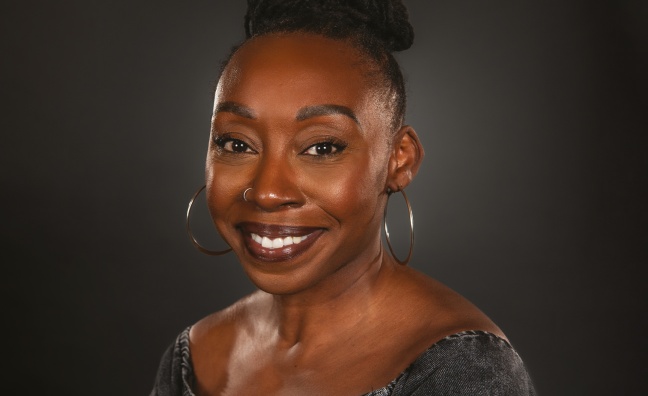
Hired as Universal Music Group UK’s chief people officer back in 2023 – and armed with a brief to “push boundaries” at the major – Andrea ‘Ange’ Pattico has an indispensable part to play at the company. Two years in, she talks Music Week through her work, outlines the culture she is helping to shape and takes the pulse of where the industry currently stands in its fight for equality…
WORDS: Colleen Harris
PHOTOS: Carsten Windhorst & Gerard Hynes
Universal may be strengthening the bridge between UK and global audiences, but its leadership is also looking inward right now. For chief people officer Andrea ‘Ange’ Pattico, the label’s “new era” isn’t just about artists – it’s about ensuring the business behind them is as globally minded, connected and representative as the music being made.
Christened ‘Andrea’ but known universally as Ange – a nickname born from her younger sister’s childhood mispronunciation – she has made approachability and authenticity central to her leadership.
“Andrea’s my naughty name, I don’t want to be called that,” she laughs. “It means I’ve either offended you or you’re annoyed at me. Nope. Ange is fine.”
Leading a team that consists of “33 wonderful people”, Ange emphasises that they’re just as essential to achieving the company’s goals as her own leadership. “It’s a privilege to work with them,” she says. “It’s not about me, it’s about us.”
While she says it’s a very busy time for Universal Music Group UK, Ange regularly steps back to focus on the bigger picture: namely, a long-term plan to future-proof the business, from building globally minded leadership pipelines to nurturing talent at all levels, including those without a university background.
“I already know where we’re going, it’s just that there are steps to get there,” she says. “So when you hear me talk about some of these things, if we have another conversation at the end of next year, or even in five years’ time, you’ll find that it was all leading somewhere.”
Her perspective is rooted in experience. Previously, Ange has held senior HR and people leadership roles at Universal Pictures, NBC Universal, ASOS, Moneysupermarket PLC and MVF, progressing from HR manager and director roles to group chief people officer positions. Early in her career, she actually interviewed for two jobs at Universal Music and Universal Studios on the same day and was offered both. Wary of appearing to chase a recording contract – like many, she dreamed of singing professionally – she took the advisor role for Studios over the music co-ordinator role but vowed to the interviewer for Universal Music that she would end her career in the industry that inspired her most. Decades later, that vow has come full circle.
“This is not by fluke or accident,” she says. “I’m here because I was always meant to be here. And so, here I am. It was written for me to be here.”
Today, Ange is focused on shaping the next chapter of Universal Music Group UK – a story she’s ready to share in her own words...
You were appointed back in 2023. How has life been at Universal so far?
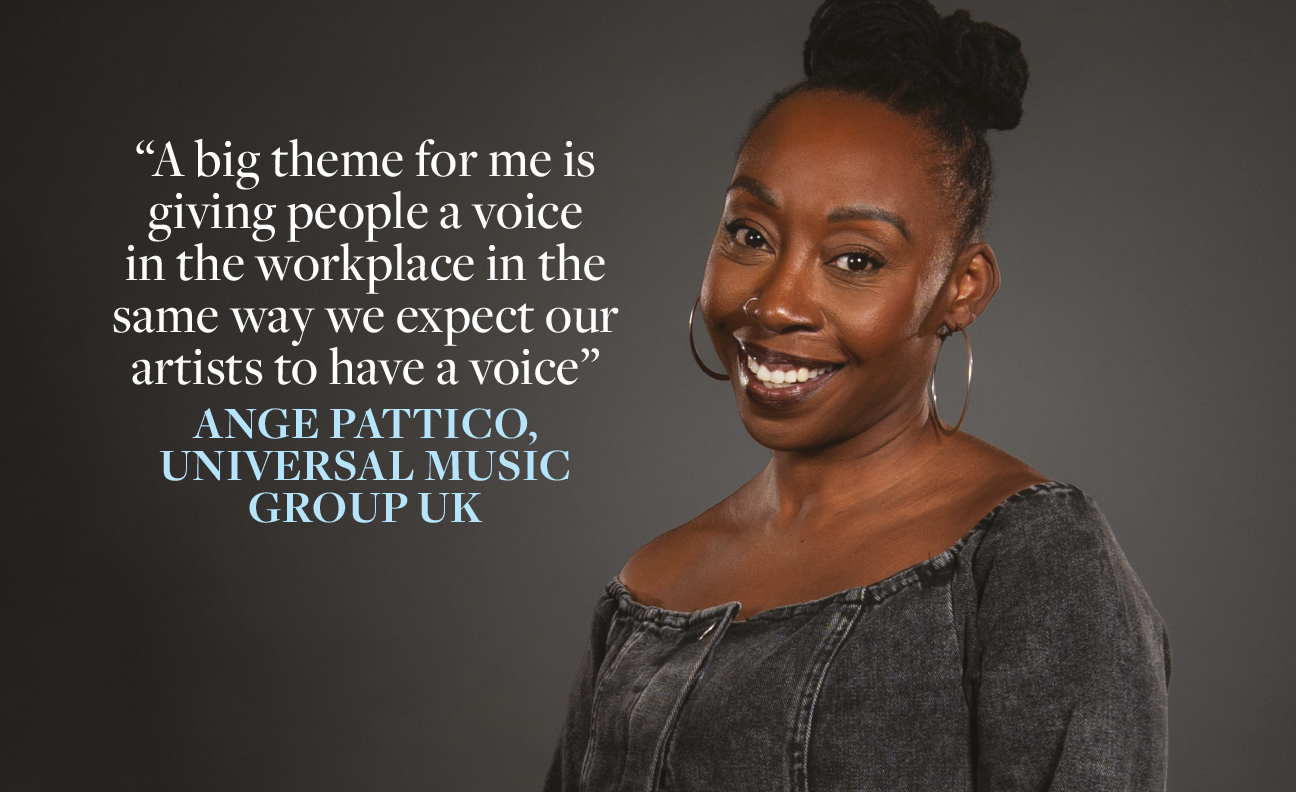
“Very, very busy. There’s been a lot to contend with, and we’ve still got a lot to do – there are buckets of things that I have to support the organisation with, like moving us on from being HR-y to really considering the experience that we give our people. There is a very thin line between artists and employees. The experience that we want for our artists, we want to be able to give a really great and similar experience to our employees as well. So it’s thinking about things like: What does our roster look like? What does our employee base look like, is it diverse enough? Does it represent the community that we’re trying to support? Those are big themes for me: representation, thinking about giving people a voice in the workplace in the same way that we expect our artists to have a voice. There’s lots on my agenda, and two years in, the team are doing a really great job, but there’s still a long way to go.”
What are you proud to have changed so far?
“One of the big things, which speaks to developing talent, breaking barriers to entry and increasing representation, is our early talent programme. It was piloted last December, and it’s called Amplify U. It has six verticals, from immersive days to work experience. There are two different types of work experience, so under-18s can do two weeks’ rotation. Next year, we’re introducing rotation for Year 12s, which is one week in May, and then this year we introduced summer work experience for over 18s. Out of that, we’ve had some people made permanent. We’ve revamped our internship, so it is a better experience. We also introduced the first tech apprenticeship at Universal about a month ago [and] hired 12 people. We’ve partnered with Makers on that. Their bootcamp will end in December and they start full-time apprenticeship roles in January. We don’t want to leave graduates out, but we wanted to start with non-grads because there’s been a heavy focus on graduates for many years. Elsewhere, we have our on-boarding programme where people come and learn, not just about the team that you’re going into, but about the entire business. And believe it or not, that wasn’t in place 12 months ago. Plus, we have our L&OD [Learning and Organisational Development] curriculum, [offering] a host of training programmes that people can sign up to whereby they can feel supported with their learning, whether it’s about their role or the business at large. Universal has a management development programme, too. Some might say, ‘Oh, a lot of companies have that’, but in our industry, people have typically been promoted because they’re technically good at what they do. We offer an accredited management development programme, which helps people that are existing managers but also [those] newly promoted, so they know what good looks like. That was just accredited, so I’m really proud of that. Finally, we have community groups – and they’re not just there for social activities, meaning getting together and having a good time; they’re there to make change in the business for the individuals that are part of their community groups.”
What are the shared values that you’re trying to instil into the wider Universal Music Group UK workforce?
“I want to see an environment where everybody feels safe. You asked what I feel proud of, and we’ve done a lot of work around safeguarding. I sit on the Creative Industries Independent Standards Authority (CIISA) council and I would love to see more shining of a light on the good things that are happening in the industry when it comes to safeguarding. I’d like to also see a culture where people can really feel like they can be themselves and bring their authenticity to work. On the flip side of that, from a values perspective, that means we’re looking for people that have drive and courage, that are entrepreneurial. Our chairman [Dickon Stainer] speaks a lot about entrepreneurialism and drive, so when we’re looking for people, we say, ‘Are these individuals who are thinking outside of the box and bringing something fresh to the industry?’ If you’re trying to develop globally minded leaders, we need to make sure that they know about the world at large, not just the UK. Our artists need leaders who have more of a global outlook. I think that’s where this resurgence of British music that we’re seeing of late is coming from because people are daring to push against barriers that may have been in place before.”
So how have you been working with Dickon towards that?
“A couple of the things that we’ve been focused on with Dickon is around future-proofing our business and making us more globally minded. We have got incredible artists we want to take out to the world, and I have to think about how we get our employees to be thinking with that global mindset. And, also, how do we future-proof the business to make sure that we are represented enough across the industry for all different types of diverse people? Our artists don’t just look one way, so that’s really important because in order to serve them, you’ve got to look like the artists that you serve. I know what people might say, because if you look at our management team, for example, there’s a lot of people on there who do look the same. I’m eager to help change that. Sustainable change takes time, but of course I’m impatient and want to see results. I have a personal responsibility to show up and be a representative and a role model. I do think that there’s a lot we have been doing since last year to make sure we’re addressing those challenges within the workplace, but future-proofing the business means the early talent programme, the management development programme, the way we recruit, and how we’re addressing our gender pay gap [Universal Music Group UK’s mean (average) pay gap increased slightly to 27.5%, up from 25.9% in April 2023. Despite this rise, the median gender pay gap saw a reduction of 0.9 points to 23.5%]. We’re trying to make sure we balance the employee base from the ground up.”
When it comes to the barriers you’ve touched on there, can you give us your plan of attack?
“So, for our gender pay gap, the most recent one, we’re working with Caerus Executive; they’re a brilliant consultancy. From our gender pay gap we’re finding that we have a particular demographic of women who we’re finding hard to retain. So what we’re doing with Caerus is running a series of focus groups to understand the reasons why this group has left our business. We’ve taken a look at the number of women that have left over the last three years in this particular age range, and we’re going to run focus groups. We’re also going to talk to women internally who are here within that age range and find out why they stay. Then we’ll take all of that data and it will tell us what we need to do. Currently, we think part of it is around mentoring and sponsorship, so there’ll be work we do there. When we’re looking at a mentoring programme, it will not just be for women, it is going to be an overarching one. It will basically figure out what we need to do to support different types of lived experience, whether you’re a woman, or LGBTQ+, or of a certain ethnicity. We’ll be figuring out what we need to do to support them from a mentoring perspective, and that programme will be reciprocal. So, you could have a junior person mentoring a senior person, or people of different colours mentoring each other. That will help with challenges from an ethnicity representation perspective, too. Belonging tends to happen when people see themselves represented, so we also have nine community groups that people can join to build relationships with people who have similar lived experience and who have been at the company for a while. Those groups have one or two objectives that they work on every single year, which have ‘circular value’ and those objectives change year on year. If you take our Pride Network, they have done amazing work around our gender identity policy, and that’s going to be rolling out in November. From next year, we’re going to be looking at our trans policy and the support that we give to anybody who might be transitioning.”
What work are they doing in that area?
“We didn’t have a gender identity policy. A lot of businesses might still be measuring gender from a purely male-female perspective, but that isn’t how the world operates now, and there might be people who don’t feel seen as a result. This is the data that we are collecting. If you tell us how you identify from a gender perspective, we’ll make sure that whatever support you feel that you need, that the company doesn’t currently offer, that it is in place. And so we’ve worked with the Pride Network – ‘we’ being PIC [People, Inclusion & Culture division] – to develop the gender identity policy. A lot of this comes from the employees and not from us. These are basics we’re talking about, and this is probably a good point to make. If you were to walk into industries like tech or e-commerce – where, by the way, the music industry is hiring from – some of these things are already in place and expected. If we are going to be hiring non-traditional music talent, we have to be able to compete with these organisations, and right now, the industry does not. So from a Universal perspective, we’re here to compete, not to languish in the background.”
Are there any other issues affecting the modern workforce that are particularly close to your heart?
“We’ve done a lot of work on family leave, and one of the aspects that tends to get missed out is around fathers. We do a lot with women, so we teamed up with [Parenting Out Loud founder] Elliott Rae to host a conference for dads, because we want to support equal parental leave. In terms of our demographic, there are a lot of people who need support in terms of financial wellbeing and coaching, so there’s a lot that’s coming in the new year where that is concerned. We’ve also got an internship with the Black Music Coalition. It’s a two-year programme, which is specifically developed for somebody who has been recruited by the Black Music Coalition to come and work in our business, and we’re really excited about that. It’s the first of its kind.”
The BMC’s chair Sheryl Nwosu recently told us that she believes that diversity, equity and inclusion in the music industry have “slipped to all but a footnote on many an agenda” in the last couple of years. What’s your take on that point of view?
“I understand where she’s coming from, because if we go back to 2020 there was a lot of focus, and probably something in the press every single week, and that isn’t happening anymore. So I do understand where she’s coming from in that respect, but I do think it depends on who you’re talking to. There is a lot of work which is being done quietly. If you were not having this conversation with me, you wouldn’t know that any of this stuff is happening at Universal, and that’s partially on purpose, because I want us to have done something before we talk about it. I have this thing about organisations which talk first and try and do stuff after, and then they don’t land it. There are things being done quietly that aren’t necessarily getting the noise that they deserve. I can name you a bunch of stuff that I think has been excellent. There’s work that Small Green Shoots are doing to take their model out to Liverpool and Manchester, and they’re not necessarily doing it in their name, they want to work with organisations who are out in those areas. And there’s all the work BMC has done with BIMM [Music Institute] and Wretch 32, with their programmes and partnerships. So, we are doing what we need to do behind the scenes to give voice to organisations and partnerships that want to improve representation, but the whole industry has to play their part. I feel confident and happy that Universal is doing what we need to. We don’t need to shout loud about it. We just need to get it done.”
Are there any other barriers that need breaking down?
“We are really proud of the work that we did on neurodiversity. There is, however, an extension of that which we need to focus on. Neurodiversity is really important, and so is disability and accessibility. Within our industry, it would be great to have an enhanced or broadened focus on creative differences as well as neurodiversity, because neurodiversity is a disability. We’re already working with Attitude Is Everything on expanding our support for employees with disability, and if we can get it right with employees, we can get it right for artists as well. The other thing we need to focus on is artist and employee wellbeing. A lot of companies separate employee wellbeing and have EAPs [Employee Assistance Programmes] or medical support. But the world we live in, from a music industry perspective, is quite different to other spaces that don’t have to think about their artists who might be on tour and the kind of things they might be experiencing.”
Finally, in your experience, do you think the stories that often get told in the media truly reflect the full spectrum of people that make up the music industry’s workforce?
“No, absolutely not. I can tell you for a fact, we have got some amazing people working here, and they’re doing amazing work, and their stories aren’t necessarily getting told across the board. It’s like a lot of news; sometimes we hear about the things which are not so good before we hear about things that are great. I joined UMG because I love music, I love our artists, I love people, and I love the people that work for us. There’s a bit of a myth, in my opinion, that we’ve got a lot of ‘power players’ and chancers in the music industry, but that’s not the case. We’ve got people who are passionate and care. They love music, and they love the artists, and they just want to help our artists do well. I think we’ve got to change the narrative and stop being so negative and focus on people from a positive intent perspective. I want everybody to know about the amazing people that work in this industry, whether it’s Universal Music or across the board. And I believe that passionately.”