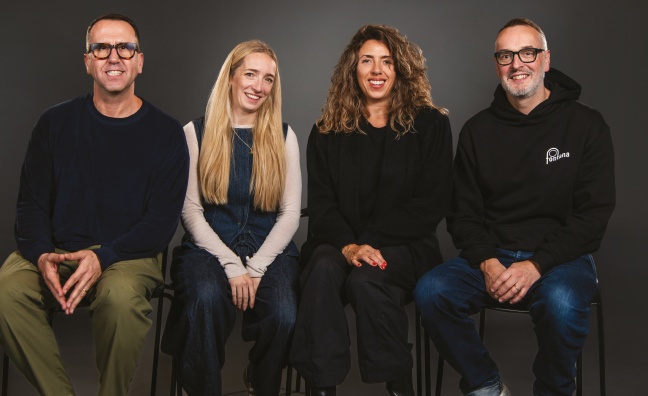
It is quite the line-up we have assembled here for you. Decca president Laura Monks, and Tom Lewis, her counterpart at the recently revived Fontana, both specialise in bringing lesser known corners of the music industry into the mainstream. Elsewhere, Universal Music Recordings president Hannah Neaves spearheads their work supercharging the major’s incredible catalogue for the modern era, while Globe boss Marc Robinson ensures the roster is represented at the cutting edge of sync, soundtracks and brand partnerships. Together, they play an essential role in everything Universal does, as they tell Music Week…
PHOTOS: Carsten Windhorst & Gerard Hynes
The new era at Universal Music Group UK is personified by four easygoing but highly experienced execs who gather together for an interview that underlines the major’s collaborative process.
Decca’s now sole president Laura Monks and Fontana president Tom Lewis – sporting an on-brand label hoodie for our photoshoot – have just been appointed to their new jobs. The sense of mission is palpable from the pair, who know CEO & chairman Dickon Stainer well from his previous roles at Decca and Global Classics & Jazz.
“There’s been a burst of energy throughout the whole building,” says Lewis, who’s worked with Stainer for 22 years. “It’s been a fantastic first year.”
“He’s definitely brought that passion, can-do attitude and dynamism he’s had throughout his career into a leadership role – it has been very energising,” agrees Marc Robinson, who’s approaching his 10th anniversary as Globe president.
“And I think this interview speaks to how he loves to develop talent,” adds Monks, a Decca Records mainstay approaching 15 years of service.
For Monks, Decca is literally her dream job – she recently witnessed a nocturnal Max Richter perform his eight-hour composition Sleep through the night to an audience who bedded down at Alexandra Palace for its 10th anniversary show.
“It was amazing,” she recalls. “I woke up at four in the morning, looked up and I just thought, ‘Wow, he’s still there and he’s playing, how is he doing this?’ It was such a powerful, almost spiritual thing for me.”
As she discusses recent projects and campaigns – from the giant chalk mural of Pavarotti on a Welsh hillside and Andrea Bocelli’s TikTok hit with Karol G to a version of the Monster Mash supplemented with additional screams for Halloween – the global reach of the Decca repertoire becomes clear.
With the reorganisation of the frontline labels last summer and Stainer’s background in international roles at UMG, Universal Music Group UK under its new leadership is also broadening its horizons when it comes to British talent.
“He’s very globally focused,” says Hannah Neaves, who was made sole president of Universal Music Recordings in summer 2024 after two years of joint leadership. “That’s definitely somewhere where there’s a renewed focus and energy.”
“And it feels like there’s a huge energy at the moment for UK music,” declares Robinson, who was behind the recent LA showcase featuring Olivia Dean, FLO, Holly Humberstone and Sekou, presided over by Stainer alongside UMG CEO & chairman Sir Lucian Grainge.
The Universal event was staged in partnership with Abbey Road Studios and Globe, the UK major’s creative and partnerships division. Globe is expanding into the US with its first ever hires planned in New York and Los Angeles, in order to open up more opportunities for British talent.
“The turnout was incredible, and it did fill you with excitement that there’s all this incredible talent coming through and the world’s paying attention again,” he adds. “We definitely had the best turnout we’ve ever had on American shores for a UK-based showcase, it was quite phenomenal.”
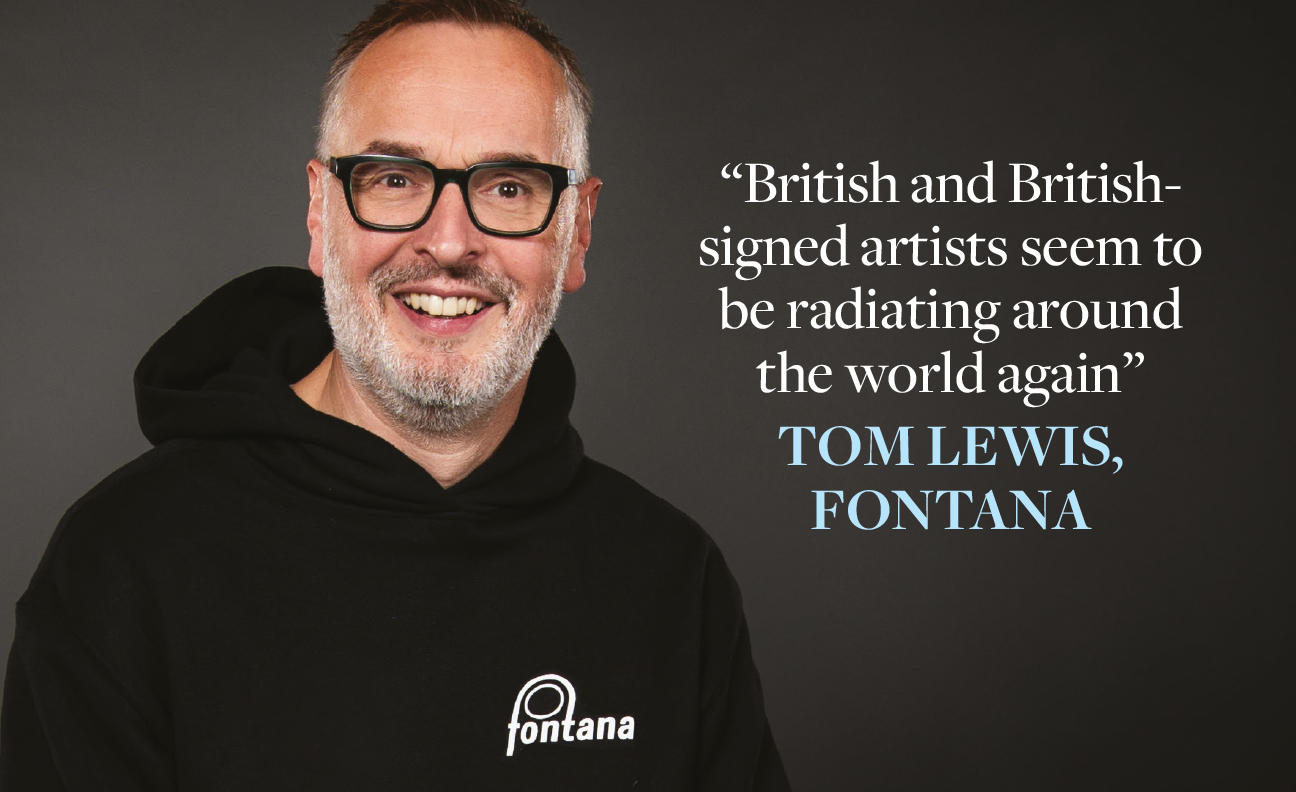
“If you talk to our colleagues over in America, the one thing they all seem to say is that Britain’s back,” reflects Lewis. “British artists, and British-signed artists, seem to be radiating around the world again.”
Neaves gives a shout-out to catalogue superstar Sir Elton John for showing his support at the LA event. “He’s the godfather of British music – he makes us better at our jobs every day,” she smiles.
Here, the quartet assemble for a discussion covering catalogue, sync and those singular artists who don’t quite fit in the mainstream, but manage to infiltrate it anyway…
Starting with Laura and Tom and the launch of Fontana, drawing on Decca’s jazz, blues, soul and folk roster. How has that changed your working relationship?
Tom Lewis: “We did some brilliant things together at Decca, now we’ve got our own lanes in which we’re working, but still collectively. Dickon has always had this belief that music can come from anywhere. Actually, Lucian has always had this belief that music can come from anywhere and can grow into the mainstream. This investment feels like a real commitment to that belief that music can emerge from [anywhere] and take on the world.”
It was quite a time for you, Laura, as you were appointed Decca president and inducted into the Women In Music Roll Of Honour…
Laura Monks: “It was a great week. When I started at Decca, Dickon was leading it, and I’ve been working alongside Tom for 15 years – amazing allies who have supported women. Within Decca, but also within Universal UK, there is a laser focus on developing all forms of diversity and talent. At Decca, I have some brilliant female leaders that I work alongside. And then I work hand-in-hand with people like Hannah, who is the most wonderful woman to work with. It’s a really positive place to be.”
Are you building a new team at Decca?
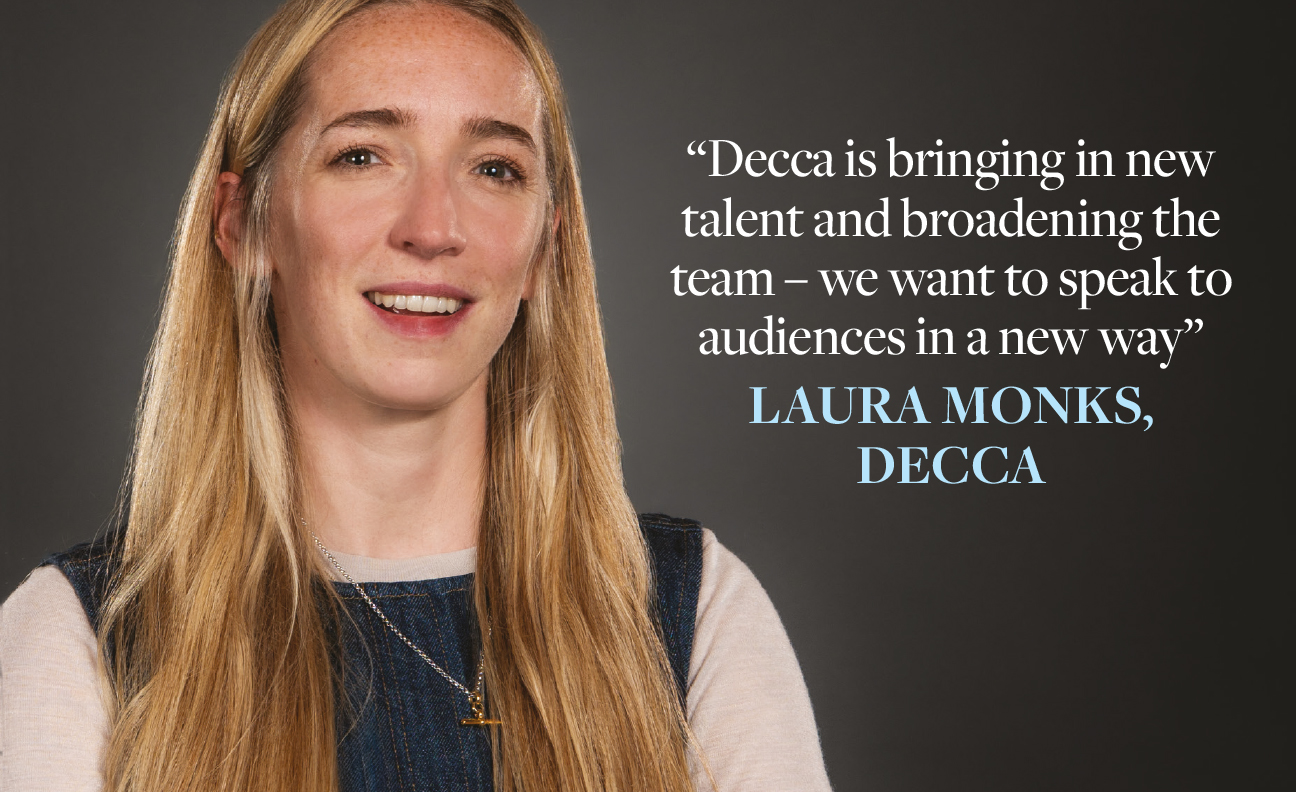
LM: “There are some wonderful colleagues that have been around for a long time with me at Decca. But we’re hiring, Decca is open. We’re bringing in new talent, broadening the team and the outlook – we want to speak in a new way to audiences. It’s very exciting to be opening up new opportunities for young people.”
How have you both developed artists like Jacob Collier and Jeff Goldblum, who are not typical chart stars?
TL: “It’s about belief in the long term. It’s about building a team around the artist that can flex. As campaigns start to grow, we grow what we do within the scope of the Decca-Fontana family, then into the broader part of the company. So with Marc, we’ve worked closely on aspects of Jacob’s career. Abbey Road and AMS [Audience, Media & Strategy] have played a huge part in it, and Hannah, in terms of exploiting his catalogue as well. So actually, he’s a really good example of that force of going from a so-called niche space into the mainstream, and in doing so calling on all aspects of the company to facilitate that. We’ve seen some incredible results.”
And you’ve established Jeff Goldblum as an artist with a higher chart result for each LP…
TL: “It’s a universal truth that people love Jeff Goldblum, and he brings magic to everyone and everything he does.”
LM: “He’s shown our artists at Decca and Fontana what hard work means. He did a 13-hour promo day. Jeff is an example for artists in how hard you have to work, and how much you need to connect with people in order to create success.”
Are you establishing a team at Fontana, Tom?
TL: “We inherited that side of the Decca roster that sits within jazz, blues, soul and folk. It includes Jacob, Aurora, Dodie, Jordan Rakei, Jeff Goldblum, Victor Ray, Melody Gardot, Tori Amos, Muireann Bradley and The Teskey Brothers. In most cases, staff that were working across A&R and marketing with those artists moved across too, so that was the foundation of the team. It’s very rare that you have the privilege of starting something from scratch, and that’s been a huge thrill for the Fontana team.”
What’s the A&R vision for Fontana?
TL: “We’re trying to sign artists in those musical spaces who are incredibly ambitious, who want to take on the world and believe in that possibility.”
Decca is approaching its 100th anniversary in 2029, there must be so much rich catalogue?
LM: “Ultimately, the artists we’ve worked on over time have all been one of one, right back to the Rolling Stones; artists that wanted to do things differently. Pavarotti ended up in massive arenas when people thought opera could only stay in concert halls. Einaudi this year did six consecutive nights at the Royal Albert Hall, the longest any pianist has ever done in that concert hall. So for this 100-year anniversary, there’s going to be a real build-up to it, we’re planning lots.”
Continuing with catalogue, Hannah, did you feel a big sense of responsibility when taking on the UMR role?
Hannah Neaves: “Definitely and we talk about it a lot within the team. It’s a really young team now, very heavy on female leadership. There is a moral responsibility for our artists in ensuring that their music doesn’t die out, and that we keep finding new audiences and new energy around it. We take it really seriously, although we obviously have a lot of fun with it.”
How has it evolved under your leadership?
HN: “We’re definitely much more globally focused. We now have our international catalogue team report into Nickie Owen, which is brilliant. They’re much more dynamic, more nimble and more able to react to a piece of deep catalogue or something that’s fairly shallow – for us, catalogue’s anything over three years old. So it’s a vast range of skills and a vast range of artists. That young team, and the broader skill set, has brought a lot of energy in. For me, the focus is really on the team and enabling them to achieve that creative excellence, because that’s what will stand us apart from anyone else.”
Marc Robinson: “Hannah is probably one of the most creative people in the industry. Her creative brain is unparalleled, and you can really sense that when dealing with that division.”
HN: “Thank you – that is the bit where we really take pride. If we can sit with an artist, convince them to do something based on a piece of data and a creative strategy and then deliver on it, that’s the joy. Whether it’s going to Elton’s house to tell him about our strategy for getting Diamonds to No.1 for the first time and then actually delivering on it, or winning a Grammy for The Beatles, beating Billie Eilish and Kendrick Lamar [Best Music Video, 2024], those are the moments where we’re really proud.”

Does it help having a young team when you’re trying to bring in a new generation of fans?
HN: “Totally. You need the expertise as well. But we see now that, as much as streaming audiences are maturing, the biggest growth market for vinyl in the UK is the 13-24s. We’re now seeing some of the much more shallow catalogue hitting our Top 10 D2C sellers. Olivia Dean’s Messy album will be catalogue next year, so it’s pretty broad. Artists like ABBA have this incredible super-streamer audience under 21, so you have to look at it through multiple lenses and all different directions at all times for each artist.”
Are there good examples of shallow catalogue?
HN: “Sam Smith is one of our biggest artists in that space, especially on a global level. There’s a beautiful campaign coming for Sam, which they’re spearheading. It’s Sam embracing their catalogue, the songs that they love and want to shine a light on, and it dovetails perfectly into new music. When we started working with Sam, they hadn’t really leaned into their catalogue, and by the time we’d finished that first campaign, they wanted to reshoot In The Lonely Hour with the original photographer as they are now. We do see that now with a lot of artists, especially with the advent of TikTok. Once an artist can see that they’ve got a brand new young audience, they’re much keener to jump in and talk about their older music than they ever were before.”
LM: “What Hannah spoke to there is really important, because that’s basically the key part of our job now: to bring the right teams at the right times around an artist or any track of theirs. It doesn’t matter what it is, as long as it’s something that’s connecting.”
We’ve heard about the creativity in catalogue – are there any new campaigns you would highlight there, Hannah?
HN: “For next year, we have Amy Winehouse’s Back To Black 20th anniversary, we have a Spice Girls 30th anniversary. I think the current energy around The Beatles, and the new team at Apple Corps, is the most exciting thing, looking at what the next three years could look like leading into the Sam Mendes biopic series [due in 2028]. We’ve done great work with them, but what’s to come is going to be incredible.”
Is it a delicate process working with legacy artists and estates?
HN: “It is, and there needs to be a lot of trust. Elton is in charge of Elton, that’s brilliant and his team are fantastic to work with. But then there are artists like Amy Winehouse, where there is not a huge catalogue but an incredible legacy. She means so much to so many people. It involves an enormous amount of trust knowing that any step you take needs to be welcomed by the fans, but also open up that catalogue to new audiences. You’ve got to be able to put someone in a room that can convince Dire Straits to look at their catalogue differently. Also, you’ve got to be able to do an amazing campaign around Kendrick Lamar’s Super Bowl [show]. You need all of these different skill sets in place at all times.”
Across streaming and vinyl, is catalogue now more vital than ever?
HN: “It is more important, but you can’t just think it’s going to grow on its own. It needs to be worked, and you need to be really innovative with it. That goes from what you’re doing with your short form to your merchandise, appealing to a more lifestyle-focused, younger audience, to the syncs, the documentaries. Also, to the product so that it caters to a 21-year-old who doesn’t want to spend more than 25 quid on a piece of vinyl, and for the people that want the fully expanded box set. That is one of the great things about the team, they have so much energy and so much passion. Whether it’s a really niche prog artist like Peter Hammill, or the Rolling Stones, they bring the same level of energy.”
MR: “We’ve been working closely with Hannah, developing documentaries around some of those [catalogue] artists, because of all the archive and the relationships we have with these artists. We’re bringing on different directors and production companies to come and help tell those stories to a new audience.”
Marc, Globe won Sync Team Of The Year at the Music Week Awards in 2025, what gives you the edge?
MR: “The team is just excellent. Again, under that ethos that Dickon brings, it’s how do we market in a way that we’ve never done before, not just within the UK but globally? Sync now is very much in two different lanes, equally as important. There’s licensing music to content. And now there’s so much content being made, how do we make sure that our artists are on the front foot to get those opportunities? We’re putting in more focus on the US, because it’s 60-65% of the market. And we’ve been doing a lot of work in Japan, because that’s the second biggest sync market in the world.”

How did the recent LA showcase featuring Olivia Dean and more help with that international sync effort?
MR: “We’ve done numerous syncs, from the Messy album into now. She’s got a brilliant management team. LA was this glory moment. It was a nice way to look at America and say, ‘We told you so.’ We’ve been saying for five years that Olivia is incredible. What’s amazing about her is she’s done it all on her own terms. It’s the same with Lola and a lot of our artists. For sync, we’re working on films that are coming out at the end of next year and into 2027 – it’s a longer game and it’s a very congested market. So for us, it’s about, how do we give our artists the best look globally?”
What have the changes at Universal in the UK meant for Globe?
MR: “It’s been great because my relationship with Dickon over the last 20 years has always been through film & TV, sync and soundtracks, from Decca to when he went over to America. He understands the landscape of my world really well. He’s like, ‘Get out there, show our artists, go to America, go to these territories.’ It’s also about changing our thinking. For example, the Aurora sync in [Netflix drama] Adolescence, we knew it was one of the best series coming out this year, but we had no idea that it was going to travel so globally. We had to be on the front foot to maximise that, working with the Decca team. And K-Pop Demon Hunters: all of a sudden the biggest record of the year [at that point] came from a Netflix series. So our world is evolving at a rapid rate, we just need to make sure that we’re working with the right people and catching opportunities.”
HN: “[The recent success of] Sophie Ellis-Bextor is a brilliant example of the way we all work together.”
MR: “The Saltburn effect, as it’s now known, was just incredible. You never know how a film is going to connect, but what was great was that we were really ahead of it. I don’t know if it was Gen Alpha or Gen Z, but they adopted that film like it was their Trainspotting, and the song [Murder On The Dancefloor] went ballistic. She then signed to Decca, she’s now touring America for the first time.”
TL: “It was a combination of Marc bringing in the opportunity, Hannah, your team doing incredible work on maximising the impact of Murder..., and then us arriving with a brand new record. That’s actually a really nice illustration of the way we’ve all worked together to tell a brand new story about a British artist, who is once again taking on the world.”
HN: “My obsession is Gen Alpha now. We have an incredible kids team headed up by Sarah Boorman [general manager, Youth Strategies], who did a deal with Yoto, and we’ve now got Elton, the Beatles, ABBA and our biggest catalogue artists [available on Yoto]. And K-Pop Demon Hunters. She turned that around in zero time. We’re all working really closely together to constantly think about these audiences and opportunities.”
What Globe projects are you particularly proud of for Christmas 2025 and going into 2026?
MR: “We’ve got James [She’s A Star] on the Waitrose Christmas campaign ad, while Jona Lewie [Stop The Cavalry] is on a Christmas ad for Morrisons. And [the Chloé Zhao movie] Hamnet, which is unbelievable – if Max Richter doesn’t win an Oscar there’s something wrong. We’ve promised Universal Pictures we are going to [market this] as a Max record, not just a soundtrack, because it’s a pivotal moment in Max’s career.”
LM: “In our space, he would be the equivalent of what we’ve all been talking about here, where lots of different teams have come in at any one time. When we’re signing artists, by the way, we bring Marc and Hannah in the room. They’re part of the initial conversations. Max has had a huge amount of significant syncs, and via some of these relationships with Hollywood, now he’s on Hamnet. It’s the most gut-wrenching film you’ll ever see, and the music plays a role as a character. That’s why Max is going to be an Oscars contender next year, and that’s incredibly important.”
Finally, do you think there are any misconceptions at the moment about Universal Music Group UK?
TL: “All we’re looking to do is collaborate, grow and amplify an artist’s vision, and make them as big as they possibly can be around the world. That’s our mission. The only misconceptions happen when people rest on stereotypes. All I would say is that the doors are open. Come and talk to us, because you’ll meet some incredibly enthusiastic, infectiously energetic and ambitious people who only want the best for their artists.”
MR: “Despite what’s happening, in broader terms, in the music industry, Universal always has and always will believe and invest in the UK, culturally and musically. Being inside the building, you see that, and you feed off artists’ and their teams’ creativity. There is an entrepreneurial spirit that’s always existed that I don’t think often gets recognised.”
LM: “If there’s any misconception that there’s nervousness around British music, there wouldn’t be if you walk in the door [at Universal]. There’s an incredible excitement in the building. I’d say that does come from Dickon at the top as well – you go in a room, he says anything is possible, you can do anything. We feel it, we exude it to our team, we can sense it in the building. It’s a really exciting time for us and for British music.”
HN: “We’ve always punched above our weight in the UK on a cultural soft power level. We’ve got some of the biggest and the best artists, and even the ones that aren’t the biggest, they all have such incredible value. That’s one of the things that Laura and Tom do so well, is taking those artists that will work globally and on a more subcultural level as well. I think whoever your artist is, we’ve got all the experience, we know so much.”
 FOLLOW