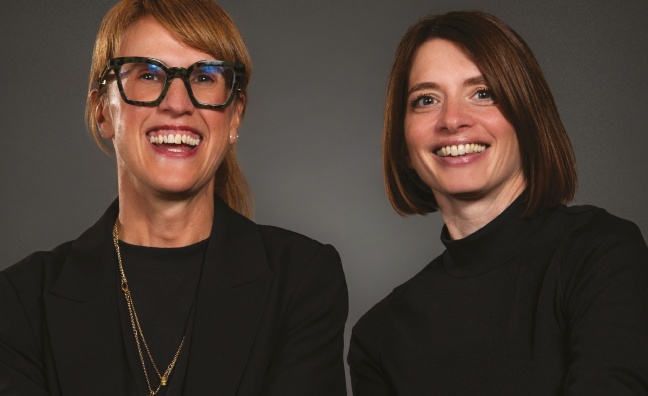
Overseeing Universal Music Group UK’s innovative new Audience & Media Division and its International Marketing department respectively, presidents Rebecca Allen and Nickie Owen have a crucial role to play at the major. Supporting the frontline labels while offering a helping hand to artists and their management teams, their work constitutes a vital cog in connecting Universal to audiences at home and abroad. Here, the pair reveal their masterplan to boost British talent…
WORDS: Anna Fielding
PHOTOS: Carsten Windhorst & Gerard Hynes
It was the night Universal Music Group UK arrived in Los Angeles. Gathered inside an event space in the Miracle Mile district, there were decision makers from film and TV companies, DSPs and sync agencies as well as actors, producers and directors. They had all come to watch Olivia Dean, Holly Humberstone, FLO and Sekou, but on the night were even treated to a surprise appearance by Sir Elton John.
“It was an almost un-British thing to do, we became very American,” says Rebecca Allen, president of the group’s recently launched Audience & Media Division (more on that shortly). “We became very bold, very ambitious. We made our presence felt.”
Nickie Owen, president of Universal Music Group UK’s International Marketing department, is smiling at this description.
“I think when Dickon [Stainer, Universal Music Group UK CEO and chairman] came into the business, his view was always that we should take control of our export in a way we’ve never done before,” Owen says. “And in some ways, what he manifested at the beginning was what was delivered at the showcase. It was incredible for us to do. Not only did we have Olivia Dean, who’s having the success she has, but also three other acts to show this room full of US execs what Britain has to offer in terms of music export.”
“It was overwhelming and thrilling,” says Allen, with Owen providing an echo of “overwhelming!” in the background. “We felt extremely proud of the UK company, our labels and every artist in that room, because they all performed so incredibly well and it was a tough audience. We feel proud as a company right now about what we’re delivering on the global stage. We wore our badges with pride, that night, didn’t we, Nickie?”
Owen picks up the thread about British music on the global stage.
“The musical world is pretty cyclical,” she says. “Our British music legacy shows us that there was rock‘n’roll, there was punk, there was Britpop. We’ve always been at the forefront of genres that have bled out globally. There was a big pop cycle, with a lot of female stars coming out of the US. Right now we have Lola Young and Olivia Dean and they have been developed by labels over time and it is now their moment. It just so happens that they are British-signed. I do think that opens doors and we’re taken a little more seriously. Olivia Dean is the first artist to be breaking outside of the UK since Dua Lipa, which was seven or eight years ago. Before that, Universal did it with Sam Smith… The truth is, we had two incredibly amazing British artists that had their moment. And, as we talked about at the showcase, there’s more to come. When the door is slightly knocked open you can push it through.”
The pair are certainly closely aligned on how to do this. And more.
“Nickie is my best friend,” says Allen.
We probably speak to each other more than our close family,” chimes in Owen. “We’re extremely aligned in terms of what success looks like and how our teams work together. We have a shared vision and, I think, a lot of common interests.”
"We share a lot of the same principles about how we like to work with people, to approach things from a place of kindness and respect,” continues Allen. “We love artists and managers. When I got my new job working more in the centre and across all labels, it was Nickie who really guided me about how to do that. I’d been so used to working inside a label where the culture is very different. She was a really strong support to me.”
The feeling is mutual.
“On a personal level, when I started my career at Universal, there weren’t many successful female executives that also had a family,” Owen jumps in. “Sometimes you feel you were made to make a choice. Becky was always a mentor, she gave me faith that you can rise through a company and have a family and a career.”
“I’m going to cry,” says Allen, but both of them are laughing.
Here, Music Week joins the two for a sit-down about how their departments are bringing Universal’s music to legions of new fans...
Rebecca, prior to his appointment as CEO and chairman last year, you already had a long working relationship with Dickon Stainer – what’s it been like for you since the big change?
Rebecca Allen: “I first met Dickon in 1999 when I was his press assistant. So this is the guy that took me from being a press assistant to a president over the course of 20 years. He literally guided my career right up until I took over [as president of] EMI. He’s a great friend, but he’s also one of the most competitive people I’ve ever worked with and one of the most compassionate people I’ve worked with. He was supporting women in music way before we had to do an awards event to celebrate women. He was supporting women having children way before the best maternity rights were out there. He used to say to me – and I think this really meant that I could be the best version of myself, raising my girls – ‘I don’t care how you get your job done, just do it.’ Obviously, David Joseph was phenomenal to work for when I was running EMI, but when David sadly decided to leave the company, and I found out it was Dickon [now at the helm], I was like, ‘Oh my God, I’ve got my guy back.’”
And Nickie, how has your role changed since Dickon started?
Nickie Owen: “He has been a game changer, both for me personally and with the emphasis on breaking artists globally in the company. His experience of running Global Classics & Jazz means his view was global from the beginning. I was also incredibly fortunate to work with David Joseph. In a similar way to Dickon and Becky, David gave me every opportunity and I was able to run the department. But Dickon has really elevated the international division and, I would say, changed the company’s mindset and put breaking artists globally at the top of the agenda. I’ve thoroughly enjoyed this year working under him. It’s been just such a privilege, and I feel I’ve personally developed as an executive.”
Rebecca, the launch of your new division drew a lot of interest last year. What can you tell us about how it has operated so far?
RA: “We call ourselves AMS: Audience, Media and Strategy. We’re like an agency within the heart of Universal that is made up of young, dynamic marketing and media specialists. We wake up every day and the thing we think about most is how to connect our artists to fans. The whole team is made up of really young, brilliant minds and specialists – whether it’s performance, marketing, community, youth, influencer, creator, data, insights, audience development… We have platform specialists. We do event marketing, we do fan experience. It’s been one of the most inspiring periods of my career. There’s real magic happening across the teams. I’ve got this incredible group and I don’t think there’s anybody in the UK that’s doing what we’re doing. And I would like to be quite bold and say that, globally, working alongside Nickie and her colleagues, I don’t think there’s anybody else around the world that is managing to do what we’re doing. And we’ve only just got started.”
So what’s the difference between working as part of a label and working in the ‘centre’ of Universal UK, as you call it?
RA: “When you’re at a label, you’re part of its culture. It’s like a football team. You have that pride of being part of Island, Polydor, Capitol, EMI, 0207 Def Jam, Decca or Fontana… When I came out of that, I started to think about what my identity was, and that was quite a big thing for me. But then I suddenly realised, actually, my identity is the artist. That’s the badge I wear now. I think about the artist first, because I’m not associated with the label side and I’ve really enjoyed that experience. I’ve also really enjoyed understanding that, when you take a step out of label life, you start to see the identities of the different labels. That’s been so fascinating. Each label has a very unique identity.”
At launch, the Audience & Media Division was described as UMG UK’s “largest division” – is that still the case?
RA: “It is, yes, and it’s growing. The more we see opportunity, the more we’re investing in this area. We’re starting to really look at new media opportunities, new digital platforms, and we’re really investing in them. Not just in terms of our time and support, but we’re also investing in them financially because we want to grow those new audiences… There are so many young journalists that are doing it via visual media. How do we help them grow those platforms? We don’t look at things in a traditional way. We’re not a cookie cutter. The greatest thing that we are doing right now is putting the right team around the right artist at the right moment. Not every artist’s needs are the same. One of the partners we are obsessing about is YouTube. Everybody in my team has the word ‘YouTube’ next to their title, because everything that we do has a YouTube focus. YouTube touches everything that we do. If you work in data you need to understand YouTube; if you’re working in TV, or digital marketing, creator marketing, all roads lead back to YouTube.”
NO: “And then from a global perspective, we have to look at some of the emerging markets that are really important to us. In India, YouTube is the biggest platform; in [South] Korea, for Anglo music, YouTube is the biggest platform. In Brazil, YouTube is the biggest platform for Anglo discovery. So for us to be completely joined up and create a strategy for artists on that platform also helps us to develop artists within those newer emerging markets. It’s a challenge, because India is 90% domestic music, and so to be able to cut through, you have to be delivering the right content in the right way. And that might not always be ‘new’ [content]. Part of that could be looking back. Whether it’s Olivia Dean or Lola Young, they already have a catalogue, which is an incredible opportunity. So we don’t have to just think ‘new’, we just need to tell their visual story to start those connections early because those markets are the future and they’re growing. We talk about building bridges and connecting into culture, and that’s the way we can do it, through fandom. But it’s important to look to the future, where the opportunities are, and lay the foundations for our artists so they can have a bigger career. How amazing would it be if an artist said they wanted to break India in the way they say they want to break America?”
What are the practical strategies that you’ve used to make sure that UK acts can break globally?
NO: “Coming out of Covid, where I basically took over the sole running of the department, we made sure that everything we do is completely intentional and proactive. We stopped talking about international as, ‘Let’s be global, let’s be international’, and talked about breaking it down per artist, per country, because it allows you to work extremely well with the labels and the managers, and talk about what that means for that artist. Different artist propositions land in different markets differently. We do a lot in partnership with the labels and working with managers. We sit down with a 12-month strategy and planning doc and say, ‘What is important for you?’ An artist needs to be in market, so what time do they have? How do they connect to that audience in person? How do they build those relationships? We used to have different release dates around the world and start internationally post the album being out in the UK. When everything became digitally flat, it became everything, everywhere all at once. And actually, that’s not how you break an artist. That’s why with artists such as Olivia Dean, Lola Young and Glass Animals we were able to work hand in hand with all of the various labels, with the managers, with Becky’s team, with Marc Robinson [president, Globe] and our sync and brands team, and really build out an individual, bespoke, global plan that has accountability, but is specific to markets. When we reset what international marketing could look like post-Covid, it really made sense for us to be what the local market needs and wants. We’ve got 68 Universal offices around the world. They’re complete experts in what it means to break in Denmark or in Korea. There are lots of markets where there’s a different platform [to focus on]. It’s not about a global Spotify plan. You should be focusing on Melon if you’re in Korea or YouTube for India. You can take a global strategy, but in order to deliver on it, it has to be local. For Olivia and Lola, we’ve been working on them for five-plus years, so we’ve learned a lot together along the way, and learned about what’s important to them and where they resonate.”
Do you think that an artist could break in an international market without this kind of hyper-focused leaning in?
NO: “My personal view would be that a track could break, but an artist needs to be present. So I think you have to identify two strands. You can have a global hit – something my team and Becky’s have delivered a good few times – and that can be completely digitally focused. But to break an artist globally we have to have that lean-in. A streaming hit doesn’t equate to a fan.”
Jo Charrington told us that she wants to break Olivia Dean in the US and mentioned a campaign that never sleeps. What goes on in a project like that?
NO: “Olivia has been signed for six years and we were one of the first departments to meet her. She’s toured a lot around the world; I think her first ever promo trip was to Korea. She’s been to a number of places. So when we talk about building fans, she’s done that over a long period of time. She’s always had ambitions to be a stadium artist, and she’s understood that to do that, you have to repeatedly visit different places. You never stop. And because of that she has a No.1 airplay record in Australia. She’s had a No.1 single in Australia. Her album went to No.1 in Australia. She’s about to go and be the only international artist to perform at the ARIAs in Australia, which is huge. She’s the only artist who, since I’ve been doing this job, has gone to Australia twice in the same calendar year. Her commitment to breaking around the world is enormous and sometimes it’s our job to keep up with that energy. She has ambition to go into China. With America, she’s literally there now and she will have been there for a month, and that’s her third visit. We’re doing a fan event in India with her and she wants to do an Asia tour at the back end of next year. So we’re getting her signed up to all the Chinese socials to make sure that those foundations are there.”
How do you actually work out what success in any given territory looks like for an artist?
RA: “When you talk about measuring success, we’ve always felt that it can look like many different things. The phrase we always use is, ‘Are we moving forward?’ So, are we growing new fans? Are our socials growing? Are our streaming numbers getting bigger? Are we selling more tickets? Maybe we’re selling five more T-shirts than we did last month. For artists, success looks like so many different things at so many different points in their career. We have artists where a No.1 album is a really big deal to them. And if that’s the case, then we support that, and we’ll do everything we can to deliver that. For other artists, look at Olivia, she wants to be a stadium-selling artist. That is important. Our job is to create a path for that to happen.”
NO: “To use Sekou as an example. He has released music before, but is just starting his campaign. He has a very direct relationship with his fans, so he loves putting on fan events. He’s done it in America, in the UK, and it works really well. So, working with Becky’s team, we can identify where there’s interest, literally from a digital perspective. We suggested that he should go to Paris for a small listening event for his fans, as France is spiking from a consumption perspective across his socials. He went and twice as many people as the venue could hold turns up, and then we follow that through. It’s about those early wins and building foundations for the artist.”
How important is international radio still?
NO: “It’s artist by artist, but also country by country. Any entry point into discovery is really important. In America, Germany and Australia, radio is still very important. It’s about what the overall artist strategy and campaign is. Australia still has a very strong tastemaker radio format, so stations like Triple J… The endorsement of that platform becomes extremely important. We don’t discount any particular vertical that helps bring people into an artist.”
RA: “And to add, we live in a really noisy world, right? So people do crave curation and this is where radio still wins out because it’s not algorithmic. Radio is about programming, and it’s about taste, and about putting together a playlist of songs they think you’re going to enjoy… And I think that’s why radio is holding out.”
Are there any marketing strategies that used to work but now seem outdated?
RA: “Marketing is now about specialisms, you can’t be a jack of all trades now. Expecting one person to do everything to do with marketing is not the right thing. That’s why we built this in-house team that can be all of the specialisms you need. In my team, Sarah Boorman [GM, Youth Strategies, Universal Music Group UK] concentrates purely on Gen Alpha strategies and to make sure that we’re thinking about our audiences for the future. That’s a really strong marketing role to have here. So I think that’s where it’s evolved.”
NO: “From my perspective, there are Universal offices around the world and we get the absolute privilege of talking to our colleagues in that [particular] market to truly understand what the cultural touch point is. So to Becky’s point about specialisms, there’s no one more specialist at understanding what Olivia Dean means in Germany than somebody that’s working in the German marketing team. So it’s adapting that strategy. We’ve gone back to basics, in a way. Nothing is better than the artist being in-person and that real artist-to-fan connection.”
Going back to your Audience & Media Division, Rebecca, how do you see it evolving in the coming years?
RA: “I think that it’s probably less about AMS, in some ways, and more about the business. I have been working in the record business for over 25 years, and nothing sits still. No year feels the same, no way we approach an artist is the same. It changes all the time. So when you talk about AMS, it might be something different in two years’ time, possibly because of the needs of the artists, because of the way the world moves forward.”
Finally, what have you both learned about yourselves during your time working in the music industry?
RA: “My career has had more twists and turns than an EastEnders plot line. Somebody will go, ‘Have you thought about this? No? You’re doing it tomorrow.’ I’m 52 and I still just can’t believe I’m in this business learning and being inspired by people I work with, and working with artists that fill me with so much hope and love.”
NO: “This is going to sound like such a cliché, but I realised how lucky I am to do a job I’m so passionate about. It’s changed so much over the years. When I first started at International, we released on different days of the week, then streaming came in, and everyone’s, ‘Oh my God, everything’s the same.’ And then Covid happened. You have to keep looking forward. We probably wouldn’t have talked about India five years ago, and now there’s a whole market out there that artists are only just starting to have opportunities in. I feel what I’ve learned about myself is that I’m totally in the right job.”