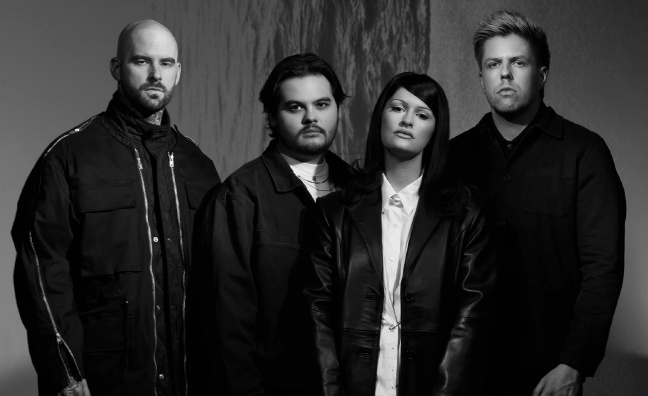
Spiritbox singer Courtney LaPlante may point out that the Canadian metal band have “more experience making lattes and delivering pizzas” than they do playing to thousands of people, but that won’t be the case for much longer. The latest stop on their lightning trajectory is the release of their second album Tsunami Sea, which follows their biggest ever show at London’s Alexandra Palace and a second Grammy nod. Given that they eschewed most traditional routes, their success is all the more remarkable, as LaPlante, joined by manager Jason Mageau and label BMG, explains…
WORDS: ROD YATES PHOTOS: JONATHAN WEINER
When the 66th annual Grammy nominations were announced in 2023, Spiritbox vocalist Courtney LaPlante was so sure the band’s name wouldn’t be read out she opted to sleep in rather than tune into the ceremony. So confident was she that the Canadian four-piece would be overlooked she told her husband, Spiritbox guitarist Michael Stringer, that if they were nominated she would buy him a dog; he’d always wanted one called Spaghetti.
That LaPlante begins our interview from her Los Angeles home by apologising in advance for any noise Spaghetti may make – they’ve nicknamed the Poodle-Bernese Mountain Dog-cross “Ghetti” – is proof she is a woman of her word. It’s also a reminder that Spiritbox – completed by bassist Josh Gilbert and drummer Zev Rosenberg – were indeed nominated for the Best Metal Performance Grammy that year for their song Jaded (Metallica took the gong). They repeated the honour this year with their second nod in the same category, for the track Cellar Door.
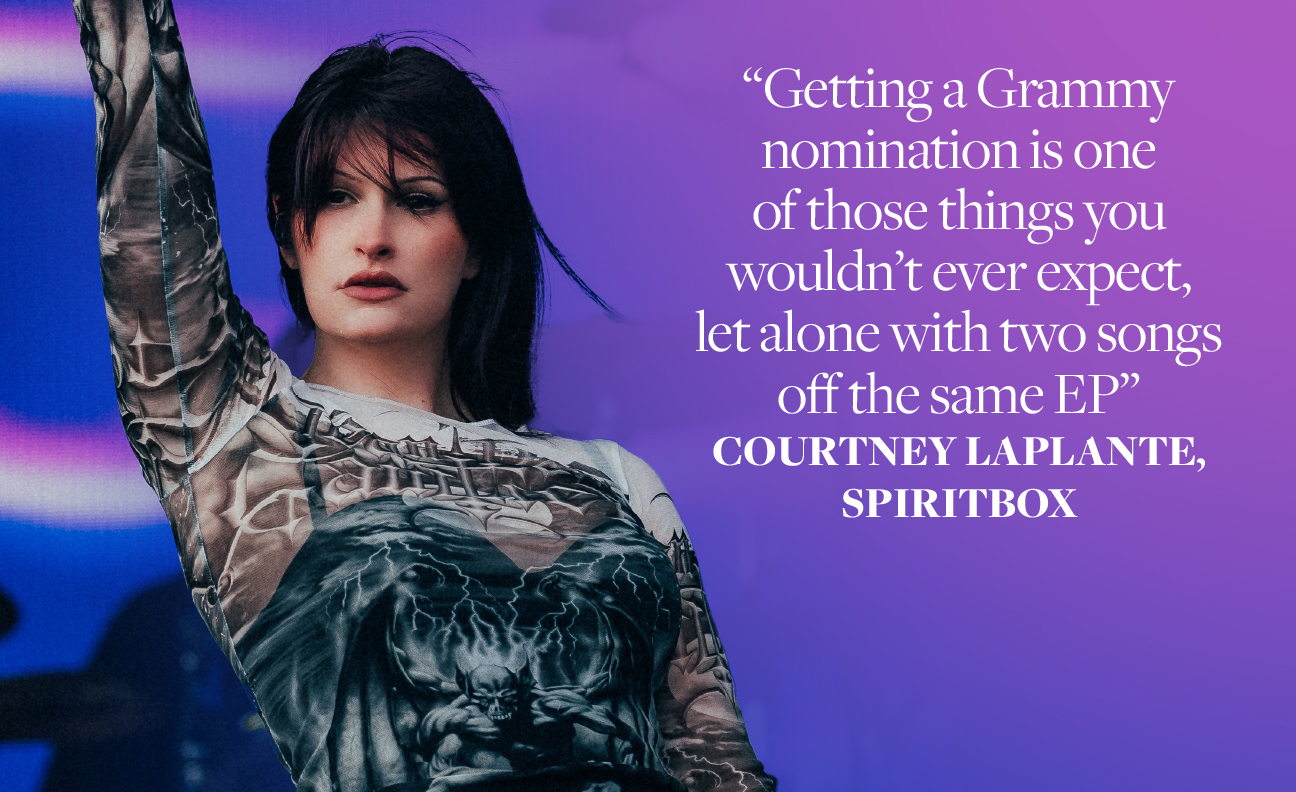
“It’s one of those things that you wouldn’t ever take for granted would happen to you, let alone two times off the same EP,” smiles LaPlante, referencing 2023’s The Fear Of Fear six-track outing.
Ask the vocalist if the nominations have had any measurable impact on the band’s career, and she thinks for a second.
“It’s another piece of ammunition that is like a tangible stat to give you an edge,” she says. “Professionally, a lot more people are aware of who we are in that world. But I don’t really know if it impacts you financially and creatively. But instead of being a boring metric, it’s an exciting one that’s easier for everybody to understand.”
“From a PR side I think it’s helped,” adds manager Jason Mageau, whose Culture Wave company began a partnership with Red Light Management at the beginning of 2025 after previously being under Roc Nation. “This is a prestigious thing, so I would say it’s helped in that capacity.”
If Mageau and LaPlante sound grateful, if a little reserved, it’s because Spiritbox have reached this point with a DIY approach that’s taken them from Stringer’s mother’s basement to London’s 10,000-capacity Alexandra Palace, where they played their biggest headline show earlier this month. Later this year, they will be one of the main draws at Download Festival, before supporting Linkin Park at Wembley Stadium on June 28. Their debut album, 2021’s Eternal Blue, reached No.19 in the UK (it has 23,561 sales, according to the Official Charts Company) and No.13 in the US. They’re expected to surpass those positions with follow-up Tsunami Sea (out March 7).
That they’ve done this wielding a bludgeoning form of metal that isn’t afraid to accommodate genres such as EDM and atmospheric, melodic rock is a tribute to their diehard community of fans, who understand and embrace their genre-straddling approach. Collaborations with artists such as rapper Megan Thee Stallion and American DJ Illenium speak to a band that not only thinks outside the box, but perhaps never knew it existed in the first place.
Add to this the fact that Spiritbox upended the traditional approach metal bands have in the past taken to building an audience – tour, tour, album, tour, tour – favouring instead to nurture a following online while releasing EPs and singles, and you sense that they would continue to thrive whether the Recording Academy noticed them or not.
“They’ve built such a loyal fanbase because they’ve consistently lived up to the hype,” explains Katherine Parrott, director, international campaign management new recordings at BMG. “Their fearless exploration of diverse sounds is matched by an unwavering commitment to quality. Their music is always the focus – there are no gimmicks, just authenticity. Fans recognise and appreciate that, which is why they stay so connected to the band.”
That commitment to the music shines through on Tsunami Sea, an album that pushes Spiritbox’s sound to even more extremes. Soft Spine is one of the most ferocious songs of the band’s career, a brutal, hate-filled takedown of bad actors in the music industry; while No Loss, No Love and Crystal Roses uncompromisingly embrace the quartet’s EDM tendencies. Deep End and Perfect Soul are heavy modern rock songs in which LaPlante affirms her reputation as one of music’s most versatile vocalists, her trademark guttural roar making way for a pure and melodic singing voice.
Clearly this is a record made without any concessions to commercial expectations.
“It’s really important to us that we never think about the focus-group approach, like, ‘To sustain my career I need to make this type of music,’” says LaPlante. “We try to stay indifferent to that and have an innocence and playfulness to creating stuff.”
During the Covid pandemic there were no rules – we took advantage of that
Jason Mageau, Culture wave
The singer regards Tsunami Sea, which was co-produced by Stringer and longtime producer Dan Braunstein, as a sister album to Eternal Blue.
“A lot of it is about my mental state,” she offers. “[Eternal Blue was about] that isolating feeling that we felt during that time [lockdown], when we didn’t have any resources or people around us that really understood or cared about what we were trying to do.”
The singer notes that the context the new record was made in was entirely different.
“On this one, all my circumstances have changed, but it’s all still there,” she says. “My life is a dream now, and to my surprise I still struggle with the same feelings and very severe depression. [With Eternal Blue] it was like, ‘I feel trapped in my environment’. And now I feel embarrassed to feel that way because I’m living a dream life. Both albums are an autobiography of how I’m feeling.”
The album’s title references both LaPlante’s fascination with a predicted natural disaster, and its parallels to her at-times fragile mental state.
“We always hear about ‘the big one’, the earthquake that’s going to destroy the whole West Coast of America,” she says. “But also the tsunami from the earthquake will completely submerge where I’m from [Vancouver Island] immediately; everyone on my island will die. So that’s always been something that fascinated me. And then Tsunami Sea is a perfect description of not being neuro typically all together. Rather than the disaster of one tsunami, imagine the whole ocean, and every single piece of that ocean is its own tsunami going towards whatever shore...”
The Spiritbox story begins in 2016 in Vancouver Island, which lies off the coast of British Columbia. Stringer was born and raised there, while LaPlante relocated from Alabama at the age of 15.
After leaving their previous group, mathcore outfit Iwrestledabearonce, they asked that band’s manager Mageau to give them “six to eight months”, after which they’d deliver him a fully realised new product. True to their word, LaPlante and Stringer formed Spiritbox and wrote and recorded the songs that would become 2017’s self-titled debut EP.
Rather than send them down the traditional route of building an audience via heavy touring, Mageau set about building demand online.
“I said, ‘We can’t be naive and think that all these people [who were fans of Iwrestledabearonce] are following you, they’re just not,’” he recalls. “And touring the country, jumping in a van, it didn’t seem responsible. Why would we spend all this money to assume people are going to show up in Nebraska or wherever? Let’s take whatever expenses we would put towards something like that [and] spend that online.”
Key to building their community was releasing a constant stream of music and a sustained campaign of creating FOMO. They only started selling physical product once demand was there, beginning with a limited run of one T-shirt, which would be available for only 48 hours. By the third time around, the shirts were selling out. Their first vinyl release came two years into their career with their second EP, 2019’s Singles Collection. It sold out immediately.
All the while the band were building their own email database, a direct-to-fan approach that Mageau says has “been everything”.
“In the beginning it was a Patreon fan club, we maybe had 1,000 people,” he says. “I think there were about $100,000 a year’s worth of transactions happening there and we were doing a lot of connecting with these people. They had a private Discord that we didn’t let anybody else into. Those people would help our algorithms because they would get stuff 24-48 hours early and would be the first to like, comment and share. So by the second we hit social media they had already heard it and seen it and were loving it.”
Label interest was, however, harder to attract. While shopping around their debut EP, one label told Mageau, “We already have a female metal artist and it’s not performing very well.”
“I was like, ‘Oh wow, you said that out loud,’” he says. “And in my head I’m like, ‘What about the 30 male metal bands that aren’t performing well either?’”
Opting to self-release the EP, Mageau secured a distribution deal through The Orchard. LaPlante and Skinner continued to write, releasing new songs as they went. When they were compiled for the Singles Collection EP, Mageau created his own label, Pale Chord, to release it. He didn’t publicise the fact he owned Pale Chord but thought that having a label brand behind Spiritbox might add legitimacy.
“I was like, maybe [the other labels] don’t want to be the first one to take a chance,” he says. “But everyone loves to come along and steal it whenever someone else has done the foundational work. Then they can take credit for the next level.”
When 2020 single Blessed Be was picked up by US rock station SiriusXM Octane, calls from labels finally started coming in. Of all the reps Mageau met with, only one, Rise Records’ SVP Sean Heydorn, asked the manager a simple but crucial question: “What is it that you guys want?”
“I just said we don’t want to do a masters deal,” recalls Mageau. “We’re interested in licensing. And even in the terms of that I was like, ‘I only want seven-year-terms, I don’t want a 10-year term.’ We still wanted the proper funding. We wanted 70-30, we didn’t want 50-50. Everyone thought I was crazy because I was asking a lot for a young band.”
With the group’s community-building efforts having created enough demand, in late 2019 they finally began playing live, once again utilising FOMO tactics to sell tickets.
“We had this psychological thing: wouldn’t it be fun to do a European tour first and really piss off North America?” chuckles Mageau. “And them being like, ‘When are you coming here? Why aren’t you touring here?’”
A few warm-up shows in Vancouver were scheduled, after which Spiritbox hit the road for the first time supporting After The Burial in Europe. Then the Covid pandemic struck, cutting short the tour after only a few gigs. Rather than watch their momentum grind to a halt, Spiritbox soared, drawing on their early experience of growing their audience online.
“We didn’t skip a beat,” says Mageau. “We would record a song at home. Mike and Courtney would direct the music video in a field for $600. Once [Eternal Blue] was done, it gave us an excuse to have an extended roll-out. We put out six singles, about half the record. Would we do that again? Probably not. But during that time there were no rules. We took advantage of that.”
The years of building a solid foundation had worked – when Eternal Blue was released, it sold more than 20,000 copies in the US in its first week. All this for a band that, prior to the album, had played “maybe 10 shows” and released two EPs and a handful of singles.
Spiritbox’s surge in popularity over the past few years has, for LaPlante, been a transition. Having been the underdog for much of her musical career, she is now a full-time artist with a global following. Not long ago she was working in a coffee shop, convinced her career was over.
“I’ll be 36 this year,” she reveals. “And I have a lot of experience making lattes for people and folding clothes in a retail store, and Michael does delivering pizzas and working at a grocery store. I have a lot more experience doing that than I do playing to 10,000 people at my own sold-out show.”
As for why Spiritbox have had such a meteoric rise, BMG’s Katherine Parrott has a theory.
“With such a wide range of sounds, we’ve been able to reach an audience beyond just the metal world, showing that heavy music can be far more approachable than people might expect,” she offers. “That’s what Spiritbox do – they invite newcomers to heavy music and make them feel welcome, show them it’s a space where they belong.”
That wide range is reflected in the scope of their collaborations, perhaps most significantly with Megan Thee Stallion on 2023’s Cobra and 2024’s TYG.
“I think we kind of have an anxiety in metal, like we’re worried the artist is going to leave our little community,” says LaPlante. “In other genres if they had a fun party song their listener wouldn’t be like, ‘Oh no, that’s all their music is going to be [from now on].’ Their audience wouldn’t fear that. People that consistently listen to us understand the fluidity that we enjoy having.”
The cultural impact of moments such as the Megan Thee Stallion collaboration is significant.
“Rolling Stone never mentioned or covered us, but [they ran] a photo of Megan and Courtney,” says Mageau. “That shit matters. Sure, we can see streams go up here and there, but I think there’s an unknown measurement in the cultural conversation.”
Speaking of streams, Spiritbox currently have 2.7 million monthly listeners on Spotify and Parrott has ideas as to how they might grow that base.
“Technically, their music is still very much rooted in the metalcore and metal scene, so playlisting will continue to lean heavily in that space,” she notes. “However, their musical influences and collaborations have broadened their fanbase beyond the traditional metal audience. Above-the-line partnerships and storytelling opportunities with DSPs have helped expand their narrative and reach, moving beyond the core fanbase to create superfans who now have a deeper connection and investment in the band.”
Spiritbox invite newcomers to heavy music and make them feel welcome, show them it’s a space where they belong
Katherine Parrott, BMG
Parrott also cites initiatives like their upcoming Spotify show in Los Angeles to exemplify this approach, adding that accolades including two Grammy nominations and National Metal Day campaigns with Spotify have contributed to broader exposure.
“This diversity in musical styles not only appeals to their existing fanbase but also allows us to tap into a wide variety of playlists and connect with an even broader audience,” she says.
In terms of playing live, Alexandra Palace and Wembley Stadium are a far cry from the 800-cap venues Spiritbox played on their first UK dates, two years after Eternal Blue came out.
Having since toured with acts like Korn and Bring Me The Horizon, LaPlante and her bandmates have witnessed first hand what it takes to exist as a live draw of that size.
“We played with Bring Me The Horizon at this stadium-level show in Budapest in 2023,” says LaPlante. “And then in Brazil a year and a half later, we saw how much their show had evolved from the beginning. They kept working on it, they kept evolving it, and they didn’t stay complacent. That was so inspiring. For Michael and me, Bring Me The Horizon really validate how obsessive and hard on ourselves we are, because they’re the same.”
Rest assured that LaPlante’s goals for the band don’t stop at Alexandra Palace. It’s simply one more rung on the ladder.
“The next level is doing arenas,” she says, looking ahead. “The Alexandra Palace show is very important for us because we want to prove to our fans that we’re worth the ticket price, we’re worth them spending their time and money and booking off work and getting hotels.”
Before we part, LaPlante finishes with one final expression of her band’s intent.
“It’s a lot of pressure, but I want all these people who are sacrificing their time to feel like it was worth it,” she says. “This is our statement for 2025 and beyond...”
Additonal photo: