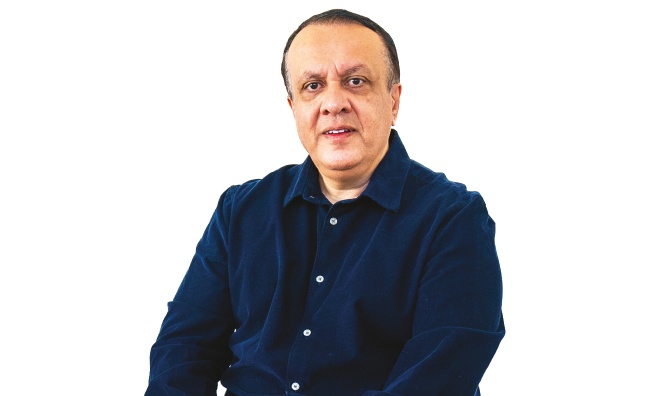
Not only will Sat Bisla be celebrating 40 years in the music business in 2025, his MUSEXPO conference will also turn 25. To mark his incredible achievements so far – which include founding artist development platform A&R Worldwide – Music Week meets the passionate executive to discuss artist development, sweeping change in the industry and the key to building a lasting legacy…
WORDS: JAMES HANLEY PHOTOS: XAMNIL
Why isn’t Sat Bisla running a record label? The president and founder of MUSEXPO/A&R Worldwide is a fount of knowledge on music business matters, having built his reputation over the best part of 40 years since emigrating from Wolverhampton to the US as a teenager. Despite wearing countless hats in that time (DJ, manager, booker, journalist and broadcaster, to name just a few), the title of label boss has eluded him – but it’s not due to a shortage of offers.
“I haven’t really talked about this publicly, but since it’s almost 40 years I guess it’s OK now,” says Bisla, in revelatory mood. “When I first started getting into A&R in the mid-’90s, I was asked by at least a dozen labels to work for them full time, but I turned them all down because I loved managing; I loved working in radio; I loved doing events; I loved doing a lot of different things – and at the time you could only do one or the other. So I graciously declined, but I said, ‘I’ll consult for you.’”
As Bisla explains, circumstances dictated he was better suited to being a trusted sounding board to the industry, but never say never.
“At one point, I was consulting for 14 major labels at the same time, which I think was unprecedented,” he chuckles. “That was the time when I did think about it, but felt that I didn’t want to be beholden to a system that was not very flexible.”
So, would he consider doing it today?
“I’d consider it as long as the circumstances enabled me to operate creatively and freely, but also being fiscally responsible, which I am,” he says. “As the old saying goes, you can walk and chew gum at the same time. So you can be creative and entrepreneurial, but also run a successful business.”
Bisla is speaking from first-hand experience given the accomplishments of his artist discovery and development company A&R Worldwide and music business conference MUSEXPO, which will stage its 25th edition at Castaway in Burbank, California from March 16-19, 2025.
Confirmed speakers include Mom+Pop Music’s Michael Goldstone, CAA’s Emma Banks, Concord Music Publishing’s Kim Frankiewicz, songwriter Savan Kotecha, NBCUniversal’s Mike Knobloch, PULSE Music Group co-CEOs Josh Abraham and Scott Cutler, Wasserman Music’s Tom Windish and music supervisors Jen Malone and Julia Michels, while Music Week is also signed up as an event partner.
Mom+Pop founder and co-owner Goldstone will receive the Seymour Stein Global A&R Award as part of the International Music Industry Awards gala dinner held at the end of the conference. The award, introduced in honour of the late Sire Records co-founder Seymour Stein, was first presented this year to Republic Records president and chief creative officer Wendy Goldstein.
“We launched the award last year in partnership with Seymour’s daughter, Mandy, and Seymour’s former business partner, the co-founder of Sire Records, Richard Gottehrer,” Bisla tells Music Week. “Not only was Seymour a big inspiration to me personally – I was a massive fan of every artist on Sire – he really stood for what is to me, personally, really important, which is a passion for music. It was in his DNA.”
Bisla happily notes that Seymour was a regular attendee of MUSEXPO and says the pair travelled the world together as friends.
“In fact, his last international trip, which was to Jerusalem and Tel Aviv back in 2018 before he got ill, we did together,” he says. “So when he passed, I felt it was important to maintain his legacy and the true meaning of A&R.”
Bisla’s commitment to that idea is unwavering.
“These days, we’ve got it backwards,” he says. “Everyone’s so focused on data, but it’s the human emotion that creates a reaction that then causes the data to be born. So we wanted to ensure that the importance of music at a grassroots level, and A&R at its honest level, are not forgotten.”
To find out more on MUSEXPO 2025, talk A&R, and the growing importance of India, Music Week jumps to the front of the queue in calling on Bisla’s wisdom…

MUSEXPO is celebrating 25 editions – how have you managed to sustain that longevity?
“At the end of the day, for any event to have 25 global editions, you’ve got to have some form of relevance, impact and consistency. With MUSEXPO, it’s not just an event, it’s an experience. We’re in the trenches of the global music industry 24/7, 365 days a year, because our day jobs have us working across A&R, media, sync, publishing, management, marketing, technology, streaming. So we have a really good understanding from a grassroots level, but also from a 30,000ft level of what’s happening across the globe at every single key vertical of the music business.”
Why do you think the event is important to the industry?
“Since the pandemic, the industry has changed to more of the business of music. But music is still a very human thing and so MUSEXPO is a very personal experience, because relationships matter. The whole event started off as a dinner that my friend Dave Holmes [former Coldplay manager] and I started many years ago, and the dinners evolved into this gathering where people would fly in from all over the world. Alex Jones-Donnelly, who was head of music at BBC Radio 1 in the fall of 2003, flew out to our dinner in New York and all the major label heads were like, ‘How the heck did you get him to do that when we can’t even get a meeting with him in London?’ Alex said to me, ‘These dinners are really special. I meet so many interesting people that I wouldn’t typically meet, so you should do a conference. If you do that, I’d recommend it to all my friends in the United Kingdom.’ That’s literally how MUSEXPO started.”
You have welcomed so many big names over the years – what is your favourite memory so far?
“These aren’t just names, these are relationships and I keep emphasising that. Most of the speakers that attend MUSEXPO are people I’ve developed relationships with over the course of months, years or decades and so I want to make sure it’s people that really understand and are passionate about music first, and the business second, and that’s always been the focus. One of the highlights – and I didn’t see this coming – was back in 2006 when we had music and tech entrepreneur Chad Hurley, whose PR happened to be a big fan of my Indie 103.1FM radio show back in the early 2000s. Through my assistants, they connected and said, ‘My client Chad Hurley is doing this great online platform called YouTube.’ We were the first music business conference that Chad ever spoke at and that was the first time a lot of the label heads had spoken to Chad directly, because most of it was being handled through lawyers. We wanted to make sure that we created a constructive dialogue to help all parties because, at the end of the day, we all need each other.”
Do any other moments stand out?
“There are so many. But man, speaking of Seymour earlier, one of the most memorable was when Tommy Ramone and him did a one-on-one conversation [in 2008]. That was the first time I had seen Seymour cry publicly, because he was talking about The Ramones, and how most of them had passed away. The only surviving member at the time was Tommy and he got really emotional. We recorded that interview and I gave that video to Mandy, his daughter, for a forthcoming documentary. That was really a very personal and powerful moment: it was raw, authentic, and about people and music.”
You will be honouring Michael Goldstone with the Seymour Stein Global A&R Award – what makes him a worthy winner?
“We wanted to make sure it was someone that espoused the true essence of A&R but also maintained Seymour’s vision and beliefs. And Michael also worked with Seymour at Sire Records for six years, so that was another personal attachment. We picked Michael for his consistency, his belief, his passion, but also his ability, on a consistent basis, to take artists from their infancy to global success. Michael’s done an incredible job of developing so many amazing artists that have had a long lasting cultural impact.”
In terms of your own career, you’re celebrating 40 years in the business. How did you get this far?
“I started off very young as an intern at a radio station when I first moved to America in my mid-teens. Again, I’ve always been a music fan, and I think that’s been part of the reason why I’m still doing what I’m doing: because I still believe in music. I still get excited about new artists. And so I consider myself very fortunate every morning I wake up to be able to do what I do.”
What is the biggest change you’ve seen to date during your time in the industry?
“I feel it’s become very transactional, which is important from a business perspective, but it’s a people business, and making the time to come together seems like it’s getting less and less important to a lot of people, which I think is a very dangerous place to be. You then basically become a faceless, soulless industry and, if that becomes too far entrenched, you lose a culture of music and that’s when I think it could have a really negative impact.”

How do you define the art of A&R?
“I look at A&R in four fundamental steps. There’s the aspect of artists and repertoire. Artists and relationships and that relationship with the fan, the industry and other creatives. There’s obviously the analytics and research aspects, because even though you may grow things organically, you still have to see what’s reacting and what’s not. And then ultimately, it’s a business, so there’s artists and revenue. Those are the four pillars of A&R, but it starts with artists and repertoire and that step has maybe been overlooked by a lot of people.”
What are your thoughts on A&R in the UK right now?
“Well, look, the UK is a unique market. Having been born in England, I look at what made England such a powerful exporter and it’s because the A&R community took chances on people they believed in that had real talent. These days, I think the focus – not just in the UK – is very moment-driven, thanks in part to social media and streaming. I guess you could call it ‘fast food’ A&R. It’s like, ‘Let’s find what’s most popular.’ Well, McDonald’s is popular, it doesn’t mean it’s good for your health. And I’ve always been a big believer in supporting and developing artists and songwriters that have more of an organic, authentic, movement-driven mentality, which might take longer, but you get better results. When you look at the bulk of the major labels’ and major publishers’ revenue these days, it’s catalogue. And most of these catalogue-driven artists took a long time to develop, were authentic, impactful, and have stood the test of time, whereas a lot of the fast-food A&R comes and goes very quickly. It’s disposable, and I hate to use that word for music, but I don’t call it music, I call it content, because there’s a difference between an act and an artist.”
Do you foresee anything changing on a broader scale?
“The problem is that over the last 10 years, there hasn’t been a lot of investment in teaching people how to do A&R. They’ve just been data scientists, mining for stats. A re-educational programme needs to be done on how to put the right ingredients together: the right songwriters, the right producers, mixers, engineers and develop the right, authentic brand for the artists before they go to market. That’s what A&R people used to do. Right now, you’re seeing the growth of the independent sector and that’s because a lot of the independent labels are investing in long-term talent development and the proof is in the pudding. There are companies that are growing by cutting, which I don’t think is a healthy way forward because you only cut so much before you completely dismantle the roots and the tree topples over, as opposed to those that nurture that seed and help it grow and flourish. It might take a few years, but eventually you’re going to have a very healthy tree that bears a lot of fruit.”
Given the relative lack of UK mainstream breakthroughs lately, would you agree there’s a breaking acts crisis right now?
“When we launched the Seymour Stein Global A&R Award, we wanted to introduce an independent artist that no one had heard of before. A couple of years ago, I came across Masi Masi, a singer-songwriter from Leeds. He had 25 followers on YouTube, but I thought his music was amazing, so we convinced him on his own dime – and he’s a bricklayer by his day trade – to come out to LA and play our conference. He goes on stage, sings his two songs, and the first person to stand up and applaud was John Legend. The whole room stood up and he walked away with multiple label and publishing offers. I just knew if I’d sent his music out to people prior and they saw that he only had 25 followers on YouTube, they would never have given me the time of day. But they saw him at his rawest and most personal and that, to me, was a really powerful statement, to go back to the core essence of what I personally believe in, but also what this business should be built on, which is real talent.”
What single issue is worrying you most?
“Short-term thinking. It’s all about market share, what’s going to be good now, focusing on what’s popular and not really putting in the time and effort and investment to build a business that’s going to have longevity. You’ve seen a shift to where a lot of VCs and investment bankers are in the business. Again, they’re in the business of music, not necessarily the music business.”
How has your connection to the industry in India developed?
“I’ve always been connected to India, because my parents are from there. I was born and raised in England listening to John Peel but also to Punjabi and Bollywood music, as well as Top Of The Pops. Back in 2008, I started heading out to India at the recommendation of my late friend Safta Jaffery, who worked with Muse [through his Taste Media business]. He told me, ‘Sat, something’s going to happen in India very soon, you need to be part of this.’ When I first went to Mumbai in 2008, the market was probably 98% Bollywood-centric, but from talking to a lot of the independents there I could see there was a slow shift in mindset. I also came in trying to educate people about artists of Indian descent that had gone on to have global success or success in the UK, whether it was Jay Sean, White Town, Talvin Singh, Cornershop, Babylon Zoo, Apache Indian. I tried to introduce them to key relationships that can help them nurture and grow their business in India.”
And how do you see the market there today?
“India is becoming a very formidable force, not only because it’s one of the fastest growing economies, but it’s also the largest English speaking country in the world. It also has a massive diaspora of Indians living across the globe. Music in India has always been very culturally connected at its roots. When you look at Arijit Singh, who’s one of the biggest streaming artists in the world, he’s an independent artist, not signed to a major label. He has a strong cultural connection. Same thing with Diljit Dosanjh – he’s got roots in the community. They’ve grown from the bottom up, not the top down. That’s part of the reason why you’re seeing a lot of Indian artists connecting, because they’re creating movements, not just moments.”
Finally, what’s next for you?
“Next year, I’m going to be unveiling something that maybe I should have done a long time ago, but it all happens when it’s meant to happen. I’m really excited to be announcing something new next year at MUSEXPO in March.”